Cáo Studio · वियतनाम फोटोशूट गाइड · Vietnam में Ao Dai Photoshoot: Studio को कैसे चुनें #
Ao Tu Than Northern Costume Photoshoot: Guide & Hanoi Booking #
Cáo Studio टीम · हनोई
The ao tu than (आओ तु थान्) is a layered traditional northern Vietnamese costume featuring a fitted bodice, flared skirt, and often embroidered silk panels. Cáo Studio – Makeup & Photoshoot in Hanoi offers authentic ao tu than photoshoots that combine heritage styling, cultural respect, and professional lighting to capture this distinctive garment in natural outdoor light and studio settings.
Unlike the southern ao dai (which is one long column of silk), the ao tu than requires understanding layering, color harmony, and the posture it demands. Most travelers booking northern costume shoots don't know what separates a rushed session from one that honors the garment's construction. This guide walks you through fabric weight, fit standards, photography angles, and how to evaluate a studio's experience with heritage costumes.
Ao Tu Than vs. Ao Dai: What's the Real Difference for Photography?
The ao tu than and ao dai are both Vietnamese dress forms, but they photograph entirely differently. The ao tu than has a shorter, fitted upper bodice and a dramatically flared skirt that hits the knee or shin—this creates volume and demands posing that emphasizes the skirt's movement. The ao dai is one continuous column, elegant in stillness, while the ao tu than requires walking or twirling to show its construction.
For photography, the ao tu than's silhouette photographs best with dynamic poses. Sitting flattens the skirt; walking or slight turns show the tailoring and embroidery. Studio lighting also differs: the ao dai needs side-light to catch the silk sheen; the ao tu than benefits from front and 45-degree angles to reveal the bodice details and skirt volume.
Cáo Studio's northern-focused sessions (available at /hi/hanoi) account for this distinction in pose direction and location scouting. Many generalist studios treat it as "another ao dai shoot"—then the client walks away with flat, sitting-down photos that hide the garment's actual silhouette.
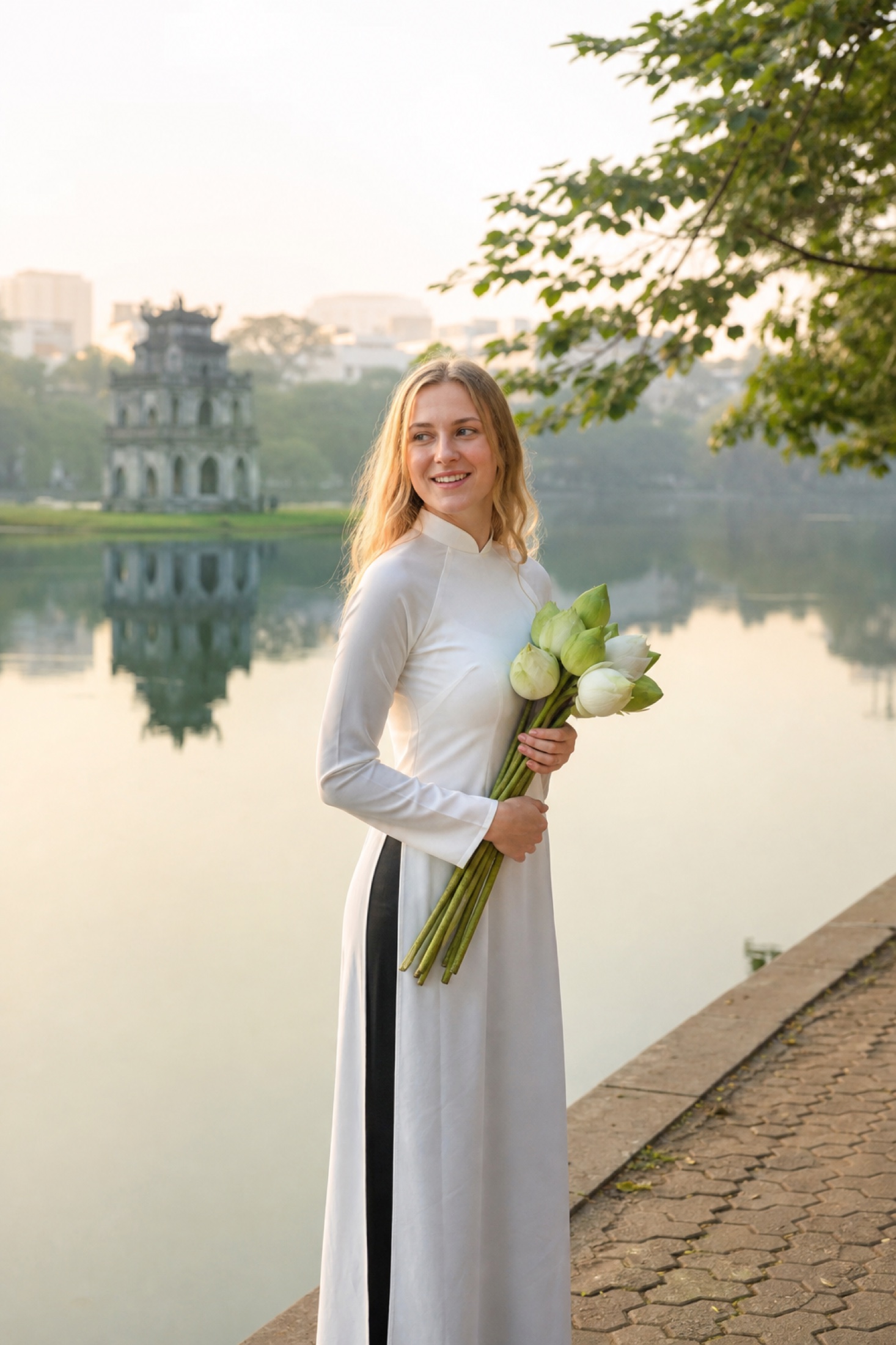
What Fabric Weight Tells You About Session Quality
Ao tu than costumes come in three fabric tiers: cotton-silk blends (lightest, drapes loosely, less formal), pure silk (mid-weight, drapes with structure, ceremonial-grade), and embroidered silk with lining (heaviest, holds shape, most expensive). The fabric dictates what a photographer can achieve.
Cotton-silk blends are affordable and work fine for casual documentary shots, but they wrinkle easily and don't catch light crisply. Pure silk holds creases and shines, making it ideal for editorial-style shoots where every fold matters. Embroidered versions with structured lining photograph like sculpture—the bodice holds its shape even in wind, and the embroidery catches side-light dramatically.
Before booking, ask your studio: What weight of fabric does the costume have? If they say "all silks are the same," they're not prepared for heritage costume work. The heavier the silk and the more structured the lining, the longer the session needs to be to position and reposition folds between shots. Budget accordingly—a silk-blend session might run 2 hours; a full embroidered piece might need 3 hours to show all angles without wrinkles resetting.
Cáo Studio's wardrobe includes both mid-weight ceremonial silks and lighter festival versions, so you can choose based on your vision's mood (formal vs. everyday storytelling).
How Northern Styling Differs: Hair, Makeup, Accessories
Northern Vietnamese ao tu than traditions include specific styling rules that southern ao dai photography skips entirely. Hair is typically worn in a low bun or twisted crown, not flowing loose (which reads as casual, not costume). Makeup is slightly heavier on lips and brows to balance the ornate bodice.
Accessories matter enormously: traditional northern looks include fabric belts (dyed to match or contrast), cloth shoes (not modern heels), and often a shawl or overskirt. Modern photoshoots blend traditional and contemporary, but the hybrid choices must be intentional, not accidental. A neutral modern belt on a 1950s-style embroidered ao tu than looks confused; an heirloom-style silk belt looks curated.
Cáo Studio's makeup team and costume coordinators work specifically with northern garment traditions. They know which belts photograph as distraction vs. emphasis, how to style hair so the bodice's embroidery reads in close-ups, and when to keep accessories minimal to let the costume speak.
💄 Makeup & hair at your hotel — if you're staying in central Hanoi, the team can come to you.
Posing for Ao Tu Than: Static vs. Motion Angles
A common mistake: posing an ao tu than subject exactly like an ao dai shoot. The ao dai works sitting cross-legged (the column drapes elegantly), walking slowly (the slit opens gracefully), or standing still (the line is pure). The ao tu than resists sitting (the skirt bunches), demands movement (the volume disappears in stillness), and needs angles that frame the bodice and skirt together.
Professional photographers shooting northern costume know five pose families: walking at 45-degrees to camera (shows skirt volume and movement), three-quarter turn standing (balances bodice detail and skirt shape), hands positioned to frame the waist (creates line), slight lean (opens the chest to camera), and twirl documentation (the only way to show a full embroidered skirt).
Each pose needs 4–6 frames to catch peak fabric placement. A rushed 90-minute session might hit two pose families; a 3-hour session captures all five with variations. If a studio promises "50+ finished images," ask how many unique pose families that includes—bulk shots of one pose re-framed are not variety.
Cáo Studio's northern costume sessions build pose variety into the timeline. Sessions typically start with standing and walking angles, move into more intimate framing as comfort rises, and finish with twirl and movement documentation.
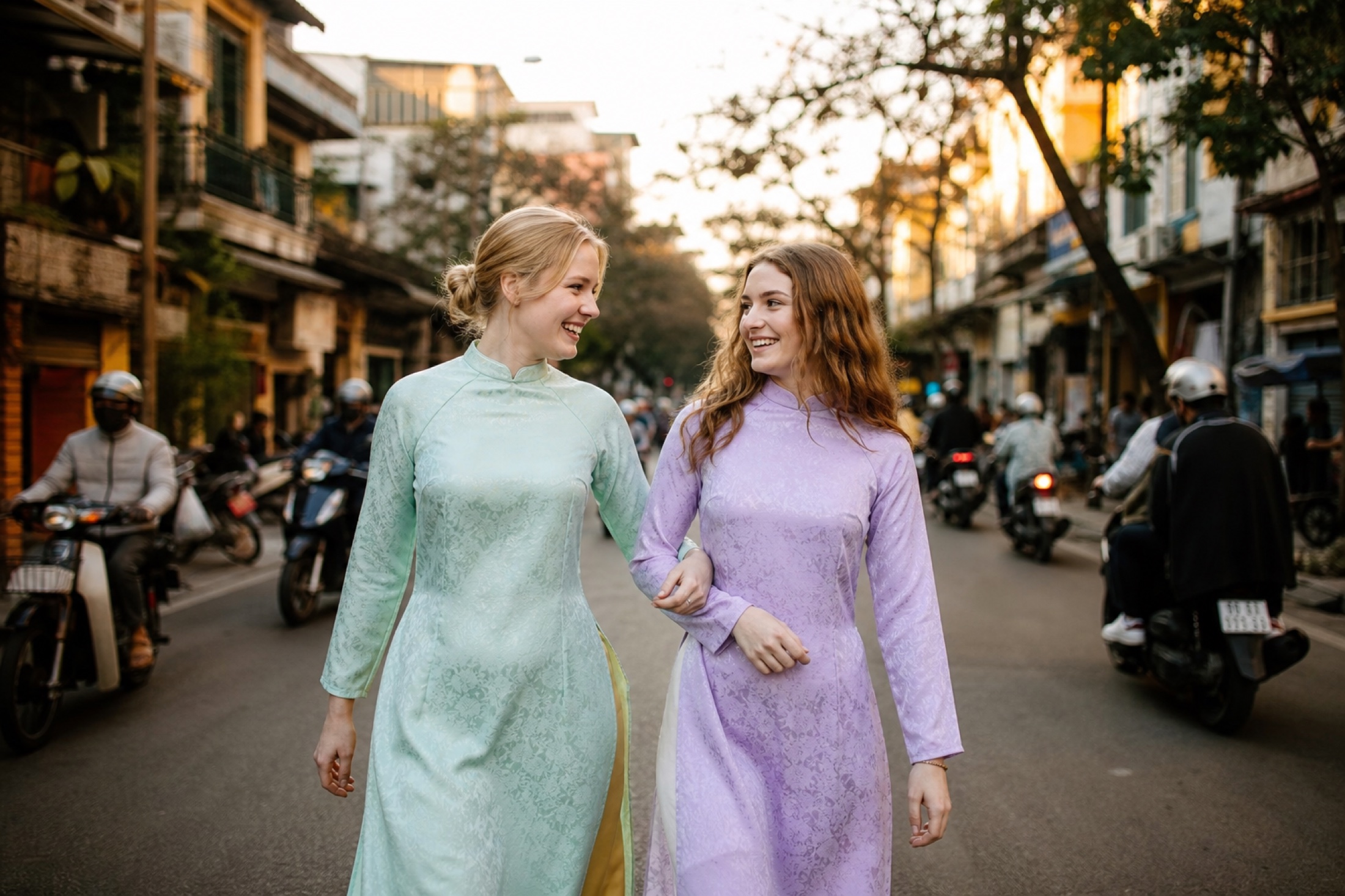
Hanoi Locations: How Light and Backdrop Change the Costume's Feel
The ao tu than reads differently depending on backdrop. Against French colonial architecture (Hoan Kiem Lake (होआन किएम झील), Hanoi Opera House), it reads as a bridge between eras—tradition in modernity. Against cyclo streets or temple grounds, it grounds into its historical context. Against neutral studio seamless, it becomes formal documentation.
Choose location based on story intent. If you want "heritage family documentation," Old Quarter narrow alleys and local temple courtyards work. If you want "fashion editorial," Hoan Kiem Lake's reflective waterfront and tree-lined pathways suit the garment. Studio (seamless or natural-light studio space) works if you want close-up embroidery detail and fashion-focused framing.
Hanoi's light shifts by time of year. October–February (dry season) offers crisp morning light and golden evening hours without humidity haze. March–September (monsoon) brings diffused cloud cover (less shadow, softer contrast, ideal for close-ups but flattens outdoor volume) and afternoon rain that stops shoots.
Cáo Studio books based on season and location preference. Ask about light direction during your session—morning shoots at Old Quarter face backlighting (silhouettes), afternoon shoots face front-light (see fabric texture), golden hour (5–6 PM Sept–Feb) gives side-light that makes embroidery shine.
📸 Book on WhatsApp — ao dai photoshoot — message in Hindi or English.
What to Check Before Booking: A Practical Checklist
| Decision Point | What to Ask | Why It Matters |
|---|---|---|
| Costume weight & fabric | "Is the ao tu than silk or blend? Is it lined?" | Heavy silk holds shape; light blend wrinkles. |
| Pose experience | "How many pose families do you shoot?" | Rushed studios repeat static poses. Northern costume needs dynamic angles. |
| Session length | "How long for northern costume?" | 2 hours minimum; 3 hours for embroidered pieces. |
| Location scouting | "Can we shoot Old Quarter vs. studio vs. lake?" | Different backdrops change story entirely. |
| Edited turnaround | "When do I get the gallery?" | 2 weeks standard; faster costs extra. |
| Styling included? | "Does makeup/hair/accessories come with it?" | Check what's provided vs. "bring your own." |
Before committing, confirm:
- Costume provided by studio or yours?
- Makeup artist included or separate booking?
- Location scout done beforehand or on-the-fly?
- How many final edited images?
- Refund policy if cancellation happens?
Cáo Studio's standard northern costume sessions include costume (mid-weight silk or embroidered), makeup and hair by a team familiar with heritage styling, location choice, and 2-week edited gallery delivery. Confirmation happens on WhatsApp after your initial inquiry.
🌸 Ideas & lookbook — see past northern costume shoots.
Beyond Hanoi: Northern Costume Shoots in Hoi An and Ho Chi Minh City
Hoi An (होई आन्) has northern Chinese and Vietnamese heritage architecture, making it an atmospheric backdrop for northern costume photography. Cáo Studio shoots ao tu than sessions in Hoi An by appointment—the team travels from Hanoi when dates align. Ask on WhatsApp for Hoi An scheduling and availability.
Ho Chi Minh City (सैगॉन/Saigon) (साइगॉन) shoots are also available at /hi/saigon, though authentic northern styling is more specialized here. The studio works with northern costume shoots in Saigon, but the environment (modern cityscape, less heritage architecture) requires more intentional backdrop choices.
For travelers in Hanoi, northern costume work is most authentic and easiest to schedule. Sessions run at the studio's three central branches or at your hotel if you book makeup and hair services.
Couple and Family Northern Costume Sessions
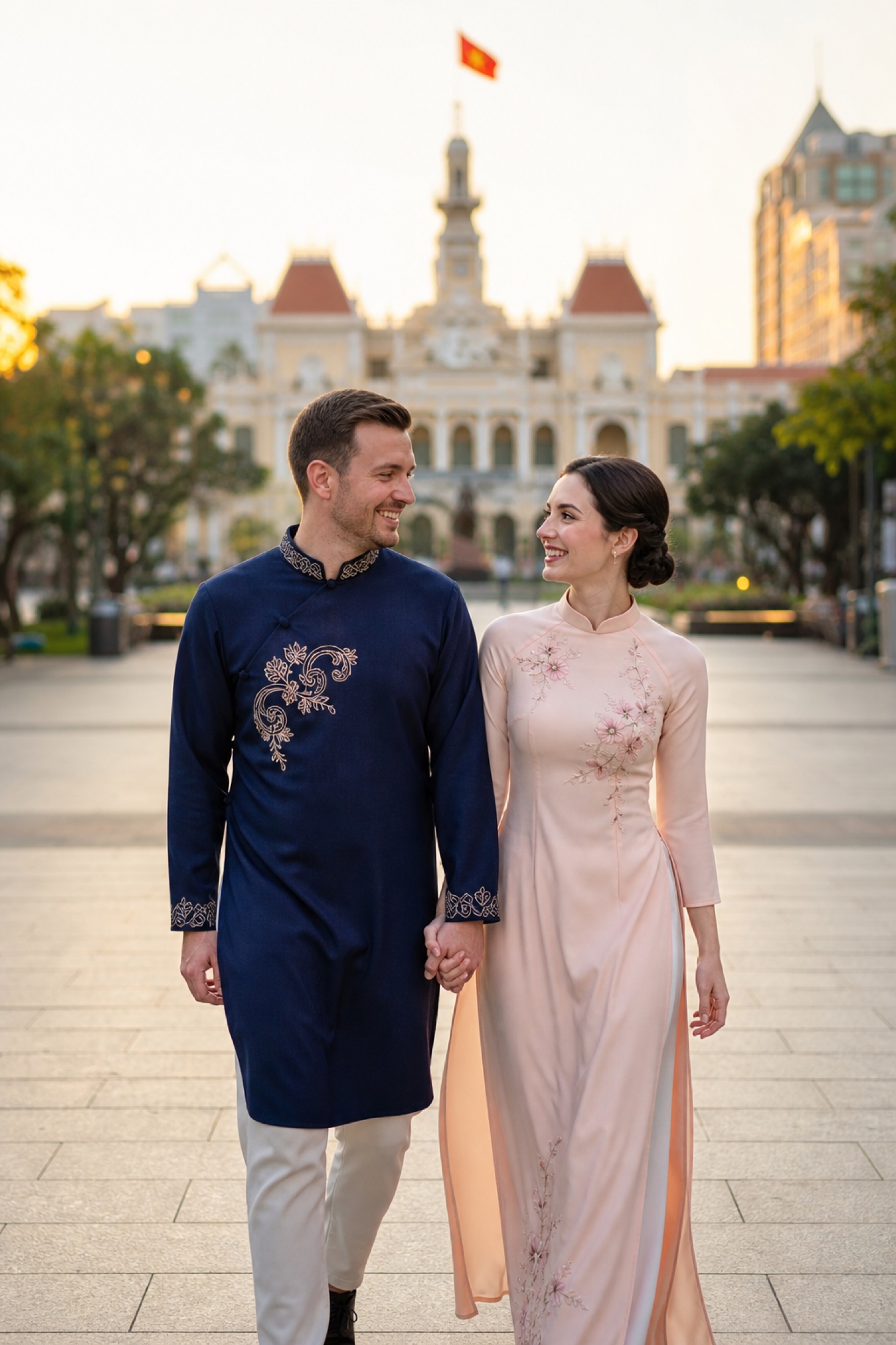
If you're photographing with a partner or family in matching or coordinating northern costumes, the approach shifts. Couple sessions need poses that frame both subjects equally and show their costumes in relation to each other. Family shoots require tighter framing and faster pose transitions (keeping small children patient demands efficiency).
Cáo Studio offers couple & family photoshoots that adapt northern costume styling to group dynamics. Couples typically book 2–3 hours; families with children 2.5–3.5 hours depending on group size.
---
#
FAQ
What's the actual difference between ao tu than and ao dai for photography?
Ao tu than has a fitted bodice and flared short skirt; photographs best in movement and dynamic poses. Ao dai is one long column; photographs in stillness. Ao tu than needs 45-degree walking angles and twirl shots; ao dai works sitting and standing still. Lighting angles differ too—ao tu than benefits from front-and-side light to show embroidery and volume.
Can I wear my own family ao tu than, or should I rent from the studio?
You can wear your own (authentic pieces often photograph best). Tell the studio beforehand so they can inspect fit and fabric. If it's antique or delicate, bring a backup plan (rental or studio costume) in case of snags. Studio costumes are mid-weight professional silks, cleaned between sessions, so fit is predictable.
How long does a northern costume session take?
Minimum 2 hours for light silk blends; 3 hours for embroidered or heavy pieces. Northern styling (hair, makeup, costume fitting) takes 30–45 minutes, leaving 90–150 minutes for location and poses. Rushed 60-minute "ao dai photoshoots" skip detail work; northern garments need time.
What season is best for ao tu than photography in Hanoi?
October–February (dry season) offers sharp light and no rain delays. September–March gives golden hour (5–6 PM) that makes embroidery shine. Avoid May–August (humidity, afternoon rain, midday heat that limits outdoor time). Book location in morning (backlighting silhouettes) or late afternoon (warm side-light) year-round.
Do I need a professional makeup artist, or can I do my own?
Professional makeup photographs better (longer-lasting, contoured for camera distance, color balanced for light). Northern costume shoots benefit from a makeup artist who understands heritage styling (heavier brows, defined lips, balanced to ornate bodice). Cáo Studio includes makeup; you can also book makeup at your hotel separately.
How many edited images do I get, and when?
Standard turnaround is 2 weeks for full gallery. Studio sessions typically deliver 60–100 edited images (varies by length and poses). Confirm final count before booking. Rush turnaround (5–7 days) usually costs extra; ask on WhatsApp for pricing.
Can I shoot northern costume in Ho Chi Minh City, or should I go to Hanoi?
Hanoi is more authentic (heritage backdrops, local expertise, northern costume cultural context). Ho Chi Minh City is possible but requires more intentional styling and backdrop choices. Hoi An is atmospheric and available by appointment. For true northern costume work, Hanoi's three branches at /hi/hanoi offer the deepest experience.
अक्सर पूछे जाने वाले सवाल
What's the actual difference between ao tu than and ao dai for photography?
Ao tu than has a fitted bodice and flared short skirt; photographs best in movement and dynamic poses. Ao dai is one long column; photographs in stillness. Ao tu than needs 45-degree walking angles and twirl shots; ao dai works sitting and standing still. Lighting angles differ too—ao tu than benefits from front-and-side light to show embroidery and volume.
Can I wear my own family ao tu than, or should I rent from the studio?
You can wear your own (authentic pieces often photograph best). Tell the studio beforehand so they can inspect fit and fabric. If it's antique or delicate, bring a backup plan (rental or studio costume) in case of snags. Studio costumes are mid-weight professional silks, cleaned between sessions, so fit is predictable.
How long does a northern costume session take?
Minimum 2 hours for light silk blends; 3 hours for embroidered or heavy pieces. Northern styling (hair, makeup, costume fitting) takes 30–45 minutes, leaving 90–150 minutes for location and poses. Rushed 60-minute "ao dai photoshoots" skip detail work; northern garments need time.
What season is best for ao tu than photography in Hanoi?
October–February (dry season) offers sharp light and no rain delays. September–March gives golden hour (5–6 PM) that makes embroidery shine. Avoid May–August (humidity, afternoon rain, midday heat that limits outdoor time). Book location in morning (backlighting silhouettes) or late afternoon (warm side-light) year-round.
Do I need a professional makeup artist, or can I do my own?
Professional makeup photographs better (longer-lasting, contoured for camera distance, color balanced for light). Northern costume shoots benefit from a makeup artist who understands heritage styling (heavier brows, defined lips, balanced to ornate bodice). Cáo Studio includes makeup; you can also book [makeup at your hotel](/hi/services/makeup-and-hair) separately.
How many edited images do I get, and when?
Standard turnaround is 2 weeks for full gallery. Studio sessions typically deliver 60–100 edited images (varies by length and poses). Confirm final count before booking. Rush turnaround (5–7 days) usually costs extra; ask on WhatsApp for pricing.
Can I shoot northern costume in Ho Chi Minh City, or should I go to Hanoi?
Hanoi is more authentic (heritage backdrops, local expertise, northern costume cultural context). Ho Chi Minh City is possible but requires more intentional styling and backdrop choices. Hoi An is atmospheric and available by appointment. For true northern costume work, Hanoi's three branches at [/hi/hanoi](/hi/hanoi) offer the deepest experience.