services/makeup-and-hair
Airbrush vs Traditional Makeup in Humid Climate: Which Lasts?
Why Does Humidity Wreck Makeup So Badly?
Hanoi's monsoon season hits 85–95% humidity, and traditional makeup absorbs moisture instead of repelling it. Cream bases and powders swell slightly, breaking the seal. Oils from sweat activate silicones in foundations, causing separation. Airbrush makeup uses a polymer-silicone mix that polymerizes on application—it bonds like a thin film instead of sitting on skin. Result: airbrush stays intact; traditional foundation pools in pores within an hour.
📸 Book on WhatsApp — ao dai photoshoot
How Long Does Each Method Actually Last?
Traditional makeup (cream or powder foundation):
- Typical hold in Hanoi humidity: 1.5–3 hours before visible creasing or sliding.
- Touch-ups needed every 2 hours; blotting papers used constantly.
- Reapplication over sweat leaves streaks and uneven texture.
Airbrush makeup:
- Typical hold in Hanoi humidity: 4–6 hours without major breakdown.
- May need powder blotting by hour 5, but base stays put.
- Reapplication blends seamlessly because the primer is still tacky.
For a full-day pre-wedding photoshoot in Hoi An or outdoor couple sessions, airbrush is non-negotiable. For a 1-hour studio shot, traditional works fine and costs less.
Comparison: Cost, Setup, Durability
| Factor | Traditional | Airbrush | Winner for Humid Climate |
|---|---|---|---|
| Upfront cost | $20–50 (makeup only) | $150–400 (compressor + makeup) | Traditional (lower barrier) |
| Per-session product cost | $1–3 | $0.50–1 (less product used) | Airbrush (efficient) |
| Setup time | 5–10 min | 10–15 min (priming + loading) | Traditional (faster) |
| Humidity durability | 1.5–3 hours | 4–6 hours | Airbrush (clear win) |
| Retouch difficulty | Medium (blending hard) | Easy (polymerization helps) | Airbrush |
| Skill ceiling | Low–medium | Medium–high | Traditional (easier to learn) |
| Finish in photos | Natural (if blended well) | Flawless, high-def (can look plastic if heavy) | Tie (depends on artist) |
For Cáo Studio clients: We rent airbrush setups on-location; you don't own the gear. Traditional is hand-applied by our artists at all four branches (Hanoi + Saigon). Pick airbrush if your session is outdoors or 3+ hours; traditional if studio-based or you're budget-conscious.
Which Should You Choose? A Practical Decision Tree
- How long is your shoot?
- Under 2 hours, indoors → traditional is fine.
- 3+ hours or outdoors → airbrush essential.
- What's your skin type?
- Oily or combo → airbrush (polymer bonds better to oil).
- Dry or sensitive → traditional (less heavy, less irritation risk).
- Budget?
- Tight → traditional (lower cost upfront).
- Flexible → airbrush (better ROI for full-day events).
- Photography style?
- Soft, natural look → traditional (easier to customize).
- High-definition, editorial → airbrush (microscopic application, flawless finish).
- Humidity window?
- May–September (peak monsoon, 85%+ humidity) → airbrush only.
- October–April (40–60% humidity) → both work; pick by preference.
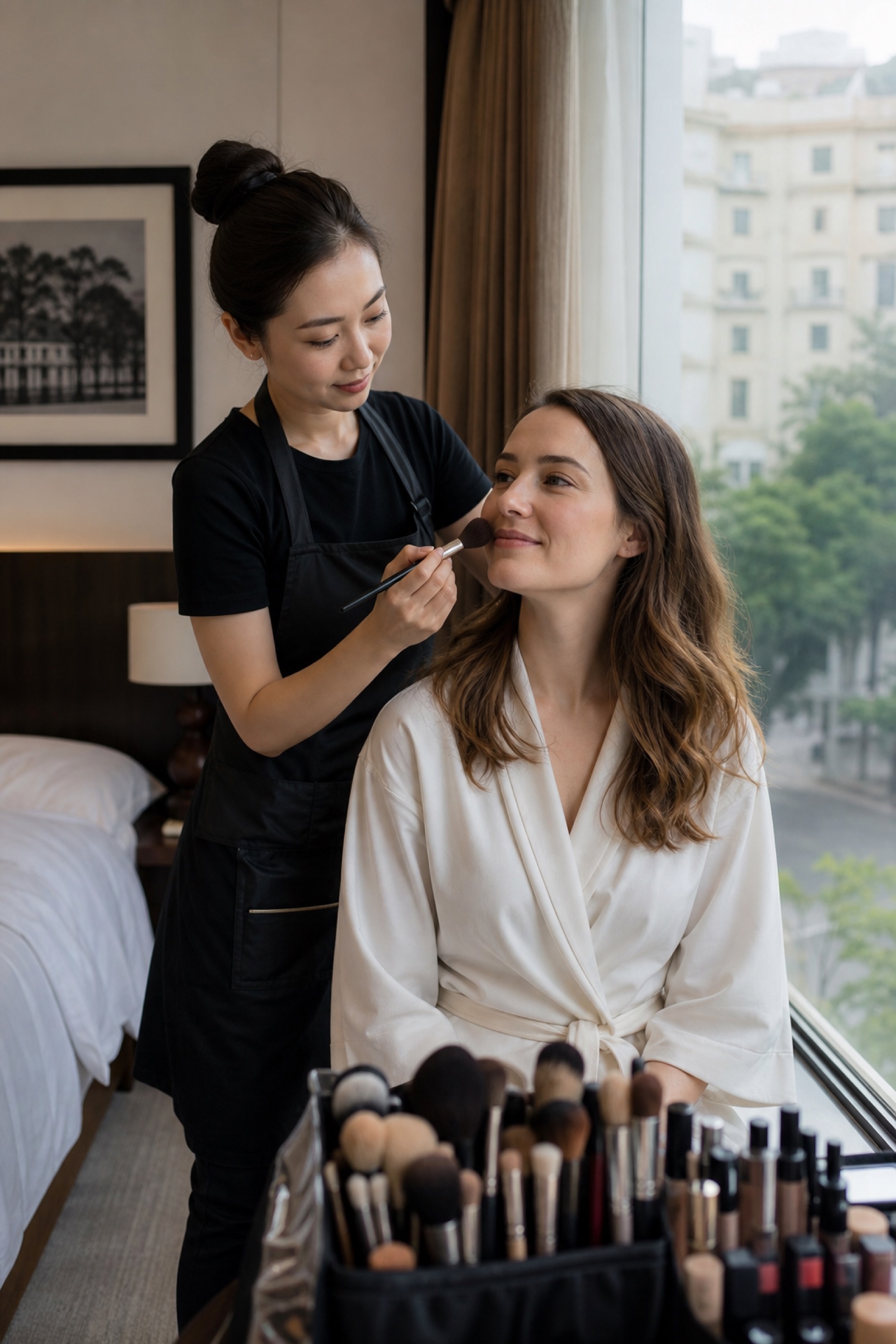
At Cáo Studio, we ask these five questions before recommending. For a proposal or anniversary session, we default to airbrush if the venue is outdoors (temple grounds in Hanoi, riverside in Hoi An). For hotel-based makeup and hair services, we often use traditional because rooms are air-conditioned and sessions run 30–60 minutes.
Real Pitfalls: What Goes Wrong and How to Avoid It
Traditional makeup in humidity:
- Pitfall: Sweat activates oil in foundation, causing it to slip downward and pool at jawline.
- Avoid: Use a long-wear primer (silicone-based, not water-based); apply setting spray that's hydrophobic, not hydrophilic.
- Test it: spray water on set makeup—it should bead and roll off, not dissolve.
- Pitfall: Powder cakey or muddy after touch-ups.
- Avoid: Use a pressed powder, not loose; blend with a damp sponge, not a brush (dry brushing = more powder buildup).
Airbrush in humidity:
- Pitfall: Compressor runs hot and condenses moisture into the air line, spraying water spots on face mid-session.
- Avoid: Use a professional compressor with a built-in moisture trap and regulator. Cáo Studio's compressors are serviced monthly; ask about maintenance on WhatsApp.
- Pitfall: Product dries too fast on the gun nozzle, clogging between applications.
- Avoid: Clean the nozzle every 15 minutes with rubbing alcohol; load fresh makeup after each application.
- Pitfall: Looks too matte or plastic under natural light.
- Avoid: Request a mix of 60% airbrush base + 40% traditional cream highlight and contour. This is the hybrid approach Cáo Studio uses for ao dai photoshoots to blend polish with softness.
What to Check Before You Book
If you're booking airbrush makeup:
- ✓ Confirm the compressor has a moisture trap (non-negotiable in Southeast Asia).
- ✓ Ask if the artist mixes custom shades or uses pre-made formulas (custom = better match in humid conditions because less product needed).
- ✓ Request a test patch 24 hours before; airbrush can irritate sensitive skin if the primer is wrong.
- ✓ Clarify the retouching policy—how many touch-ups are included?
If you're booking traditional makeup:
- ✓ Request a humidity-tested primer and setting spray (ask which brand by name).
- ✓ Confirm the artist uses pressed, not loose, powder.
- ✓ Ask for a touch-up kit you can carry (blotting papers, powder, spray bottle for hydrating mist).
For any booking at Cáo Studio:
- ✓ Tell us your session date and location (outdoor temple shoot, hotel, studio). We'll recommend airbrush or traditional based on venue and weather.
- ✓ Mention any skin sensitivities. We stock fragrance-free primers and alcohol-free setting sprays.
- ✓ Confirm your session length. Sessions under 90 minutes don't usually need touch-ups; over 2 hours, ask us to pack your touch-up kit.
Final Takeaway: Why Cáo Studio Uses Both
We don't insist on one method because the choice depends on your situation, not ours. For studio couple and family photoshoots in Saigon's air-conditioned space, traditional makeup lets our artists blend color freely and creates a softer, more relatable look in prints.
For outdoor ao dai photoshoots in Hanoi's Old Quarter or at Hoan Kiem Lake during warm months, airbrush is standard because we're competing against 90% humidity, 15-minute heat exposure, and high-definition camera sensors that pick up every texture change.
The honest answer: try airbrush if your session is 3+ hours, outdoors, or in May–September; try traditional if you're indoors, under 90 minutes, or prefer a softer finish. Both look beautiful in photos when applied by a skilled artist. The difference shows up at hour 3, not on screen.
📸 Book on WhatsApp — ao dai photoshoot | 💄 Makeup & hair at your hotel | 🌸 See the lookbook
---
FAQ
Does airbrush makeup feel heavy on your face?
No. Airbrush uses 30–50% less product than traditional because it atomizes; the film is 0.1–0.2 mm thick versus 0.4–0.6 mm with cream foundation. Most clients say it feels like nothing after 10 minutes. Sensitivity depends on primer, not airbrush itself.
Can I do airbrush makeup myself at home in Hanoi?
Technically yes, but compressor quality matters enormously in humidity. Budget $200–400 minimum for a reliable unit with a moisture trap. Most travelers don't own one; renting or booking an artist is cheaper and safer for skin.
Will airbrush makeup look unnatural in casual photos (not studio)?
If applied correctly—medium coverage, no over-blending—no. Natural light may show slight matteness if you overpowder. Ask your artist for a mix of airbrush base + traditional cream contour for dimension.
How do I touch up airbrush makeup myself during the day?
Airbrush is hard to touch up solo because you need the compressor. Ask your artist to pack a traditional powder compact and setting spray. Light powder touch-ups work on top of dried airbrush without looking patchy.
Is traditional makeup safer for sensitive skin than airbrush?
Not inherently. Both depend on primer. Silicone-heavy primers (common in airbrush) irritate some skin; water-based primers are gentler but less durable in humidity. Tell us your sensitivities; we'll match the method and primer accordingly.
What humidity level makes airbrush worth the extra cost?
Above 75% humidity and session length over 2 hours, airbrush ROI is clear. Below 60% humidity, traditional holds fine. Hanoi hits 75%+ May–October, so airbrush is standard in our booking advice during those months.
FAQ
Does airbrush makeup feel heavy on your face?
No. Airbrush uses 30–50% less product than traditional because it atomizes; the film is 0.1–0.2 mm thick versus 0.4–0.6 mm with cream foundation. Most clients say it feels like nothing after 10 minutes. Sensitivity depends on primer, not airbrush itself.
Can I do airbrush makeup myself at home in Hanoi?
Technically yes, but compressor quality matters enormously in humidity. Budget $200–400 minimum for a reliable unit with a moisture trap. Most travelers don't own one; renting or booking an artist is cheaper and safer for skin.
Will airbrush makeup look unnatural in casual photos (not studio)?
If applied correctly—medium coverage, no over-blending—no. Natural light may show slight matteness if you overpowder. Ask your artist for a mix of airbrush base + traditional cream contour for dimension.
How do I touch up airbrush makeup myself during the day?
Airbrush is hard to touch up solo because you need the compressor. Ask your artist to pack a traditional powder compact and setting spray. Light powder touch-ups work on top of dried airbrush without looking patchy.
Is traditional makeup safer for sensitive skin than airbrush?
Not inherently. Both depend on primer. Silicone-heavy primers (common in airbrush) irritate some skin; water-based primers are gentler but less durable in humidity. Tell us your sensitivities; we'll match the method and primer accordingly.
What humidity level makes airbrush worth the extra cost?
Above 75% humidity and session length over 2 hours, airbrush ROI is clear. Below 60% humidity, traditional holds fine. Hanoi hits 75%+ May–October, so airbrush is standard in our booking advice during those months.
Ao dai, makeup, hair and a local photographer in Hanoi or Saigon — one WhatsApp message.