/proposal-and-anniversary
Anniversary and vow renewal photoshoot in Ninh Binh
A vow renewal photoshoot in Ninh Binh means hiring a photographer to direct you (often as a couple, sometimes with family) through the province's most photogenic spots—rice fields, Hang Mua's stone steps, boat routes at Trang An or Tam Coc—during the best light of the day. The shoot typically runs 4–6 hours, moving between 2–3 locations. Cáo Studio operates from Hanoi and can coordinate a vow renewal session there, but Ninh Binh lies 90 km south; you'll need to hire a local photographer familiar with Ninh Binh's light, permits (some temples require booking) and boat logistics. The best season is Mar–May or Sep–Nov (cool, stable light, rice fields either green or golden). Avoid Jun–Aug heat and storms, and late Dec–Feb grey light. Plan 2–3 weeks ahead; confirm your photographer knows how to work with outfits (ao dai, wedding dress, suits) in the field, and ask for a shot list before the day (wide landscape frames first, then medium two-shots, then detail—never stiff poses at monuments).
Why does Ninh Binh work for vow renewal photos?
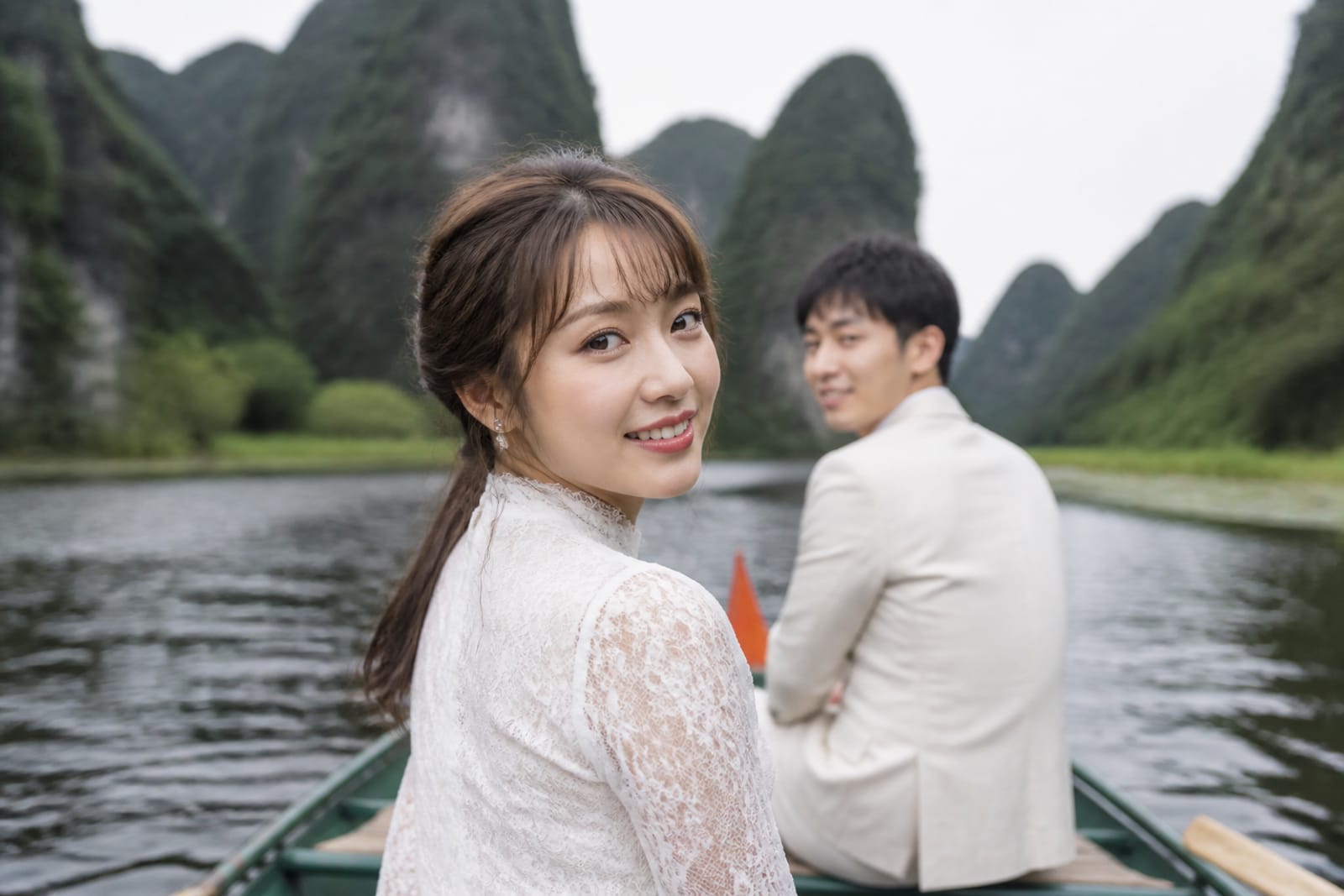
Ninh Binh holds three landscapes most renewal couples choose: rice paddies that turn golden or stay emerald depending on season, limestone karsts you can frame behind you, and calm boat routes where you walk toward the camera or sit close together on wooden boats. The light here isn't forgiving—it's specific. At 6 am, side light rakes across paddy water and creates separation between you and the field. By 10 am, it's flat and overhead. Late afternoon (after 4 pm) drops golden side light again, but clouds roll in fast during monsoon. Ninh Binh has no Cáo Studio base—you'll coordinate with a local photographer who understands this timing and can move your outfits and hair between boat docks and hillside steps. The landscape feels less touristed than Ha Long or Ha Giang, which means fewer crowds in your frames and more time to reset between setups.
Which season gives you the best light and comfort?
| Season | Light quality | Outfit fit | Rain risk | Comfort | Best for |
|---|---|---|---|---|---|
| Mar–May | Golden-hour warmth, stable mornings | Layers work (cool starts, warm midday) | Low | Ideal; cool dawn, warm noon | ao dai, sheer layers |
| Jun–Aug | Harsh overhead, fast storms | Damp, clinging to skin | High | Difficult; heat exhaustion risk | avoid—reschedule |
| Sep–Nov | Soft side light late afternoon, misty mornings | Layers work; cool starts | Med–high (Sep–Oct worst) | Good; cooler, stable mid-day | ao dai, wedding dress |
| Dec–Feb | Flat, grey overcast, weak shadows | Heavy layers needed | Low | Cold mornings; grey light limits drama | avoid—wait for spring |
Mar–May and Sep–Nov are the professional windows. Mar–May gives you predictable cool mornings and warm afternoons; rice fields are either bright green or transitioning to gold depending on planting cycles. Sep–Nov carries typhoon risk (especially Oct–Nov), but if the weather holds, you get moody misty mornings and rich golden late-afternoon light—ideal for storytelling. Book a scout call with your photographer 1–2 weeks before to check the actual weather and field condition; a wet monsoon day might shift you from paddy fields to cave interiors (Hang Mua, Hang Trong) where you can still shoot drama with stone and shadow.
How do you choose between rice fields, Hang Mua steps and boat routes?
Each location asks different things of you and your photographer. Rice fields (best near Tam Coc or Trang An villages) require an early start—6–7 am—to catch farmers working and side light that hasn't yet turned harsh. You'll walk on narrow dirt paths between paddies; wear shoes that don't slip (mud is common after rain), and plan on your ao dai or dress hem getting wet. Hang Mua's 500-step stone staircase to the viewpoint means your photographer shoots you climbing, resting mid-way, and framed at the summit with karst ridges behind—it's a narrative arc, not a pose. Go early (before 8 am) or late (after 4 pm) to avoid crowds. Boat routes at Trang An or Tam Coc work best in late afternoon when the sun is lower; you sit or stand on traditional wooden boats while your photographer shoots from the shore or a second boat, capturing reflections and the cave entrances behind you. Each costs differently in logistics (boat rental, guide tips, transport between sites); ask your photographer upfront which combination fits your energy level and outfit care.
Comparison: Rice fields = early start, muddy, intimate agricultural frames; Hang Mua = physical effort, iconic silhouette, crowd timing; boats = reflective water, serene pacing, no climbing. Pick two locations maximum in one 5-hour session to avoid rushed framing and outfit mishaps.
What outfit choices work best for Ninh Binh's landscape?
Three types dominate anniversary renewals in Ninh Binh: the ao dai (Vietnamese tradition, floats beautifully in wind, requires careful movement on boat and steps), the Western wedding dress (theatrical, needs tucking for mud and steps, reads well against limestone), and the casual-formal mix (silk pants, flowing top, minimal jewelry—less iconic but easier to move in). An ao dai in deep jewel tones (emerald, burgundy, navy) stands out against golden rice; pale ivory or cream works if the paddy is very green. If you choose a wedding dress, confirm your photographer has helped others manage the hem on muddy paths and stone steps—it's not romantic to spend 20 minutes hiking with your dress bunched in your hands. A smart strategy: wear the ao dai or dress for half the session (rice fields, Hang Mua lower steps), then change to a lighter outfit (silky lounge set, embroidered co-ord) for boat sequences where movement matters more than formality. Hair and makeup should be waterproof and sweat-proof if you're climbing; Ninh Binh's humidity peaks mid-day. Book a local makeup artist through your photographer, or ask Cáo Studio's hotel makeup service if you're based in Hanoi and shooting the day after an overnight in Ninh Binh.
The ao dai is the most photographed choice for a reason—it photographs larger than life and feels ceremonial without a wedding dress's practical friction.
How do you find and vet a local Ninh Binh photographer?
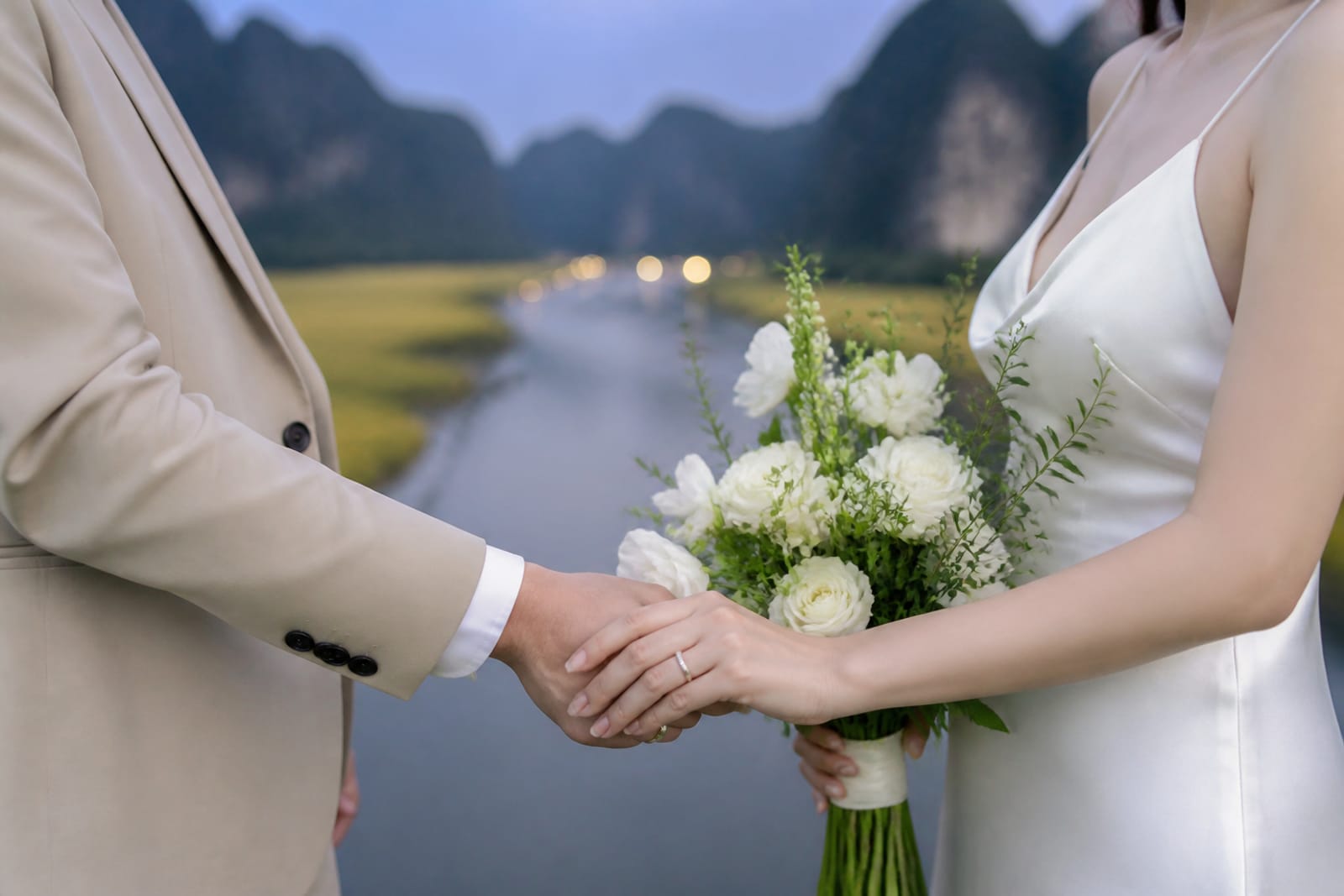
Ninh Binh has no Cáo Studio team; you'll hire a local freelancer or small studio. Start by asking your Ninh Binh hotel concierge or your tour operator if they recommend a photographer (many hotels work with the same 2–3 trusted vendors). Search Instagram for hashtags #NinhBinhPhotographer #NinhBinhWeddingPhotos and look for portfolios with other couples, not just solo travelers—this tells you they can direct two people and manage outfits. Message 3–4 photographers; ask these exact questions:
- Do you have experience with ao dai, wedding dress, or formal outfits in Ninh Binh's locations?
- Can you start at 6 am for golden light in rice fields, or do you prefer mid-morning?
- Which locations do you know well (Hang Mua, Trang An boat routes, specific paddy villages)?
- Do you work with a makeup artist, or should we hire separately?
- How do you deliver photos (timeline, editing style, number of edited files)?
Request a 15-minute call before booking—a real photographer will ask you questions back: What's your vision? Do you want storytelling or posed frames? Are you climbing Hang Mua or staying at water level? A red flag: they push package prices without understanding your needs, or they have no photos of couples (only landscapes or solo travelers). Expect to book at least 2 weeks ahead; Ninh Binh fills fast during Mar–May and Sep–Nov.
📸 Book on WhatsApp — ao dai photoshoot
What should you confirm before booking?
Before you commit to a date and photographer, verify these five things:
- Outfit care plan: Does your photographer have an assistant? Where will they keep your ao dai or dress between locations—hung, folded, in a garment bag? Humidity and mud wreck silk; ask how they protect it.
- Permit and boat costs: Some temples (like inside Hang Mua's cave) may require a small permit or local guide. Boat rentals at Trang An or Tam Coc have daily rates. Ask your photographer which costs are included in their fee and which you pay separately.
- Backup weather date: If it rains on your shoot day, what happens? Do they reschedule free, or charge a rescheduling fee? Mar–May is safer; Sep–Nov carries risk.
- Edited timeline: When will you see photos? "2–3 weeks" is standard; "48 hours" is rare for local Ninh Binh photographers. Cáo Studio delivers edited photos within 48 hours, but that's a Hanoi/Saigon service—Ninh Binh photographers typically need longer.
- Shot list and pacing: Ask for a written plan—which locations, what time you'll arrive at each, how many outfit changes. This prevents you arriving at 9:30 am (too late for good rice field light) and discovering your photographer had a different schedule.
---
When should you think about Cáo Studio instead?
If you're based in or willing to travel to Hanoi, Cáo Studio's proposal and anniversary package offers one team (photographer, makeup artist, stylist, director) who coordinate everything—outfit choice, hair, makeup, light planning—and deliver edited photos and a short film within 48 hours. You'd shoot Hanoi's iconic sites (Huc Bridge at dawn, Old Quarter, West Lake) rather than Ninh Binh's fields, but you get a seamless, directed experience without coordinating three vendors across different locations. Ninh Binh's appeal is the rice field narrative and karst drama; Hanoi's appeal is urban intimacy and historical framing. Choose Ninh Binh if the landscape matters most; choose Hanoi (Cáo Studio) if you want one team and fast turnaround. Read the lookbook to compare the light and mood of each.
---

FAQ
Can we do a vow renewal photoshoot in Ninh Binh if we wear an ao dai?
Yes. An ao dai photographs beautifully against Ninh Binh's rice fields and karst limestone. Choose a jewel tone (emerald, burgundy) to stand out on green fields. Plan for mud on paths and narrow steps; bring flats or grippy shoes, and confirm your photographer knows how to manage the hem safely between locations.
What time of day has the best light for couple photos in rice paddies?
6–7:30 am for side-lit golden warmth with farmers still in fields, or 4–5:30 pm for rich late-afternoon glow. Avoid 10 am–3 pm when light is flat and overhead. Clouds roll in fast during monsoon season (Sep–Nov), so have a backup location (cave, boat route) ready.
How many locations can we fit into one vow renewal session in Ninh Binh?
Two locations maximum in 5–6 hours, including travel time and outfit changes. Trying three (rice field, Hang Mua, boat route) leads to rushed framing and outfit care fails. Prioritize the one landscape that matters most to your story.
Should we hire a Ninh Binh photographer or book Cáo Studio in Hanoi?
Hire local if Ninh Binh's rice fields and karsts are your must-have backdrop. Book Cáo Studio in Hanoi if you want one coordinated team (photographer, makeup, stylist), fast 48-hour turnaround, and are happy with urban/historical light instead of rural landscape. Ninh Binh photographers typically need 2–3 weeks to deliver.
What's the best season to shoot a vow renewal in Ninh Binh, and why?
Mar–May (cool mornings, predictable light, rice fields bright green or golden) and Sep–Nov (moody misty mornings, rich golden afternoons) are ideal. Jun–Aug is too hot with harsh light and afternoon storms. Dec–Feb is cold and grey. Book 2–3 weeks ahead to secure your photographer and scout weather conditions.
Do we need a permit to shoot photos at Hang Mua or boat routes in Trang An?
Most photo locations in Ninh Binh don't require a special permit, but entry tickets are required for Hang Mua and Trang An boat trips—check the current price on their official sites. Some cave guides request a small tip for extended shooting time. Confirm with your photographer what's included in their quoted fee.
FAQ
Can we do a vow renewal photoshoot in Ninh Binh if we wear an ao dai?
Yes. An ao dai photographs beautifully against Ninh Binh's rice fields and karst limestone. Choose a jewel tone (emerald, burgundy) to stand out on green fields. Plan for mud on paths and narrow steps; bring flats or grippy shoes, and confirm your photographer knows how to manage the hem safely between locations.
What time of day has the best light for couple photos in rice paddies?
6–7:30 am for side-lit golden warmth with farmers still in fields, or 4–5:30 pm for rich late-afternoon glow. Avoid 10 am–3 pm when light is flat and overhead. Clouds roll in fast during monsoon season (Sep–Nov), so have a backup location (cave, boat route) ready.
How many locations can we fit into one vow renewal session in Ninh Binh?
Two locations maximum in 5–6 hours, including travel time and outfit changes. Trying three (rice field, Hang Mua, boat route) leads to rushed framing and outfit care fails. Prioritize the one landscape that matters most to your story.
Should we hire a Ninh Binh photographer or book Cáo Studio in Hanoi?
Hire local if Ninh Binh's rice fields and karsts are your must-have backdrop. Book Cáo Studio in Hanoi if you want one coordinated team (photographer, makeup, stylist), fast 48-hour turnaround, and are happy with urban/historical light instead of rural landscape. Ninh Binh photographers typically need 2–3 weeks to deliver.
What's the best season to shoot a vow renewal in Ninh Binh, and why?
Mar–May (cool mornings, predictable light, rice fields bright green or golden) and Sep–Nov (moody misty mornings, rich golden afternoons) are ideal. Jun–Aug is too hot with harsh light and afternoon storms. Dec–Feb is cold and grey. Book 2–3 weeks ahead to secure your photographer and scout weather conditions.
Do we need a permit to shoot photos at Hang Mua or boat routes in Trang An?
Most photo locations in Ninh Binh don't require a special permit, but entry tickets are required for Hang Mua and Trang An boat trips—check the current price on their official sites. Some cave guides request a small tip for extended shooting time. Confirm with your photographer what's included in their quoted fee.
Ao dai, makeup, hair and a local photographer in Hanoi or Saigon — one WhatsApp message.