/ao-dai-rental
Ao dai for wedding photos in Mu Cang Chai: renting, fitting and stylin
Renting an ao dai in Mu Cang Chai works best through a studio that travels to you—because mountain fittings happen on-site, not in a shop. Cáo Studio does not operate in Mu Cang Chai; the team shoots in Hanoi, Ho Chi Minh City and Hoi An only. If you're based in northern Vietnam and want an ao dai photoshoot with professional styling, book a Hanoi session or ask on WhatsApp about Hoi An dates. For Mu Cang Chai itself, you'll rent locally—look for tailors in nearby Yen Bai town or Hanoi, check that the fabric breathes (silk crepe or linen, not stiff brocade), ensure the hem clears the ground by 2–3 cm on slopes, and bring the ao dai to a fitter who understands mountain terrain. Avoid heavy embroidery; it catches wind and reads flat in wide-angle frames. 📸 Book on WhatsApp — ao dai photoshoot | 🌸 See the lookbook ---
Do you actually need to rent in Mu Cang Chai, or can you bring your own?
Bringing your own ao dai saves fitting time—but mountain terrain demands a second look. Terraces slope sharply; hems drag in mud unless hemmed 2–3 cm shorter than usual. Fabrics matter: silk crepe and cotton breathe and move in wind; heavy brocades wrinkle and don't flatten in photos. If you own an ao dai, pack it, but plan a 30-minute pre-dawn walk-through to test the ground. Rent only if you don't own one, or if your ao dai is formal and stiff for outdoor terrain.
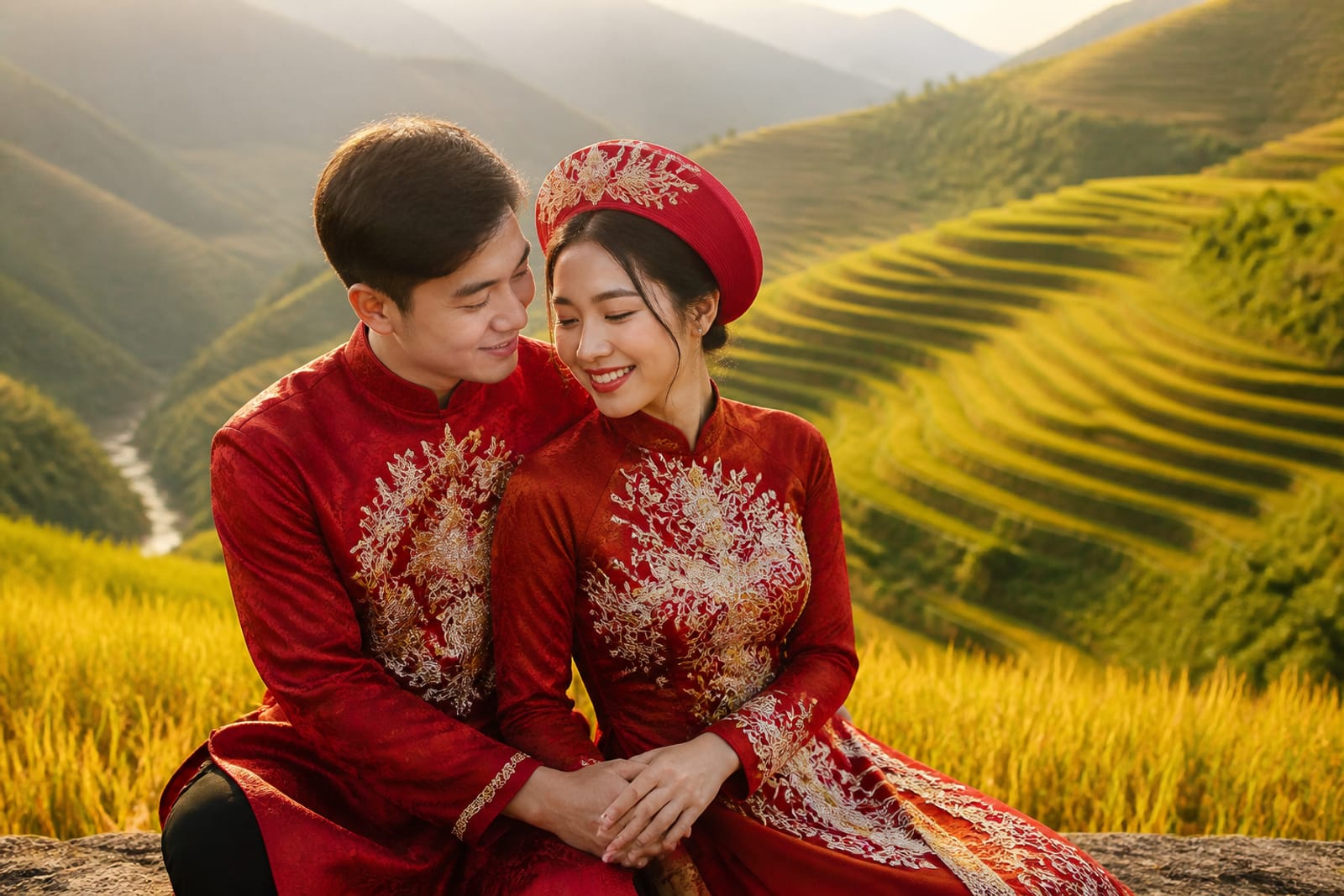
How do you fit an ao dai on a mountainside?
Fitting happens best in daylight, on the actual slopes where you'll shoot. If you rent from a Hanoi or Yen Bai tailor, schedule the fitting 2–3 days before your session so adjustments can be made. The tailor should understand that ao dai for terraces need: shorter hems (just above ankle or mid-calf depending on slope steepness), a fitted bodice (wind will pull loose fabric), and a waistband that doesn't dig when you walk downhill. Bring a photo of your intended walking pose; let the tailor see how the hem clears your shoes and the áo drapes over the terrain.
What styling choices work best on Mu Cang Chai's light and terrain?
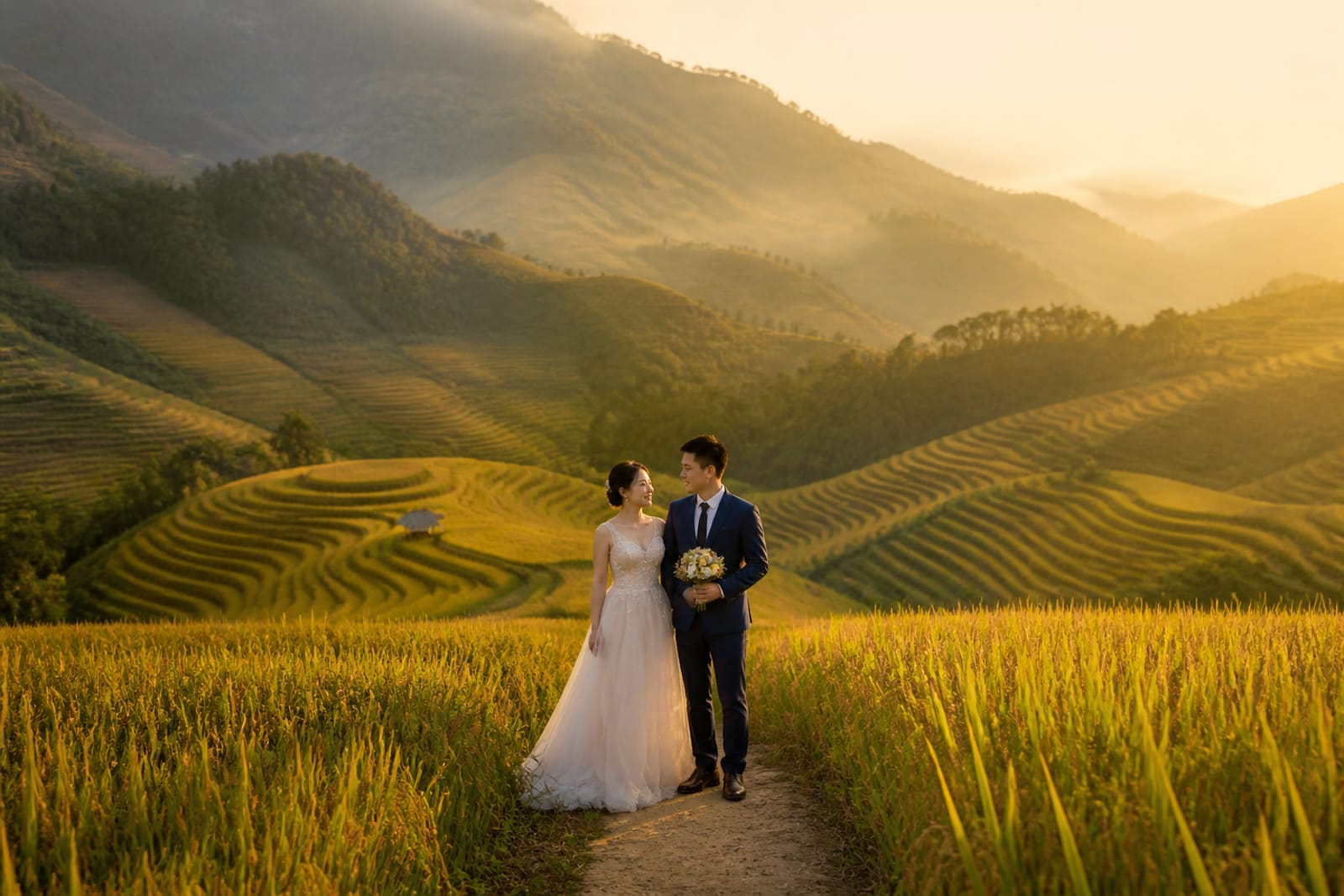
Light on the terraces is soft and even in early morning (before 7 am); it becomes harsh and directional by 9 am. Your ao dai color should contrast with the green or gold terraces without competing—deep jewel tones (emerald, sapphire, burgundy) read well in wide shots; pastels fade into the landscape. Avoid white or cream unless it's mid-morning when side light creates separation. Pair the ao dai with minimal jewelry (a simple necklace, no bangles that catch light and distract). For your hair, choose a style that won't blow across your face in mountain wind—a low bun or half-up hold better than loose waves. Makeup should be matte and waterproof; the humidity and morning dew will challenge powder foundations.
💄 Makeup & hair at your hotel | 🌸 See the lookbook
When do the terraces look best, and does that change what you wear?
| Season | Terrace state | Ao dai color | Fabric weight | Light quality |
|---|---|---|---|---|
| May–Jun | Water-filled, reflective | Jewel tones, pastels | Lightweight silk | Soft, diffuse; morning haze |
| Jul–Aug | Transitioning to green | Emerald, sapphire, burgundy | Breathable cotton blend | Brighter; afternoon shadows deep |
| Sep–early Oct | Golden-yellow | Deep burgundy, navy, forest green | Medium weight | Warm, directional; ideal for side light |
| Oct–Nov | Harvested, brown/grey | Jewel tones for contrast | Heavier silk crepe | Overcast often; flat light mid-day |
| Dec–Feb | Sparse green, cold | Bright jewel tones for warmth | Medium-heavy layers | Cool, sharp shadows at midday |
Golden terraces (mid-Sep to early Oct) pair best with deep, saturated ao dai colors. Water-filled seasons (May–Jun) favour lighter fabrics and jewel tones that reflect in the wet paddies. Cold months ask for slightly heavier silk that drapes richly and holds its shape in wind.
What should you check before renting or booking a photoshoot in Mu Cang Chai?
Before renting the ao dai:
- Confirm the tailor has fitted ao dai for outdoor/terrain work—not just formal events.
- Check hem length in person on slopes; photos of flat-ground fitting can mislead.
- Ask if the áo has internal ties or boning; these prevent sliding when you walk downhill.
- Request a fabric swatch beforehand; see how it moves and whether it wrinkles easily.
- Plan the fitting at least 3 days before your session (alterations take time).
Before booking a photoshoot:
- Verify the photographer knows mountain light and uneven terrain (not just studio or flat-ground experience).
- Ask to see frames from other terrace shoots—wide shots first, then medium and detail (this is how professionals frame terrain).
- Confirm the team includes both photographer and a stylist familiar with ao dai on slopes (outfit + hair + makeup in one session is more coherent than three vendors).
- Book early morning (before 7 am) for soft, even light; avoid 10 am–3 pm when shadows are harsh.
- Check the weather forecast 3 days before; mountain conditions change fast.
Cost factors (never fixed amounts—ask on WhatsApp):
- Rental varies by tailor skill and fabric quality; Hanoi tailors charge more than Yen Bai locals.
- Fitting adjustments add time if the ao dai doesn't arrive altered.
- Travel cost for a photographer depends on their base (Hanoi or Yen Bai) and session length.
- Group sessions (couples, families) cost less per person than solo shoots.
---
How does Cáo Studio approach ao dai photoshoots elsewhere?
Cáo Studio shoots ao dai photoshoots in Hanoi, Ho Chi Minh City, and Hoi An only. The studio's method is: one team (photographer, makeup artist, stylist) handles outfit, hair, makeup and framing in a single session. This integration means the ao dai is chosen and fitted with the light and location in mind—not as an afterthought. For Mu Cang Chai, you'll coordinate separately with a local tailor and photographer; the studio can advise on styling and light strategy over WhatsApp if you're preparing a DIY session.
If you're in Hanoi before or after Mu Cang Chai, consider a Hanoi ao dai photoshoot with Cáo Studio—Huc Bridge at dawn, the Old Quarter's narrow alleys, or the Red River embankment all offer water and light similar to terraces without the 4-hour drive.
📸 Book on WhatsApp — ao dai photoshoot | 💄 Makeup & hair at your hotel | 🌸 See the lookbook
---
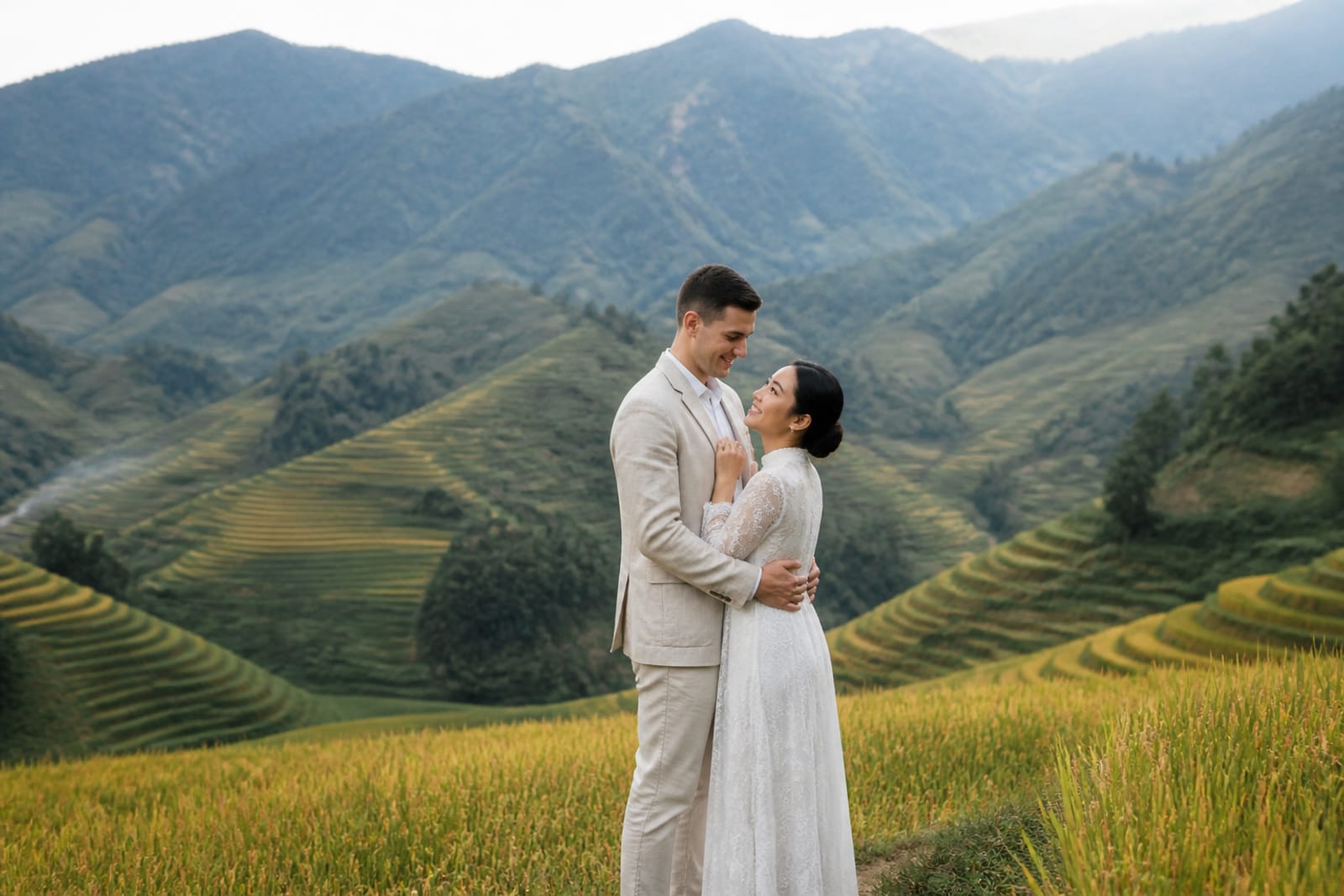
What's the difference between renting and wearing an ao dai you own?
Ownership means perfect fit and no rental timeline pressure. Renting is fast and free you from packing. For mountain terrain, fit matters more than ownership—a rented ao dai altered on-site beats an expensive owned one that's too long or too stiff. If you rent, budget for a tailor visit; if you own, budget for transport and potential last-minute adjustments.
Can you wear an ao dai in Mu Cang Chai if you're not Vietnamese?
Yes. The ao dai is worn by visitors from all backgrounds, especially in photoshoots. Respect the fabric and terrain—don't drag it through mud, don't pose stiffly like a monument statue (walk, look at each other, do something natural). Local guides and farmers see ao dai photoshoots regularly; no etiquette issue arises from respectful wear.
What if the ao dai doesn't fit on the morning of the shoot?
This is why fitting happens 2–3 days before. If something shifts (humidity, travel, a misunderstanding), bring safety pins, a small needle and thread, and tape in your kit. Hemming tape can hold a dragging hem for a few hours. Wear an undershirt or slip under the áo to prevent fabric from catching on rough terrain. If the bodice is too loose, wear a lightweight base layer that doesn't add bulk.
Do you need a permit or permission to photograph in Mu Cang Chai?
No permit is required for personal or small-group photoshoots on the terraces. If you're hiring a professional photographer and want exclusivity (keeping others out of your frame), ask the local guides about reserved-access hours—early morning often feels quieter. Check the current rules with local tourism offices before you go; regulations change.
How long does an ao dai photoshoot in Mu Cang Chai usually take?
Plan 2–4 hours depending on the number of outfits and locations. One ao dai + one terrace location = 90 minutes. Two outfits or two locations = 3 hours. Build in time for walking to the site (15–30 min from the road), light changes, and outfit swaps. Start before 6:30 am if you want pre-dawn soft light; finish by 8–9 am when crowds and harsh light arrive.
Can you combine an ao dai shoot in Mu Cang Chai with other destinations?
Yes. Many travelers pair Mu Cang Chai with Hanoi, Hoi An, or the northern highlands. If you're also visiting Hanoi, book a Hanoi ao dai photoshoot with Cáo Studio—the team handles outfit fitting, makeup and framing in a single day. For Mu Cang Chai and Hoi An together, the studio can advise on timing and light strategy over WhatsApp, and then shoot the Hoi An leg if you're there near your travel dates.
FAQ
Is it cheaper to rent locally in Mu Cang Chai than in Hanoi?
Yes, local Yen Bai tailors typically charge less than Hanoi boutiques. Quality depends on the tailor's experience with terrain fits. Ask for referrals from your hotel or local guides; inspect the finished ao dai in person before the shoot day.
What happens if it rains during the Mu Cang Chai photoshoot?
Mountain rain arrives fast and often clears within 20–30 minutes. Reschedule to the next early morning if heavy rain is forecast. Light drizzle can create moody frames, but wet fabric clings and looks dull. Keep the ao dai in a garment bag until the last moment; bring an umbrella for waiting periods.
Can you wear an ao dai in Mu Cang Chai without professional photos—just for walking around?
Yes, but rent from someone who understands terrain fit. Tourist-focused rentals sometimes offer stiff, heavy ao dai meant for studio backdrops. Test the fit on slopes before committing; worn fabric and poor tailoring will frustrate you during a half-day visit.
Should the ao dai be new, or is vintage or well-worn acceptable?
Vintage or well-worn ao dai photograph beautifully—they drape softly and show character. New ao dai can look stiff and polished (not always bad, but less romantic). Check for fraying seams, faded colour patches, and loose stitching. A well-loved ao dai costs less to rent and feels authentic in mountain light.
What if I don't speak Vietnamese and need to coordinate with a local tailor?
Bring a trusted hotel staff member or local guide to the fitting; they can clarify terrain fit, show the tailor walking poses, and confirm the hem length. Take photos of your intended route on the terraces; visual communication works when language is a barrier. Allow extra time for the fitting if translation is needed.
FAQ
Is it cheaper to rent locally in Mu Cang Chai than in Hanoi?
Yes, local Yen Bai tailors typically charge less than Hanoi boutiques. Quality depends on the tailor's experience with terrain fits. Ask for referrals from your hotel or local guides; inspect the finished ao dai in person before the shoot day.
What happens if it rains during the Mu Cang Chai photoshoot?
Mountain rain arrives fast and often clears within 20–30 minutes. Reschedule to the next early morning if heavy rain is forecast. Light drizzle can create moody frames, but wet fabric clings and looks dull. Keep the ao dai in a garment bag until the last moment; bring an umbrella for waiting periods.
Can you wear an ao dai in Mu Cang Chai without professional photos—just for walking around?
Yes, but rent from someone who understands terrain fit. Tourist-focused rentals sometimes offer stiff, heavy ao dai meant for studio backdrops. Test the fit on slopes before committing; worn fabric and poor tailoring will frustrate you during a half-day visit.
Should the ao dai be new, or is vintage or well-worn acceptable?
Vintage or well-worn ao dai photograph beautifully—they drape softly and show character. New ao dai can look stiff and polished (not always bad, but less romantic). Check for fraying seams, faded colour patches, and loose stitching. A well-loved ao dai costs less to rent and feels authentic in mountain light.
What if I don't speak Vietnamese and need to coordinate with a local tailor?
Bring a trusted hotel staff member or local guide to the fitting; they can clarify terrain fit, show the tailor walking poses, and confirm the hem length. Take photos of your intended route on the terraces; visual communication works when language is a barrier. Allow extra time for the fitting if translation is needed.
Ao dai, makeup, hair and a local photographer in Hanoi or Saigon — one WhatsApp message.