/ao-dai-photoshoot
Ao dai wedding photos at Ban Gioc Waterfall: light, seasons, and logis
Ban Gioc Waterfall is a two-tiered cascade on the Quay Son River between Cao Bang province and China's Guangxi. An ao dai photoshoot there works best in the rainy season (July–September), when the falls run full and the mist photographs cinematic; avoid October–November when flooding closes access. Shoot at dawn or late afternoon to catch side light on the cliffs without harsh glare. Cáo Studio does not operate in Cao Bang — you'll need a local photographer vetted through on-the-ground guides or travel coordinators. The ao dai must fit under protective gear during river crossings; aim for a lightweight silk blend and test the fit in advance. Budget extra time for the four-hour drive from Hanoi and unpredictable water levels that shift the shoot location daily.
Why does Ban Gioc work for an ao dai shoot at all?
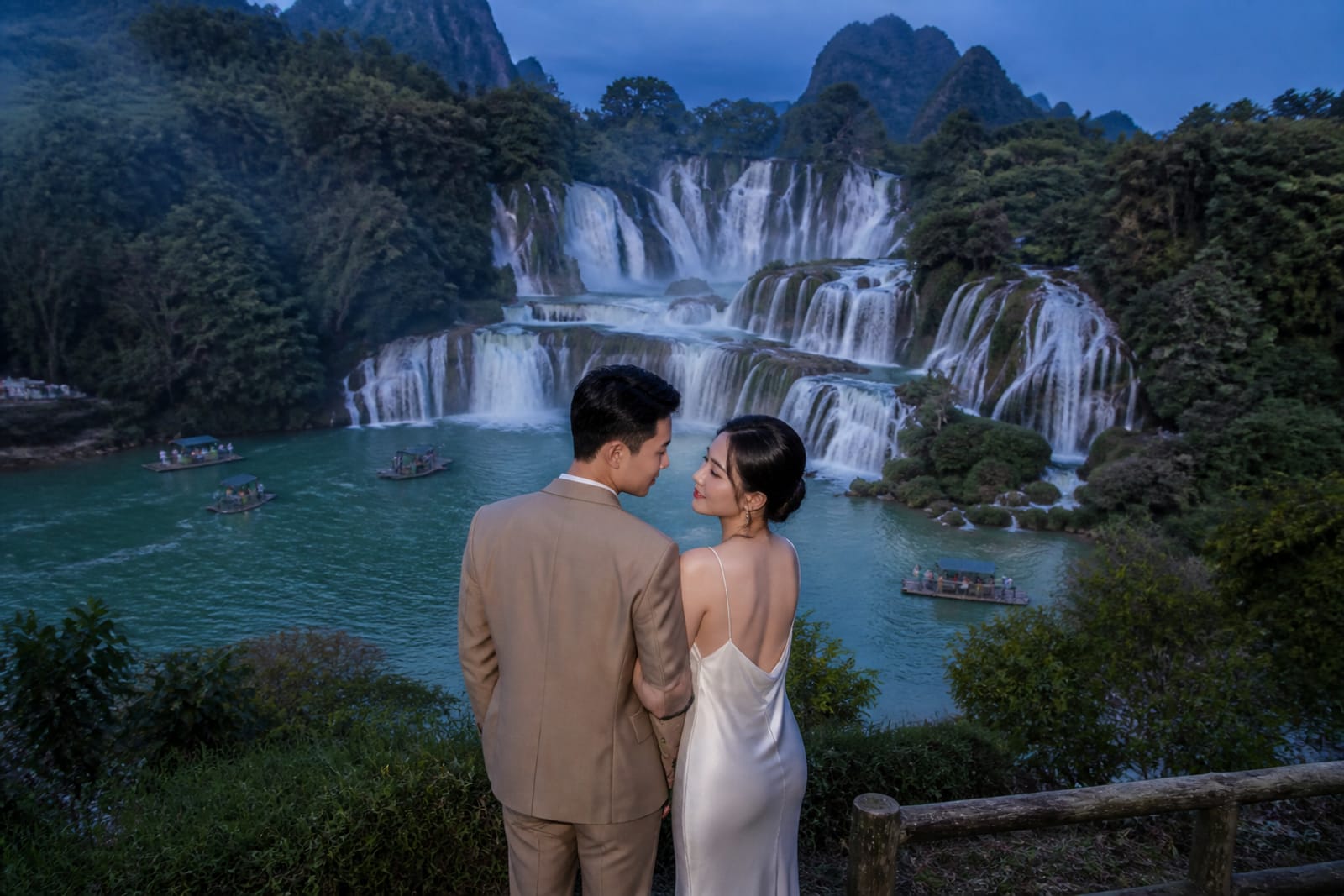
Ban Gioc's power lies in two layers: the falls themselves, and the limestone cliffs that frame them. The waterfall creates its own microclimate — mist backlit by morning sun glows like smoke, softening the ao dai's silhouette against grey stone. The river gorge acts as a reflector, filling shadows so the embroidered fabric and trousers read clearly even in overcast light. The scale humbles the wearer, which photographs as presence rather than posture. Most ao dai shoots in Vietnam happen in towns (Hanoi's French Quarter, Hoi An's Ancient Town) where controlled light and heritage buildings anchor the frame. Ban Gioc inverts this: the landscape dominates, and the ao dai becomes a warm accent. That works only if the wearer accepts being small in the frame and the photographer knows how to expose for mist without blowing highlights. The trade-off is access: you're crossing a border zone with limited services and unpredictable conditions.
📸 Book on WhatsApp — ao dai photoshoot | 🌸 See the lookbook
When is the light actually shootable at Ban Gioc?
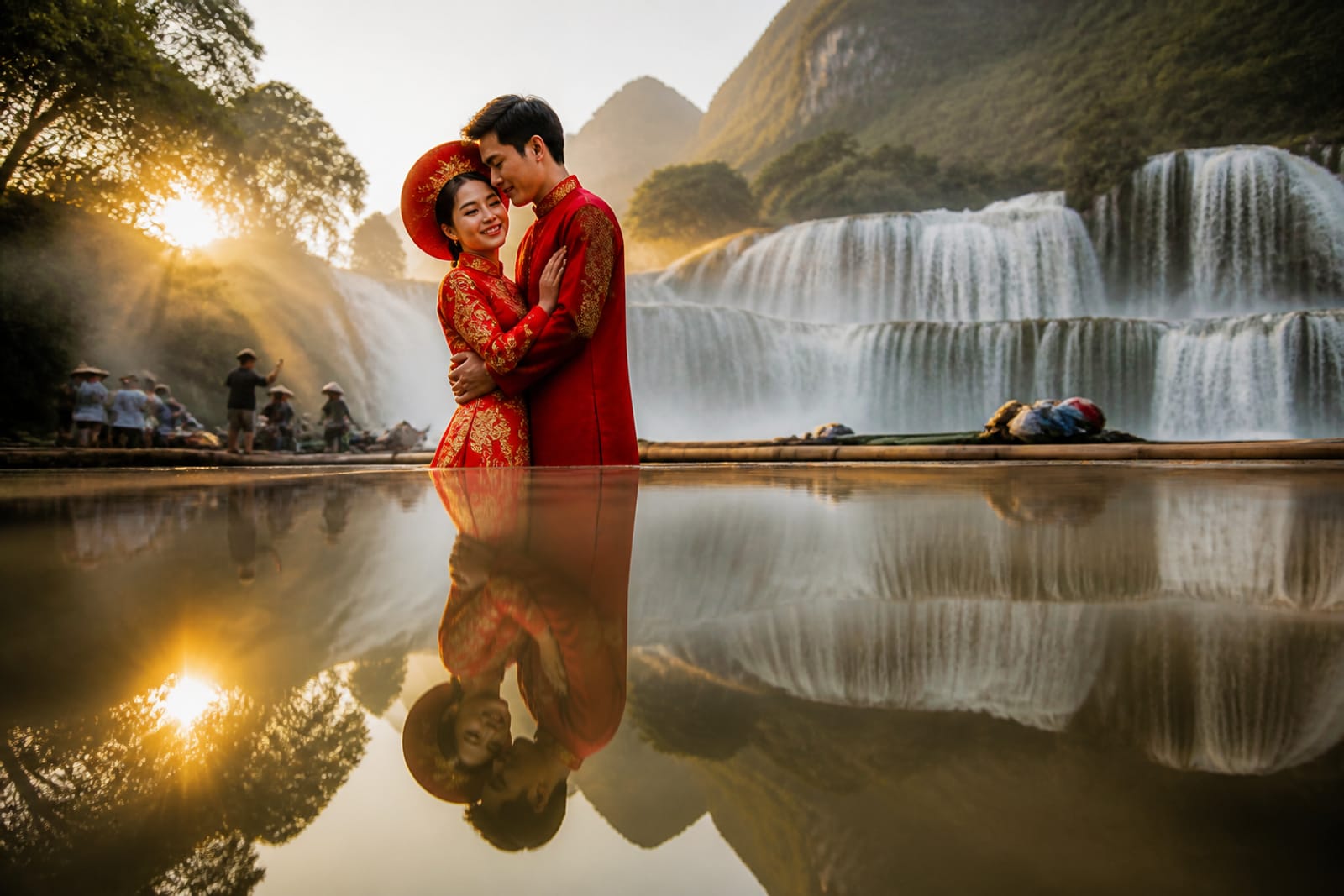
The waterfall's best light occurs in two narrow windows: sunrise (5:30–6:30 am) and late afternoon (4:00–5:30 pm). At sunrise, the sun rises behind the China side and casts long shadows westward across the Vietnamese bank, creating a moody rim light on the ao dai's back and shoulders. By mid-morning (8:00 am onward), the sun climbs directly overhead or swings behind the cliffs, and the falls sink into flat grey light that flattens the embroidery. Late afternoon brings side light from the west, warm and low, which illuminates the ao dai's front and face without the blown-out haze of midday. The trade-off: sunrise requires a 3:30 am departure from Cao Bang town; late afternoon narrows your window to 90 minutes before dark. Both windows mean early starts and fatigue before the shoot begins — many couples underestimate this. Overcast days (common even in the dry season) eliminate the sun angle advantage entirely, leaving only the falls' mist as ambient fill light. That can work for a moody, editorial look, but it requires a photographer who understands exposure latitude and isn't shooting on automatic settings.
Should you shoot in the rainy season or the dry season?
| Season | Water volume | Mist & drama | Weather risk | Access | Best for |
|---|---|---|---|---|---|
| Rainy (Jul–Sep) | Full, thundering | Heavy, cinematic | Flash floods (Oct–Nov worst) | Open, negotiable river level | Drama, mist, full cascade |
| Dry (Dec–Apr) | Thin streams, sometimes dry | Minimal, hazy | Clear skies, harsh light | Stable paths, wider crossing points | Clarity, detail work, easier access |
| Shoulder (May–Jun, Oct) | Good-to-full | Moderate | May encounters light rain | Variable; Oct starts flooding risk | Compromise; fewer crowds |
The rainy season (July–September) fills the falls to their most photogenic: two clear tiers, white spray, and constant mist. The drawback is weather volatility. A single heavy rain upstream swells the river overnight, making crossings unsafe. Cao Bang authorities may close the site without notice. October and November bring the worst typhoon risk — the site shuts regularly, and even if open, the falls churn brown with silt. The dry season (December–April) keeps the falls stable and access predictable, but the cascade shrinks to thin streams. Midday light is harsh and direct, forcing you into the narrow sunrise/sunset windows or accepting flat, muddy water in your background. The mist effect vanishes. Dry-season shoots work best for editorial detail work — close frames on the ao dai's embroidery, the wearer's face against stone — rather than landscape drama. If you're committed to the Ban Gioc geography, commit to July–September and have a weather contingency (reschedule, or pivot to a nearby temple or rice-terrace shot). Most travel photographers in Vietnam choose the dry season simply to avoid climate risk — that's valid, even if it means a less dramatic backdrop.
How does an ao dai actually work on river paths and cliff crossings?
The ao dai's elegant proportions become a logistics problem at Ban Gioc. The outer tunic hangs from shoulder to ankle, slit up both sides to the hip — designed for sitting on a motorbike or walking on flat ground. At Ban Gioc, the paths narrow, rocks are slick, and you cross the river on unstable bamboo or stepping stones. The loose fabric snags on branches, the trousers drag in spray, and the wearer must manage balance while holding fabric clear of water. Most photographers (and rental services in Hanoi and Ho Chi Minh City) dismiss this risk. In practice, many ao dai shoots at Ban Gioc end with a soaked hem, a torn seam, or a frustrated wearer who spends the shoot managing cloth rather than inhabiting the frame. A few strategies mitigate this: (1) rent or bring a lightweight silk-blend ao dai, not heavy cotton or brocade — it dries faster and clings less when wet; (2) wear the trousers slightly rolled at the cuff, not full length; (3) use clips or safety pins to tack the outer tunic's inner slit closed, shortening the effective length by 4–6 inches for river crossings, then unpin for landscape shots on stable ground; (4) plan two or three outfit changes (one for water work, one for cliff shots, one for detail close-ups) so wet garments dry between takes. If you rent an ao dai before traveling, confirm with the rental service that it's suitable for water proximity and that they accept minor moisture exposure. Many rentals have strict no-water policies, which rules out Ban Gioc entirely.
💄 Makeup & hair at your hotel | 🌸 See the lookbook
How do you actually book a photographer in Cao Bang?
Cáo Studio operates in Hanoi, Ho Chi Minh City, and Hoi An — not in Cao Bang. For Ban Gioc, you'll hire a local photographer or guide-photographer hybrid. Here's the vetting framework: (1) Check on established travel sites (ToursByLocals, Airbnb Experiences, Withlocals) for Cao Bang photographers; filter by ao dai or wedding photography experience. (2) Ask for a portfolio filtered to Ban Gioc shoots — not studio portraits or street photography. (3) Verify they own or can operate a full-frame or mirrorless camera with lenses suitable for landscape and portrait work (at least a 35mm and 85mm equivalent). Phone photography or DSLR with kit lenses won't hold detail in mist or deliver usable wide shots. (4) Confirm they've shot Ban Gioc in both rainy and dry seasons, and ask what they do on flat-light days. (5) Request examples of ao dai shoots — not just landscapes — to see if they understand fabric, embroidery detail, and movement. (6) Discuss edited-photo delivery: how many images, when, what format. Local photographers may be unfamiliar with Western delivery standards (Lightroom presets, cloud backup, high-resolution files). Set expectations in writing. (7) Agree on contingency: what happens if weather closes the site, and do you reschedule or pivot to an alternative location. Most Ban Gioc photographers work through tourism offices or guesthouses in Cao Bang town and may not have a formal booking system. Plan a phone or WhatsApp conversation with your accommodation or a travel fixer to coordinate. Build in a 30% time buffer — road delays to Cao Bang are common.
What should you pack and check before you arrive?
Clothing & gear:
- Lightweight silk-blend or linen ao dai (not brocade; water-resistant coating if available).
- Backup undergarments; water exposure is inevitable.
- Non-slip shoes or sandals for wet rock (not flip-flops or open heels).
- A small dry bag for phone, wallet, keys.
- Light rain jacket or poncho (even in "dry" season, mountain fog rolls in fast).
Photography specifics:
- Confirm photographer has at least two camera bodies or a fast backup plan if one fails near water.
- Ask if they bring backup lenses; a single lens breaking at Ban Gioc is a session-ender.
- Verify they have circular polarizing filters to cut glare off water and mist.
- Request they shoot raw files, not JPEGs only — raw gives you maximum flexibility in post-processing mist and shadow detail.
Logistics:
- Start from Hanoi or Cao Bang guesthouse by 3:00–4:00 am to catch sunrise light.
- Book an ac-minivan or private car; minibuses may arrive late and cost time.
- Bring water, snacks, electrolytes — the early start and river crossings are physically demanding.
- Check real-time water levels on local tourism sites or your guesthouse; don't rely on weather forecasts alone.
- Notify your photographer and guides of any mobility concerns or fear of water; Ban Gioc is not wheelchair-accessible and involves fording.
Post-shoot:
- Plan a clothes-drying time at your guesthouse before the return drive.
- Budget a full day for the round trip; shoots are often 2–3 hours, but travel is 6–8 hours total.
If you're considering a full ao dai wedding or couple session with more controlled conditions, Cáo Studio offers pre-wedding photoshoots in Hanoi, Ho Chi Minh City, and Hoi An, where we manage makeup, wardrobe, and light direction — eliminating much of the logistics friction you'd face freelancing in Cao Bang.
📸 Book on WhatsApp — ao dai photoshoot | 💄 Makeup & hair at your hotel | 🌸 See the lookbook
---
FAQ
Can I rent an ao dai in Cao Bang, or do I need to bring one from Hanoi?
Cao Bang has minimal ao dai rental; most services are in Hanoi. Rent in advance or have a hotel in Hanoi deliver to your Cao Bang guesthouse. Confirm the rental is water-safe before committing to Ban Gioc. Local guesthouses may have a backup simple ao dai, but quality and fit are unpredictable.
What's the risk of flood closing Ban Gioc on my shoot day?
October–November sees the highest closure risk. July–September is rainy-season open, but heavy rainfall upstream can spike water levels within hours, forcing day-of cancellations. Book a reschedule clause in your photographer agreement, and monitor local weather alerts 48 hours before.
Do I need a permit or visa to shoot at the waterfall, given it's near the China border?
Ban Gioc is in a Vietnamese tourism zone open to international visitors without special permits. Bring your passport. Do not cross the border bridge into China or allow your photographer to work from the China side — it's restricted.
How many edited photos should I expect from a Ban Gioc ao dai session?
Ask your photographer directly; local practitioners have varied delivery standards. Cáo Studio guarantees a set count and delivery timeline on WhatsApp — worth clarifying with any local crew beforehand. Expect between 30–100 edited frames depending on session length and photographer workflow.
Is it better to shoot Ban Gioc solo or as a couple or family group?
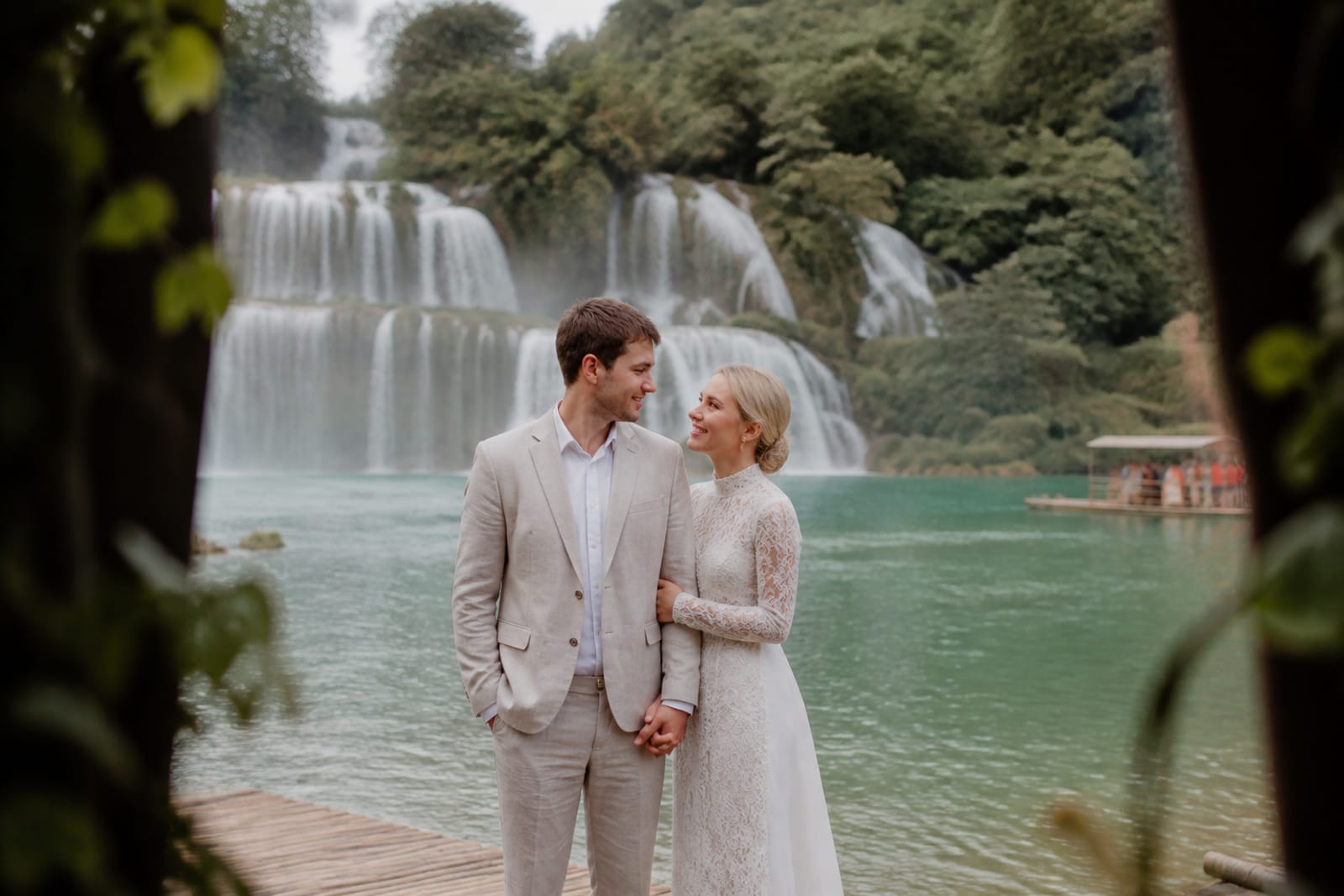
Solo ao dai works best; the landscape's drama isn't diluted by multiple people. Couples can work if the photographer is skilled at composition (one frame, both people, the falls) — but it's harder than a single wearer. Families become logistically complex with varying ao dai fits, energy levels, and water tolerance. For couple or family sessions in more manageable settings, Cáo Studio's couple and family photoshoots in Hanoi or Ho Chi Minh City may be more practical.
Can you edit mist and light into the photos if the day is flat and grey?
Poor light can't be edited into existence. A skilled photographer can lift shadows and add warmth in post-processing, but flat overcast light produces flat images. If Ban Gioc's weather is grey, pivot to close-up detail work (embroidery, fabric texture, face) rather than landscape shots. Accept the conditions, or reschedule to a sunnier forecast window.
FAQ
Can I rent an ao dai in Cao Bang, or do I need to bring one from Hanoi?
Cao Bang has minimal ao dai rental; most services are in Hanoi. Rent in advance or have a hotel in Hanoi deliver to your Cao Bang guesthouse. Confirm the rental is water-safe before committing to Ban Gioc. Local guesthouses may have a backup simple ao dai, but quality and fit are unpredictable.
What's the risk of flood closing Ban Gioc on my shoot day?
October–November sees the highest closure risk. July–September is rainy-season open, but heavy rainfall upstream can spike water levels within hours, forcing day-of cancellations. Book a reschedule clause in your photographer agreement, and monitor local weather alerts 48 hours before.
Do I need a permit or visa to shoot at the waterfall, given it's near the China border?
Ban Gioc is in a Vietnamese tourism zone open to international visitors without special permits. Bring your passport. Do not cross the border bridge into China or allow your photographer to work from the China side — it's restricted.
How many edited photos should I expect from a Ban Gioc ao dai session?
Ask your photographer directly; local practitioners have varied delivery standards. Cáo Studio guarantees a set count and delivery timeline on WhatsApp — worth clarifying with any local crew beforehand. Expect between 30–100 edited frames depending on session length and photographer workflow.
Is it better to shoot Ban Gioc solo or as a couple or family group?
Solo ao dai works best; the landscape's drama isn't diluted by multiple people. Couples can work if the photographer is skilled at composition (one frame, both people, the falls) — but it's harder than a single wearer. Families become logistically complex with varying ao dai fits, energy levels, and water tolerance. For couple or family sessions in more manageable settings, Cáo Studio's [couple and family photoshoots](/couple-photoshoot) in Hanoi or Ho Chi Minh City may be more practical.
Can you edit mist and light into the photos if the day is flat and grey?
Poor light can't be edited into existence. A skilled photographer can lift shadows and add warmth in post-processing, but flat overcast light produces flat images. If Ban Gioc's weather is grey, pivot to close-up detail work (embroidery, fabric texture, face) rather than landscape shots. Accept the conditions, or reschedule to a sunnier forecast window.
Ao dai, makeup, hair and a local photographer in Hanoi or Saigon — one WhatsApp message.