/ao-dai-photoshoot
Ao dai wedding photos at Ben Tre coconut groves
Ben Tre ao dai photoshoots work best in the dry season (December–April), when canals are calm and light is overhead-free in early morning or late afternoon. The journey from Ho Chi Minh City takes 1.5–2 hours; you shoot in coconut groves, on wooden boats, or at canal edges where water reflects light onto fabric and skin. Cáo Studio brings the photographer, makeup artist and stylist in one team, so outfit changes, hair touch-ups and framing happen without vendor gaps. The main trade-off: Ben Tre has fewer dramatic monuments than Hanoi's Old Quarter or Hoi An's Ancient Town, so the shoot leans on light, water and textile detail rather than architectural scale. A single afternoon yields frames built from walking between palms, sitting on boats, or standing where water meets sky — no stiff poses. Avoid the rainy season (May–November) when afternoon storms are unpredictable and water levels spike. ---
Why do couples choose Ben Tre for ao dai photos?
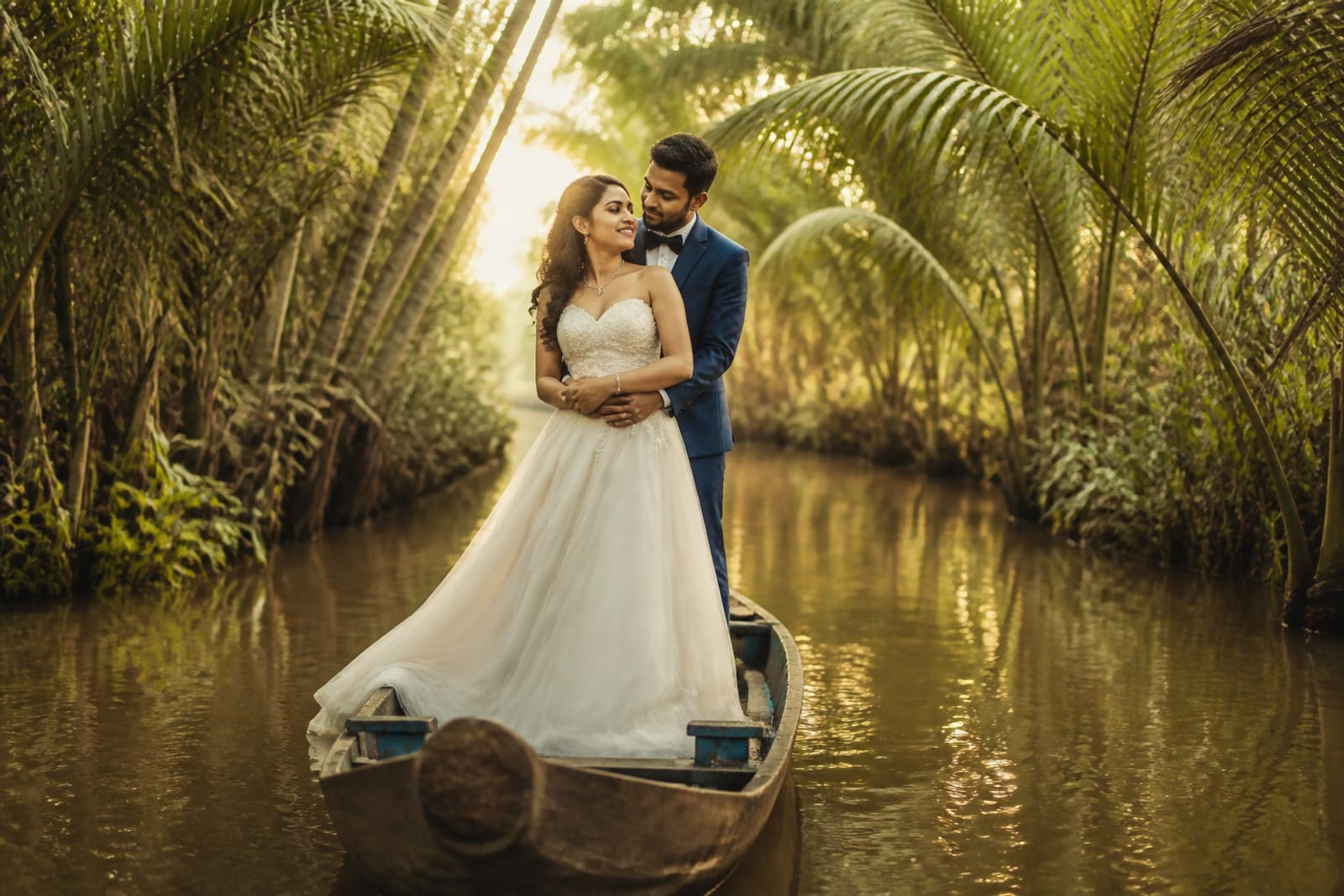
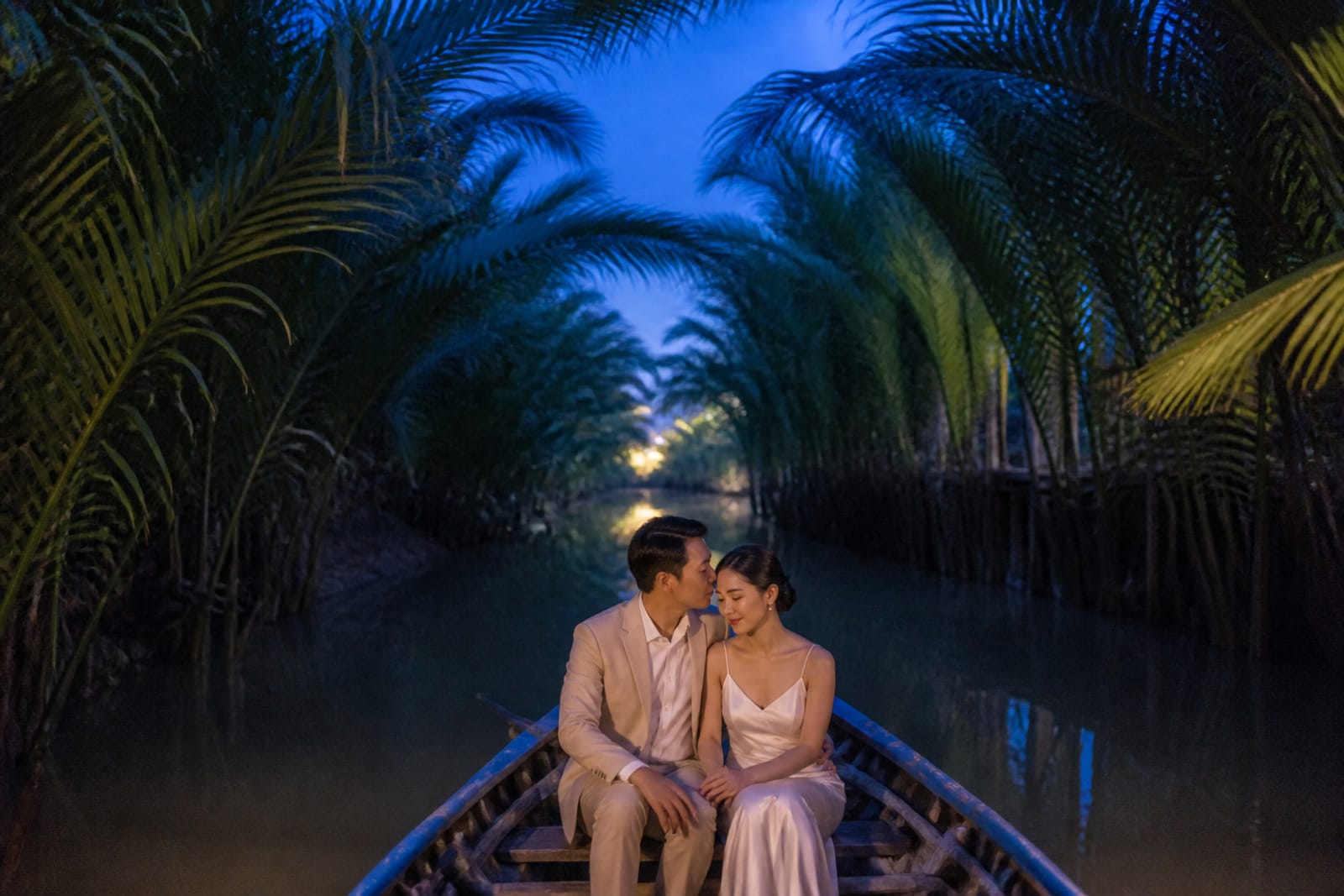
Ben Tre appeals to travelers who want natural, quiet frames without the crowds at temple stairs or Old Quarter streets. The coconut palms create soft, dappled light that flatters ao dai fabric without harsh shadows. Morning shoots catch golden water-glow; late-afternoon sessions offer clear side light. The landscape feels undeniably Vietnamese — palm canals, wooden boats, hammocks — without feeling staged. For couples seeking "we walked through a real place and a camera was there" rather than "we posed at a landmark," Ben Tre delivers.
📸 Book on WhatsApp — ao dai photoshoot | 🌸 See the lookbook
How is Ben Tre different from Hanoi or Ho Chi Minh City shoots?
Ben Tre trades architectural drama for natural light and water. Hanoi's Old Quarter and Hoi An Ancient Town offer iconic backgrounds — narrow streets, lanterns, ancient walls — but rely on monument framing. Ben Tre has no monuments; it offers texture: water reflections, palm shadows, the colour of wooden boats. Hanoi suits couples who want their frames to announce "Vietnam"; Ben Tre suits those who want frames that feel like being there. Hanoi and Ho Chi Minh City shoots often layer outfit changes across multiple neighborhoods; Ben Tre stays local, so the narrative is tighter — "a morning in the groves, by the water, in one dress or two." Both approaches work; the question is whether you want scale or intimacy.
What's the best time of year to shoot ao dai in Ben Tre?
December–April (dry season): mornings are cool and light is even; canals are calm and reflect clearly. Early starts (5:30–6:30 am) catch water-glow without heat. Mid-afternoon (4:00–5:30 pm) offers golden side light and fewer boats. May–November (wet season): afternoon showers are likely, especially October–November. High water levels make canal edges less walkable. If you choose wet-season travel for other reasons, Ben Tre shoots are possible but require flexibility — light is softer and greener, but unpredictable. Avoid Tet (late January–mid February) when transport is crowded and services close. Water level is highest June–September; lowest November–January.
How does a Ben Tre ao dai shoot actually run?
Cáo Studio arrives pre-dawn with the photographer, makeup artist and stylist. You change into the ao dai (or wear it under layers for comfort en route). The team shoots while you walk between palm groves, sit on a boat, or stand at the water's edge — no set poses, just direction: "Walk toward the lighter palms"; "Look at each other, keep walking"; "Sit here, let the light catch your face." Outfit changes happen on location or at a rest point; makeup and hair are touched up between frames. A typical session is 2–3 hours of shooting compressed into one focused narrative. You return to Ho Chi Minh City by mid-morning. The team edits and sends a short vertical film plus edited stills within 48 hours. The hardest part is the early start — but soft light is non-negotiable.
What should you check before booking a Ben Tre ao dai shoot?
| Angle | Key question | What to confirm with the studio |
|---|---|---|
| Transport | Who handles the drive from Ho Chi Minh City? | Cáo Studio arranges pickup and return; no extra cost for distance. Confirm hotel pickup point. |
| Light timing | Do you want golden hour or diffuse morning light? | Early start (5:30 am) = soft, even light. Late start (2:00 pm) = golden, contrasted light. Discuss your preference. |
| Weather backup | What happens if it rains? | Cáo Studio has contingency frames (covered boats, grove shelter) and rebooks if unsafe. Confirm the rescheduling policy. |
| Outfit fit underwater | Will the ao dai float or drag in canal water? | The team packs a slip dress and lightweight fabric for wet work. Discuss water-level safety with the team on WhatsApp. |
| Boat access | Are you comfortable on a wooden boat for 30+ minutes? | Not all shots require boats; confirm your comfort level. The team can frame alternatives on land. |
| Makeup longevity | How do you stay fresh in humidity and heat? | The artist applies waterproof, long-wear base and does on-set touch-ups. Discuss with Cáo Studio's makeup artist on WhatsApp. |
Honest check: if you want frames dominated by a famous landmark, Ben Tre is the wrong location. If you want quiet, natural, story-driven frames in genuine Vietnam light, it works.
How does Ben Tre compare to other coconut-grove locations?
Vietnam has several coconut and canal destinations. Mekong Delta canals (Can Tho, Vinh Long) mirror Ben Tre but are farther from Ho Chi Minh City and have less established tourism infrastructure. Hoi An's Thu Bon River combines water with ancient-town architecture but is less purely botanical. Ha Long Bay offers dramatic limestone water-framing but requires a full-day boat trip and overcast light is common. Ben Tre wins on proximity (90 minutes from Ho Chi Minh City), walkable groves, calm canals, and predictable logistics. The trade-off: no iconic structure to frame the couple against, so the director's work — light, timing, movement — is everything.
📸 Book on WhatsApp — ao dai photoshoot
What to wear under and with the ao dai for Ben Tre water work?
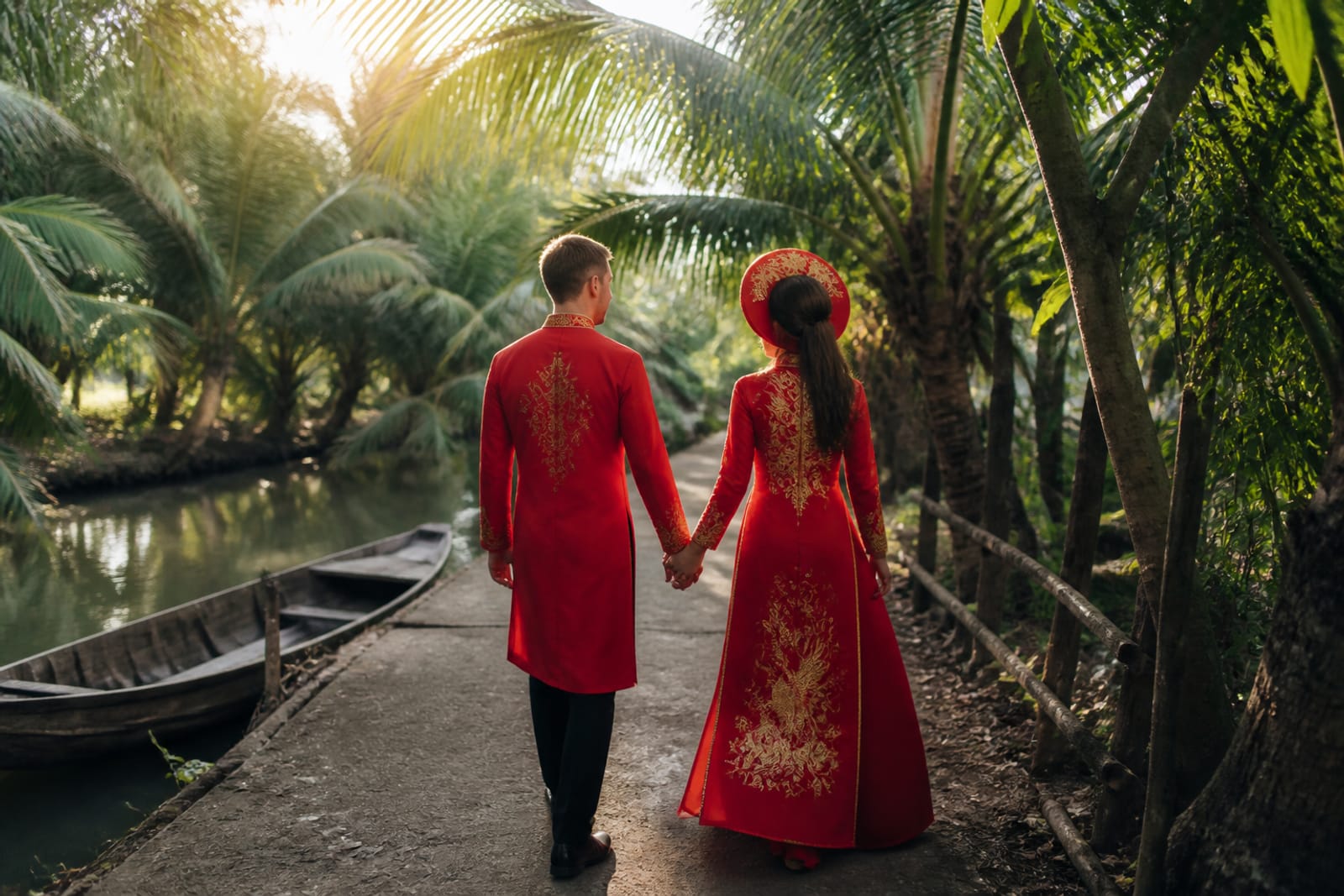
The ao dai is a tunic; underneath, wear a fitted slip dress or underdress (white or neutral) so fabric doesn't cling when wet. Cáo Studio provides guidance on fabric weight — lighter silks work better near water because they dry faster and move with breeze. For boat shots, the team may suggest a shorter underdress to avoid pooling fabric. Avoid heavy embroidery that holds water. If you're not changing clothes, wear the ao dai over loose pants or a long slip; the team will frame you so the underdress isn't visible. The artist applies long-wear makeup and brings a portable fan to keep you cool between frames. Ask the makeup artist on WhatsApp for specific product recommendations based on the season and your skin type.
Do you need a permit or permission to shoot in Ben Tre?
Ben Tre's coconut groves are private or community-managed land. Cáo Studio has working relationships with local grove owners and boat operators, so the team handles access and etiquette. You do not need a government permit to photograph there. If you hire a local photographer without studio backing, confirm they have permission before booking. The team avoids restricted areas and respects local fishing schedules — early morning and late afternoon are ideal partly because they align with traditional quiet hours.
---
What to check before you book
- Confirm the pickup time and hotel location. Early starts mean a 5:30 am hotel pickup. Verify your hotel is accessible and you're ready to go.
- Discuss weather and rescheduling. Ben Tre's dry-season rain is rare but possible. Understand the studio's policy if the shoot must be moved.
- Agree on the narrative. Do you want a single outfit or two? Walking shots or boat-focused? Let the director know so they prepare the timeline.
- Confirm what's included in the edit. Ask Cáo Studio on WhatsApp for exact details: number of edited stills, the vertical film, and delivery format.
- Discuss makeup and hair specifics. Give the artist your skin type, any sensitivities, and your vision for the look. Heat and humidity require waterproof choices.
- Ask about the photo album or prints option. After the shoot, you may want a printed album or framed prints — see the wedding photo album and photo prints & frames collections.
---
How does this fit into a pre-wedding or elopement plan?
Ben Tre ao dai shoots work as a standalone photoshoot or as part of a larger pre-wedding or elopement itinerary. If you're in Ho Chi Minh City for a few days, one morning in Ben Tre plus an afternoon session in the city (Saigon landmarks, hotel portrait, or a quiet rooftop) gives you two distinct visual stories. Some couples do Ben Tre first for color and texture, then move to the city for architectural frames. If you're flying directly to Ben Tre, the shoot doubles as your reason to visit — no wasted days. Pair it with a boat tour of the Mekong or a few nights in a rural homestay if timing allows.
See Cáo Studio Saigon for details on how we operate in Ho Chi Minh City and the surrounding region.
---
Comparing ao dai photoshoot options across Vietnam
| Location | Best for | Light / Season | Crowds & Scale | Why it works |
|---|---|---|---|---|
| Ben Tre, coconut groves | Water texture, intimacy, natural frames | Soft morning water-glow (Dec–Apr); high heat (May–Nov) | Quiet, local, no monuments | Green palms + water reflection + one outfit = focused story. No architectural fallback, so light is everything. |
| Hoi An Ancient Town | Architecture + lanterns, heritage narrative | Even dry-season light (Feb–Aug); rainy Oct–Nov | Medium crowds; iconic backdrop | Yellow walls, lanterns, narrow streets frame ao dai. Built-in visual scale. Best for couples wanting "Vietnam landmark" in the frame. |
| Hanoi Old Quarter | Urban energy, streetscape drama, narrow-alley framing | Clearest light Oct–Apr; humid May–Sep | High tourist traffic; heavy architecture | Colorful buildings, busy streets, water views. Narrative is "we found a moment in a crowded place." Requires skilled timing. |
| Ho Chi Minh City rooftops & parks | Modern Vietnam, city skyline, sculptural light | Golden hour all year (4:30–5:30 pm); heat & humidity | Medium crowds; contemporary backdrop | Modern backdrop suits modern couples. Soft, directional light. Fewer heritage constraints than Hoi An. |
Choose based on: your visual story (timeless monument vs. natural texture vs. modern city), how much you value architectural framing vs. light and movement, and your energy (early start for light vs. midday for heat tolerance).
---
Practical next steps
- Message Cáo Studio on WhatsApp +84 338 762 340 with your preferred date(s) in the dry season (Dec–Apr) and whether you want a single or double outfit.
- Confirm the narrative with the director: coconut groves and water focus, or do you want to combine Ben Tre with a second location in Ho Chi Minh City?
- Ask for the exact inclusions, timeline, and rescheduling policy specific to Ben Tre's distance and weather.
- Decide whether to add a makeup & hair top-up (see makeup & hair at your hotel) or use the on-location team.
- After the shoot, explore wedding photo album and photo prints & frames options for a keepsake.
See also: ao dai photoshoot pillar, couple photoshoot, pre-wedding elopement, and family photoshoot for other session types that can include Ben Tre or pair with it.
---
FAQ
How far is Ben Tre from Ho Chi Minh City, and how does transport work?
Ben Tre is roughly 90 minutes south of Ho Chi Minh City by car. Cáo Studio arranges pickup from your hotel, drives the team and you to the groves, shoots, and returns you by mid-morning. No extra transport cost; confirm your hotel location and pickup time on WhatsApp.
Can we do a Ben Tre shoot in the rainy season (May–November)?
Possible, but challenging. Afternoon showers are unpredictable, high water levels make canal edges less stable, and light is flat and green. December–April is far more reliable. If you're visiting in the wet season, ask Cáo Studio for a backup plan or a hybrid (partial Ben Tre, partial city shoot).
Do we need to be able to swim or balance on a boat for the shoot?
No. The team avoids risky water work. You may sit on a stable wooden boat for framing, but you're not expected to wade or balance. If water shots make you uncomfortable, the team can create the narrative entirely on land.
What if the weather changes on the day of the shoot?
Cáo Studio monitors forecasts and communicates rescheduling options if conditions are unsafe. Confirm the rescheduling policy (rebooking at no extra cost, flexible dates, or partial refund terms) on WhatsApp before you book.
How do we choose between a Ben Tre shoot and a Hanoi or Hoi An shoot?
Ben Tre suits couples who value light, water texture, and intimacy over architectural landmarks. Hanoi and Hoi An are better if you want iconic backdrops and don't mind crowds. If undecided, ask Cáo Studio to walk you through the trade-offs based on your visual preferences — they can show lookbook examples from each location.
Can we combine Ben Tre with another location the same day?
Unlikely on the same day (the journey and light timing don't align). Many couples do Ben Tre one morning, then a second session in Ho Chi Minh City later that day or the next day. Discuss a two-location itinerary with Cáo Studio on WhatsApp.
FAQ
How far is Ben Tre from Ho Chi Minh City, and how does transport work?
Ben Tre is roughly 90 minutes south of Ho Chi Minh City by car. Cáo Studio arranges pickup from your hotel, drives the team and you to the groves, shoots, and returns you by mid-morning. No extra transport cost; confirm your hotel location and pickup time on WhatsApp.
Can we do a Ben Tre shoot in the rainy season (May–November)?
Possible, but challenging. Afternoon showers are unpredictable, high water levels make canal edges less stable, and light is flat and green. December–April is far more reliable. If you're visiting in the wet season, ask Cáo Studio for a backup plan or a hybrid (partial Ben Tre, partial city shoot).
Do we need to be able to swim or balance on a boat for the shoot?
No. The team avoids risky water work. You may sit on a stable wooden boat for framing, but you're not expected to wade or balance. If water shots make you uncomfortable, the team can create the narrative entirely on land.
What if the weather changes on the day of the shoot?
Cáo Studio monitors forecasts and communicates rescheduling options if conditions are unsafe. Confirm the rescheduling policy (rebooking at no extra cost, flexible dates, or partial refund terms) on WhatsApp before you book.
How do we choose between a Ben Tre shoot and a Hanoi or Hoi An shoot?
Ben Tre suits couples who value light, water texture, and intimacy over architectural landmarks. Hanoi and Hoi An are better if you want iconic backdrops and don't mind crowds. If undecided, ask Cáo Studio to walk you through the trade-offs based on your visual preferences — they can show lookbook examples from each location.
Can we combine Ben Tre with another location the same day?
Unlikely on the same day (the journey and light timing don't align). Many couples do Ben Tre one morning, then a second session in Ho Chi Minh City later that day or the next day. Discuss a two-location itinerary with Cáo Studio on WhatsApp.
Ao dai, makeup, hair and a local photographer in Hanoi or Saigon — one WhatsApp message.