/ao-dai-photoshoot
Ao dai wedding photos at Diep Son sandbar: timing, light, logistics
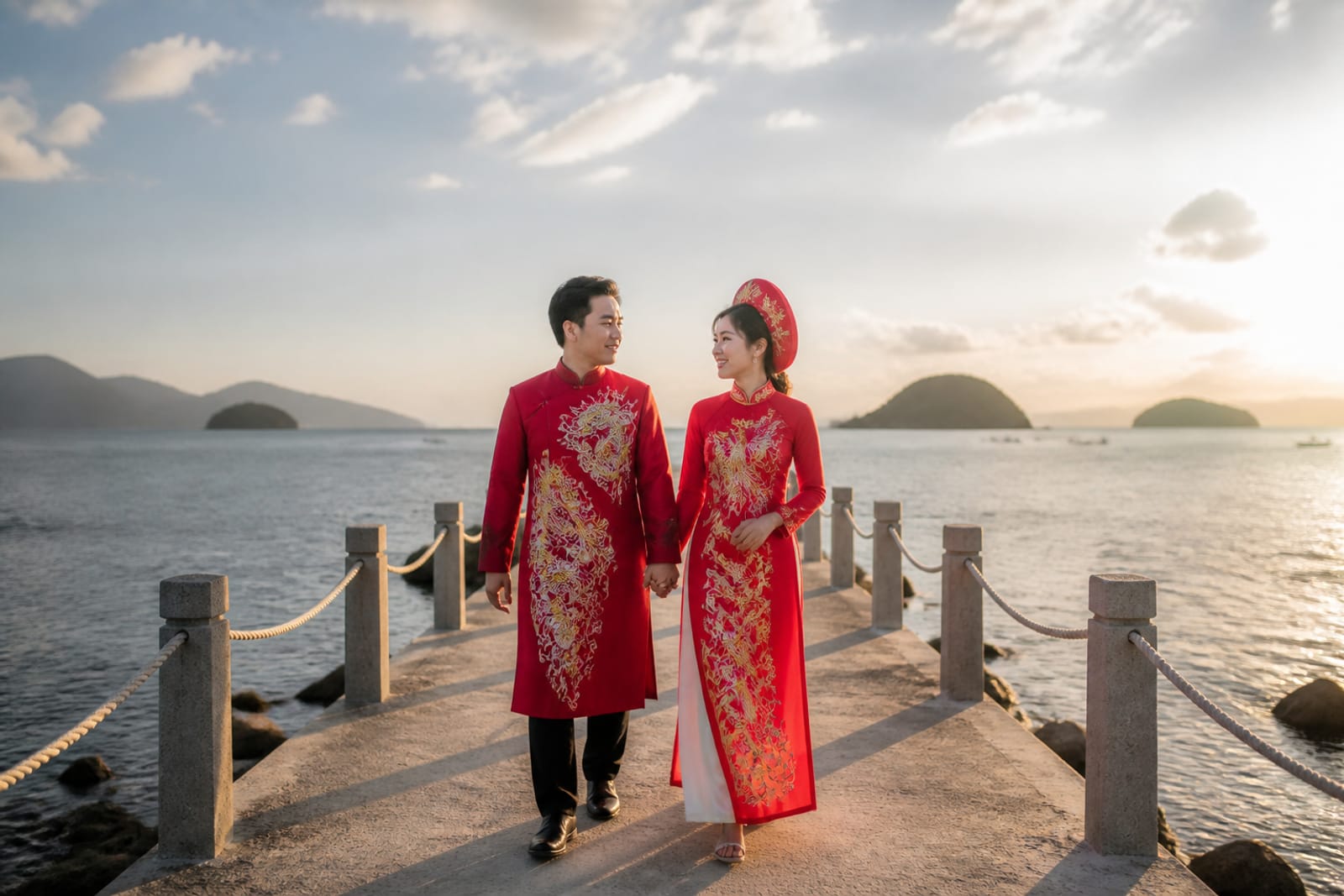
Diep Son sandbar sits off the Nha Trang coast and emerges fully at low tide, creating a three-hour window for ao dai shots before water returns. Best season is Jan–Aug (dry, calm seas); avoid Oct–Nov (typhoons, rough water). Shoot between 6–8 am for soft side light and empty sand, or 4–5 pm if morning is cloudy. Cáo Studio does not operate at Diep Son, but we shoot ao dai in Hanoi, Ho Chi Minh City and Hoi An. If you're in Nha Trang, hire a local photographer familiar with tides and check the tide calendar before booking—sandbar sessions fail without it. Outfit choice matters: traditional ao dai works, but consider a lighter silk for humidity and sand mobility. ---
Why tides matter more than you think
Low tide at Diep Son creates sand banks visible only 2–3 hours per day. Arriving at high tide means shallow, murky water—no sandbar. Check the tide calendar for your date before booking any photographer. Morning low tide (typically 6–9 am, varies by date) pairs with softer light; afternoon low tides shift later and light becomes harder. Most couples aim for dawn, but if weather is grey, afternoon tides let you shoot in clearer sky. A local photographer who knows Diep Son's specific tidal patterns will confirm the exact window before your session.
Season and weather: when the sandbar is actually usable
| Aspect | Jan–Aug | Sep–Dec |
|---|---|---|
| Sea state | Calm, predictable tides | Typhoon swells, rough water, unpredictable tides |
| Light | Bright, direct; harsh midday | Grey, diffused; fewer clear hours |
| Crowd | Moderate mornings; peaks after 9 am | Fewer tourists; fewer boats to avoid |
| Outfit comfort | Hot, silk ao dai works; sun protection needed | Cooler mornings; wind risk for hair/fabric |
| Best for shooting | Early morning (6–8 am) for soft light and solitude | Late afternoon if morning is overcast; less reliable |
Jan–Aug is the dry season for Nha Trang. Sea is calm, tides are predictable, and you get consistent early light. Sep–Dec is the rainy, typhoon season: rough seas can cover the sandbar entirely, and grey skies shorten the shooting window. Plan Jan–Aug if possible.
Light direction and framing at sandbar
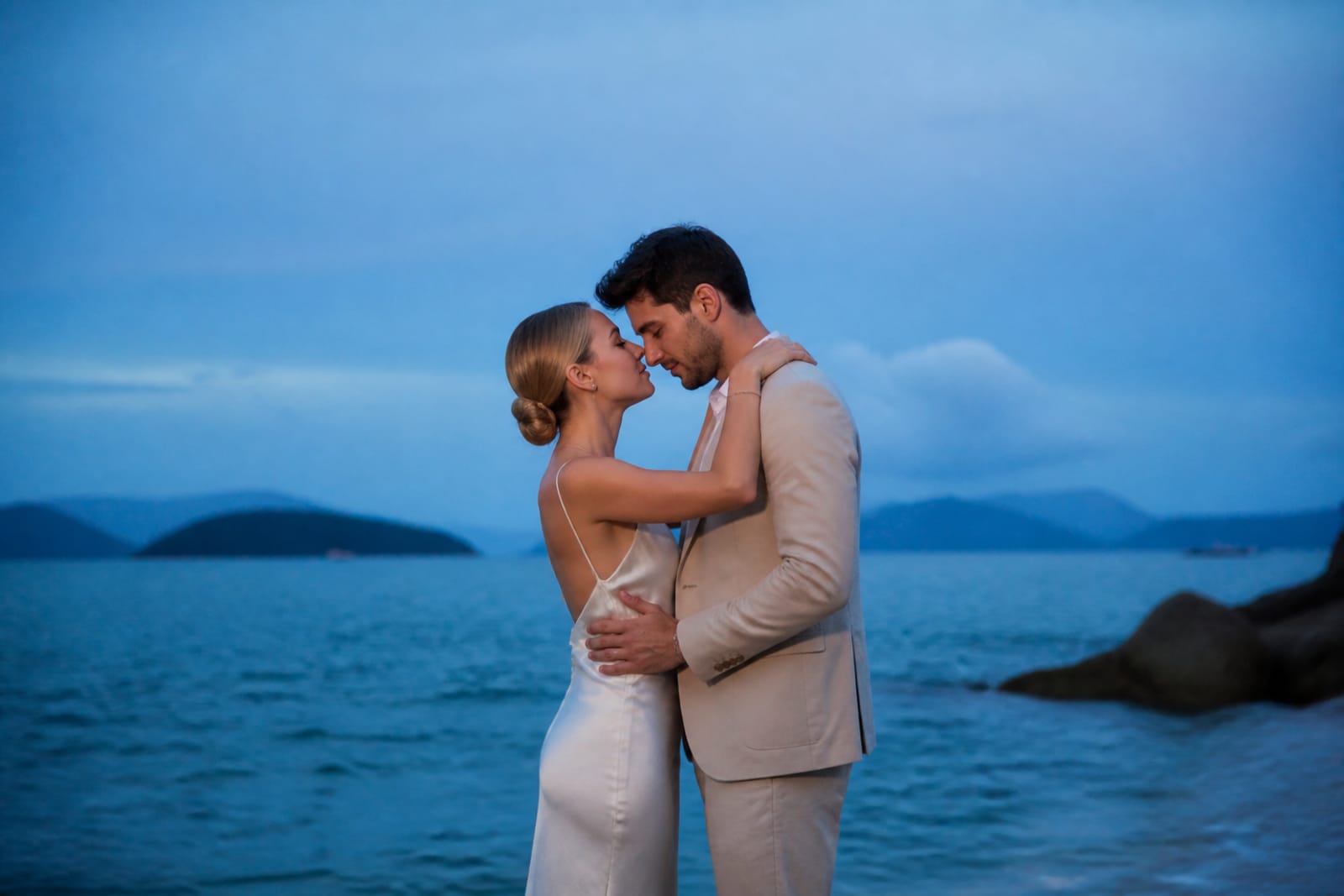
Morning shoots (6–8 am) place the sun low to your east or southeast, creating soft side light and long shadows on sand—ideal for silhouettes and textured frames. By 9 am, light hardens and crowds arrive. Afternoon shoots (4–5 pm) reverse the angle: sun is to the west, back-lighting tidal pools and ao dai fabric. Neither is "wrong," but morning light is gentler on skin and ao dai colors. A director who knows the location will choose wide shots of the sandbar first (letting water and horizon frame the couple), then move to medium and detail frames as light shifts. Avoid shooting straight into the sun (bleached fabric) or shooting when sun is overhead (noon–1 pm)—no sandbar work happens then anyway because tide is high.
📸 Book on WhatsApp — ao dai photoshoot
Logistics: getting to the sandbar and staying there safely
Diep Son lies about 45 minutes by boat from Nha Trang's harbor; you'll need a local boat operator or tour guide who can transport the couple, photographer and makeup artist. Not all photographers arrange boats—many expect you to book separately, which creates coordination risk. Outgoing tide is fastest mid-morning (6–9 am), meaning water recedes quickly and sand firms up. Incoming tide (around 10–11 am depending on date) can strand people if timing isn't strict. Wear water shoes or sandals (heels sink; ao dai hem dragging is a risk). Bring a makeup kit for touch-ups and a light cover-up or robe for the boat ride. A unified team (photographer, makeup artist, stylist) handles wardrobe and appearance in situ, so you're not juggling multiple vendors on a sandbar.
Comparing ao dai shoots: sandbar vs. other Nha Trang options
| Location | Light quality | Tide/access | Outfit fit | Crowd level | Best for |
|---|---|---|---|---|---|
| Diep Son sandbar | Soft morning, hard afternoon | Tide-dependent; boat required; 2–3 hr window | Ao dai works; hem & sleeves sink in water | Very low before 9 am | Drama, water, isolation |
| Nha Trang beach town | Bright, direct; harsh midday | Always accessible; all day | Ao dai ideal; no water hazard | High; vendors, swimmers | Classic, accessible, quick |
| Tram Huong lake | Soft, reflected in water | Year-round; no tides | Ao dai ideal; calm water for reflection | Moderate | Peaceful, reflection frames |
| Vinpearl cable car or mountain top | Sky-facing, variable | Always open | Ao dai ideal; wind risk | Moderate; queues by 9 am | Elevated, scale, sunset |
Diep Son wins for drama and isolation but demands tide coordination. Beach shoots are quick and accessible but crowded. Lakes offer calm reflection. Mountains give scale. Choose based on aesthetic priority, not just Instagram appeal—crowds kill directed, cinematic frames.
What to check before booking a photographer for Diep Son
Tide knowledge: Ask if the photographer knows Diep Son's specific tide tables and can confirm the low-tide window for your date. A "no" is a red flag.
Boat arrangement: Who books the boat? Is it included in the quote, or do you arrange separately? Miscommunication here causes delays or missed light.
Weather backup: What happens if morning is grey or seas are rough? A good photographer has a secondary location (beach, town, lake) and repacks shoots the same day or reschedules—not cancels.
Makeup & hair on-site: Can the artist work on a boat or sandbar, or do you need to be camera-ready before boarding? Sandbar humidity and salt air degrade makeup; plan for touch-ups.
Outfit care: Ao dai fabric in salt water requires rinsing same-day. Who handles this, or do you own the outfit? Rentals may have restrictions.
Delivery time: Ask when edited photos arrive. 48 hours is standard; Cáo Studio delivers directed ao dai shoots edited in 48 hours, but local Nha Trang photographers vary.
---
Outfit and styling at the sandbar
Traditional ao dai is the natural choice, but the sandbar environment demands practical tweaks. A lighter silk or cotton blend keeps you cooler during the boat ride and heat of early morning. Undergarments should be minimal (bra or bandeau); moisture and sand cling to heavy layers. Avoid loose, long sleeves that drag in shallow water—fitted or three-quarter sleeves work better. Hair should be in a high bun or braid; salt spray and sand will tangle loose strands by mid-morning. Makeup should be waterproof (spray setting, waterproof mascara, lip stain). Jewelry should be minimal and secure—earrings can catch on fabric, necklaces risk slipping into sand. Bring a light robe or kimono for the boat ride and between outfit changes. A makeup artist on your team (as in Cáo Studio's makeup and hair service) reapplies blush and lip color after the ride, ensuring skin looks fresh in the first frames.
Season-by-season guide to booking your Diep Son shoot
Jan–Mar: Peak dry season. Seas are calmest, light is clearest, and tides are reliable. Mornings are warm but not oppressive. Book early—this is the busiest window.
Apr–Aug: Hot, dry, calm. Light remains clear, but midday heat is intense. Early shoots (6–7 am) are best; afternoon light is harsh. Humidity rises toward August.
Sep–Dec: Avoid if possible. Sep–early Oct can work if seas are calm, but Oct–Nov bring typhoon risk and rough water that obscures the sandbar. Late Nov–Dec is slightly better, but tide prediction becomes difficult.
Pair your shoot with Cáo Studio's pre-wedding or elopement package if you're in Vietnam for a wedding tour—we'll handle ao dai sessions in Hanoi, Saigon or Hoi An, and you arrange Nha Trang locally with a tidal expert.
---
Why a unified team outperforms multiple vendors on sandbar shoots
A sandbar is chaotic: tides wait for no one, salt air damages gear, and moving between boat, sand and water in an ao dai requires coordination. If your photographer, makeup artist and stylist are separate vendors, someone always feels responsible for the other, and decisions slow down. A unified team (one booking, one contact, shared vision) moves together, adapts light-to-light, and solves problems on the fly. Cáo Studio works as one team because we believe one message (outfit, hair, makeup, camera) shoots better than three vendors stitched together. For Nha Trang/Diep Son, find a local photographer who works regularly with a makeup artist and stylist—ask if they've shot sandbar together before, not separately.
---
FAQ
Can we shoot ao dai at Diep Son in the afternoon?
Yes, but morning (6–8 am) has softer light and empty sand. Afternoon works if morning is grey—light is back-lit (beautiful for fabric texture) but harsher. Check tide times; low tide may be 4–5 pm on your date, cutting your window short as dusk approaches.
Do we need to own the ao dai, or can we rent?
Either works, but rentals may have salt-water restrictions. Confirm with your rental shop before booking. If you own the ao dai, rinse it in fresh water same-day to prevent salt staining—ask your photographer or makeup artist to remind you.
How long does a sandbar shoot take?
Typically 2–3 hours total: 30 min boat ride, 2 hours on sand (one outfit or quick change), 30 min return. Plan for early wake-up (5–5:30 am departure) to catch the 6–8 am light window.
What if the tide is wrong on our booked date?
Tides shift 45 minutes per day, so a date that's low-tide-at-dawn one week might be low-tide-at-9am the next. A photographer who knows Diep Son checks tide tables as part of booking confirmation and may suggest a date shift. Always confirm the exact low-tide window before paying.
Does Cáo Studio shoot at Diep Son?
No—Cáo Studio operates in Hanoi, Ho Chi Minh City and Hoi An. For Diep Son (Nha Trang), hire a local photographer experienced with tides and sandbar logistics. We're happy to discuss ao dai shoots elsewhere; contact us on WhatsApp +84 338 762 340 for other options.
What's the best month to book a Diep Son shoot?
Jan–Aug, with Jan–Mar as peak (calmest seas, clearest light). Apr–Aug is hot but usable; Sep–Dec brings typhoons and unpredictable tides. Avoid Oct–Nov entirely.
FAQ
Can we shoot ao dai at Diep Son in the afternoon?
Yes, but morning (6–8 am) has softer light and empty sand. Afternoon works if morning is grey—light is back-lit (beautiful for fabric texture) but harsher. Check tide times; low tide may be 4–5 pm on your date, cutting your window short as dusk approaches.
Do we need to own the ao dai, or can we rent?
Either works, but rentals may have salt-water restrictions. Confirm with your rental shop before booking. If you own the ao dai, rinse it in fresh water same-day to prevent salt staining—ask your photographer or makeup artist to remind you.
How long does a sandbar shoot take?
Typically 2–3 hours total: 30 min boat ride, 2 hours on sand (one outfit or quick change), 30 min return. Plan for early wake-up (5–5:30 am departure) to catch the 6–8 am light window.
What if the tide is wrong on our booked date?
Tides shift 45 minutes per day, so a date that's low-tide-at-dawn one week might be low-tide-at-9am the next. A photographer who knows Diep Son checks tide tables as part of booking confirmation and may suggest a date shift. Always confirm the exact low-tide window before paying.
Does Cáo Studio shoot at Diep Son?
No—Cáo Studio operates in Hanoi, Ho Chi Minh City and Hoi An. For Diep Son (Nha Trang), hire a local photographer experienced with tides and sandbar logistics. We're happy to discuss ao dai shoots elsewhere; contact us on WhatsApp +84 338 762 340 for other options.
What's the best month to book a Diep Son shoot?
Jan–Aug, with Jan–Mar as peak (calmest seas, clearest light). Apr–Aug is hot but usable; Sep–Dec brings typhoons and unpredictable tides. Avoid Oct–Nov entirely.
Ao dai, makeup, hair and a local photographer in Hanoi or Saigon — one WhatsApp message.