/ao-dai-photoshoot
Ao Dai Wedding Photos at Khau Pha Pass: Light, Logistics & Booking
Khau Pha Pass near Ha Giang sits at 1,400+ metres with views across limestone ridges—ideal for ao dai shots when clouds break in early morning (around 6–7 am, May–Sep). The pass is a 5+ hour drive from Hanoi; weather shifts fast, roads are narrow, and you'll need permits for some routes. Cáo Studio does not operate in Ha Giang, but this guide covers logistics, light timing, outfit fit at altitude, and how to find and vet a local photographer. The real work is coordination: team transport, ao dai fit over layers, makeup touch-ups in a car, and scouting the exact light window before sunrise. Most couples book 2–4 hours on-site; expect wind, temperature swings, and one outfit change maximum. 📸 Book on WhatsApp — ao dai photoshoot | 🌸 See the lookbook | 💄 Makeup & hair at your hotel ---
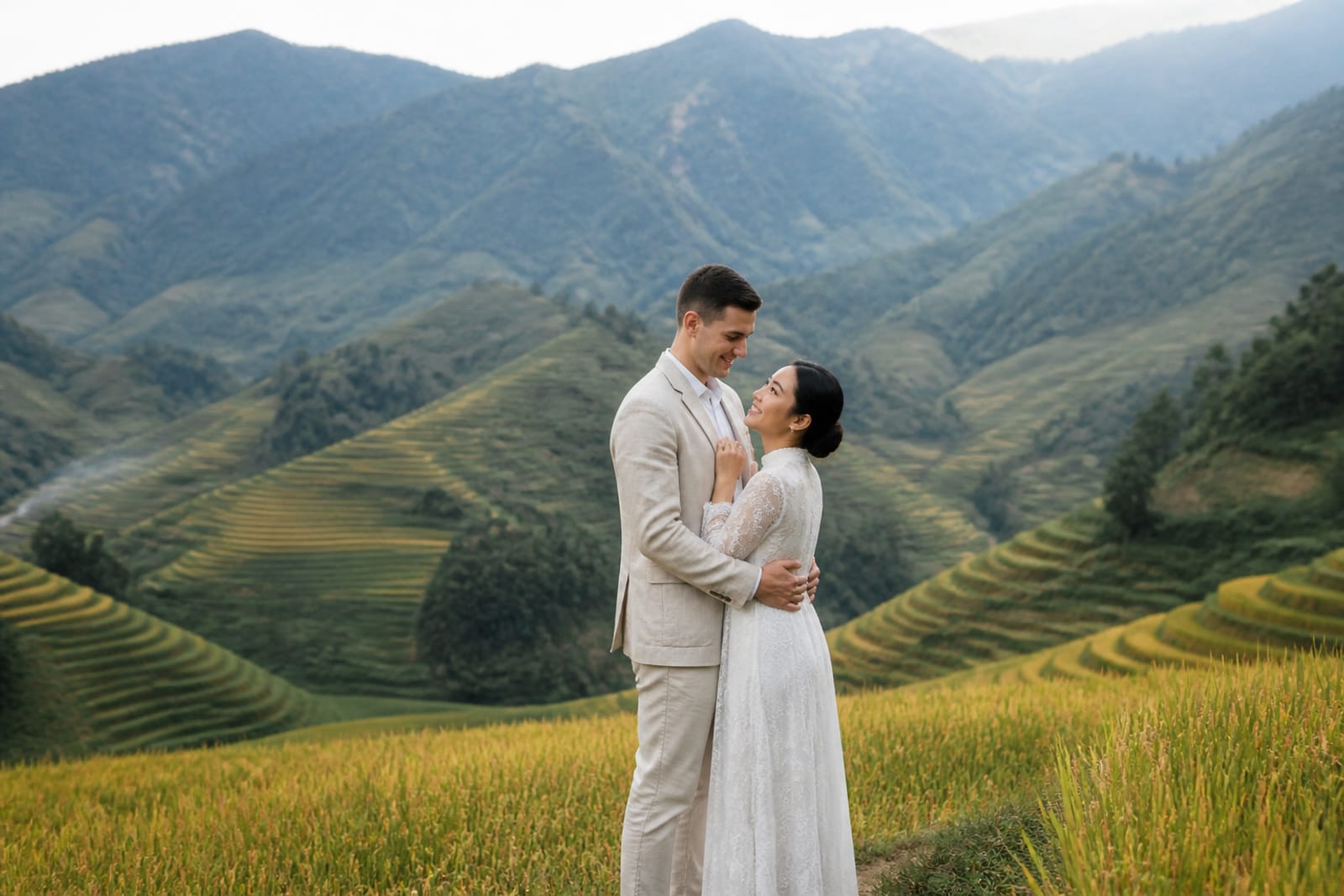
Why is Khau Pha Pass different from valley shoots?
Khau Pha's value lies in isolation and elevation light. Unlike Hanoi's temples or Hoi An's lantern-lit streets, the pass offers unobstructed sky, ridgeline shadow play, and cloud mood in the same frame. The trade-off is logistical: no cafés, no backup shelter, no second location if light fails. The pass works for ao dai because the silhouette reads against sky and ridge. But weather—fog, rain, wind—kills the shoot 3 days out of 10 during the dry season. Success hinges on scouting the exact dawn window 24 hours before and having a fallback plan (Thac Bac waterfall or another pass site 30 minutes away). Couples who book Khau Pha accept the gamble for the reward: frames that look nowhere else in Vietnam.
What time and season actually deliver the light you need?
Sunrise at Khau Pha works only May–September, when skies clear early and you have 30–45 minutes of side-light before clouds thicken. Arrive 5:00–5:30 am; shoot from 5:50–7:00 am. October–April brings fog that lifts by 9 am (too late and too harsh), or doesn't lift at all. Late afternoon (4:00–5:30 pm) works in dry months if clouds break, but planning a sunset at 1,400 m is risky—wind gusts, temperature drop, and your makeup crew is shivering. May and early June offer the most stable windows; by August, afternoon heat builds, and afternoon light flattens. Mid-September (after the worst rain) through early October shows golden ridgeline light in late afternoon, but you'll need a second team to do hair and makeup 2+ hours before dawn. Check local weather and road conditions 72 hours before; if fog is forecast, reschedule to the next clear dawn or pivot to a lower-altitude site.
| Season | Best for | Light & Weather | Fit & Comfort |
|---|---|---|---|
| May–Jun | Ao dai at dawn | Clear early light, 5–15 min window; stable skies; cool 12–14 °C | Lightweight ao dai; layers under, high humidity |
| Jul–Aug | Risk-taking couples | Hotter (16–18 °C), afternoon unstable; sunrise still works but clouds form by 7 am | Heavier ao dai risky; silk clings in sweat |
| Sep–early Oct | Golden ridgeline shoots | Sunset/golden hour works; afternoon clouds break; 15–25 °C | Standard ao dai; wind gusts—pin hems, secure flowers |
| Oct–Apr | Not recommended | Fog until 9 am+, or all day; cold rain; roads slippery | Layers needed; ao dai fabric weighs wet; light harsh or absent |
📸 Book on WhatsApp — ao dai photoshoot
How do you fit an ao dai for high-altitude wind and movement?
An ao dai at 1,400 m faces wind that doesn't exist in the Red River Delta. The solution is fit, not design change. Your seamstress (or the photographer's team) must build the ao dai with a fitted bodice and a hem that sits 1–2 cm shorter than ankle—not for aesthetics, but so you can walk uphill without tripping. The áo (tunic) should be snug enough that wind doesn't billow it vertically; loose panels still flow for frames, but they won't tangle around your legs. Wear fitted leggings or a slip underneath—the pass can be 12–15 °C even in June, and silk clings to bare skin in sweat and wind. A light cardigan or shawl is not ao dai, so skip it; instead, choose a heavier silk (double-weave) or a cotton-silk blend that doesn't chill you when wet from morning dew. Shoes are non-negotiable: flat sandals or soft ballet flats grip stone and dirt paths better than heels. If you're a Western wearer unfamiliar with the garment, practice walking, crouching, and turning 3 days before the shoot. A photographer or makeup artist who's worked ao dai at altitude will adjust the fit on-site—tuck hems, secure the top, check the shoulder seam—in the 20 minutes before light hits.
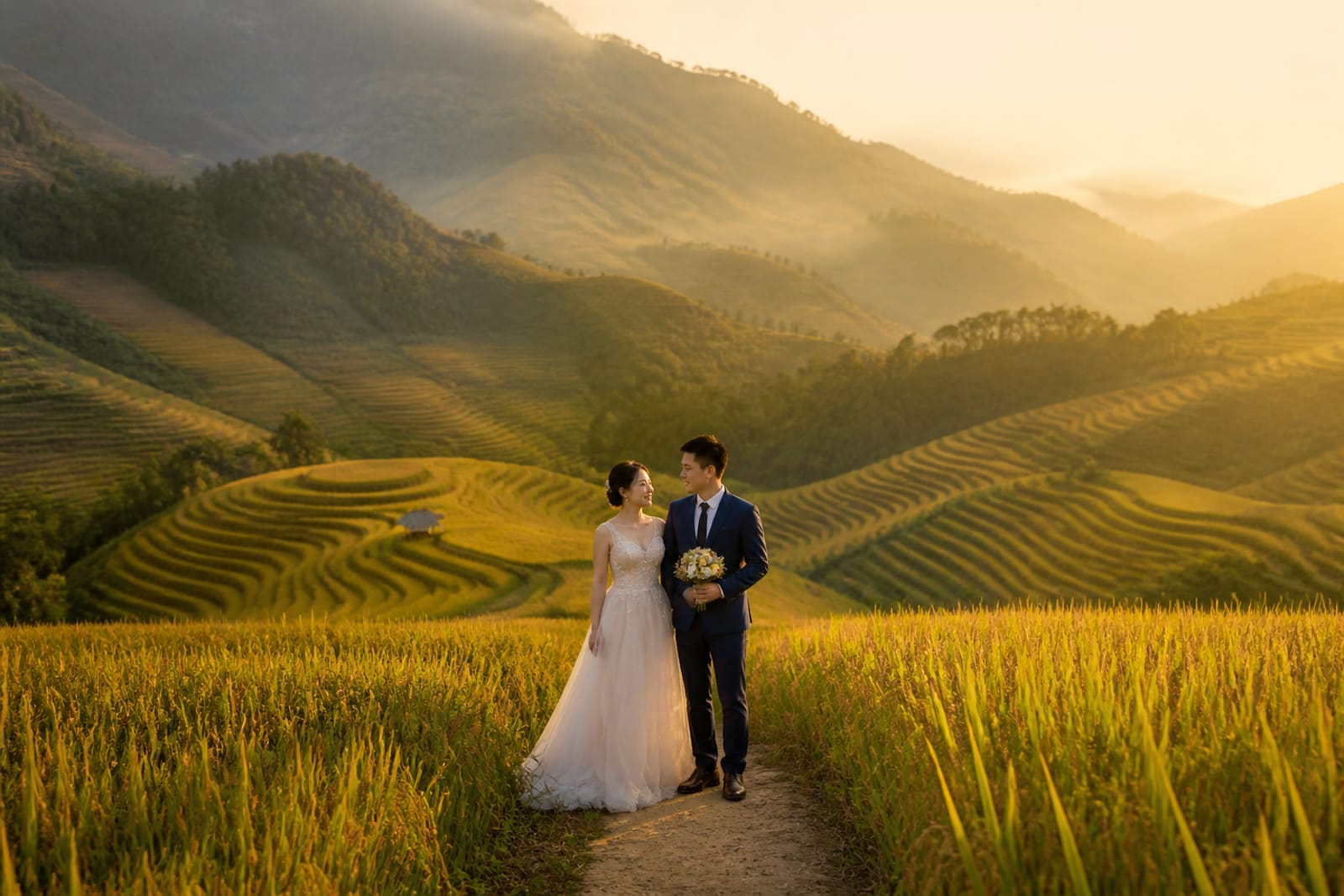
What does the team need to coordinate before sunrise?
A Khau Pha shoot requires 4–5 people: you, your partner (if a couple), a photographer, hair and makeup artist, and a driver/spotter. The entire crew must leave accommodation by 3:00 am to reach the pass by 5:00–5:30 am. En route, the makeup artist works in the car or at a pull-off with a compact mirror and natural light. Hair pins, clips, and flowers are secured 15 minutes before sunrise; makeup touch-ups happen post-shoot, after light fades. Logistics matter: identify a quiet spot near the roadside (not blocking traffic) where two people can stand for framing without slipping. Scout this spot the afternoon before, or ask locals at your hotel which Khau Pha viewpoint draws the least morning foot traffic. A permit may be required for commercial shooting in Ha Giang province—check with your photographer or local tourism office 7–10 days before the date. Backup plans are mandatory: if fog doesn't clear by 6:45 am, pivot to Thac Bac (silver waterfall, 30 min away) or reschedule. Discuss pivot sites with your photographer before the day arrives so decisions are quick and calm.
💄 Makeup & hair at your hotel | 🌸 See the lookbook
How do you choose between Khau Pha, a local photographer, and an elopement package?
Three paths exist: (1) hire a local Ha Giang photographer who knows the pass and permits; (2) book Cáo Studio for an ao dai shoot in Hanoi or Hoi An and visit Khau Pha on your own with a phone camera; (3) commission a travel photographer from Ho Chi Minh City or Hanoi to travel to Ha Giang (costly, long logistics). For path 1—local photographer—ask your hotel or local tourism board for referrals. Vet by portfolio: ask specifically for ao dai shoots, dawn mountain work, and post-processing style (overly filtered vs. natural). Request a quote that includes travel time, parking, permits, and delivery schedule. For path 2—self-guided—accept that smartphone shots won't match a director's eye for light and framing; it's authentic and free, but your ao dai and the pass deserve better. Path 3 suits couples who want Cáo Studio's one-team approach (photographer, hair, makeup, outfit rental coordinated) but will travel 8+ hours each way—this is feasible for pre-wedding shoots planned 2+ months ahead, but Ha Giang adds logistical risk (weather, roads, permits) that Hanoi or Hoi An shoots don't carry.
| Option | Best for | Cost factors | Trade-off |
|---|---|---|---|
| Local Ha Giang photographer | Budget-conscious, value local knowledge | Travel distance (your hotel to pass), 1 outfit, 2–3 hours | Unknown post-processing style, portfolio varies widely |
| Self-guided + phone | Adventurers, backup shots, free | Negligible (you're already traveling) | No professional framing, no makeup team, harsh light if timing is off |
| Cáo Studio travel to Ha Giang | Couples who want one team + full styling | Multi-day trip (Hanoi–Ha Giang–Hanoi), 2–4 outfits, hair/makeup onsite | Long travel time, weather risk, minimum booking value high |
| Cáo Studio in Hanoi + day trip | Couples wanting studio quality without Ha Giang logistics | Hanoi shoot only (same team, controlled light, fallback sites) | Khau Pha is skipped; you visit on your own or accept city/Delta landscape instead |
The honest choice: Cáo Studio does not operate in Ha Giang. We coordinate shoots in Hanoi, Ho Chi Minh City, and Hoi An. If Khau Pha Pass is non-negotiable, hire a vetted local photographer 4–6 weeks ahead. If you value Cáo Studio's direction and one-team fit, book an ao dai photoshoot in Hanoi—nearby sites like Thac Bac or the Red River offer dramatic water and light within 1–2 hours' drive, with full support for makeup, outfit rental, and next-day delivery of edited frames.
📸 Book on WhatsApp — ao dai photoshoot
---
What to check before you book a photographer for Khau Pha
- Portfolio: ask for 5+ ao dai shots on mountains or at dawn; check for consistent exposure (not blown-out skies or shadow faces).
- Permits: confirm they'll handle provincial permits and parking; clarify if you're responsible for entry tickets or fees.
- Fallback plan: have a named second location in writing (not "we'll figure it out"); ask how they'll pivot if fog doesn't clear.
- Delivery timeline: when do you receive edited photos? 48 hours, 1 week, or longer? Verify they match your timeline.
- Crew size: will hair and makeup travel with the photographer, or will you hire separately? Confirm transport and coordination.
- Weather guarantee: what if rain or fog cancels? Is the booking refundable, rescheduleable, or a paid forfeit?
---
FAQ
Can you shoot ao dai at Khau Pha in winter or spring?
October–April brings fog and cool temperatures; light doesn't clear until 9 am or later, if at all. Ao dai fits become difficult when layered against cold. May–September is the only practical window for consistent dawn light and manageable conditions.
Does Cáo Studio shoot at Khau Pha Pass?
No, Cáo Studio operates in Hanoi, Ho Chi Minh City, and Hoi An. We don't have a team in Ha Giang province. Book a local photographer through your hotel or tourism board, or choose a nearby Hanoi ao dai shoot with fallback sites we know and control.
How far is Khau Pha from Hanoi and how early must we wake?
The pass is 300+ km and 5–6 hours north of Hanoi, depending on roads. Plan to leave your Hanoi hotel by 3:00 am to arrive by 5:30 am for a 6:00 am sunrise shoot. Overnight accommodation in Ha Giang town (Ha Giang City) shortens the drive to 1–1.5 hours.
What happens to ao dai fabric in mountain wind and dew?
Silk absorbs moisture and clings to skin; wind catches loose hems and panels, creating volume but tangling risk. Wear fitted leggings underneath, choose heavier silk or cotton-blend ao dai, and have the hemline fitted 1–2 cm shorter than usual so you can walk uphill safely. Your photographer's team should carry pins and clips for on-the-spot adjustments.
Do we need a permit to shoot at Khau Pha Pass?
Commercial photography in Ha Giang province may require a permit; regulations change by year and district. Your photographer (local or traveling) must check with Ha Giang's Department of Tourism 7–10 days before your date. Always confirm this in the booking contract to avoid day-of surprises.
What's the real difference between booking a local photographer and traveling with Cáo Studio's team?
A local photographer knows the pass, permits, and logistics—cost is lower and the risk of miscommunication is lower. Cáo Studio's advantage is one coordinated team (photographer, hair, makeup, outfit styling) with a consistent editorial eye; the trade-off is travel time and a higher minimum booking. For Khau Pha, a vetted local photographer is the practical choice.
FAQ
Can you shoot ao dai at Khau Pha in winter or spring?
October–April brings fog and cool temperatures; light doesn't clear until 9 am or later, if at all. Ao dai fits become difficult when layered against cold. May–September is the only practical window for consistent dawn light and manageable conditions.
Does Cáo Studio shoot at Khau Pha Pass?
No, Cáo Studio operates in Hanoi, Ho Chi Minh City, and Hoi An. We don't have a team in Ha Giang province. Book a local photographer through your hotel or tourism board, or choose a nearby [Hanoi ao dai shoot](/ao-dai-photoshoot) with fallback sites we know and control.
How far is Khau Pha from Hanoi and how early must we wake?
The pass is 300+ km and 5–6 hours north of Hanoi, depending on roads. Plan to leave your Hanoi hotel by 3:00 am to arrive by 5:30 am for a 6:00 am sunrise shoot. Overnight accommodation in Ha Giang town (Ha Giang City) shortens the drive to 1–1.5 hours.
What happens to ao dai fabric in mountain wind and dew?
Silk absorbs moisture and clings to skin; wind catches loose hems and panels, creating volume but tangling risk. Wear fitted leggings underneath, choose heavier silk or cotton-blend ao dai, and have the hemline fitted 1–2 cm shorter than usual so you can walk uphill safely. Your photographer's team should carry pins and clips for on-the-spot adjustments.
Do we need a permit to shoot at Khau Pha Pass?
Commercial photography in Ha Giang province may require a permit; regulations change by year and district. Your photographer (local or traveling) must check with Ha Giang's Department of Tourism 7–10 days before your date. Always confirm this in the booking contract to avoid day-of surprises.
What's the real difference between booking a local photographer and traveling with Cáo Studio's team?
A local photographer knows the pass, permits, and logistics—cost is lower and the risk of miscommunication is lower. Cáo Studio's advantage is one coordinated team (photographer, hair, makeup, outfit styling) with a consistent editorial eye; the trade-off is travel time and a higher minimum booking. For Khau Pha, a vetted local photographer is the practical choice.
Ao dai, makeup, hair and a local photographer in Hanoi or Saigon — one WhatsApp message.