/ao-dai-photoshoot
Ao Dai Wedding Photos at Mui Ne Fishing Village: Light, Season & Booki
Mui Ne fishing village suits ao dai wedding photos best in November through March, when light is warm and consistent, wind sculpts the sand dunes, and weather is predictable. Sessions run 90–180 minutes depending on outfit changes and locations. Early morning (5:30–7:30 am) catches fishermen launching boats and soft side light; late afternoon (4–6 pm) gives golden overhead warmth on the sand. Cáo Studio operates from Hanoi and Ho Chi Minh City—ask on WhatsApp if a shoot in Mui Ne fits your dates, or book a local Mui Ne photographer using the vetting checklist below. Avoid May–October (afternoon downpours, typhoon risk, harsh midday glare). Budget extra time for tidal access and sand texture changes across the day. 📸 Book on WhatsApp — ao dai photoshoot | 💄 Makeup & hair at your hotel | 🌸 See the lookbook
Why is Mui Ne's fishing village so good for ao dai photos?
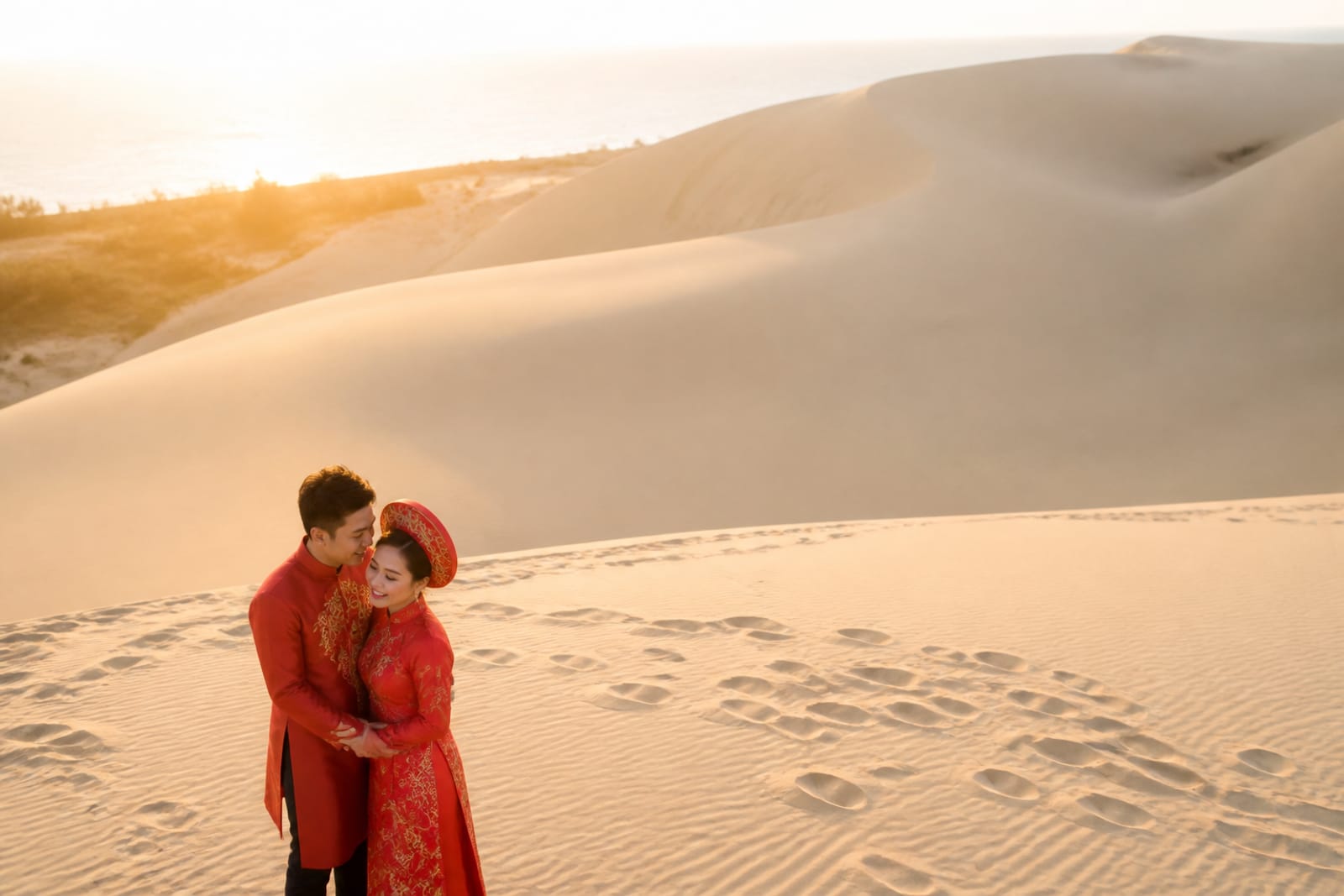
Mui Ne is one of Vietnam's driest regions and sits on exposed sand dunes and a working fishing port where wooden boats anchor in shallow water. The village has raw texture—weathered nets, pastel hulls, fishermen in motion—that contrasts sharply with a formal ao dai, creating visual depth without needing monuments. The sand itself shifts colour from pale grey at sunrise to apricot to deep gold as the sun moves, which no studio backdrop replicates. The key draw: you're not staged in front of scenery; you're embedded in an active working landscape. This works for wedding portraits, couple sessions, and pre-wedding photoshoots where the frame needs to feel lived-in, not polished.
The trade-off is logistics. Mui Ne is a 4–5 hour drive from Ho Chi Minh City; tide times control boat access; and the sand, while beautiful, is harsh on fabric and skin. Plan accordingly.
What season gives you the best light and safety?
| Season | Best for | Light & Wind | Why it works |
|---|---|---|---|
| Nov–Mar (dry) | Wedding & couple shoots | Consistent warm light 5:30–7 am & 4–6 pm; cool wind sculpts sand | Predictable weather, no rain risk, sand texture visible, comfortable for movement |
| Apr–May | Flexible timing, fewer crowds | Warming light, lighter winds, occasional afternoon haze | Transition; still reliable but heat rises after 10 am |
| Jun–Sep | Not recommended | Harsh glare 10 am–3 pm, afternoon downpours, humidity peaks | Rain halts shoots, wind flattens sand details, typhoon season Oct–Nov |
November through March is non-negotiable for wedding ao dai work. Dry season means no cancelled shoots; cool temperatures let you move without overheating in layers; and early-morning light is soft, low-angle side light that sculpts faces and fabric folds. Late afternoon gives warm overhead tones that flatter skin and make the ao dai's silk glow. Winds during this period (strongest Nov–Feb) actually benefit dune photography—they carve patterns and lift fabric naturally without you posing.
April–May is a practical middle ground if your wedding date is fixed outside Nov–Mar; rain risk is lower than Jun–Sep, but afternoon haze can soften detail. Avoid May–October entirely; afternoon thunderstorms roll in by 2 pm, typhoon season brings dangerous conditions, and midday sun creates harsh shadows that ao dai photography cannot escape.
Should you book Cáo Studio or hire a local Mui Ne photographer?
Cáo Studio operates from Hanoi and Ho Chi Minh City. For a Mui Ne shoot, contact us on WhatsApp +84 338 762 340 to confirm whether your dates, outfit needs, and vision align with a travel coordination to Mui Ne—travel time and logistics are cost factors we discuss directly. Our model is one team (photographer, hair, makeup, stylist) arriving together, which reduces coordination overhead and ensures your ao dai fits, your makeup holds in sand and wind, and your frames are directed, not assembled afterward.
If you prefer a local Mui Ne photographer, use this vetting checklist:
- Portfolio review: Look for three shoots in Mui Ne fishing village specifically (not generic beach portraits). Check whether faces are lit clearly in early morning or late-afternoon sessions, not washed out by midday glare.
- Tidal & logistics knowledge: Ask them to walk you through boat access times, sand conditions at your preferred hour, and wind direction forecasting. A real local knows that tide tables, not just sunrise times, shape your options.
- Outfit & hair coordination: Confirm they work with a makeup artist and stylist on set—sand and salt spray wreck hair and makeup, so touchups mid-session are essential. Single-vendor shoots often mean compromises.
- Post-production timeline: Ask how many edited frames you receive, when delivery happens, and whether edits account for sand texture and salt-spray haze (common in Mui Ne).
- Backup plan for wind: Strong November–March winds can flip an ao dai or tangle your hair. Ask whether they reschedule, shoot in sheltered spots, or adapt framing. Good photographers plan for this; others hope it doesn't happen.
Hiring locally costs fewer factors (no travel), but you absorb coordination risk. Booking Cáo Studio guarantees one team with shared vision; we handle weather pivots and fabric care as a unit.
📸 Book on WhatsApp — ao dai photoshoot
What do you wear under an ao dai, and how does Mui Ne's environment affect it?
An ao dai sits over loose silk or cotton pants (called quần), usually in white or matching colour. In Mui Ne, your undergarments matter because sand and salt water will reach them: wear smooth, breathable layers (avoid heavy cotton that dries slowly), and bring a spare pair of pants in your crew vehicle. Your footwear choices are:
- Bare feet (most common): Direct sand contact feels authentic and photographs beautifully, but watch for sharp shells and rocks. Sand between toes is immediate and real—embrace it or rinse in the vehicle between setups.
- White traditional slippers or embroidered shoes: Lighter than Western heels, photograph well, and protect your feet. Sand still clings; accept that as part of the aesthetic.
- Flat sandals or minimal shoes: Practical, but create visual clutter below the frame line. Photographers often shoot tighter (medium/close) to avoid showing casual footwear.
Never wear heels in sand—they sink, they're exhausting, and they create an awkward silhouette on uneven terrain. Salt spray and wind dry fabric fast, but sand residue lingers. Bring a damp cloth and a dry towel; your crew should have these on hand. If you're changing outfits (e.g., ao dai + Western dress for a couple shoot), pack each change in a sealed bag and change in a sheltered vehicle or tent, never on open sand.
For makeup and hair at your hotel before Mui Ne, request waterproof makeup (eyeliner especially) and a strong-hold setting spray. Mui Ne's salt-laden air and midday humidity challenge conventional makeup; professionals account for this. If Cáo Studio coordinates your shoot, this is confirmed on WhatsApp as part of the session brief.
How do you frame ao dai in an active fishing village without looking like a tourist snapshot?
The aesthetic difference between a wedding ao dai photo and a vacation snapshot is framing and direction. Here's the practitioner's distinction:
Tourist snapshot: Subject faces the camera in the centre of the frame, sun behind or to the side, boats blurred in the background, subject smiles on cue.
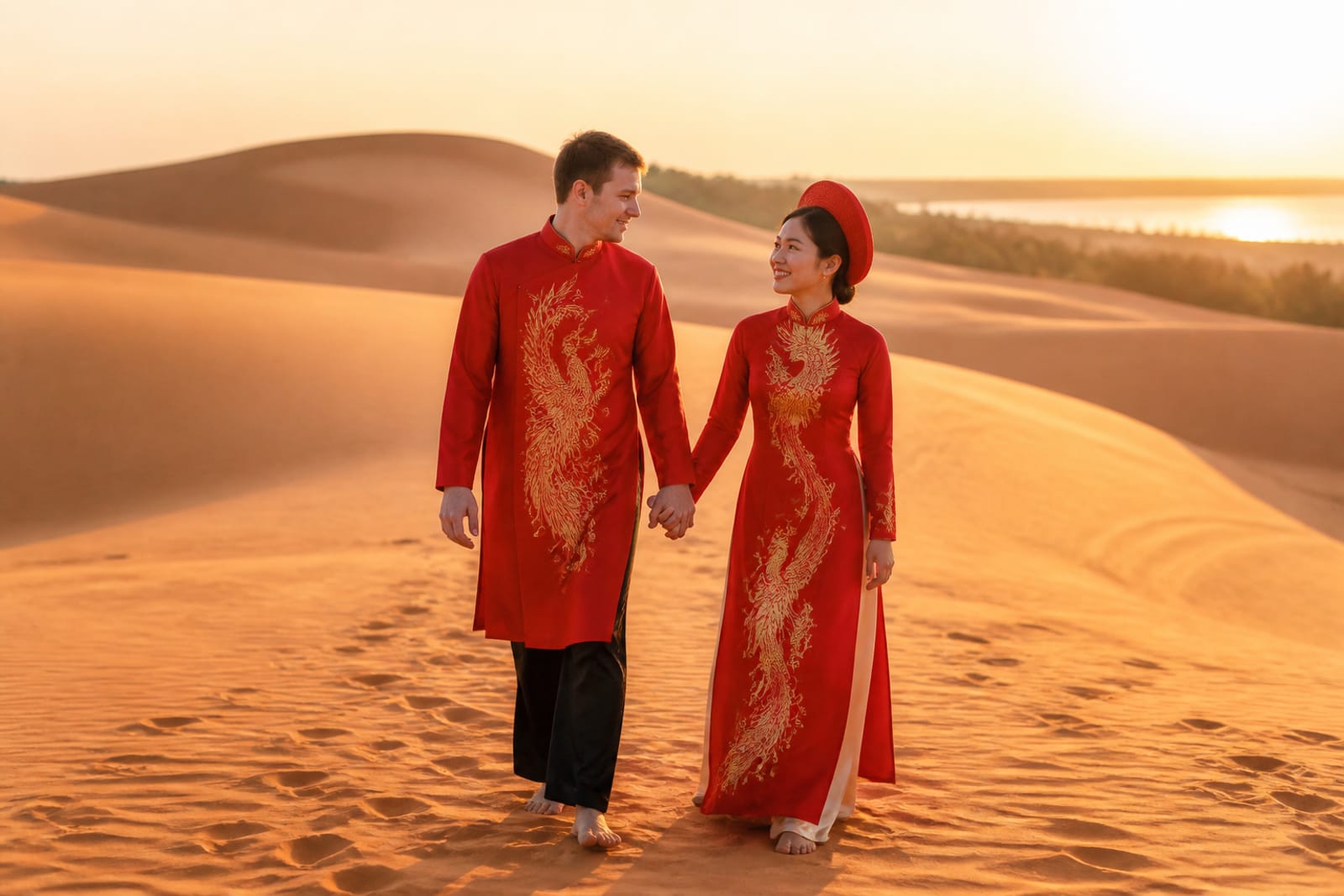
Directed frame: Subject walks through the frame, looking toward activity (boats, horizon, a partner), shot from an angle that places boats and nets in the mid-ground, light sculpts face and fabric as she moves.
The second approach requires the photographer to anticipate your movement, position themselves 15–20 metres away, and shoot as you walk naturally—not wait for a pose. For wedding ao dai work, this means:
- Shoot wide first: Establish the fishing village as a place, not a backdrop. Boats, nets, and horizon fill the frame; you walk into it or toward another person.
- Then medium: Tighter on face and upper body as you move or interact. This reveals the ao dai's silhouette and fabric detail against the village.
- Then detail: Hands, fabric folds, jewellery, the silk catching light—these close shots prove the ao dai is real, not a prop.
This sequence takes 30–40 minutes per location and requires your photographer to direct you ("walk toward the water, don't look at me, let the wind move your sleeves") rather than pose you. If a photographer says "stand here, face the camera, now smile," they're not directing; they're shooting portraits. Cáo Studio's method is direction: calm, specific, and built around real light and your actual movement, not manufactured poses.
Mui Ne's village works for this because the landscape is busy enough to absorb your presence. You're not the focal point; you're in the story. That's the frame worth keeping.
💄 Makeup & hair at your hotel | 🌸 See the lookbook
What should you check before booking a Mui Ne photoshoot?
Timeline & logistics: Confirm your photographer's travel arrangements. If they're based in Ho Chi Minh City, ask about their arrival time, vehicle, and backup plan if traffic delays them. Sunrise sessions require a 4 am departure from the city; late-afternoon sessions give more flexibility. Agree on a meeting spot and check-in time.
Outfit & accessories: Clarify whether the photographer (or crew) provides the ao dai or whether you bring your own. If you're renting, Mui Ne has minimal options—check ao dai rental with your chosen photographer or plan to hire from Ho Chi Minh City or Hanoi and transport it. Confirm that your ao dai fits and moves well before the shoot day; salt spray and sand will test every seam.
Weather contingency: Agree in writing what happens if afternoon clouds roll in or wind becomes unsafe (gusts above 30 km/h can whip sand into eyes and flip an ao dai). Does your photographer reschedule, pivot to a sheltered spot, or proceed as planned? Reasonable answers include "shift to later in the day" or "move to a nearby calmer location." Red flags: "We'll shoot whatever happens" or no contingency plan at all.
Delivery & edits: Ask for the number of edited photos you'll receive, the delivery date (standard is 5–10 business days), and whether edits account for sand texture and haze. In Mui Ne, salt spray and blown sand sometimes create a soft veil over the frame—your photographer should acknowledge this and decide whether to enhance clarity or embrace the atmospheric quality. Agree on the look you want.
Crew on set: Confirm who shows up: photographer only, or photographer + assistant + makeup artist. For an ao dai session, a makeup touchup person and a stylist assistant are worth their cost—sand and wind destroy makeup and fabric alignment. If you're hiring independently, this is a critical question.
Cost factors (not amounts—discussed on WhatsApp):
- Season (Nov–Mar is peak; Apr–May has slightly lower rates; Jun–Sep is not recommended).
- Travel time (Mui Ne to/from Ho Chi Minh City adds logistics; confirm what that cost depends on).
- Number of outfits (each ao dai change costs time and crew coordination).
- Edited file count (more photos = longer post-production).
- Crew size (photographer alone vs. photographer + hair/makeup + assistant).
Ask for a quote that itemizes these factors, not a single flat rate. A transparent photographer shows you what drives the cost.
---
Can Cáo Studio shoot an ao dai wedding in Mui Ne?
📸 Book on WhatsApp — ao dai photoshoot — contact us to discuss Mui Ne dates and logistics. We operate from Hanoi and Ho Chi Minh City; travel to Mui Ne requires coordination. Confirm your wedding date, outfit needs, and shot list on WhatsApp +84 338 762 340, and we'll quote you directly. For a full overview of our approach to wedding ao dai work, visit pre-wedding photoshoots or our lookbook.
---
FAQ
Is November–March the only time to shoot ao dai in Mui Ne?
Yes, for wedding work. Nov–Mar guarantees dry weather, predictable light, and safe wind. Apr–May is possible but carries afternoon rain and haze risk. Jun–Oct is not recommended—typhoon season, torrential afternoon downpours, and harsh glare make ao dai shoots unreliable and uncomfortable.
Do I need to hire a local makeup artist, or can I do my own?
Professional makeup is worth booking. Salt spray, sand, and sweat challenge DIY makeup; a makeup artist on set can touch up eyeliner, powder your face, and ensure your look lasts 90–180 minutes. If Cáo Studio coordinates your shoot, makeup is confirmed on WhatsApp as part of the package.
What happens if the wind is too strong on my shoot day?
A prepared photographer scouts a sheltered backup location (near dunes or village structures) or shifts your session time to late afternoon when winds often ease. Ask your photographer about this before booking. "We'll shoot anyway" is not a professional answer.
Can I wear a Western wedding dress in Mui Ne instead of an ao dai?
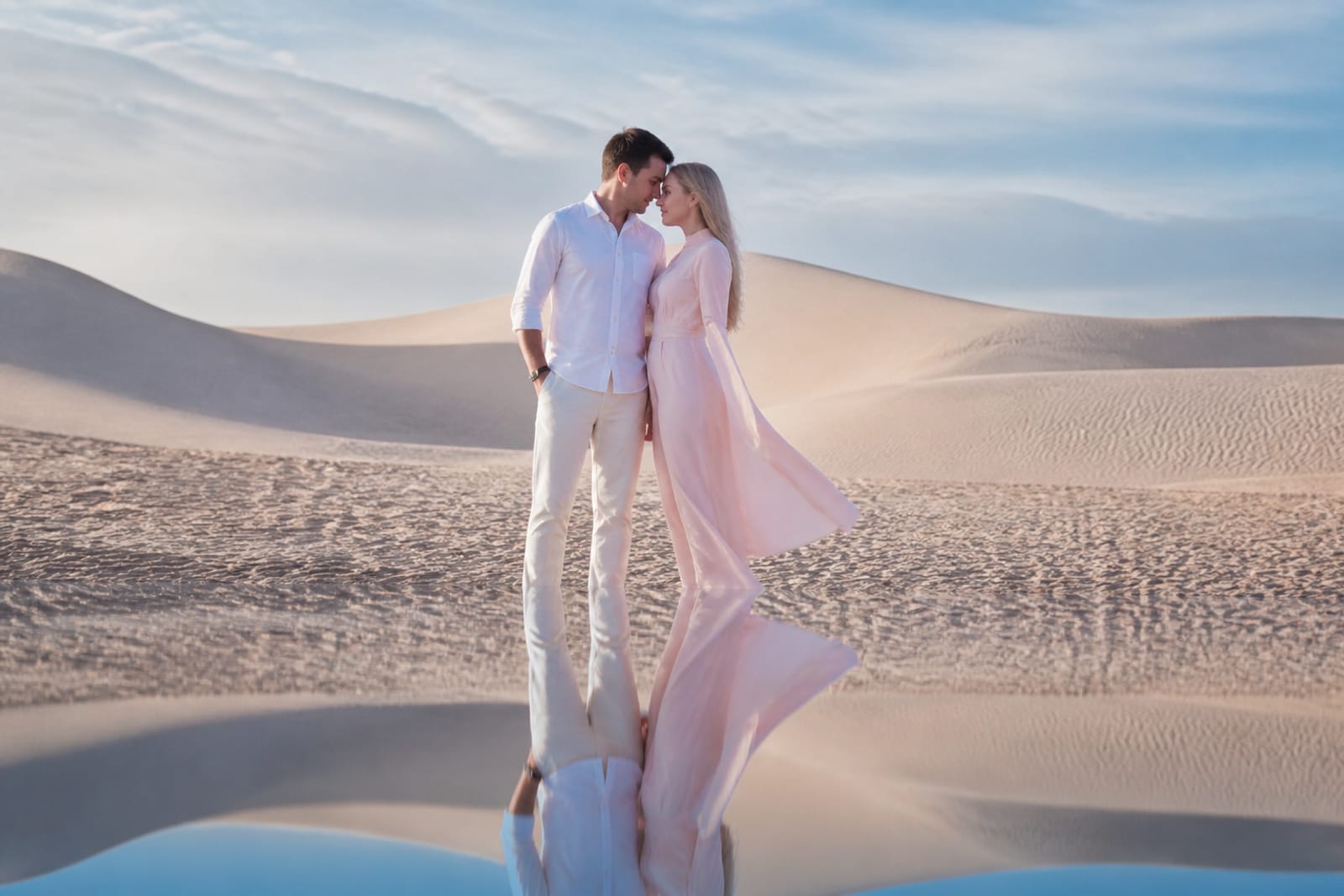
Yes, but Mui Ne's aesthetic (working boats, nets, sand) suits ao dai better. A Western dress works for couple portraits on open dunes, but sand clings to tulle and salt spray damages delicate lace. If you're set on a Western dress, keep the session to 60 minutes and plan careful fabric care (bring a dry garment bag).
How far in advance should I book a Mui Ne photoshoot?
For Nov–Mar (peak season), book 6–8 weeks ahead. Local Mui Ne photographers fill quickly during dry season. Cáo Studio's availability depends on travel coordination—confirm on WhatsApp as early as possible. Apr–May allows 4–6 weeks. Avoid last-minute bookings; photographers need time to plan logistics and crew travel.
Will my ao dai look wet or damaged after shooting in sand and sea spray?
Sand clings but brushes off; salt spray dries without staining if you rinse the ao dai within a few hours. Avoid submerging it or rolling in sand. Your photographer should guide you on movement (walk, don't sit in sand) to minimize contact. Pack the ao dai in a breathable garment bag immediately after the shoot and rinse it at your hotel.
FAQ
Is November–March the only time to shoot ao dai in Mui Ne?
Yes, for wedding work. Nov–Mar guarantees dry weather, predictable light, and safe wind. Apr–May is possible but carries afternoon rain and haze risk. Jun–Oct is not recommended—typhoon season, torrential afternoon downpours, and harsh glare make ao dai shoots unreliable and uncomfortable.
Do I need to hire a local makeup artist, or can I do my own?
Professional makeup is worth booking. Salt spray, sand, and sweat challenge DIY makeup; a makeup artist on set can touch up eyeliner, powder your face, and ensure your look lasts 90–180 minutes. If Cáo Studio coordinates your shoot, makeup is confirmed on WhatsApp as part of the package.
What happens if the wind is too strong on my shoot day?
A prepared photographer scouts a sheltered backup location (near dunes or village structures) or shifts your session time to late afternoon when winds often ease. Ask your photographer about this *before* booking. "We'll shoot anyway" is not a professional answer.
Can I wear a Western wedding dress in Mui Ne instead of an ao dai?
Yes, but Mui Ne's aesthetic (working boats, nets, sand) suits ao dai better. A Western dress works for couple portraits on open dunes, but sand clings to tulle and salt spray damages delicate lace. If you're set on a Western dress, keep the session to 60 minutes and plan careful fabric care (bring a dry garment bag).
How far in advance should I book a Mui Ne photoshoot?
For Nov–Mar (peak season), book 6–8 weeks ahead. Local Mui Ne photographers fill quickly during dry season. Cáo Studio's availability depends on travel coordination—confirm on WhatsApp as early as possible. Apr–May allows 4–6 weeks. Avoid last-minute bookings; photographers need time to plan logistics and crew travel.
Will my ao dai look wet or damaged after shooting in sand and sea spray?
Sand clings but brushes off; salt spray dries without staining if you rinse the ao dai within a few hours. Avoid submerging it or rolling in sand. Your photographer should guide you on movement (walk, don't sit in sand) to minimize contact. Pack the ao dai in a breathable garment bag immediately after the shoot and rinse it at your hotel.
Ao dai, makeup, hair and a local photographer in Hanoi or Saigon — one WhatsApp message.