/ao-dai-photoshoot
Ao dai wedding photos at Mui Ne white sand dunes
Ao dai wedding photos at Mui Ne work best at sunrise (5:30–6:30 am), when soft side light skims the sand and crowds are absent. The dunes lie in one of Vietnam's driest regions (dry season Nov–Apr, strong winds Nov–Mar); sand is firmest on cooler mornings. Cáo Studio does not operate in Mui Ne — it shoots in Hanoi, Ho Chi Minh City and Hoi An by appointment. For Mui Ne, you'll need a local photographer; this guide covers light windows, outfit fit, seasons and how to vet a Mui Ne photog before booking.
Mui Ne's sand dunes are unforgiving in the wrong hour. Most couples book midday and end up squinting into harsh glare, sweating through silk, sand blowing into makeup. The best ao dai dune shoots happen when almost no one else is awake.
Why sunrise at Mui Ne beats every other time of day
Sunrise (5:30–6:30 am) delivers directional light that defines the dunes without washout. The sand stays cool enough for bare feet; makeup holds; the ao dai flows instead of clinging. By 8 am, heat distorts the air and wind picks up. Midday shoots demand serious reflectors and touch-ups every ten frames; sunsets work if you're willing to shoot fast as light dies in five minutes.
The window is short and the drive non-negotiable. Most couples must leave their hotel by 4:45 am to reach the dunes, let the photographer scout framing, and shoot before tour buses arrive around 7 am. Plan transport the night before; hire a driver or ask your hotel concierge, never rely on finding a taxi in the dark.
What to wear under an ao dai on sand
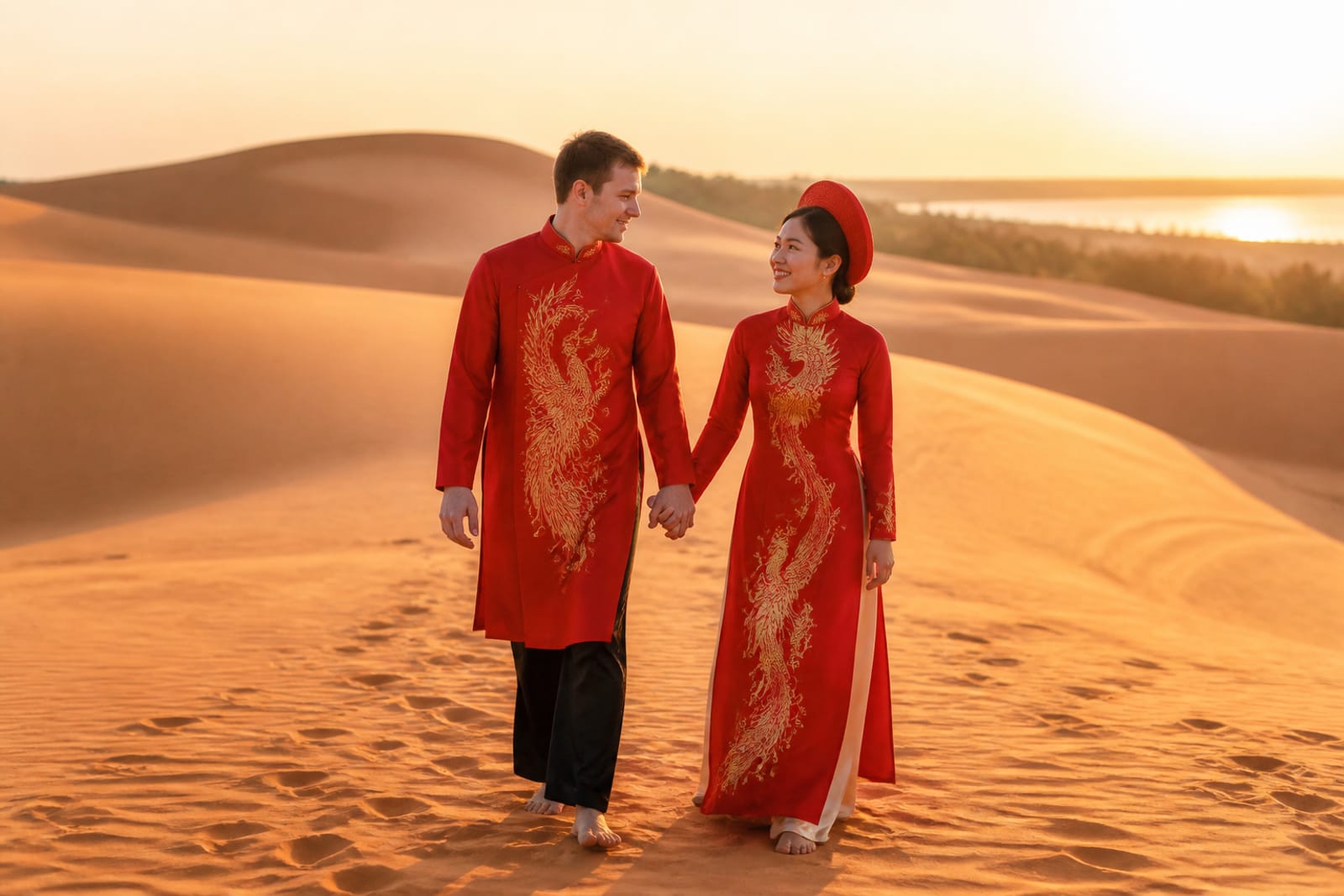
The ao dai's long tunic and wide legs tangle in sand and wind if not fitted right. Wear a bodysuit or slip under the tunic (not shorts — they show through the side slits). Let the tunic sit loose enough to move but snug enough not to twist. Avoid heavy embroidery that pulls the shoulders; lighter silk or linen hangs better and wrinkles less in the heat.
Feet matter as much as the dress. Sand is hot by 8 am; shoot barefoot only before sunrise, or bring sandals to step between frames. Some couples walk in the sandals and go barefoot for the actual shot — remove them last, after positioning. Sand sticks to damp feet and makeup; bring water and paper towels for cleanup between setups.
Hair and makeup must survive wind and salt air. Use hairspray designed for humid climates; avoid heavy crown pieces that catch gusts. Makeup should lean on long-wear formulas and a light hand with loose powder — sand particles lodge in thick makeup. Ask your makeup artist to work at your hotel before dawn and pack touch-up kits for the shoot.
Season and light: which months give you the best sand conditions
| Factor | Nov–Mar (dry, windy) | Apr–Oct (hot, humid) | Best for ao dai dunes |
|---|---|---|---|
| Sand firmness | Firm, walkable | Soft, footprints sink | Dry season (firmer) |
| Wind | Strong (Nov–Mar peak) | Light afternoon gusts | Early morning (any month) |
| Ground heat | Cool at dawn | Hot by 6 am | Nov–Feb (coolest) |
| Crowds | Moderate (tourists reduce offseason) | Peak (dry-season rush) | Dec–Jan just after Tet |
| Ao dai flow | Excellent (light winds before 7 am) | Limp, clinging by sunrise | Dry season (any sunrise) |
November to March is technically the dry season, but it's also peak tourism season. Expect more tour groups and vendors by 7 am. April to October is wetter and hotter; sunrise is earlier but the sand heats up faster and the ao dai clings. December and January offer the goldilocks window: dry, fewer crowds than Feb–Mar, and cool enough for comfort. Avoid September to November (rainy season with occasional typhoons; dunes flood and sand is sodden).
Makeup & hair timing: do it at your hotel before driving to the dunes
Makeup at the dunes is a losing battle. Sand, salt air, and touch-up delays mean half your frames lose definition by frame 30. Book a makeup artist at your hotel and finish by 5:00 am; travel with powder, lipstick and blotting papers in case of touch-ups after the drive. Cáo Studio offers hotel makeup & hair in Saigon and Hanoi — for Mui Ne, ask a local salon or your hotel concierge for a makeup artist who has worked with photographers before.
Hair should be set to survive wind, not pin curls that fall by sunrise. Loose waves pinned with bobby pins work better than braids that tangle. If you're wearing a hairpiece or crown, secure it with clips and hairspray the night before and do a walk-around test in your room. Wind at the dunes is real; a crown that feels stable at 5 am might shift on film.
How to find and vet a Mui Ne photographer before booking
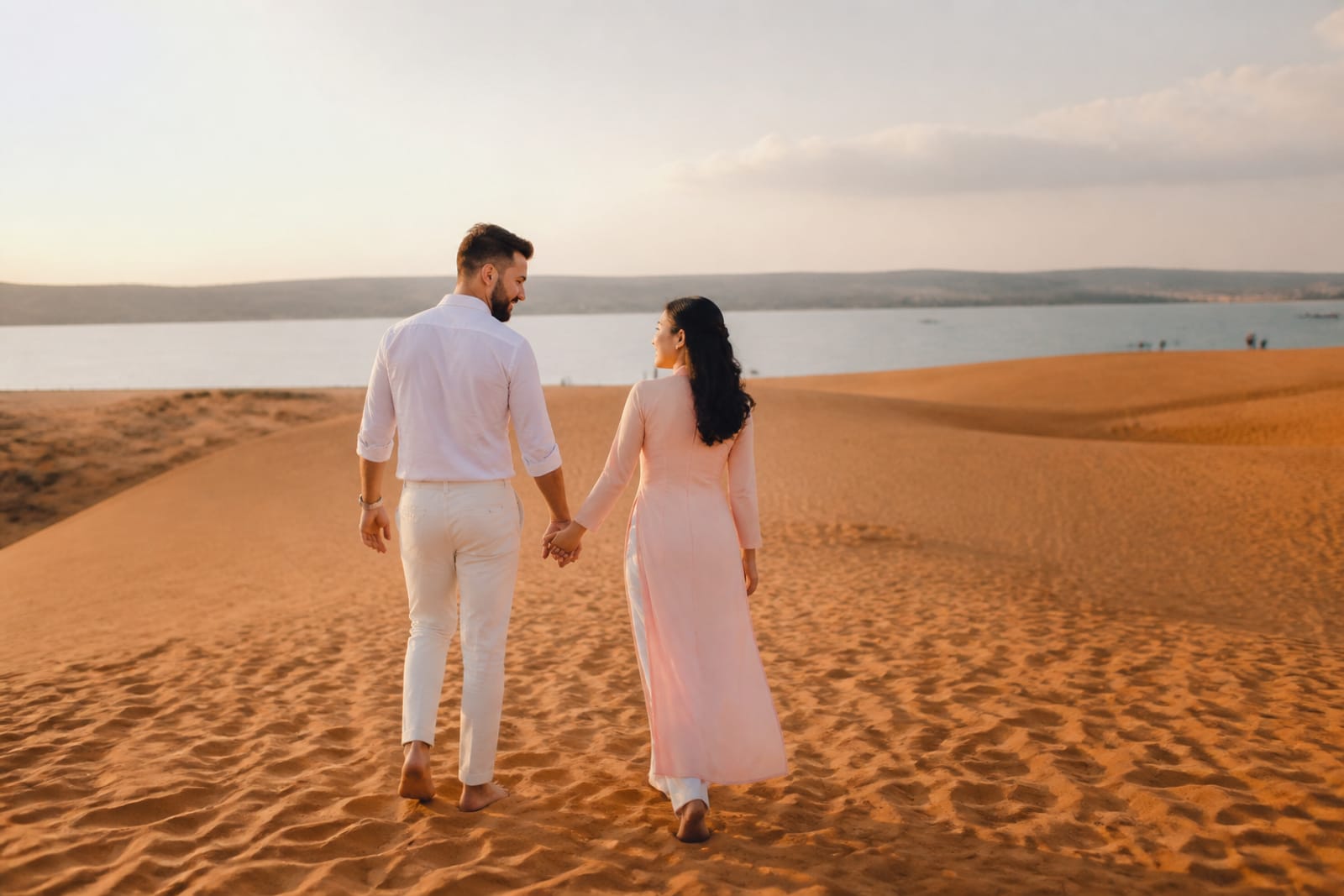
Cáo Studio does not shoot in Mui Ne, but the principles for booking any local photog are the same. Search for "Mui Ne photographer" on Instagram and look for portfolios that show dune shoots with defined light and relaxed posing — not stiff couples standing facing the camera. Check the photographer's captions for technical details ("shot at 5:45 am with an ND filter" or "sunrise session, 850 frames edited in 48 hours"). A good photog will mention light, timing and turnaround.
Message at least three photographers and ask the same questions: Do you shoot dunes at sunrise? Have you worked with ao dai in wind? How many edited images, when will I see them, and do you retouch? Ask for three recent dune sessions (ao dai or couple shoots). Look at the editing — is the sand color natural or blown out? Do faces look sharp or are eyes closed or lost to shadow? Does the flow of frames tell a story or do they feel random?
Video matters. Ask if the photog shoots stills-only or includes a short film. A five-minute edit of your sunrise walk, the light changing, the ao dai moving is worth asking about. Some Mui Ne photographers offer this; others don't. Confirm before booking.
Payment terms vary by photographer. Local photogs often ask for a deposit upfront (via bank transfer, PayPal or cash) and the balance on the morning of the shoot. Always confirm cancellation policy — Mui Ne weather can force a reschedule, and you need to know if your deposit rolls over or is lost. Write this in an email after your WhatsApp chat to have a record.
One-team advantage: why Cáo Studio's integrated model works better than three vendors
Cáo Studio's approach — one photographer, one makeup artist and one stylist working together — means no miscommunication between vendors. If light shifts, makeup knows to adjust blending; if the ao dai wrinkles, the stylist is there in two seconds. Three separate vendors (photographer booked online, makeup from a salon, outfit from a rental shop) require you to coordinate timing, solve problems alone and manage three different cancellation policies.
For Mui Ne, because Cáo Studio doesn't operate there, you're hiring locally. The closest equivalent is booking a photographer whose Instagram shows they work with a trusted makeup artist and stylist on set. If they don't mention their team, they're likely going solo — you'll own the coordination burden.
If you're planning an ao dai shoot in Hanoi, Ho Chi Minh City or Hoi An, Cáo Studio's one-team model eliminates this friction. The team handles outfit, hair, makeup and photography in one booking, shoots with directed light (not poses) and delivers edited photos plus a short vertical film in 48 hours.
📸 Book on WhatsApp — ao dai photoshoot
What to check before you book a Mui Ne dune photoshoot
Ask these questions before signing:
- Sunrise timing: Do they book 5:30–6:30 am sessions, or only midday? Insist on sunrise.
- Edited turnaround: How many days until you see proofs? (Expect 3–7 days locally; ask for a written date.)
- Retouching and files: Do you get unedited RAW files, or only edited JPEGs? How many edited images?
- Weather backup: If it rains or is too windy, can you reschedule at no extra cost?
- Outfit policy: Do they advise on ao dai fit under wind, or only say "wear whatever you want"?
- Makeup coordination: Do they shoot with a makeup artist, or do you source one separately?
For a dune shoot, ask the photographer to show one full session from 5:30–6:45 am. Scroll through the frames and ask: "Which frames are frame 5, frame 25, frame 45?" (A strong shoot builds storytelling: landing, walking, turning, light changing.) If the portfolio is all individual portraits standing still, the photog isn't directing for flow.
---
💄 Makeup & hair at your hotel | 🌸 See the lookbook
If you're choosing between Mui Ne and other Vietnam photo destinations, consider Hoi An's ancient town and river (best dry season Feb–Aug; lantern light at dusk) or Hanoi's urban geometry (morning side light on lake, colonial architecture). Cáo Studio covers all three; for Mui Ne, vet a local photog using the checklist above.
---
📸 Book on WhatsApp — ao dai photoshoot
FAQ
Is Mui Ne dunes suitable for ao dai wedding photos, or should we shoot elsewhere?
Dunes work if you book sunrise (5:30–6:30 am) with soft light and a director who frames flow, not poses. Midday shoots are harsh and the ao dai clings in heat. If you want guaranteed ease and one integrated team, Cáo Studio's Hoi An and Hanoi shoots offer lantern light and urban backdrops without the dawn logistics.
What should I wear under an ao dai on sand?
Wear a bodysuit or silk slip under the tunic (not shorts; they show through the slits). Avoid heavy embroidery that pulls shoulders. Go barefoot only before 7 am; bring sandals for walking between frames. Hair and makeup need sweat-proof formula and hairspray; pack touch-up kits.
Which season is best for Mui Ne dune photos?
Nov–Mar is the dry season with firm sand and cool mornings. Dec–Jan is ideal (fewer crowds, cool dawn). Avoid Sep–Nov (rainy, typhoon risk). Apr–Oct is hotter and the ao dai clings; sunrise is earlier but sand heats fast.
How early do we need to wake up for a Mui Ne sunrise dune shoot?
Leave your hotel by 4:45 am to reach the dunes, let the photographer scout, and start shooting by 5:30 am. Arrange a driver the night before; don't rely on taxis at dawn. Most tour buses arrive around 7 am, so finish main frames by 6:45 am.
Does Cáo Studio shoot in Mui Ne?
No. Cáo Studio operates in Hanoi, Ho Chi Minh City and Hoi An (by appointment). For Mui Ne, vet a local photographer using our checklist: ask for sunrise sessions, recent dune portfolios with defined light, makeup coordination, and edited turnaround time. Request three full sessions to judge frame flow and editing quality.
How do I find a good Mui Ne photographer instead of Cáo Studio?
Search Instagram for "Mui Ne photographer," check captions for technical detail (sunrise timing, light type), message three photogs with the same questions, and ask for three recent dune shoots. Look for defined light, relaxed posing and story-driven frame sequences. Confirm sunrise booking, edited count, turnaround, cancellation policy and makeup coordination before paying a deposit.
FAQ
Is Mui Ne dunes suitable for ao dai wedding photos, or should we shoot elsewhere?
Dunes work if you book sunrise (5:30–6:30 am) with soft light and a director who frames flow, not poses. Midday shoots are harsh and the ao dai clings in heat. If you want guaranteed ease and one integrated team, Cáo Studio's [Hoi An](/hoi-an) and [Hanoi](/hanoi) shoots offer lantern light and urban backdrops without the dawn logistics.
What should I wear under an ao dai on sand?
Wear a bodysuit or silk slip under the tunic (not shorts; they show through the slits). Avoid heavy embroidery that pulls shoulders. Go barefoot only before 7 am; bring sandals for walking between frames. Hair and makeup need sweat-proof formula and hairspray; pack touch-up kits.
Which season is best for Mui Ne dune photos?
Nov–Mar is the dry season with firm sand and cool mornings. Dec–Jan is ideal (fewer crowds, cool dawn). Avoid Sep–Nov (rainy, typhoon risk). Apr–Oct is hotter and the ao dai clings; sunrise is earlier but sand heats fast.
How early do we need to wake up for a Mui Ne sunrise dune shoot?
Leave your hotel by 4:45 am to reach the dunes, let the photographer scout, and start shooting by 5:30 am. Arrange a driver the night before; don't rely on taxis at dawn. Most tour buses arrive around 7 am, so finish main frames by 6:45 am.
Does Cáo Studio shoot in Mui Ne?
No. Cáo Studio operates in Hanoi, Ho Chi Minh City and Hoi An (by appointment). For Mui Ne, vet a local photographer using our checklist: ask for sunrise sessions, recent dune portfolios with defined light, makeup coordination, and edited turnaround time. Request three full sessions to judge frame flow and editing quality.
How do I find a good Mui Ne photographer instead of Cáo Studio?
Search Instagram for "Mui Ne photographer," check captions for technical detail (sunrise timing, light type), message three photogs with the same questions, and ask for three recent dune shoots. Look for defined light, relaxed posing and story-driven frame sequences. Confirm sunrise booking, edited count, turnaround, cancellation policy and makeup coordination before paying a deposit.
Ao dai, makeup, hair and a local photographer in Hanoi or Saigon — one WhatsApp message.