/ao-dai-photoshoot
Ao dai wedding photos at Son Tra Peninsula and Linh Ung Pagoda
Son Tra Peninsula and Linh Ung Pagoda are two distinct Da Nang locations for ao dai wedding portraits. Son Tra's white sandy beaches, turquoise water, and forested headland offer dramatic natural light best at sunrise (5:30–7:00 a.m.), with soft backlighting and minimal crowds before 9 a.m. Linh Ung Pagoda sits 200 m above sea level on a clifftop overlooking My Khe Beach; golden-hour side-lit portraits (5:00–6:30 p.m.) suit its ornate white architecture and spiritual atmosphere. Neither location is crowded before 8 a.m. or after 5 p.m. Both require 45–90 minutes of travel time from Da Nang city center and suit Feb–Aug (best May–Aug for sharp light; Sep–Dec is driest but typhoon-prone and grey). Cáo Studio – Makeup & Photoshoot can coordinate makeup, hair, and portrait sessions at Hoi An or Ho Chi Minh City; for Da Nang shoots, you'll need a local photographer—we can advise on WhatsApp on vetting and logistics. 📸 Book on WhatsApp — ao dai photoshoot
Which location matches your ao dai vision?
Son Tra Peninsula emphasizes natural landscapes: pristine beach, limestone cliffs, and jungle canopy create layered, editorial-style ao dai portraits. The sand is white and fine; water ranges turquoise to jade green depending on angle and sun position. Ao dai fabric reads clearly against water and sky. Light is directional and textured, casting shadows that define the garment's pleats and sleeves.
Linh Ung Pagoda emphasizes spiritual heritage and architecture. The pagoda's white façade, ornate railings, and Buddha statue frame ao dai as formal, ceremonial dress. Cliff-edge vistas add scale. Light is softer and more ambient indoors and on shaded verandahs; exterior terraces offer golden-hour glow.
Choose Son Tra if: you want editorial, nature-focused wedding portraits; your ao dai is in jewel tones (emerald, sapphire, burgundy) that pop against water and sand.
Choose Linh Ung Pagoda if: you want formal, spiritual, architectural framing; your ao dai is in lighter shades (ivory, blush, pale gold) that suit softer, directional light.
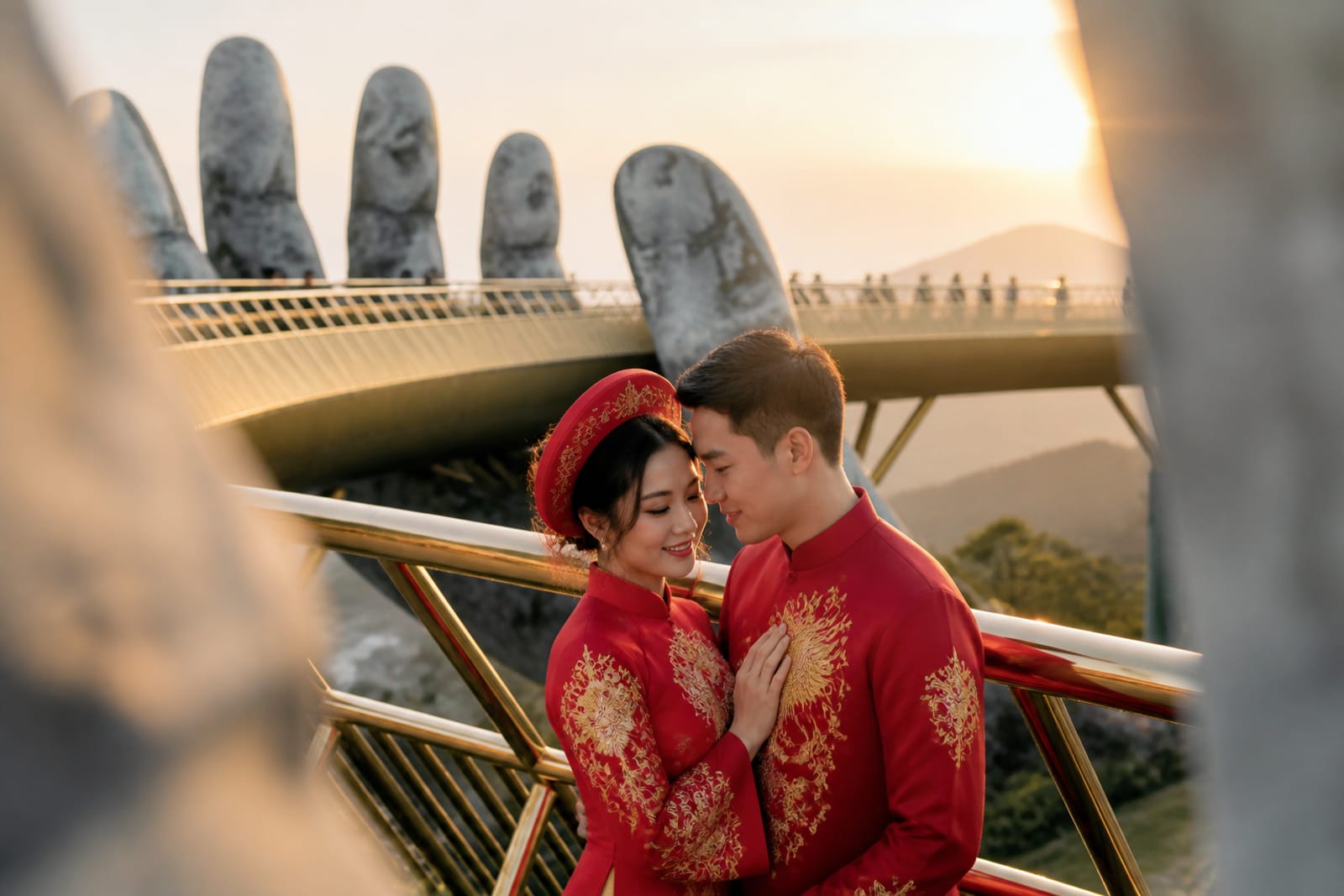
What light and timing should you plan for?
| Aspect | Son Tra Peninsula | Linh Ung Pagoda | Verdict |
|---|---|---|---|
| Best light window | 5:30–7:00 a.m. (sunrise) or 4:30–5:30 p.m. (late afternoon) | 4:30–6:30 p.m. (golden hour) | Timing depends on your vision; both need early/late booking |
| Crowd level | Minimal before 8 a.m.; heavy mid-morning onward | Moderate before 6 a.m.; peak 8 a.m.–4 p.m. | Sunrise at Son Tra = fewest tourists; Pagoda quieter at dusk |
| Ao dai fabric visibility | Sharp shadows enhance pleats and folds; water contrasts jewel tones | Soft ambient light flatters lighter ao dai; architecture doesn't distract from fabric detail | Choose time based on ao dai color, not convenience |
| Weather consistency (Feb–Aug) | Clear, dry; sea breeze may ruffle fabric | Clear, dry; wind less intense on cliff terrace | Both reliable Feb–Aug; avoid Sep–Dec typhoon season |
| Walking and access | Sandy, soft terrain; entry fees required (check current prices on site) | Stone steps and terraces (wear flat shoes); visitor parking fills by 9 a.m. | Plan 90+ minutes for travel and site setup |
Both locations are at their best when you embrace the light window your chosen spot offers. A 5:00 a.m. shoot at Son Tra feels rushed if you add makeup and ao dai rental to your timeline; equally, a Pagoda shoot at 2 p.m. fights harsh overhead sun and midday crowds.
How does travel and logistics shape your booking decision?
Son Tra Peninsula is about 20 km northeast of Da Nang city center. A private car ride takes 30–45 minutes depending on traffic; you'll need a driver familiar with the narrow coastal road and parking areas. Parking is limited and informal; arrive very early to secure a spot without leaving the car blocking access roads.
Linh Ung Pagoda is on the northern edge of Da Nang, roughly 10 km from the city center, reachable in 20–30 minutes by car. Parking is organized but fills by 9 a.m.; if you're arriving for golden-hour (5 p.m.), parking pressure eases significantly after 5 p.m.
What to arrange beforehand:
- Hire a private car and driver for the full session (typically 4–6 hours including travel, setup, and costume changes). Negotiate rate and fuel beforehand.
- Confirm whether your photographer has location-specific permits for Linh Ung Pagoda (some pagodas require advance notice).
- Scout the site in person 1–2 days before if possible; light changes based on season and time of year, and real walking distances surprise many couples.
- Confirm entry fees and whether ao dai rental outfits require shoe coverage at the pagoda (some temples restrict footwear near sacred spaces).
What ao dai rental and styling works best for each location?
At Son Tra Peninsula, bright or jewel-toned ao dai (emerald, royal blue, deep crimson, gold) photograph most memorably. Water acts as a reflective backdrop, so fabric color must have presence. Avoid heavily embroidered áo dài with sequins that catch sunlight unevenly; plain silk or silk-blend ao dai drapes and moves more naturally in sea breeze.
Footwear: traditional white or embroidered shoes are rarely worn at beaches. Most couples go barefoot on sand or wear simple sandals for travel and remove them during the shoot. Confirm your rental provider's expectations about sand and salt water on the hem and sleeves.
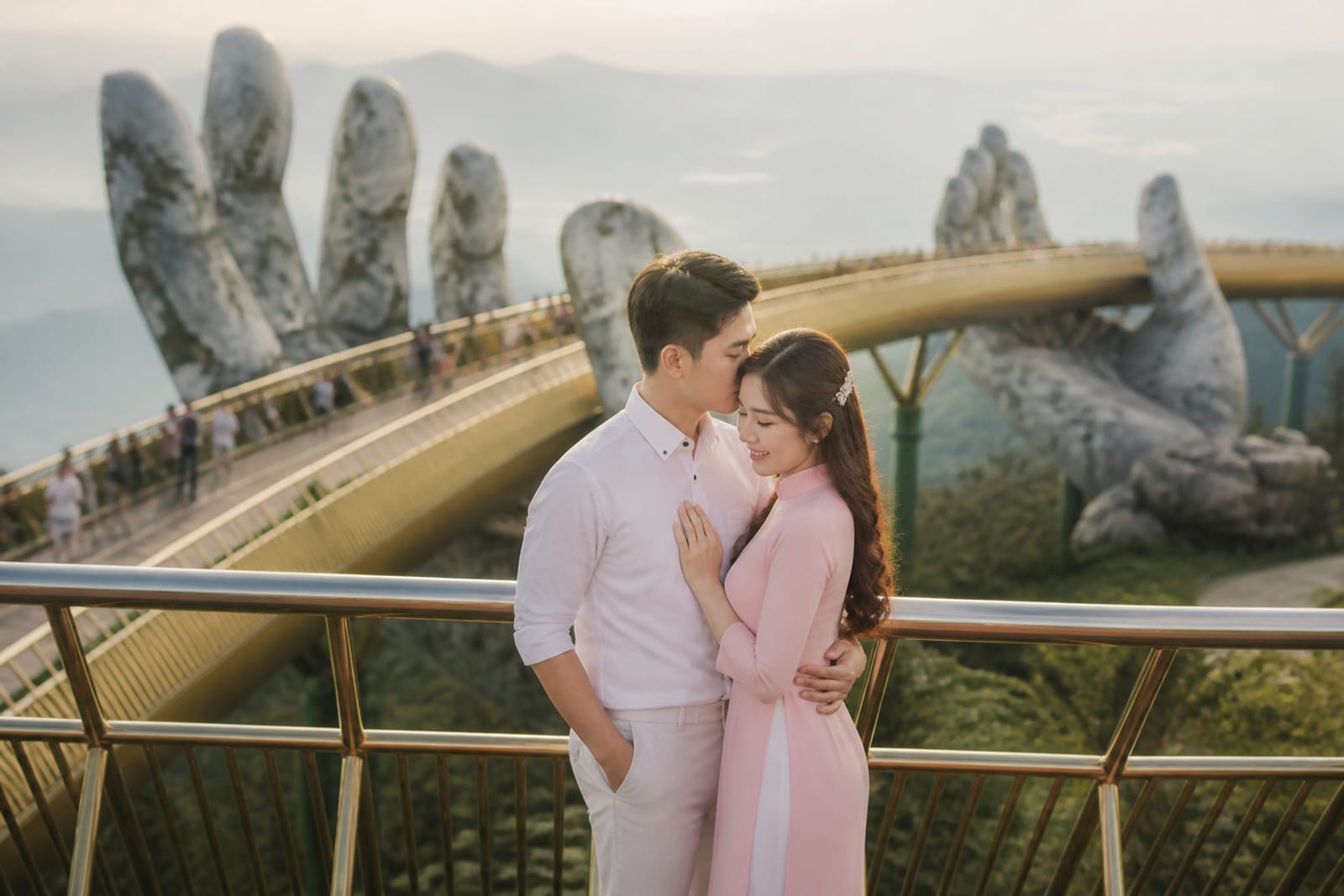
At Linh Ung Pagoda, lighter ao dai (ivory, cream, pale blush, soft gold) suit the temple's aesthetic and the softer, more ambient light indoors and on shaded terraces. Embroidery and beading are permissible and actually enhance formal portraiture. Layering (áo dài over a contrasting silk slip) adds visual depth in architectural frames.
Footwear: temples typically expect respect; many request shoes be removed on verandahs and indoors. Bring slip-on sandals or go barefoot. Your rental provider can advise on hem treatment (some ao dai are hemmed shorter to clear ground; others drag intentionally for formal effect).
Both locations: ask your rental studio whether the ao dai is tailored for your height and shoulder width specifically. Mass-produced rentals often fit loosely, especially in the shoulders, and loose sleeves photograph poorly against expansive skies and water. A half-day adjustment (tacking or pinning sleeves) by a tailor in Da Nang costs minimal and transforms the images.
What to check before you book your Da Nang photoshoot?
1. Photographer portfolio & location experience Ask to see 10–15 images from Son Tra and Linh Ung specifically. Pay attention to ao dai fabric detail (how light renders pleats, folds, embroidery), not just landscape beauty. A photographer skilled in editorial work may miss the intimate texture of ao dai; a studio portrait photographer may struggle with directional outdoor light. Request examples from Feb–Aug (dry season, your target months).
2. Light-window flexibility Confirm your photographer's willingness to book sunrise (5:30 a.m.) or golden-hour (5:00 p.m.) sessions. Many Da Nang photographers book only 9 a.m.–4 p.m. because clients resist early starts. Early light is non-negotiable at Son Tra for editorial quality; golden-hour is essential at Linh Ung for spiritual, formal mood. If your photographer prefers midday, choose a different photographer.
3. Crowd management & safety Ask how they handle tourists in your shot (Photoshop removal cost and timeline). Ask about solo operation vs. an assistant (assistant helps with costume changes, backup lighting, and walking logistics on sandy or steep terrain). A solo photographer rushing between three costume changes and travel time will miss moments.
4. Permit and access knowledge Confirm they have shot Linh Ung Pagoda and understand its rules (photography hours, where deity statues are off-limits, footwear expectations). Many photographers are unfamiliar with temple protocol. Ask whether they've coordinated group permits or vendor access.
5. Weather backup plan Feb–Aug is dry, but afternoon cloud cover or rare rain happens. Confirm whether the photographer will reschedule, offer a shorter session, or continue despite weather. Clarify this upfront to avoid disputes.
6. Ao dai rental coordination Ask whether the photographer recommends a specific rental studio in Da Nang or vouches for one they've worked with repeatedly. Cáo Studio – Makeup & Photoshoot offers ao dai rental and makeup & hair services at our Hanoi and Ho Chi Minh City branches; if you book a shoot in Da Nang through a local photographer, arrange ao dai rental directly with a Da Nang studio to simplify logistics.
How does season affect your choice of location and date?
Feb–Apr (cool, clear, lowest humidity) Best light quality; morning light is crisp, evening light is golden without haze. Both locations photograph best. Crowds are moderate (just before and after Tet closures). Humidity under 70%. Ao dai feels comfortable to wear; fabric doesn't cling from sweat.
May–Aug (hot, very clear, high humidity) Intense midday heat; sunrise and sunset light are sharper and longer-lasting. Sea breeze at Son Tra can be unpredictable (may tousle ao dai uncontrollably or provide ideal movement for fabric shots). Humidity 75–90%. Sweat marks on ao dai likely; coordinate frequent touch-ups with your makeup artist. Crowds peak at Son Tra mid-morning. Both locations are still excellent for early-morning or evening shoots.
Sep–Dec (typhoon season, grey, rain) Avoid entirely. Oct–Nov is peak typhoon season; sudden floods, rough seas at Son Tra, and cliff-edge wind at Linh Ung create safety hazards. Light is flat and grey; ao dai loses color saturation in overcast conditions. Many services close or operate reduced hours during typhoon threats.
Choose Feb–Apr for reliability and comfort; choose May–Aug only if you commit to sunrise or golden-hour sessions and plan frequent makeup touch-ups.
📸 Book on WhatsApp — ao dai photoshoot
How does Cáo Studio support Da Nang ao dai shoots?
Cáo Studio – Makeup & Photoshoot operates branches in Hanoi and Ho Chi Minh City (Saigon), not in Da Nang. However, we can:
- Advise on photographer vetting via WhatsApp: share your shortlist of Da Nang photographers, and we'll feedback on portfolios and ask critical questions on your behalf.
- Coordinate makeup & hair before your trip if you're traveling from another city. Our makeup & hair service at your hotel in Hanoi or Ho Chi Minh ensures professional styling before you depart, or we can brief a Da Nang makeup artist on your ao dai color and wedding vision.
- Recommend ao dai rental studios in Da Nang with specific tailor adjustments that photograph well outdoors.
- Provide ao dai rental, makeup & hair, and full-day pre-wedding photoshoots if you decide to shoot in Hanoi or Ho Chi Minh City instead, or add a couple's session in Hoi An on the same trip.
Message us on WhatsApp to discuss your Da Nang plans. We've coached many couples who booked local Da Nang photographers, and we know what questions to ask and what to watch for.
---
FAQ
Can Cáo Studio photograph my ao dai wedding session at Son Tra or Linh Ung Pagoda?
No. Cáo Studio operates in Hanoi, Ho Chi Minh City, and Hoi An only. For Da Nang, you'll need a local photographer. We can advise you on vetting photographers and coordinating makeup, hair, and ao dai rental via WhatsApp before or after your shoot.
What's the best time of day to shoot at Son Tra if I'm wearing a light-colored ao dai?
Sunrise (5:30–7:00 a.m.) is ideal for pale ao dai at Son Tra. Backlighting from the rising sun creates soft halos around the fabric and your silhouette, and sand and water are cool-toned. Avoid midday when overhead sun flattens colour and creates harsh shadows on your face.
Do I need to remove my shoes at Linh Ung Pagoda during the photoshoot?
Yes, many pagodas request shoes be removed on verandahs and indoors. Bring slip-on sandals or go barefoot for interior shots. Confirm your photographer's and ao dai rental provider's expectations beforehand to plan your footwear strategy.
How long should I budget for a full ao dai photoshoot at Son Tra or Linh Ung Pagoda, including travel?
Plan 5–6 hours total: 45–90 minutes travel each way, 30–45 minutes setup and makeup touch-ups, 90–120 minutes shooting, and 30 minutes costume and location changes. Start very early (4:30–5:00 a.m. for sunrise shoots) to maximize light.
Can I rent ao dai in Da Nang, or should I bring one from Hanoi or Ho Chi Minh City?
Da Nang has reputable ao dai rental studios. Renting locally simplifies travel and allows on-site tailoring adjustments. If you book with Cáo Studio in Hanoi or Ho Chi Minh City, we offer ao dai rental as part of your session package; message us on WhatsApp to compare options.
What should I do if the weather turns grey or rainy on my scheduled shoot date?
Discuss a reschedule or backup plan with your photographer before you book. Feb–Aug is generally dry, but afternoon clouds happen. A professional photographer may offer a shorter session or pivot to covered areas at Linh Ung. Confirm your photographer's weather policy upfront to avoid surprises.
Is Feb–Apr or May–Aug better for ao dai photography at these locations?
Feb–Apr offers cooler, crisp light and lower humidity; both locations are equally excellent. May–Aug has sharper evening light and intense color saturation but high heat and humidity. Book sunrise or golden-hour sessions in May–Aug to avoid midday glare and crowds. Both seasons are reliable; choose based on your comfort and light preference.
FAQ
Can Cáo Studio photograph my ao dai wedding session at Son Tra or Linh Ung Pagoda?
No. Cáo Studio operates in Hanoi, Ho Chi Minh City, and Hoi An only. For Da Nang, you'll need a local photographer. We can advise you on vetting photographers and coordinating makeup, hair, and ao dai rental via WhatsApp before or after your shoot.
What's the best time of day to shoot at Son Tra if I'm wearing a light-colored ao dai?
Sunrise (5:30–7:00 a.m.) is ideal for pale ao dai at Son Tra. Backlighting from the rising sun creates soft halos around the fabric and your silhouette, and sand and water are cool-toned. Avoid midday when overhead sun flattens colour and creates harsh shadows on your face.
Do I need to remove my shoes at Linh Ung Pagoda during the photoshoot?
Yes, many pagodas request shoes be removed on verandahs and indoors. Bring slip-on sandals or go barefoot for interior shots. Confirm your photographer's and ao dai rental provider's expectations beforehand to plan your footwear strategy.
How long should I budget for a full ao dai photoshoot at Son Tra or Linh Ung Pagoda, including travel?
Plan 5–6 hours total: 45–90 minutes travel each way, 30–45 minutes setup and makeup touch-ups, 90–120 minutes shooting, and 30 minutes costume and location changes. Start very early (4:30–5:00 a.m. for sunrise shoots) to maximize light.
Can I rent ao dai in Da Nang, or should I bring one from Hanoi or Ho Chi Minh City?
Da Nang has reputable ao dai rental studios. Renting locally simplifies travel and allows on-site tailoring adjustments. If you book with Cáo Studio in Hanoi or Ho Chi Minh City, we offer ao dai rental as part of your session package; message us on WhatsApp to compare options.
What should I do if the weather turns grey or rainy on my scheduled shoot date?
Discuss a reschedule or backup plan with your photographer before you book. Feb–Aug is generally dry, but afternoon clouds happen. A professional photographer may offer a shorter session or pivot to covered areas at Linh Ung. Confirm your photographer's weather policy upfront to avoid surprises.
Is Feb–Apr or May–Aug better for ao dai photography at these locations?
Feb–Apr offers cooler, crisp light and lower humidity; both locations are equally excellent. May–Aug has sharper evening light and intense color saturation but high heat and humidity. Book sunrise or golden-hour sessions in May–Aug to avoid midday glare and crowds. Both seasons are reliable; choose based on your comfort and light preference.
Ao dai, makeup, hair and a local photographer in Hanoi or Saigon — one WhatsApp message.