services/ao-dai-photoshoot
Áo Tứ Thân Northern Costume Photoshoot: Styles, Fit & Booking
The áo tứ thân—four separate front panels joined at the shoulders—defines northern Vietnamese formal dress and cultural documentation. Unlike the fitted áo dài, this tunic sits loosely, emphasizing craftsmanship and age-old tailoring. When shot correctly, its layered geometry and texture become a photographic subject in their own right, not just a costume.
We've styled hundreds of these for travelers, researchers, and Vietnamese clients wanting authentic documentation. Here's what we've learned about fit, style choices, and producing images where the garment reads clearly.
What is an áo tứ thân and why does fit matter?
The áo tứ thân comprises four vertical panels—two front, two back—hanging from a yoke seam at the shoulders. This geometry is intentional: it allows unrestricted arm movement and creates visual interest under studio light. Poor fit kills that effect. A tunic that's too tight bunches at the panels; too loose, and the structure disappears into fabric.
Correct fit means the panels drape from shoulder to knee without pulling or sagging. Shoulder seams sit on the point of the shoulder. Armholes sit high and snug; the tunic itself remains loose. Most tailors in Hanoi's Old Quarter understand this, but Western clients often order one size too large, mistaking traditional ease for baggy tailoring.
📸 Book on WhatsApp — ao dai photoshoot
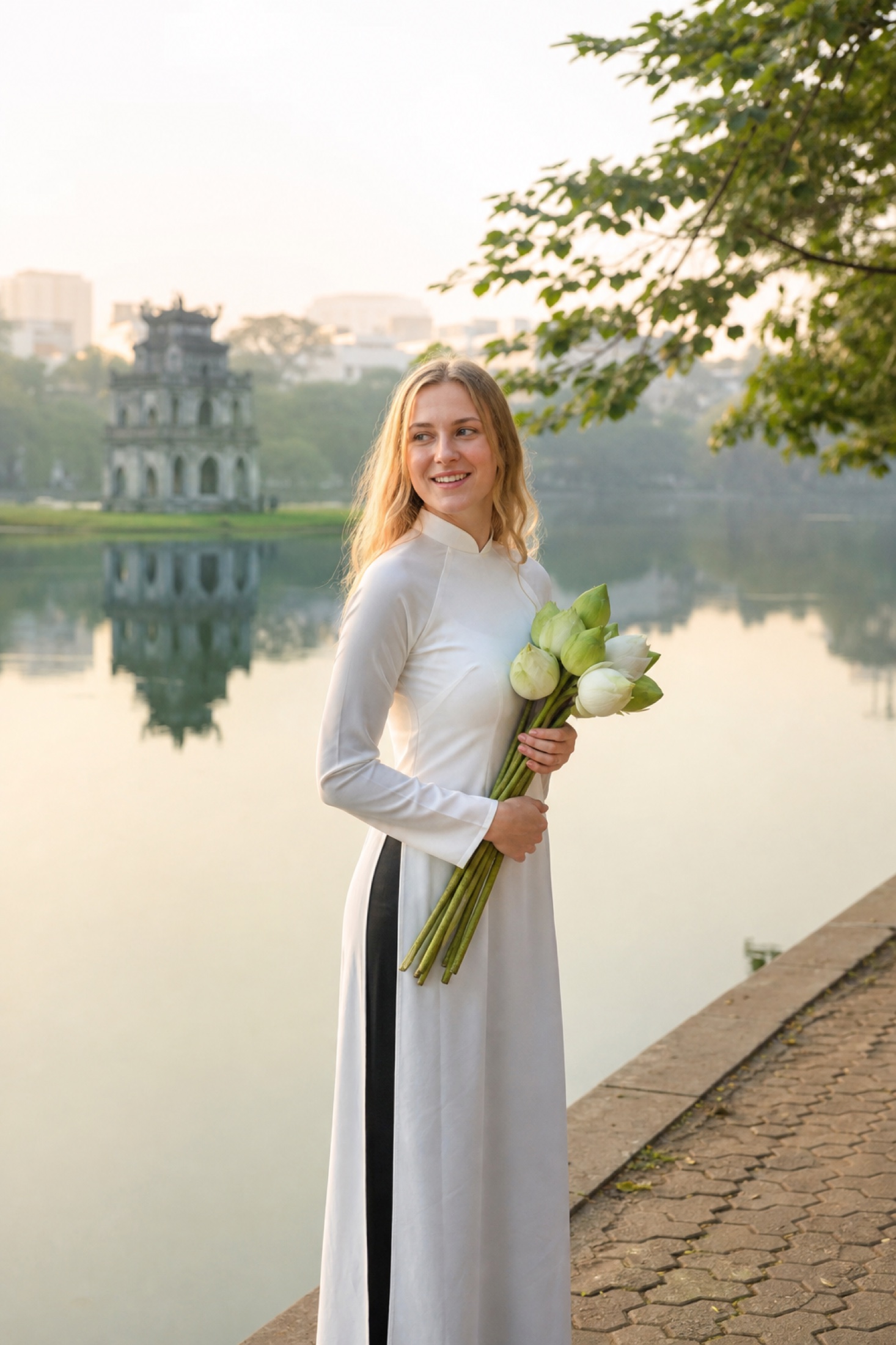
Northern styles: embroidery, color, and regional markers
Northern áo tứ thân traditionally feature silk damask or cotton in jewel tones—deep red, forest green, burgundy. Embroidery, if present, concentrates on the front panels and yoke, often in geometric or floral motifs inspired by mountain communities. This differs sharply from southern áo dài, which tend toward pastel silk and minimalist design.
For a photoshoot, the regional identity is the angle. A carefully chosen northern style—particularly pieces with visible embroidery or indigo-dyed cotton—photographs more dynamically than plain versions. The texture reads in close-ups; the color pops in natural light.
We source áo tứ thân from established tailors in the Old Quarter and recommend clients bring their own if they have one. Renting is rare; most studios and costume shops in Hanoi lease áo dài, not áo tứ thân. If you order a piece, allow 2–3 weeks before travel.
When to wear an áo tứ thân: seasons, occasions, and photoshoot timing
Traditionally worn for formal family events, temple visits, and Tết celebrations, the áo tứ thân suits photoshoots year-round in Hanoi—though timing affects the final image.
Spring (Feb–Apr): Morning light is soft; noon glare is minimal. Humidity is low. Ideal for outdoor sessions at Hoi An locations or Hanoi's French Quarter. The silk drapes beautifully and color saturation is high.
Summer (May–Sep): Heat builds by 10 a.m. Morning sessions only. Indoor studio work avoids sweat marks and protects embroidery. Humidity can dull colors in RAW files—we boost saturation subtly in post.
Autumn (Oct–Nov): Perfect light, cool air, minimal rain. Best season overall. Sessions can run full-day without heat stress.
Winter (Dec–Jan): Cold air makes fabric stiff; however, studio heating (if available) softens this. Low-angle winter sun flatters the tunic's panel geometry.
For a 2-hour session, we recommend booking morning light (7–10 a.m. outdoors, 9–11 a.m. studio). This gives clean shadows and avoids midday heat.
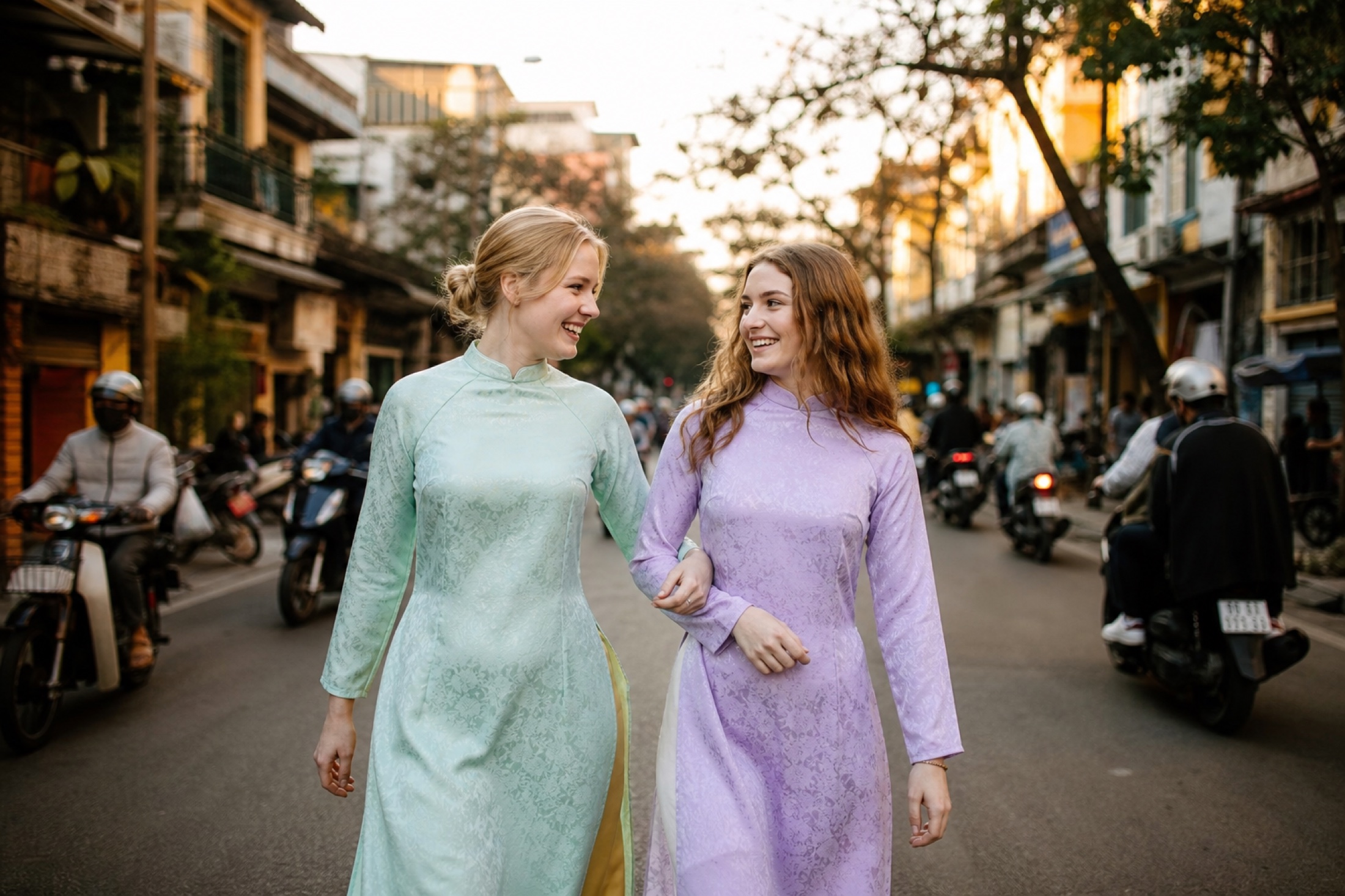
How to prepare: undergarments, hair, and what to bring
The áo tứ thân is shot open—unbuttoned or partially fastened—to show the inner garment and pants clearly. This is non-negotiable for authenticity. Wear a plain silk camisole or white cotton undershirt beneath; avoid visible bra lines or thick seams. Undergarments must be intentional; they're in the frame.
Hair & makeup:
- Hair: traditionally pinned up (low bun, twisted crown, or loose waves). We coordinate with your makeup artist during the pre-shoot consultation.
- Makeup: bold brows, natural lips, or muted red—nothing trendy. The garment is the star. We offer makeup & hair at your hotel or in-studio application.
What to bring:
- Two pairs of traditional silk trousers (burgundy, black, or navy) if you have them. If not, the studio has alternatives.
- Jewelry: minimal—a jade bangle, pearl necklace, or vintage brooch if you own one. Large or shiny pieces distract.
- A robe or shawl for between-shot warmth.
Pack nothing else. We provide steaming and light touch-ups on-site.
Choosing a photographer: studio vs. location, and what to check
Studio sessions (recommended for áo tứ thân) let us control light on the garment's panels and embroidery. Harsh studio light that might look unflattering on skin actually flatters textured fabric—it reveals weave and embroidery depth. A 2-hour studio session with Cáo Studio includes 5–8 outfit changes, hair, makeup, and 40–60 finished images.
Location sessions are possible but demand more planning. We shoot at temple courtyards (with permission), colonial villas in Hanoi, or rice paddies near the city. Outdoor light is unpredictable; wind can distort the fabric drape. These are best for couple & family photoshoots where environmental context matters more.
If booking a local photographer independently:
- Portfolio check: do they have examples of traditional dress? Áo tứ thân is niche—many Hanoi photographers have shot áo dài but not this tunic.
- Styling knowledge: can they position your arms and panels to avoid bunching? Ask directly.
- Equipment: full-frame camera (Canon 5D, Sony A7 series minimum). Phone photography flattens the fabric texture.
- Turnaround: how long to edited files? 2–4 weeks is standard; anything faster may indicate minimal retouching.
Cáo Studio offers pre-wedding & elopement shoots that include traditional dress—many couples combine áo tứ thân with an áo dài session.
| Session type | Best for | Duration | Includes | Why choose it |
|---|---|---|---|---|
| Studio session | Garment detail, embroidery, texture | 2 hours | Hair, makeup, 5–8 changes, 40–60 images | Controlled light on panels; ideal for documentation |
| Outdoor (temple/villa) | Context, cultural setting, narrative | 2.5–3 hours | Hair, makeup, 3–4 changes, 30–50 images | Environmental storytelling; less technical garment focus |
| Couple session | Dual áo tứ thân or paired costume | 2–3 hours | Hair, makeup, both subjects, 50–80 images | Relational narrative; couple & family photoshoot expertise |
| Full-day (studio + location) | Comprehensive documentation | 4–6 hours | Multiple outfits, two settings, 80–120 images | Deep archive; ideal for researchers or Tết records |
What to check before you book
1. Garment sourcing: Do you have an áo tứ thân, or does the studio? If you order one locally, allow 3 weeks. If renting, confirm size and embroidery style before deposit.
2. Makeup artist: Has your makeup artist worked with traditional dress? Ask to see a portfolio. Western makeup (contouring, bold brows) can clash with the garment's age-old aesthetic.
3. Image ownership: Ask whether you own the RAW files or receive JPEGs only. Many studios retain RAWs; this affects your ability to reprint or re-edit.
4. Retouching scope: Is blemish removal and color correction included, or is that extra? Define this upfront.
5. Delivery timeline: When do you receive edited files? If you're leaving Hanoi within 10 days, confirm the studio can prioritize your session.
6. Session flexibility: If you're unsure of your outfit or pose style, ask whether a consultation call is free. This is standard at Cáo Studio.
---
For researchers and documentation projects, our lookbook shows áo tứ thân styling across studio and outdoor settings. Book a session on WhatsApp, or review our pricing page for package details.
Hanoi's Cáo Studio is centrally located (3 branches); we also offer sessions in Ho Chi Minh City and shoot in Hoi An by appointment. The main áo dài photoshoot page explains how we style all traditional Vietnamese dress.
---
FAQ
Can I wear my own áo tứ thân, or should I rent one from the studio?
Bring your own if you own one—we style and steam it on-site. Renting is uncommon in Hanoi; most costume shops lease áo dài. If ordering new, allow 3 weeks. We can recommend tailors in the Old Quarter who specialize in northern dress.
How long does a typical session take, and how many images do I receive?
Studio sessions are 2 hours and yield 40–60 finished images. Outdoor sessions (2.5–3 hours) produce 30–50 images due to travel time and light management. All images are color-corrected and retouched for skin.
What's the difference between an áo tứ thân and an áo dài for a photoshoot?
Áo tứ thân is a layered, four-panel northern tunic that photographs best in controlled studio light, emphasizing embroidery and texture. Áo dài is fitted and flattering on the body, suited to outdoor settings. We offer both at our main photoshoot page.
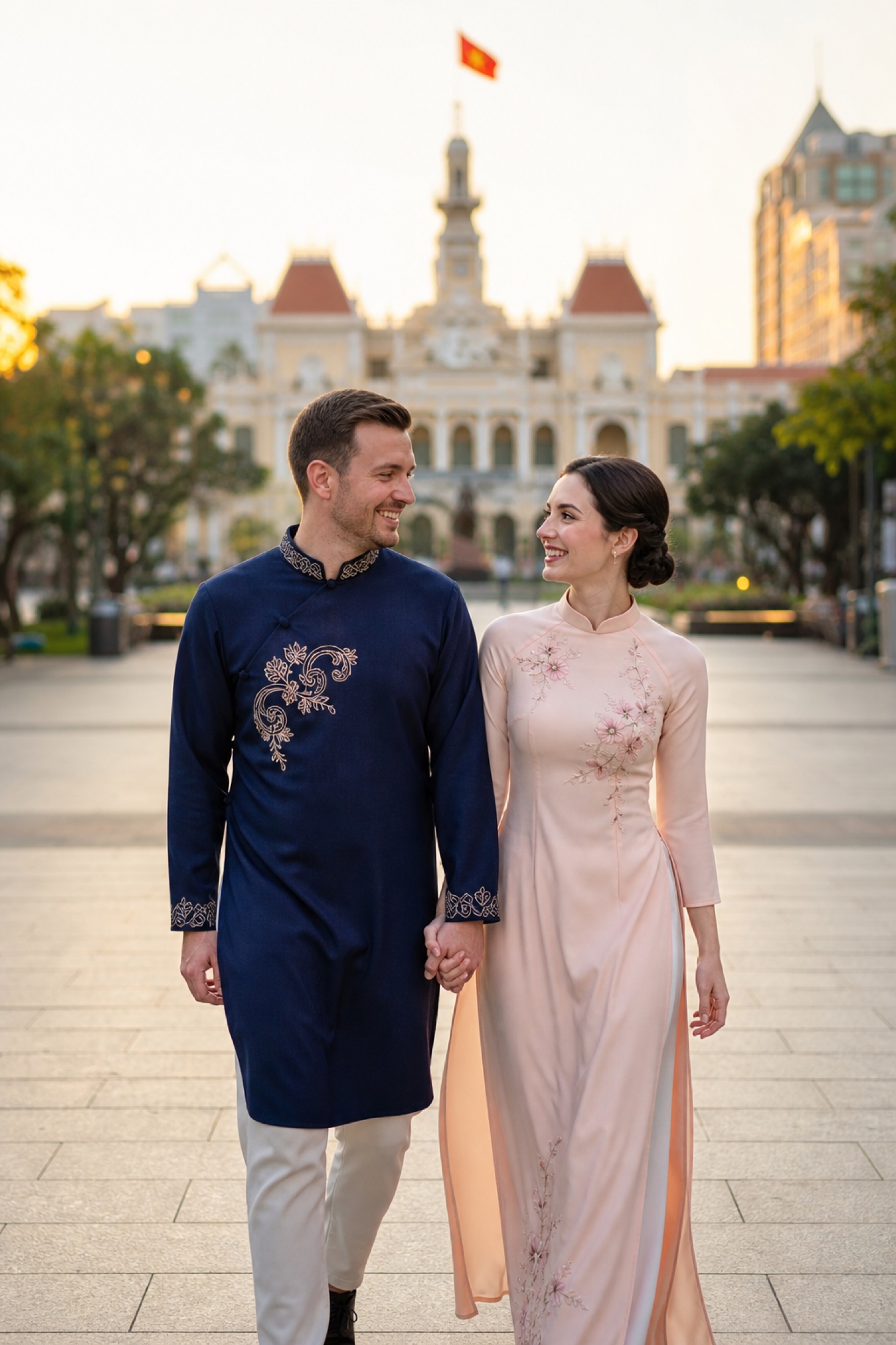
If I'm doing a couple shoot, can we both wear áo tứ thân?
Yes. Many couples choose matching or complementary northern styles. Refer to our couple & family photoshoot page for pricing and options. We coordinate styling so the outfits harmonize without matching exactly.
What if I'm visiting Hoi An instead of Hanoi—do you shoot áo tứ thân there?
We travel to Hoi An by appointment for shoots. Ask on WhatsApp about Hoi An dates and availability. Hoi An's colonial town is beautiful for location shots, but we still recommend studio-based sessions for garment detail.
Can I order prints or albums after my session?
Yes. Once you receive edited images, we offer printing, albums, and framing through our sister brand Hoa Lang Thang. Ask during your booking consultation for keepsake options and lead times.
FAQ
Can I wear my own áo tứ thân, or should I rent one from the studio?
Bring your own if you own one—we style and steam it on-site. Renting is uncommon in Hanoi; most costume shops lease áo dài. If ordering new, allow 3 weeks. We can recommend tailors in the Old Quarter who specialize in northern dress.
How long does a typical session take, and how many images do I receive?
Studio sessions are 2 hours and yield 40–60 finished images. Outdoor sessions (2.5–3 hours) produce 30–50 images due to travel time and light management. All images are color-corrected and retouched for skin.
What's the difference between an áo tứ thân and an áo dài for a photoshoot?
Áo tứ thân is a layered, four-panel northern tunic that photographs best in controlled studio light, emphasizing embroidery and texture. Áo dài is fitted and flattering on the body, suited to outdoor settings. We offer both at [our main photoshoot page](/services/ao-dai-photoshoot).
If I'm doing a couple shoot, can we both wear áo tứ thân?
Yes. Many couples choose matching or complementary northern styles. Refer to our [couple & family photoshoot page](/services/couple-photoshoot) for pricing and options. We coordinate styling so the outfits harmonize without matching exactly.
What if I'm visiting Hoi An instead of Hanoi—do you shoot áo tứ thân there?
We travel to [Hoi An by appointment](/hoi-an) for shoots. Ask on WhatsApp about Hoi An dates and availability. Hoi An's colonial town is beautiful for location shots, but we still recommend studio-based sessions for garment detail.
Can I order prints or albums after my session?
Yes. Once you receive edited images, we offer printing, albums, and framing through our sister brand Hoa Lang Thang. Ask during your booking consultation for keepsake options and lead times.
Ao dai, makeup, hair and a local photographer in Hanoi or Saigon — one WhatsApp message.