/pre-wedding-photoshoot
Avoid crowds at Mui Ne red sand dunes for your pre-wedding shoot
Mui Ne's dunes fill quickly after sunrise, especially Oct–Apr when weather is dry and stable. To avoid crowds, shoot in the off-season (May–Sep, outside school holidays) at sunrise before 6:30 am, or hire a local Mui Ne photographer who can access quieter sections via inland routes away from the main tourist carpark. Cáo Studio does not operate in Mui Ne; our team shoots in Hanoi, Ho Chi Minh City, and Hoi An. For a crowd-free Mui Ne pre-wedding shoot, find a local photographer through trusted referrals, verify their experience with couple sessions on red dunes, ask about their earliest access times and which dune sections they use, and confirm their turnaround for edited files and video. Budget for a full morning (4–5 hours) to allow light changes and outfit swaps without rushing past crowds.
The Mui Ne red sand dunes are one of Vietnam's most photographed landscapes, but popularity brings foot traffic that can undermine an intimate couple session. Most visitors arrive between 5:30 and 8:00 am, when the main carpark fills and guides shepherd groups up the same well-worn paths. If you're booking a pre-wedding photoshoot in Mui Ne, understanding light, season, and local access is the difference between sharing your moment with fifty other couples and having the dunes almost to yourselves.
Why do dunes get crowded even at sunrise?
The red dunes open early, and most tour operators start at 5:30 am to catch soft light. By 6:30 am, the main slope—the one on every postcard—hosts dozens of visitors. The carpark has limited space; once it fills, latecomers park further away, often closer to quieter interior sections. Mui Ne's tourism boom means even "early" arrivals overlap. A local photographer familiar with the area can identify secondary dunes, interior tracks, and less-promoted vantage points that receive traffic 30–60 minutes later. Choose based on your willingness to move: the most isolated dune sections require a 10–15 minute walk across sand, discouraging casual visitors.
When is Mui Ne driest and least crowded?
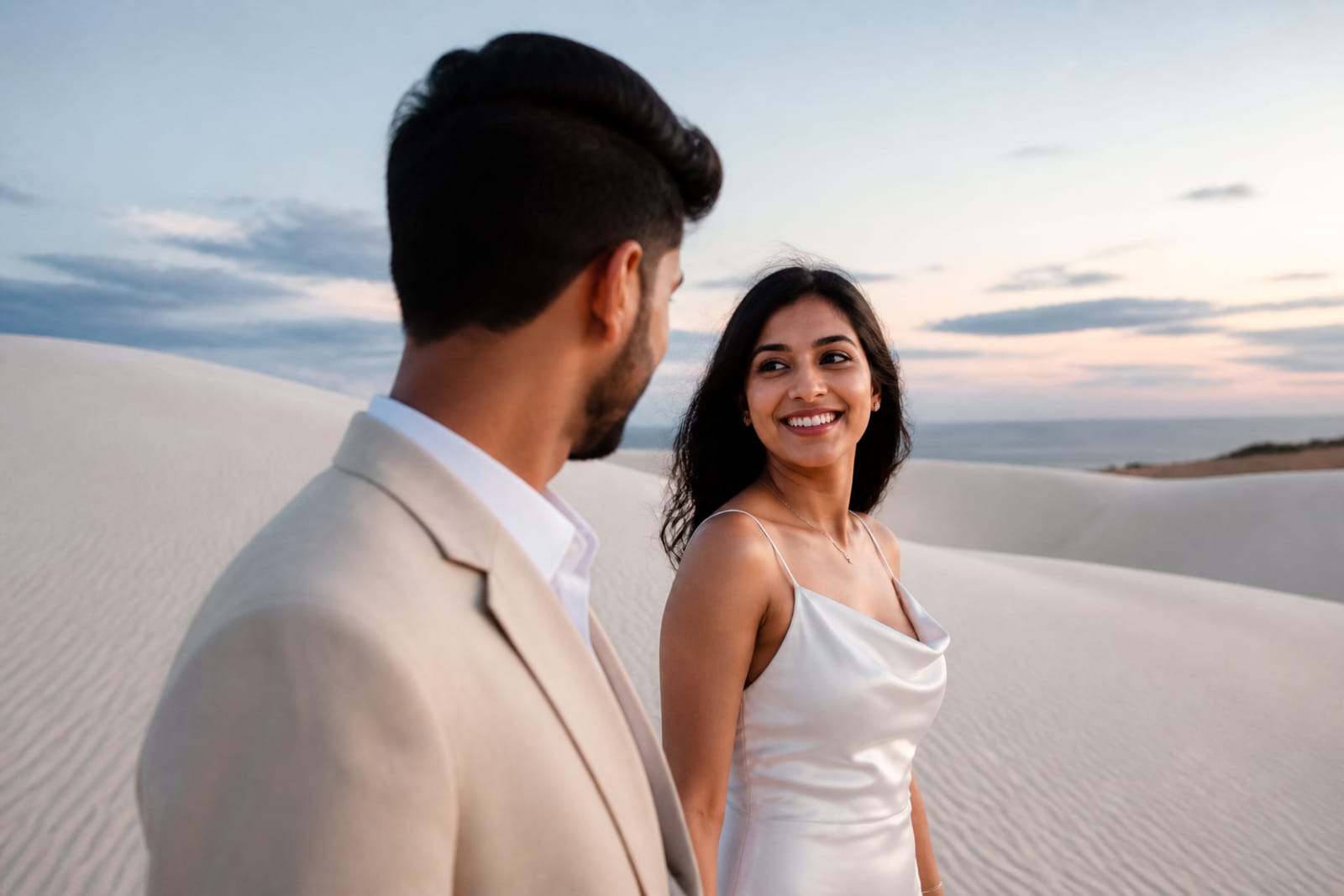
Mui Ne is one of Vietnam's driest regions. Dry season runs Nov–Apr, with the most stable light and lowest humidity; however, Nov–Mar brings strong winds that whip sand upward (especially 9 am–noon), complicating makeup and clothing. Feb–Mar is ideal for light and temperature, but Tet holidays (late Jan–mid Feb) spike crowds. May–Sep is the wet season with afternoon downpours, yet it is also when fewer tourists visit Mui Ne. June–Aug have school holidays in some countries, bringing family visitors, but late May, early June, and Sept–early Oct see the fewest domestic and international tourists. Winds are gentler May–Aug, reducing sand blown during shoots. Trade-off: you'll need a backup plan for afternoon rain, but you'll likely have the dunes to yourselves.
| Season | Light & wind | Crowds | Rain risk | Best for |
|---|---|---|---|---|
| Nov–Jan | Stable, strong winds | High (peak tourist) | Low | Willing to wait; consistent light preferred |
| Feb–Mar | Excellent, windy | Very high (Tet) | Low | Avoid Feb; Mar works if pre-Tet |
| Apr–May | Good, calming | Moderate | Low–medium | Sweet spot: fewer crowds, stable light |
| Jun–Aug | Soft, light winds | Low | Medium–high | Tolerating rain for isolation; gentler sand |
| Sep–Oct | Warm, variable wind | Low–moderate | High (typhoon risk) | Late Sep best; early Oct risky |
What time should you arrive at the dunes?
Most couples arrive 5:30–6:00 am and shoot until 7:30 am. If isolation matters, aim for 5:00–5:15 am—you'll be setting up before the main wave arrives. Sunrise at Mui Ne varies by month (roughly 6:00 am in Jan, 5:15 am by May, 6:30 am by Dec), and soft golden light extends 45–60 minutes after sunrise. A local photographer will know whether 5:00 am gives you an empty dune or simply an earlier crowd. Discuss with them: do they have transport to the dunes, or do you need to arrange a driver or rent a car? Some photographers work with a driver or own transport; others expect you to meet them on-site. Clarify who handles the timeline—a photographer confident in their location knowledge will say "we'll shoot the wide overview at 5:40 am, change outfits by 6:20 am, and work closer details as light warms" rather than "just meet me at sunrise."
How do you find and vet a local Mui Ne photographer?
Cáo Studio operates in Hanoi, Ho Chi Minh City, and Hoi An; we do not shoot in Mui Ne. To find a capable local photographer, start with referrals from your accommodation (resorts and hotels often recommend trusted vendors). Search Instagram for "Mui Ne couples photoshoot" or "Mui Ne pre-wedding" and filter by recent posts (last 3 months); look for galleries showing multiple outfits, natural light framing, and frames taken at different dune positions (not just the main slope). Contact 2–3 photographers and ask:
- Have you shot couples on red dunes in the last six months? (Recent work = current access knowledge.)
- What time do you start, and which dune section do you use? (Vague answers are a red flag.)
- If the main dune is crowded, where's your backup? (A good answer names a specific spot.)
- Do you offer outfit changes, and how many outfits fit in your session? (Crowd-free shoots benefit from swaps: áo dài, dress, casual wear—each feels fresh in soft light.)
- How many edited photos and video will I get, and in what timeframe? (Expect 48–72 hours for edited stills; video often takes 1–2 weeks.)
- Do you bring a makeup artist, or should I hire one separately? (One integrated team—photographer, makeup, hair—ensures cohesion; separate vendors add coordination risk on-site.)
A photographer comfortable answering specifics is more reliable than one offering flat packages.
What should you wear to avoid sand and manage multiple looks?
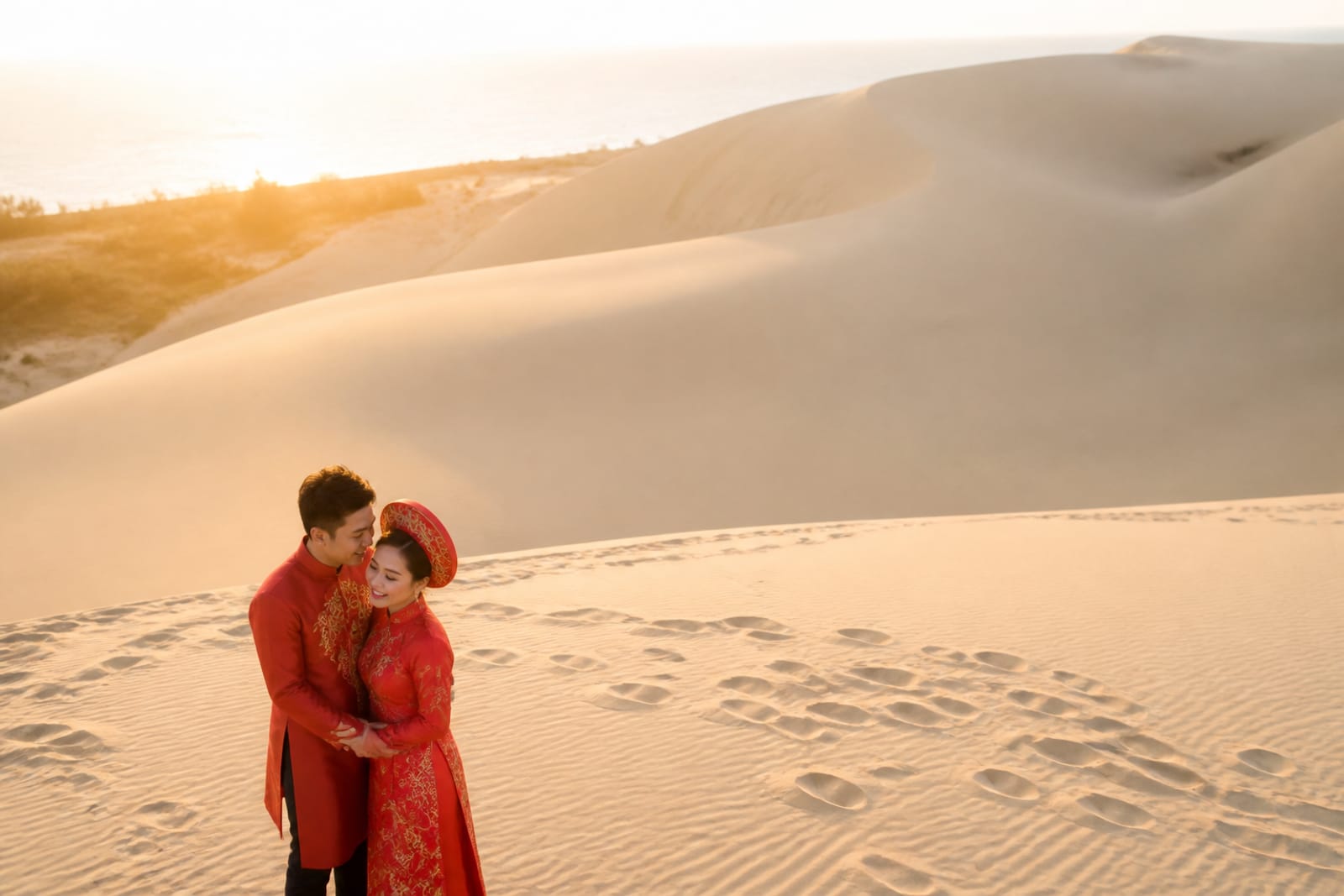
Red sand clings to light fabrics and shows dust on white easily. For dune shoots, wear layers you can remove or swap: an áo dài (traditional Vietnamese tunic) photograph beautifully against red sand and require minimal touch-ups between takes; a linen or cotton dress in jewel tones (emerald, burgundy, navy) won't show sand as readily as pastels. Avoid synthetic fabrics that stick to sand. If you're bringing two outfits, wear the heavier/more formal first (the áo dài, for example) while light is softest and your makeup is fresh, then change into something lighter for medium and close-up frames as light hardens. Inform your photographer in advance; a photographer experienced with dune shoots will frame outfit changes strategically—changing between light phases rather than mid-light, so the visual feel doesn't jump.
For couples, coordinate without matching: one person in a light neutral (white linen shirt, cream áo dài) and the other in a deeper tone creates visual separation and balances composition. Sand gets into everything—bring wet wipes or a small towel for quick touch-ups between setups. Shoes: wear sandals you can remove, or accept that sand will coat shoes; ask the photographer how they prefer you to walk (some frame barefoot steps; others frame shoes for stability).
What's the honest trade-off: time vs. isolation vs. outfit changes?
A 2–3 hour dune session allows one outfit (or quick changes within the same look), guaranteed light consistency, and minimal crowd overlap if you start early. A 4–5 hour session (starting 4:45–5:00 am, finishing 9:30–10:00 am) includes sunrise, outfit changes, a break for makeup touch-up, and a final set as light shifts toward harder midday tones—but you risk seeing tourist buses arriving by 8:30 am. Discuss with your photographer: is speed or comprehensiveness your priority? A crowd-minimization approach often means fewer outfit changes, tighter framing (wide, medium, detail, rather than 200+ shots), and one cohesive story rather than a full-day narrative. That's not worse—it's focused. Compare this to a couple photoshoot in a city like Hanoi or Ho Chi Minh City, where you can move between locations and manage crowds differently; dune light is singular and time-locked, so crowds are your main variable to control.
What to check before you book a Mui Ne photographer
- Portfolio dates: Ask when their recent dune couples work was shot. Seasons affect access and conditions; a 2024 portfolio shot in Jan may not reflect May conditions.
- Session length & turnaround: Confirm hours on-site, number of edited images, delivery timeline, and whether video is included.
- Outfit & makeup: Clarify if the photographer brings or coordinates makeup/hair, or if you hire separately. An integrated team reduces morning logistics.
- Backup plan: Ask what happens if weather turns (afternoon rain) or crowds peak earlier than expected. Do they reschedule, shoot elsewhere, or shorten the session?
- Cost factors (not amounts): Budget varies by season (peak Feb–Mar vs. quieter May–Sep), session length, and whether the photographer includes an assistant or travel from elsewhere. Ask "is this price higher in school holidays?" and "what's included?"—then confirm via WhatsApp or email before paying.
- Local knowledge: A photographer who names specific dune sections, explains wind patterns, and describes how they frame light in each season is more trustworthy than one offering a generic "sunrise dune shoot" package.
---
If you're planning a pre-wedding session in Ho Chi Minh City or Hanoi, Cáo Studio handles everything—outfit, hair, makeup, direction, and editing—in one integrated team. We don't operate in Mui Ne, but our pre-wedding photoshoot process shows how one team shoots better than vendors stitched together. For Mui Ne, the same principle applies: find a local photographer who knows the dunes and can answer the questions above.
📸 Explore pre-wedding shoots in Ho Chi Minh City & Hanoi | 💄 Makeup & hair coordination | 🌸 See couple sessions in our lookbook
---
FAQ
Can I shoot Mui Ne red dunes in the rainy season without a backup date?
Yes, but afternoon downpours (typically 2–4 pm) are common May–Nov. Shoot sunrise to late morning, when rain is rare. Late May, June, and September have the gentlest weather; Oct–Nov sees typhoon-track moisture and heavier downpours. Ask your photographer how they've handled rain in past shoots.
Should I hire a makeup artist in Mui Ne or do it myself?
If you're comfortable with touch-ups and carry supplies, do it yourself—one fewer person to coordinate at 5 am. If you want professional finish and have a makeup artist friend or local vendor you trust, book them early (they may not answer on the day). A photographer familiar with dune shoots can advise whether they've worked with local makeup artists or if you should arrange it in advance.
Do I need a permit or guide to access the red dunes?
Most red dune areas in Mui Ne are open to visitors without formal permits, but access via the main carpark may charge an entry fee. Check with your photographer or accommodation for current requirements and costs. A local photographer will handle access logistics; confirm this before booking.
How many outfits can I change into during a dune shoot?
In a 3-hour session starting early, expect 1–2 outfit changes comfortably (setup, shoot, change, shoot again). In 4–5 hours, you can manage 2–3 outfits without rushing. Each outfit change costs 15–20 minutes for wardrobe, makeup touch-up, and repositioning. Ask your photographer to propose a timeline and clarify how many outfit setups they've shot successfully on dunes before.
What's the best way to avoid sand damaging clothes and makeup?
Bring wet wipes or a damp cloth for quick cleanups between setups. Wear clothes you don't mind getting sand on (red sand shows on light fabrics). Ask your photographer if they prefer you barefoot, wearing removable shoes, or if they frame you in a way that hides sand. Choose a makeup style that sets well (matte products over dewy); a makeup artist experienced with outdoor shoots can recommend products that hold in heat and humidity.
If crowds arrive while we're shooting, can we move to a quieter dune section?
Yes, if your photographer knows alternative sections. Discuss escape routes and backup dune spots during your pre-booking call. A local photographer with 6+ months of recent dune work will have scouted quieter areas. Arriving by 5:15 am minimizes the chance you'll need to move mid-session.
FAQ
Can I shoot Mui Ne red dunes in the rainy season without a backup date?
Yes, but afternoon downpours (typically 2–4 pm) are common May–Nov. Shoot sunrise to late morning, when rain is rare. Late May, June, and September have the gentlest weather; Oct–Nov sees typhoon-track moisture and heavier downpours. Ask your photographer how they've handled rain in past shoots.
Should I hire a makeup artist in Mui Ne or do it myself?
If you're comfortable with touch-ups and carry supplies, do it yourself—one fewer person to coordinate at 5 am. If you want professional finish and have a makeup artist friend or local vendor you trust, book them early (they may not answer on the day). A photographer familiar with dune shoots can advise whether they've worked with local makeup artists or if you should arrange it in advance.
Do I need a permit or guide to access the red dunes?
Most red dune areas in Mui Ne are open to visitors without formal permits, but access via the main carpark may charge an entry fee. Check with your photographer or accommodation for current requirements and costs. A local photographer will handle access logistics; confirm this before booking.
How many outfits can I change into during a dune shoot?
In a 3-hour session starting early, expect 1–2 outfit changes comfortably (setup, shoot, change, shoot again). In 4–5 hours, you can manage 2–3 outfits without rushing. Each outfit change costs 15–20 minutes for wardrobe, makeup touch-up, and repositioning. Ask your photographer to propose a timeline and clarify how many outfit setups they've shot successfully on dunes before.
What's the best way to avoid sand damaging clothes and makeup?
Bring wet wipes or a damp cloth for quick cleanups between setups. Wear clothes you don't mind getting sand on (red sand shows on light fabrics). Ask your photographer if they prefer you barefoot, wearing removable shoes, or if they frame you in a way that hides sand. Choose a makeup style that sets well (matte products over dewy); a makeup artist experienced with outdoor shoots can recommend products that hold in heat and humidity.
If crowds arrive while we're shooting, can we move to a quieter dune section?
Yes, if your photographer knows alternative sections. Discuss escape routes and backup dune spots during your pre-booking call. A local photographer with 6+ months of recent dune work will have scouted quieter areas. Arriving by 5:15 am minimizes the chance you'll need to move mid-session.
Ao dai, makeup, hair and a local photographer in Hanoi or Saigon — one WhatsApp message.