/pre-wedding-photoshoot
Avoid crowds at O Quy Ho pass: pre-wedding photo guide
O Quy Ho pass (Fansipan cable car road, northern Vietnam near Sa Pa) is a high-altitude hairpin stretch favored for pre-wedding shoots — the light is clean, the turns theatrical, and the scale epic. The problem: midday crowds (tourists, motorbikes) blur the frame and heat flattens the light. Best windows are dawn (5:30–7:00 am) or late afternoon (4:30–6:30 pm) before the sun dips behind the range. You'll need a Sa Pa–based photographer familiar with permits (road access varies) and transport logistics (Hanoi is 5+ hours away). Cáo Studio does not shoot in Sa Pa — the distance and permit complexity exceed our standard Hanoi, Ho Chi Minh City and Hoi An service areas. This guide helps you plan a local hire or assess whether the logistics suit your pre-wedding day. ---
Why does O Quy Ho fill with crowds by late morning?
O Quy Ho sits on Fansipan cable car access road. Tour groups and independent travelers reach it by 8:30–9:00 am, peak between 10 am–2 pm, then thin after 4 pm. The road itself is narrow (one lane plus pullouts); tour buses stop at scenic hairpin 11 (the most photographed turn). Once three or four buses stack up, your couple can't walk or pose without interruption. The light also hardens: at 11 am–3 pm, sun angle is steep, shadows are harsh, and the dramatic valley below washes out. To avoid this, you shoot at either end of the day when light is low, soft and directional.
📸 Book on WhatsApp — pre-wedding & elopement
Which dawn or dusk slot gives you the best light?
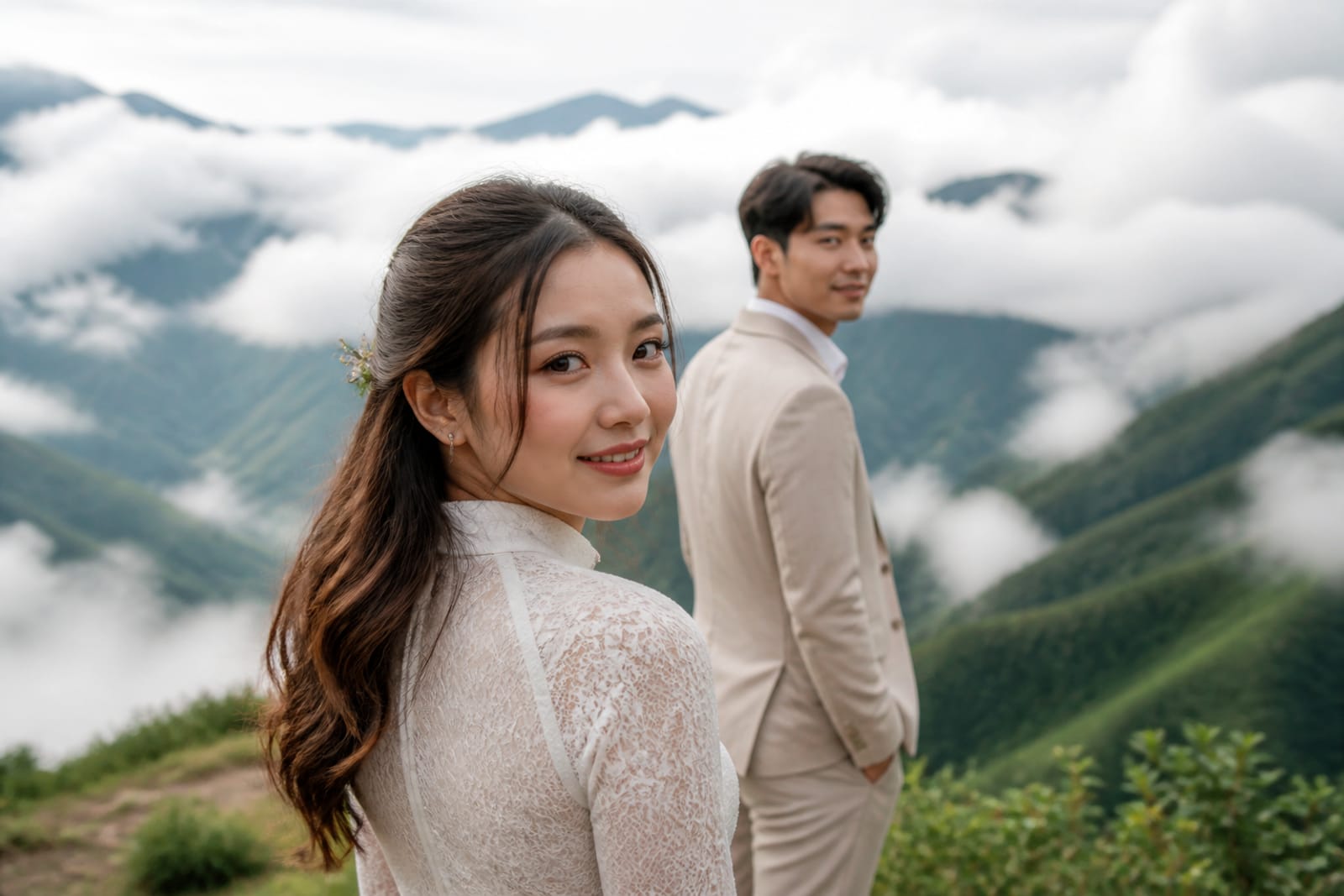
Dawn (5:30–7:00 am): Soft sidelight grazes the hairpins; the valley is still misty or in shadow, creating depth. Tourist buses don't arrive until 8:30 am. You have the road to yourself for 60–90 minutes. The trade-off: you'll be cold (above 1,500 m, temps drop to 10–15°C even in summer), and you need to start from Sa Pa town by 4:45 am for transport and a walk-through scout.
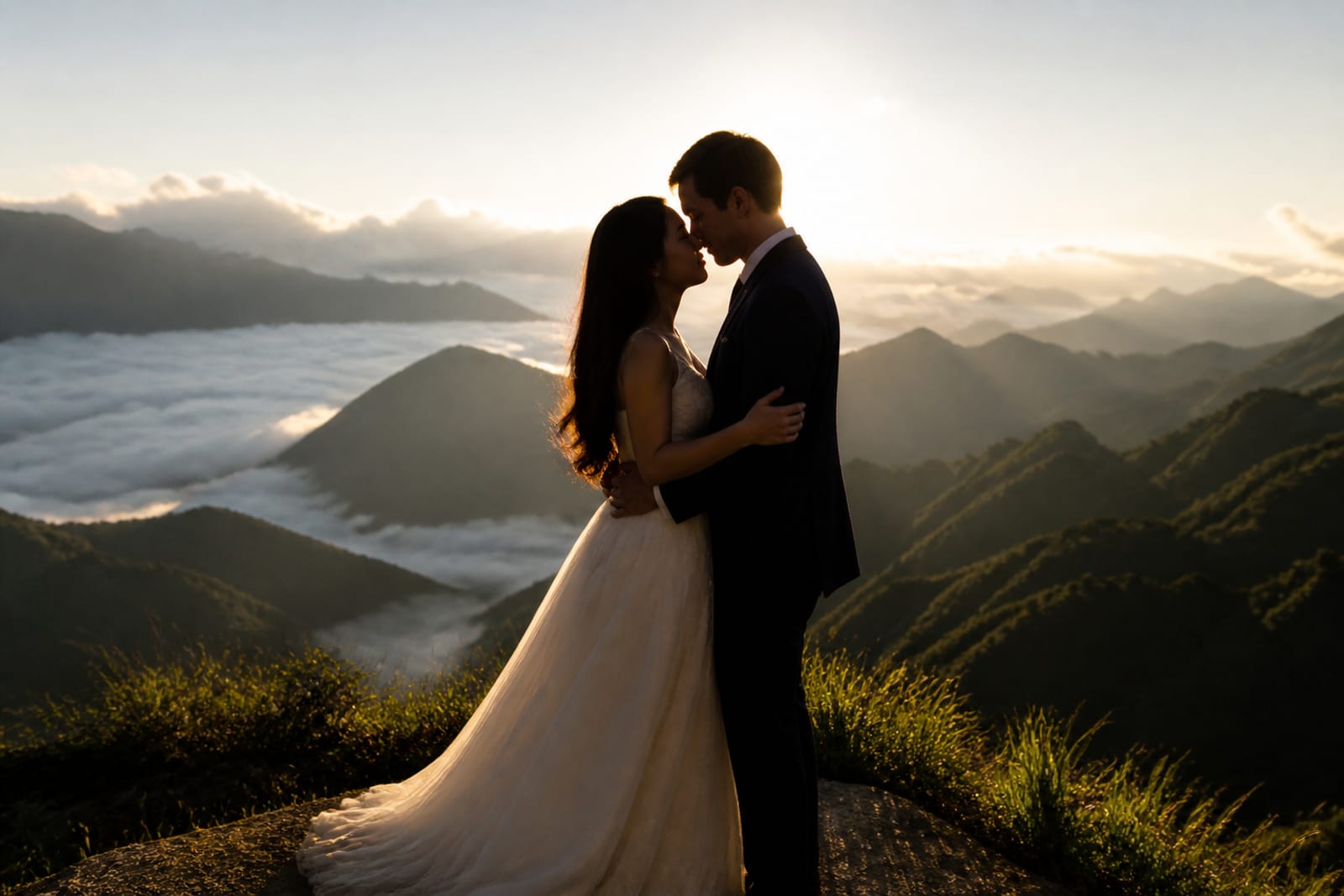
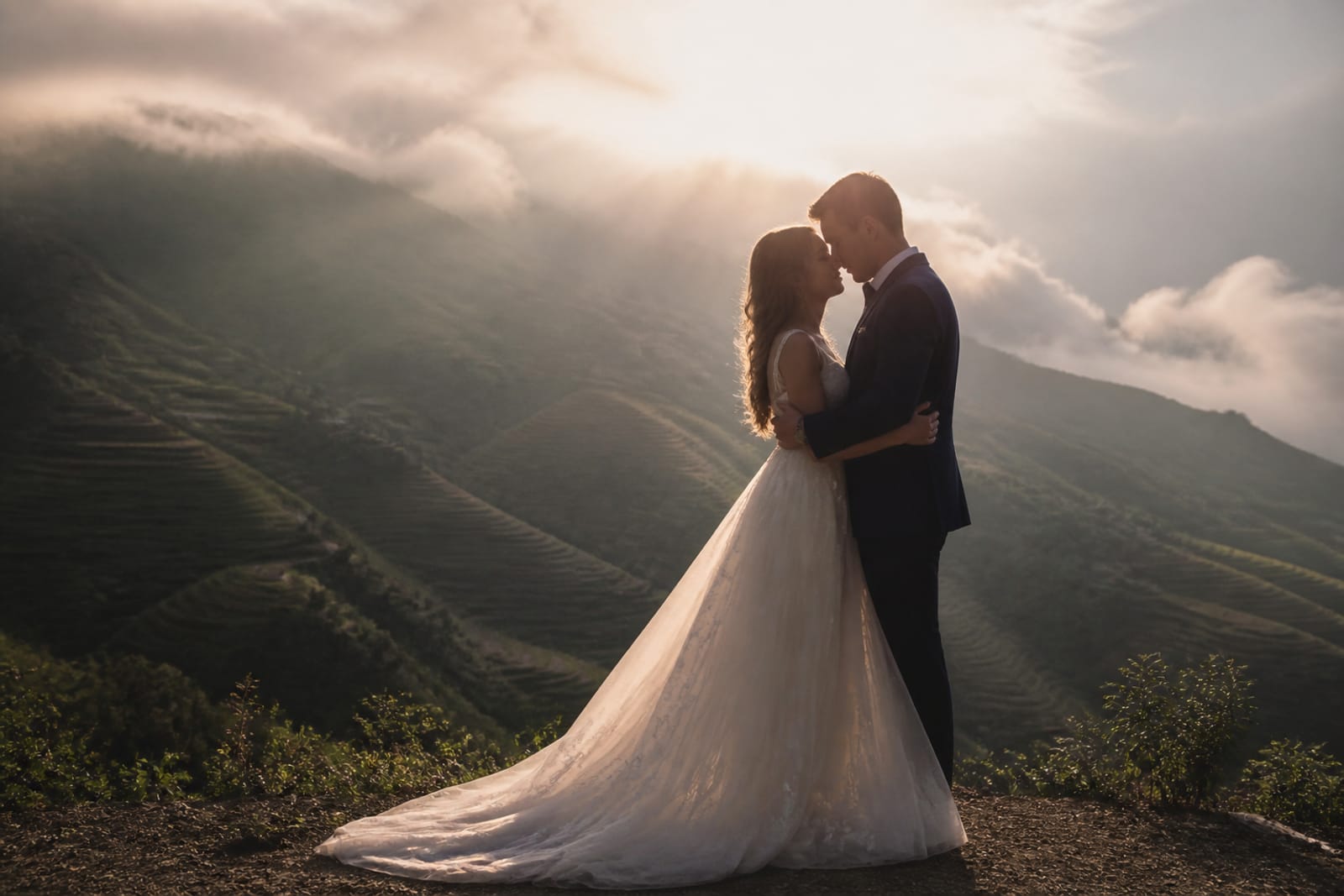
Dusk (4:30–6:30 pm): The valley below glows; backlighting silhouettes the couple against the landscape. Buses begin leaving by 4:00 pm. You have 90–120 minutes before full darkness. The trade-off: if the sky clouds over (common in wet season, May–Sep), the light fades fast, and you need to be back in Sa Pa by 7:00 pm for safe descent.
| Window | Light quality | Crowds | Weather risk | Effort |
|---|---|---|---|---|
| Dawn 5:30–7 am | Soft sidelight, misty valley | None (buses arrive 8:30 am) | Low risk, but very cold | High (early start, cold walk) |
| Mid-morning 7:30–8:30 am | Softer than 10 am, some warmth | Light (first tour groups) | Low | Medium |
| Midday 10 am–3 pm | Harsh, flat, washed-out | Severe (3–5 buses, motorbikes) | High heat stress | Low physical effort |
| Late afternoon 4:30–6:30 pm | Backlighting, golden glow | Light to none (buses leaving) | Cloud-in risk, fast fade | High (stairs, tight time window) |
The honest take: dawn suits couple shoots where moody, intimate light matters. Dusk suits dramatic landscape-couple framing, but demands weather luck and fast editing logistics.
What kind of photographer do you need for O Quy Ho?
A pre-wedding shoot at O Quy Ho requires someone who knows Sa Pa terrain, road access rules and transport coordination — not a Hanoi-based day-tripper. Here's what to vet:
Local Sa Pa–based photographer: — Owns or books reliable transport (van, guide). — Knows current road access (permits, festivals, landslides can close sections). — Has shot the pass multiple times; understands light angles per season. — Can move fast between hairpin 9, 11 and 12 (best frames) without long hikes. — Usually charges per half-day or full-day, not per-couple (they may combine two couples on the same morning).
How to find one: Ask your Sa Pa hotel concierge or guesthouse owner (they vet photographers regularly). Check local photography groups on Facebook ("Sa Pa Photographer" or "Fansipan Weddings"). Ask for Instagram portfolio — look for sharpness, light control and whether they've shot in dawn fog (shows experience).
Hanoi-based teams (including Cáo Studio) do not offer O Quy Ho services — the 5+ hour transfer, high-altitude logistics and limited editing window make it outside our operational scope. If you want a Hanoi team for your pre-wedding, we shoot in Hanoi with local landmarks (Huc Bridge at dawn, Old Quarter alleyways, West Lake at golden hour), or travel to Hoi An or Ho Chi Minh City where we manage all logistics in one team.
Should you pair O Quy Ho with a secondary Hanoi or Hoi An shoot?
Many couples shoot O Quy Ho for the dramatic landscape, then book a second half-day in Hanoi or Hoi An for intimate, styled frames. Consider this:
O Quy Ho alone (half-day, dawn or dusk): — 90–120 minutes of shooting. — Landscape, movement, couple-in-environment frames. — Raw, natural styling (light jacket, jeans, simple dress — hiking isn't romantic). — Edited gallery in 2–3 days (simple turnaround). — Best for couples who want the mountain story only.
O Quy Ho + Hanoi combo (full day split): — O Quy Ho at dawn (4:45–7:30 am): landscape, connection. — Drive back to Hanoi (arrive ~12:30 pm). — Makeup & hair at your hotel (1:00–2:30 pm): makeup & hair services refresh you into ao dai or formal dress. — Second shoot in Old Quarter or West Lake (3:00–5:30 pm): styled, intimate frames. — One edited gallery combines landscape + formal story. — Edited delivery in 3–4 days (larger edit, longer turnaround).
O Quy Ho + Hoi An combo (two separate days): — Day 1: Fly or drive Hanoi → Sa Pa, O Quy Ho shoot at dawn, return to Hanoi or stay in Sa Pa. — Day 2 or Day 3: Fly/drive to Hoi An, Hoi An pre-wedding shoot (lantern town, river, ancient street) at dusk. — Two independent photographers or one (if your Hoi An team can coordinate Sa Pa sub-contractor — ask before booking). — Two edited galleries, separate workflows.
The cost factor: O Quy Ho adds transport, altitude guide fee, and a half-day photographer rate. Hanoi or Hoi An second shoots add makeup/hair (if not already at your hotel) and a second photographer or second session fee. Bundle deals sometimes exist — ask on WhatsApp whether combining locations reduces overall spend.
What should you confirm before booking an O Quy Ho pre-wedding?
Before you hire anyone for O Quy Ho:
- Road access: Ask the photographer if the pass is currently open and if permits are required. In wet season (May–Sep), landslides can close sections for days. In Tet (late Jan–mid Feb), it may be congested or restricted.
- Transport included: Confirm whether transport from Sa Pa town is included or costs extra, and what vehicle (van, motorbike, etc.). A couple + photographer + guide typically needs a van.
- Timing flexibility: If dawn clouds roll in, can you shift to the afternoon shoot instead? Ask the photographer's cancellation/reschedule policy.
- Number of edited photos: Ask how many finished images you'll receive and by when (typical: 30–60 edited photos within 2–3 days for a half-day shoot).
- Outfit suitability: O Quy Ho means hiking or climbing stairs. Confirm the photographer has shot couples in hiking boots, light jackets and jeans, not formal gowns. If you want an ao dai shoot, you'll need a secondary location with stairs/paths that suit the dress — ao dai photoshoots work best on flat terrain or gentle slopes.
- Weather plan: What happens if fog, rain or clouds persist? Do you reschedule, shoot anyway, or get a refund?
- Equipment weight: Photographers carry tripods, backup batteries (high altitude drains them faster), and multiple lenses uphill. Confirm they've done this before.
Check before committing: See a portfolio of O Quy Ho shoots (same season, same weather as your date). Ask for references from recent couples. Verify the photographer's response time on WhatsApp or email (a slow responder will miss your dawn light window).
Is a pre-wedding at O Quy Ho worth the logistical effort?
O Quy Ho delivers frames you can't get in a city. The scale, isolation and clean light are genuine assets. But the logistics are real: early wake, cold exposure, high-altitude fatigue, and reliance on one weather window.
Choose O Quy Ho if: — The mountain landscape is central to your wedding story. — You're already in Sa Pa for your honeymoon or a northern tour. — You have 2+ days to allow for weather reschedules. — You want bold, environmental portraiture over soft, intimate styling.
Skip O Quy Ho if: — You want maximum control, comfort and fast turnaround. — You're on a tight schedule (one afternoon in northern Vietnam). — You prefer styled, formal frames to adventure aesthetics. — Budget is tight (transport, local guide, photographer all add up).
For a more controlled, single-team experience, Cáo Studio's pre-wedding photoshoots in Hanoi, Hoi An or Ho Chi Minh City give you one director, one message, and edited frames in 48 hours. See the lookbook for the range. If Sa Pa is still in your heart, a local photographer is your only option — use the vetting checklist above to find a skilled one.
---
FAQ
Do I need a permit to shoot at O Quy Ho pass?
Road access can change. Check with a Sa Pa–based photographer or your hotel concierge before booking — they'll know current permit rules and any seasonal closures.
Can an ao dai shoot work at O Quy Ho?
Not practically. Ao dai is floor-length and delicate; O Quy Ho involves steep stairs, wind, and rocky ground. Pair O Quy Ho with jeans/jacket frames, then shoot the ao dai on flat terrain (Hanoi Old Quarter, Hoi An Ancient Town).
How early do we need to start on shoot day?
For a dawn shoot, plan to leave Sa Pa town by 4:45–5:00 am. Your photographer will scout the road first, then position you. Expect to shoot until 7:00–7:30 am, then drive back for breakfast.
What if it's foggy or cloudy at dawn?
Fog can be atmospheric (soft, moody light) or impenetrable (nothing visible). Ask your photographer's policy: do you proceed, reschedule, or get a partial refund? Ideally, agree on a "low-visibility clause" before booking.
Should we do O Quy Ho or a Hanoi pre-wedding instead?
O Quy Ho suits couples who want drama and scale; Hanoi suits those who want comfort, style control and faster turnaround. Many couples do both (two days, two locations, one team if possible). Ask about bundle pricing on WhatsApp — a Hoi An or Hanoi photographer can sometimes coordinate a Sa Pa sub-contractor for a seamless experience.
FAQ
Do I need a permit to shoot at O Quy Ho pass?
Road access can change. Check with a Sa Pa–based photographer or your hotel concierge before booking — they'll know current permit rules and any seasonal closures.
Can an ao dai shoot work at O Quy Ho?
Not practically. Ao dai is floor-length and delicate; O Quy Ho involves steep stairs, wind, and rocky ground. Pair O Quy Ho with jeans/jacket frames, then shoot the ao dai on flat terrain (Hanoi Old Quarter, Hoi An Ancient Town).
How early do we need to start on shoot day?
For a dawn shoot, plan to leave Sa Pa town by 4:45–5:00 am. Your photographer will scout the road first, then position you. Expect to shoot until 7:00–7:30 am, then drive back for breakfast.
What if it's foggy or cloudy at dawn?
Fog can be atmospheric (soft, moody light) or impenetrable (nothing visible). Ask your photographer's policy: do you proceed, reschedule, or get a partial refund? Ideally, agree on a "low-visibility clause" before booking.
Should we do O Quy Ho or a Hanoi pre-wedding instead?
O Quy Ho suits couples who want drama and scale; Hanoi suits those who want comfort, style control and faster turnaround. Many couples do both (two days, two locations, one team if possible). Ask about bundle pricing on WhatsApp — a Hoi An or [Hanoi photographer](/hanoi) can sometimes coordinate a Sa Pa sub-contractor for a seamless experience.
Ao dai, makeup, hair and a local photographer in Hanoi or Saigon — one WhatsApp message.