/pre-wedding-photoshoot
Avoid Crowds at Tan Dinh Pink Church: Wedding Photo Tips
Tan Dinh Pink Church (Tan Dinh Basilica) in District 1, Ho Chi Minh City, draws up to 50 visitors per hour during peak times, making midday and weekend shoots nearly impossible for uninterrupted photos. Crowds thin sharply before 7:00 a.m. and after 5:00 p.m., but exterior light hardens at midday. The church does not reserve times for tourists or couples; you must arrive early, pay a small donation if entering, and expect foot traffic. A guided pre-wedding photoshoot with Cáo Studio – Makeup & Photoshoot (Ho Chi Minh City branch) handles timing, light management, and crowd avoidance so you focus on the shoot. Private timing through a local photographer or studio ensures unobstructed access and professional positioning. Success depends on season (dry Feb–Aug is clearest), hour (golden hour 5:30–6:30 p.m. is ideal but still busy), and whether you book a guide or shoot solo.
The Tan Dinh Pink Church problem is real: it is Vietnam's most photographed church and has no ticketing, no time slots, and no crowd control. Solo couples waste 40 minutes posing around pedestrians. A photoshoot session with professional guidance solves this by timing arrival, securing permission, and using light correctly. This guide compares your options and tells you exactly what to check before booking.
Why mornings (before 7:00 a.m.) fail even though they sound quiet
Early arrivals avoid tourist groups, but the church faces east and north, so pre-7:00 a.m. light is blue-grey and flat. Your ao dai or bridal gown looks desaturated; skin tones are cool and unflattering. The west-facing facade—the iconic pink face most couples want—sits in shadow until 10:00 a.m. and is front-lit (harsh, unflattering) from 11:00 a.m. to 2:00 p.m. Early morning is quiet but photographically weak. A photographer knows this and schedules around it, not around quiet alone.
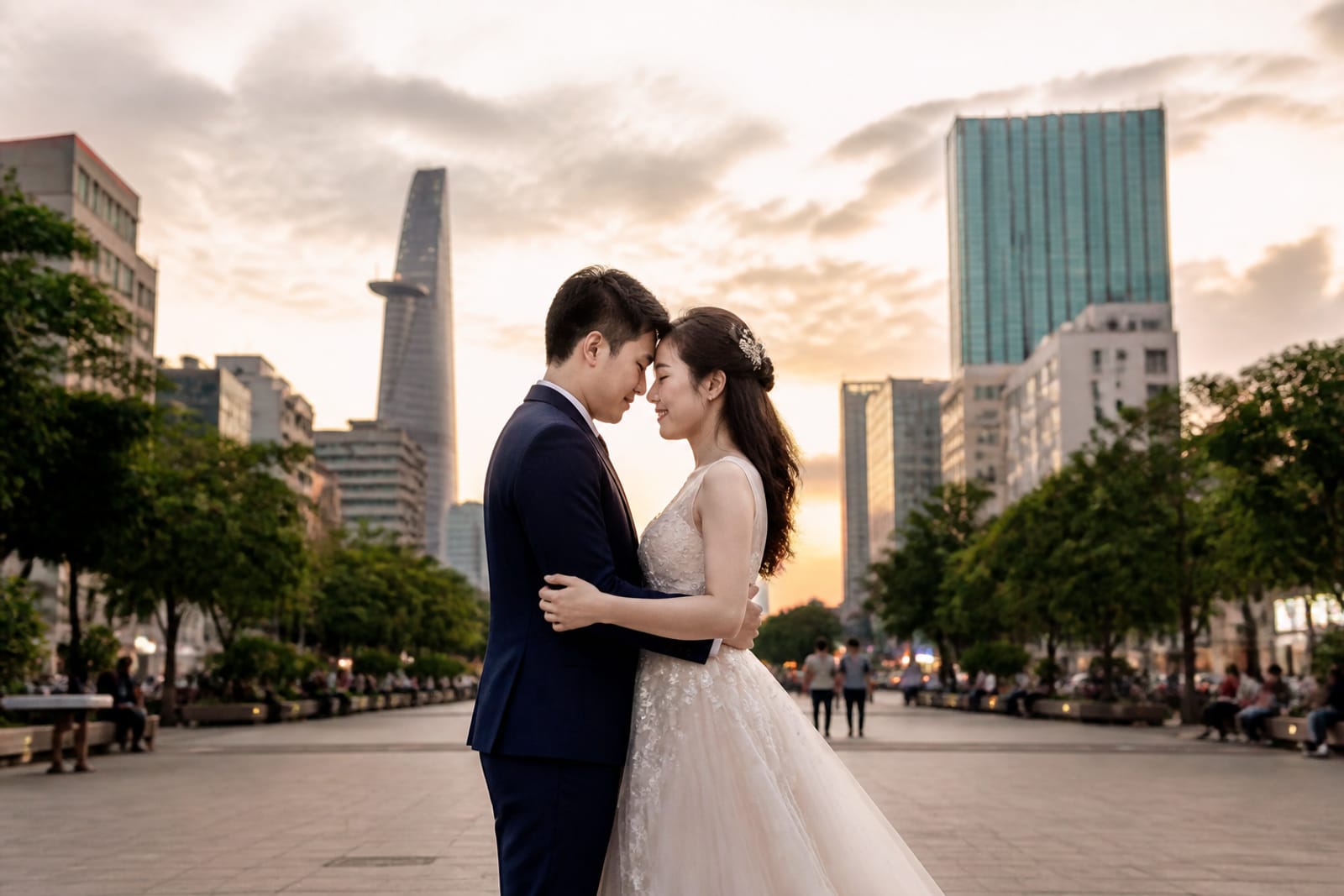
Golden hour (5:30–6:30 p.m.) offers the best light but attracts other couples
The side and rear facades glow warm amber; skin tones warm; colors pop. The pink façade gets directional, three-dimensional light. This is why everyone shoots then—you will compete with 15–20 other couples, groups, and phone photographers in a 90-minute window. Booking with a studio (Cáo Studio's Ho Chi Minh City branch) reserves a dedicated photographer who positions you while others are waiting their turn, squeezes in 25–40 minutes before the crowd peaks, and moves to quieter side angles. Solo shooting during golden hour means standing in lines for the main facade.
Comparison: solo vs. guided vs. hybrid shoots
| Option | Best for | Light control | Crowd avoidance | Cost factors |
|---|---|---|---|---|
| Solo couple (no guide) | DIY photographers, tight budgets | Limited; you chase light | Luck-based; mornings are quiet but dim | None, but hours wasted |
| Guided session (pre-wedding photoshoot) | Couples wanting certainty, professional output, minimal hassle | Professional; timed for optimal hours | Scheduled arrival + positioning | Time, makeup, location variety |
| Hybrid: makeup at hotel + self-shoot | Couples wanting professional look, then freedom to explore | Self-managed; makeup artist advises | None; you navigate crowds | Makeup service + your time |
Guided sessions work because the photographer knows the site's permit rules (no flash inside; donations requested; no drones), times the arrival to miss bus groups (usually 10:00 a.m.–12:00 p.m. and 2:00–4:00 p.m.), and uses a tripod or reflector while you relax. Solo shooting requires you to scout light, dodge pedestrians, and reset between shots.
How season affects crowds and light at Tan Dinh
Ho Chi Minh City's dry season runs December to April; wet season is May to November. Dry season (Feb–Aug) is clearest because morning haze lifts by 6:30 a.m. and afternoon light is sharp. December–January is also dry but cooler and has more domestic holiday visitors. May–September brings afternoon downpours (usually after 3:00 p.m.) and heat haze that softens midday light; golden hour is less dramatic. October–November is typhoon season with sudden, heavy rain and unpredictable light. Book a February–July session and you get predictable light and fewer casual tourists. A photographer planning your session checks the forecast 48 hours ahead and has backup indoor angles.
What happens on the day: real timings and unexpected obstacles
Arrival: A guide books 90 minutes of shooting and arrives 15 minutes early to scout light and position reflectors. A solo couple shows up at golden hour and finds 30 people on the church steps already. Inside: The church interior is dim, cool, and often has a quiet prayer service (check hours locally; it is a working basilica). Flash is forbidden; tripods need permission. A studio photographer knows to shoot the couple in side aisles or the lobby; solo shooters argue with staff or leave disappointed. Outside: The pink facade is the money shot but also the most trafficked. A photographer pre-frames shots using side angles—the rear courtyard, the east garden, the left portico—where light is still good and pedestrians are few. You get 15–20 solo portraits plus couple shots; solo shooters get the facade with strangers in the background and spend time editing them out. Sunset: Light fades fast (by 6:45 p.m. in winter, 7:15 p.m. in summer). A photographer wraps up one minute before light dies; solo shooters chase it and end up with silhouettes or regret. Donation: A small cash donation (amount varies) is customary if you enter to shoot. A guide brings exact change; solo shooters fumble and waste time.
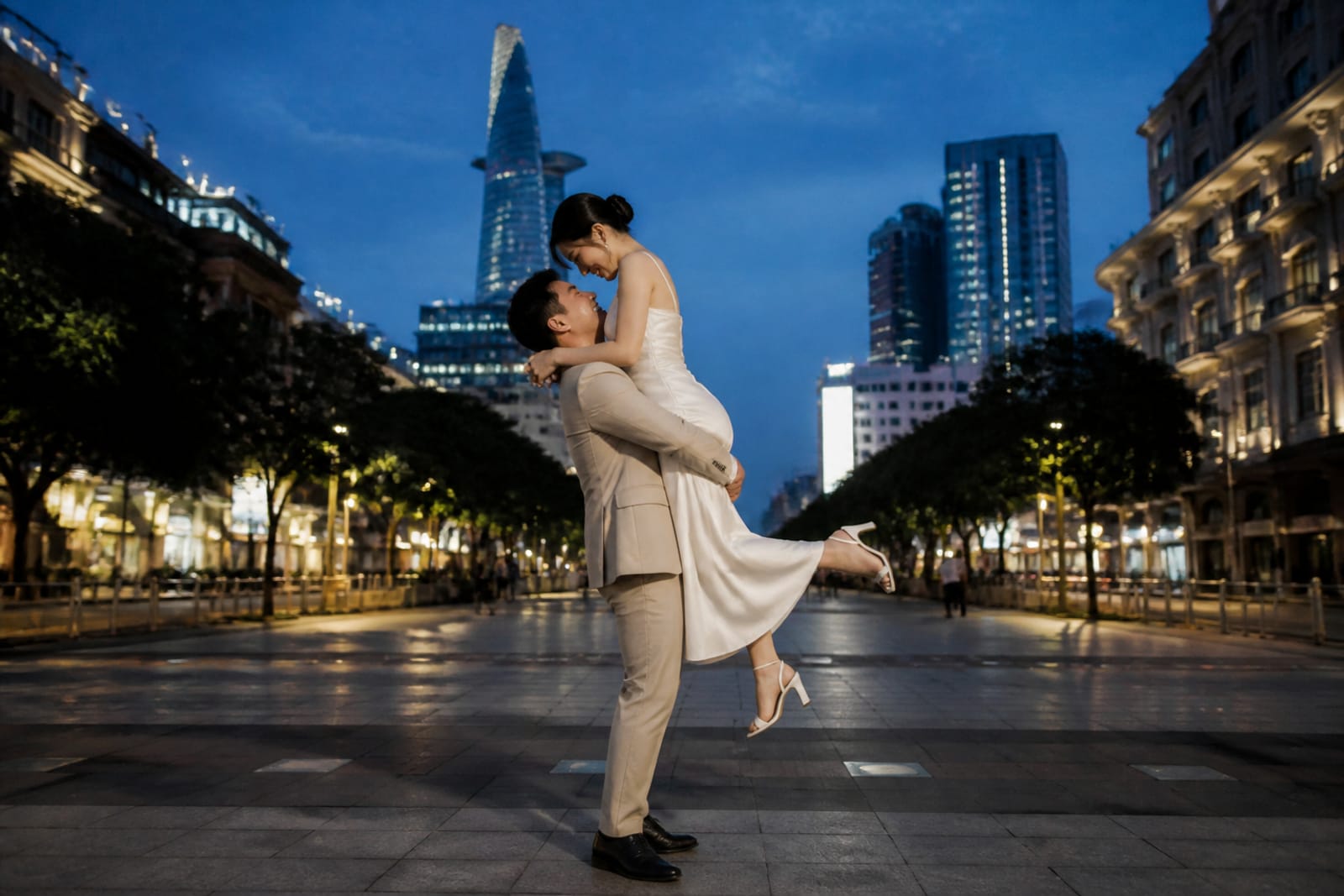
Decision framework: choosing between studio booking and DIY shooting
Ask yourself these questions in order:
- Can you compose and edit photos? If no, book a pre-wedding photoshoot with a guide. If yes, continue.
- Do you have a tripod and remote shutter? If no, book a guide. If yes, continue.
- Can you arrive before 6:30 a.m. or after 5:00 p.m.? If no, book a guide (they know off-peak side angles). If yes, continue.
- Will you accept crowds and unsharp midday light as trade-offs for saving cost? If yes, shoot solo. If no, book a guide.
- Do you want makeup and a second outfit (e.g., ao dai)? If yes, a pre-wedding session with makeup is faster and cheaper than separate services. If no, DIY is viable.
Most couples book a guide because: natural light matters; they have one shot; stress ruins the mood. A session takes logistics off your plate.
What to check before you book
If booking with Cáo Studio – Makeup & Photoshoot (Saigon branch):
- Confirm the exact start time and how long you have (usually 2–3 hours for a pre-wedding shoot).
- Ask if the package includes makeup and what outfits are offered (the specifics are confirmed on WhatsApp when you quote).
- Check whether the location fee or donation is included or if you pay it on the day.
- Verify the delivery timeline for edited images.
- Ask about weather backup; Tan Dinh has no indoor backup, so ask whether shots move to an alternate site or reschedule.
- Confirm the photographer is on-site (not sent a junior assistant).
If shooting solo:
- Scout Tan Dinh 2–3 weeks before your date at the same time you plan to shoot.
- Check the church's website or call (+84 28 3829 5360) to confirm prayer times and any restrictions that week.
- Bring a polarizing filter to reduce haze and glare on the pink facade.
- Pack a tripod, remote shutter, white reflector, and a small donation in the correct currency.
- Check the weather forecast the day before and plan a backup site (e.g., nearby District 1 streets or the Saigon River for golden hour).
- Arrive 45 minutes early to find your angle and adjust settings.
---
📸 Book a pre-wedding session | 💄 Makeup & hair for wedding day | 🌸 See the lookbook
---
Real logistics: what to wear under an ao dai for ease and comfort
If you book a guided session and choose to wear an ao dai (traditional Vietnamese tunic and trousers), know this: an ao dai is elegant but requires a tight inner slip and layers that can feel restrictive under studio lights. The silhouette is stunning in photos, but it does not breathe well in Ho Chi Minh City's 30°C+ heat. Wear lightweight cotton undergarments and a breathable slip. If you are shooting in May–September, the ao dai is still possible but you will feel warm; golden hour (after 5:30 p.m.) is kinder to comfort. Rental ao dais (check the rental service) are pre-fitted, so allow 15 minutes for fitting before shooting. A professional makeup artist will powder your face mid-session if humidity builds.
Comparing locations: why Tan Dinh is iconic but not the only option
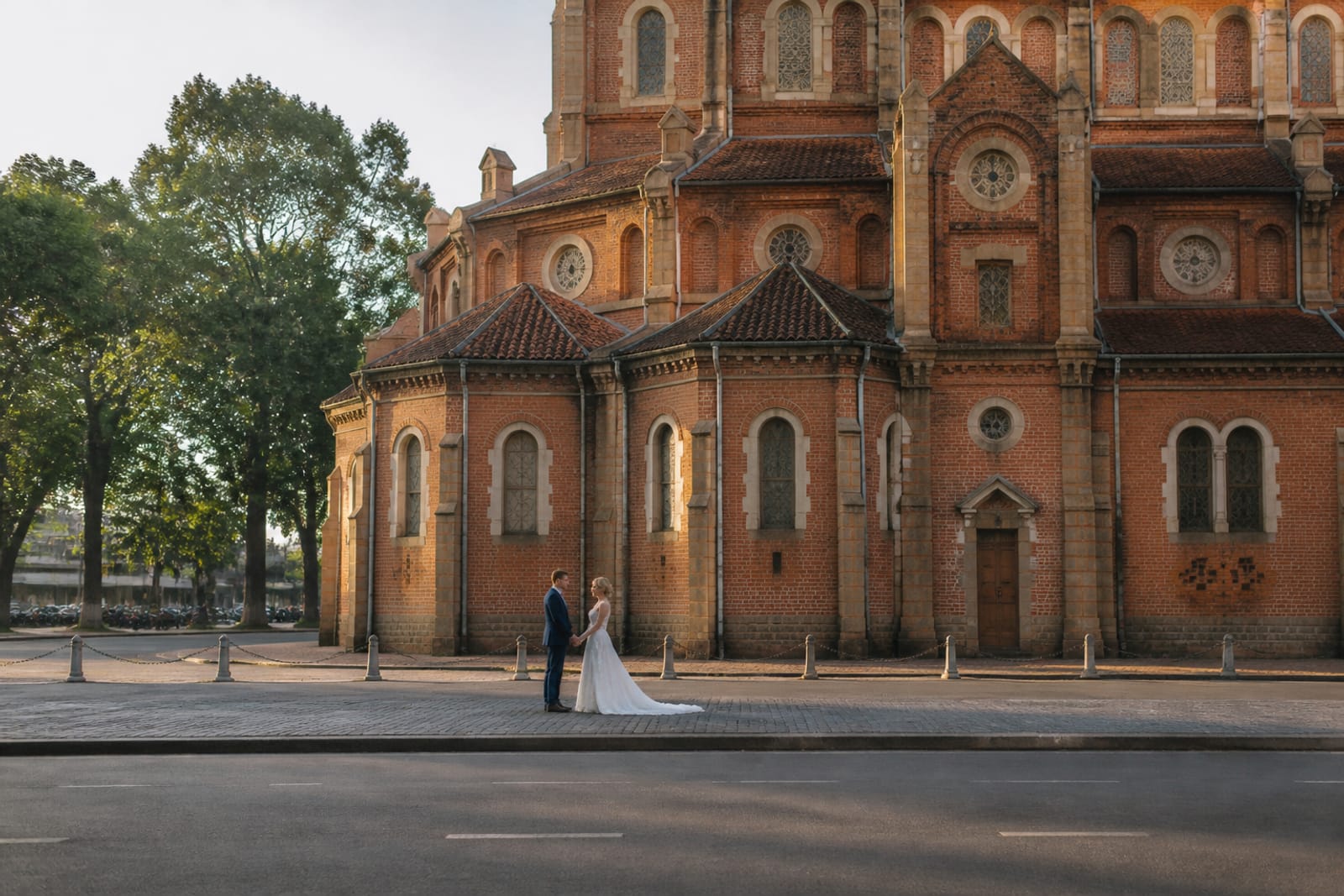
Tan Dinh's pink facade is unique and Instagram-famous, but it is crowded and the setting is urban (busy street, parked motorbikes, shop signs visible in wide shots). If you are booking a pre-wedding photoshoot and want fewer crowds, ask Cáo Studio about alternatives: the quieter Saigon Notre-Dame Cathedral (French colonial, stone, interior cool-toned light—note: check its restoration status before booking), the Binh Tay Market (golden hour, chaos-to-photo ratio is high, but energetic), or the Saigon River at dusk (zero crowds, romantic light, open backdrop). Each has its own light challenge. Tan Dinh is best for timeless, grid-friendly shots; others suit lifestyle and adventure vibes. A good photographer offers location advice based on your aesthetic.
---
📸 Book on WhatsApp — pre-wedding photoshoot | 💄 Professional makeup & hair | 🌸 Explore the lookbook
---
FAQ
Can I bring a drone to shoot Tan Dinh Church from above?
No. Vietnam prohibits unauthorized drone flights in urban areas; Ho Chi Minh City is restricted. You need a permit from the Department of Defence, which tourists rarely obtain. Stick to ground-level angles or book a photographer who knows legal workarounds (e.g., high vantage points from nearby buildings). Cáo Studio does not offer aerial shots at Tan Dinh; ask on WhatsApp if an alternate site allows it.
What time of day has the least crowd but still good light?
Early morning (6:30–7:30 a.m.) has fewer tourists but flat, cool-toned light on the pink façade. Golden hour (5:30–6:30 p.m.) has warm, flattering light but 15–20 other couples. Late afternoon (3:30–5:00 p.m.) is a sweet spot: decent side light, fewer groups than golden hour, and you can shoot until sunset. A guide navigates this trade-off; solo shooters often miss the window.
Do I need permission from the church to photograph?
The church does not issue photo permits for tourists or couples. It is a working basilica; you must respect prayer times (check locally). A small donation is customary if you enter the interior. A guide knows when services are held and avoids shooting during them. Solo shooters should call ahead or check the church's notice board.
How much does a professional guided pre-wedding shoot cost?
Pricing depends on the package length, location variety, number of outfits, and whether makeup is included. Ask Cáo Studio on WhatsApp for a quote. Cost factors include the photographer's time, travel within Ho Chi Minh City, and digital delivery. Alone, shooting at Tan Dinh is free; hiring a guide is an investment in certainty, light, and crowd avoidance.
What if it rains during my golden-hour shoot?
May–November brings afternoon downpours. A guide checks the forecast 48 hours ahead and has an indoor backup (e.g., a hotel lobby, temple interior, or a covered market). Solo shooters often miss this and go home empty-handed or get soaked. Book a session with a backup plan in writing. Ask Cáo Studio what their rain policy is when you quote.
Can I do makeup at my hotel and then shoot solo at Tan Dinh?
Yes. Book makeup & hair at your hotel separately from the photoshoot, then scout Tan Dinh yourself. You save on the guide fee but lose crowd timing, light planning, and risk wasting your makeup investment on mediocre photos. A hybrid approach works best for confident DIY photographers; most couples prefer all-in-one sessions.
Is the interior of Tan Dinh as photographable as the exterior?
The interior is dim, candlelit, and atmospheric but challenging for cameras without flash (which is forbidden). It is best for moody, close-up couple shots rather than grand vistas. The exterior pink façade is the real showstopper. A photographer uses the interior as a 5–10 minute detour for variety, not the main event.
FAQ
Can I bring a drone to shoot Tan Dinh Church from above?
No. Vietnam prohibits unauthorized drone flights in urban areas; Ho Chi Minh City is restricted. You need a permit from the Department of Defence, which tourists rarely obtain. Stick to ground-level angles or book a photographer who knows legal workarounds (e.g., high vantage points from nearby buildings). Cáo Studio does not offer aerial shots at Tan Dinh; ask on WhatsApp if an alternate site allows it.
What time of day has the least crowd but still good light?
Early morning (6:30–7:30 a.m.) has fewer tourists but flat, cool-toned light on the pink façade. Golden hour (5:30–6:30 p.m.) has warm, flattering light but 15–20 other couples. Late afternoon (3:30–5:00 p.m.) is a sweet spot: decent side light, fewer groups than golden hour, and you can shoot until sunset. A guide navigates this trade-off; solo shooters often miss the window.
Do I need permission from the church to photograph?
The church does not issue photo permits for tourists or couples. It is a working basilica; you must respect prayer times (check locally). A small donation is customary if you enter the interior. A guide knows when services are held and avoids shooting during them. Solo shooters should call ahead or check the church's notice board.
How much does a professional guided pre-wedding shoot cost?
Pricing depends on the package length, location variety, number of outfits, and whether makeup is included. Ask Cáo Studio on WhatsApp for a quote. Cost factors include the photographer's time, travel within Ho Chi Minh City, and digital delivery. Alone, shooting at Tan Dinh is free; hiring a guide is an investment in certainty, light, and crowd avoidance.
What if it rains during my golden-hour shoot?
May–November brings afternoon downpours. A guide checks the forecast 48 hours ahead and has an indoor backup (e.g., a hotel lobby, temple interior, or a covered market). Solo shooters often miss this and go home empty-handed or get soaked. Book a session with a backup plan in writing. Ask Cáo Studio what their rain policy is when you quote.
Can I do makeup at my hotel and then shoot solo at Tan Dinh?
Yes. Book [makeup & hair at your hotel](/makeup-and-hair) separately from the photoshoot, then scout Tan Dinh yourself. You save on the guide fee but lose crowd timing, light planning, and risk wasting your makeup investment on mediocre photos. A hybrid approach works best for confident DIY photographers; most couples prefer all-in-one sessions.
Is the interior of Tan Dinh as photographable as the exterior?
The interior is dim, candlelit, and atmospheric but challenging for cameras without flash (which is forbidden). It is best for moody, close-up couple shots rather than grand vistas. The exterior pink façade is the real showstopper. A photographer uses the interior as a 5–10 minute detour for variety, not the main event.
Ao dai, makeup, hair and a local photographer in Hanoi or Saigon — one WhatsApp message.