/pre-wedding-photoshoot
Best time for a pre-wedding photoshoot in Mu Cang Chai
Mu Cang Chai—a remote valley 140 km northwest of Hanoi—shoots best May–June (blue-water terraces, soft overcast) or September–early October (golden rice, crisp morning light). Both seasons suit pre-wedding work if you accept a 5–6 hour mountain drive and plan logistics with a local photographer experienced in high-altitude, uneven terrain. Avoid July–August (oppressive heat and haze) and October-end onward (rain risk). The decision hinges on your aesthetic (reflective water vs. warm grain), physical stamina, outfit choice (ao dai handling mud and steps), and whether you hire a team that owns the light on location—not one that improvises in remote terrain.
Why does Mu Cang Chai look so different season to season?
Mu Cang Chai is a patchwork of hand-carved terraces flooding with spring melt and monsoon rains. In May–June, farmers flood the paddies for planting; the water creates mirror surfaces that reflect sky and cloud. By September, those same fields ripen to amber or gold, depending on harvest timing. Each state rewrites the visual grammar: water terraces feel abstract and calm; golden rice feels warm and temporal. The trade-off is access and comfort. Water-season shoots demand careful footing on muddy banks; rice-season requires dawn starts (by 7 am, light softens; by 9 am, glare flattens the gold).
📸 Book on WhatsApp — ao dai photoshoot | 💄 Makeup & hair at your hotel | 🌸 See the lookbook
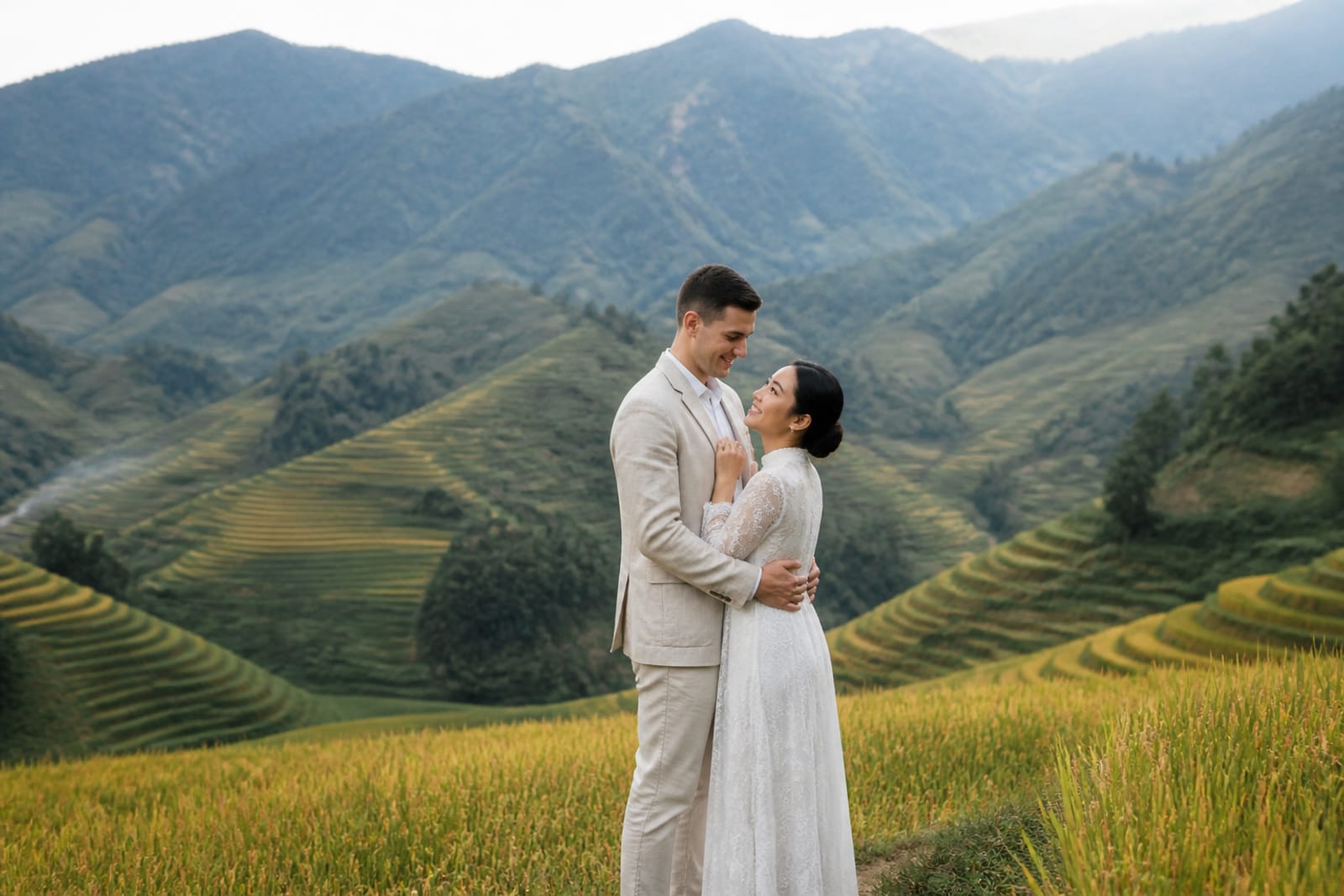
Water terraces (May–June): which conditions actually work for a pre-wedding shoot?
May–June water terraces photograph cleanly on overcast days or before 8 am. Direct sun bleaches reflection and turns the landscape flat. You'll find crowds heaviest on weekends and weekday mornings (locals and tour buses arrive 6–8 am). The risk: mid-morning haze rising off wet paddies, obscuring the distant valley. Fog is not romantic here; it's a hard compositional wall. An ao dai works if hemmed above the calf and your footwear grips wet stone steps. The humidity is high but not yet oppressive (May is cooler than June). Book a photographer who has shot water-season work before—they know which terraces retain water longest and where to position you to avoid harsh reflections in your eyes. A team experienced with location hair and makeup (like Cáo Studio's approach) saves time on muddy banks where touch-ups demand fresh water and secure ground.
Golden rice (September–early October): light, crowds and outfit considerations.
Golden rice peaks mid-September to early October, when sunlight turns the grain warm without yet flattening the landscape. This window is narrow: harvest happens fast, and rain (possible late September onward) can drench the valley overnight. You'll need pre-dawn starts—5:30–6:30 am—to catch side-lit, directional light. Tour crowds thin before 7 am, but increase sharply by 8 am. An ao dai suits the season better than spring (lower humidity, less mud), but morning dew wets the hem, and you'll walk through harvested stubble that snags fabric. Book a photographer who understands directional light in undulating terrain: they should show you a lighting plan on the day (how the sun will move relative to the terrace slope, where you'll stand to keep the light at 45 degrees from your side). This is not improvisation terrain.
How does terrain affect what you wear and how the shoot actually runs?
Mu Cang Chai is unforgiving underfoot: terraces are narrow, steps are hand-carved stone, and earth crumbles. An ao dai (traditional silk tunic) is vulnerable to mud, tears and tangling in undergrowth. If you choose an ao dai, have it tailored shorter (calf-length) and pair it with sturdy, grip-soled shoes (not sandals—you will slip). Trousers and a silk or cotton shirt work better functionally, but test your outfit on steep ground before the shoot day. Hair and makeup must account for humidity, wind (ridges funnel gusts) and sweat from climbing. A lightweight, sweat-proof foundation and a braided or pinned style survive better than loose waves. If you book a full pre-wedding photoshoot with a team that includes a hair and makeup artist, they'll anticipate these challenges and bring waterproof products and backup pins. A photographer solo will not. The shoot itself is slow: you'll walk, pause for frames, climb to a higher terrace, and repeat. Expect 2–3 hours on location and wear hiking boots you're comfortable being photographed in.
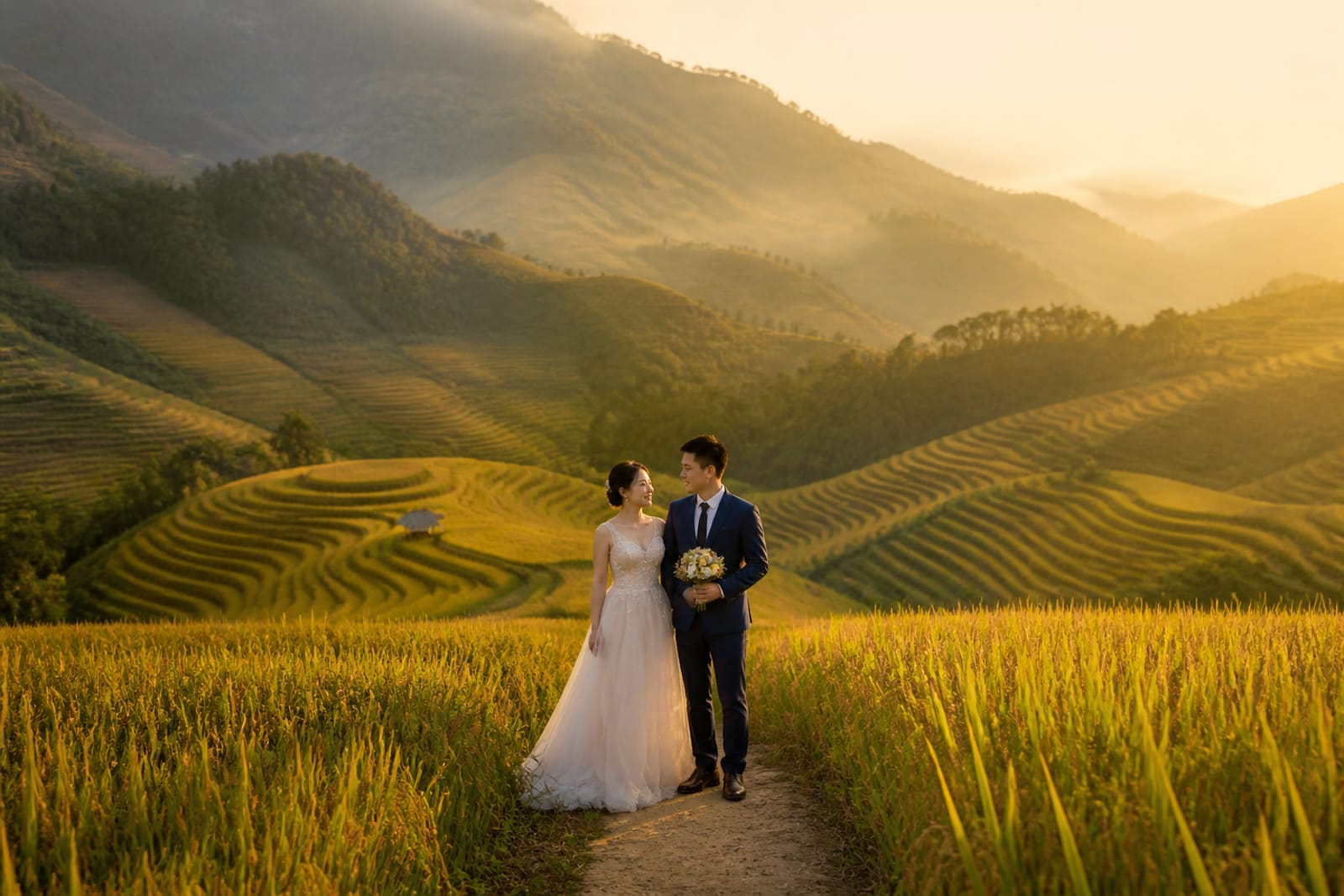
Cáo Studio doesn't shoot Mu Cang Chai—so how do you hire and vet a local photographer?
Cáo Studio operates in Hanoi, Ho Chi Minh City and Hoi An. Mu Cang Chai is a specialist destination requiring a local team or a Hanoi-based photographer willing to travel. When vetting, ask for:
- Location portfolio. They must show work shot in Mu Cang Chai across seasons (water and rice). Generic Vietnam pre-wedding shots don't prove familiarity with terrain, light angles or logistical realities.
- Team structure. Will you get a photographer only, or a small team (hair, makeup, styling)? A solo photographer cannot retouch makeup or manage an ao dai on muddy banks mid-session.
- Arrival and timing plan. Ask how early they'll arrive to scout light and plan your positions. A professional arrives 1–2 hours before your start time, not 15 minutes before.
- Transportation logistics. Who arranges the 5–6 hour round-trip drive from Hanoi? Does it count as part of the session time, or is it separate cost? Clarify this in writing.
- Weather protocol. What happens if rain, fog or haze ruins the planned light? Do they offer a re-shoot date or a refund? A credible photographer documents this in a contract.
- Editing and delivery. How many edited photos and in what format? When will you receive them? Ask to see the editing style on previous Mu Cang Chai work (some photographers over-saturate gold rice; others underexpose water reflections).
Check reviews on Google Maps or local Facebook groups for Hanoi photographers, but weight first-hand portfolio and the team's responsiveness over star counts.
When should you decide: water season or golden rice—and what does it really cost?
| Aspect | Water terraces (May–Jun) | Golden rice (Sep–early Oct) | Comparison |
|---|---|---|---|
| Light quality | Soft, overcast; reflections mirror sky. | Directional, warm; side-lit grain glows. | Water suits diffuse, dreamy; rice needs precise timing. |
| Crowds | Moderate mornings; less crowded mid-week. | Heavier mornings (peak season); thin before 6 am. | Both require early starts; golden rice necessitates pre-dawn. |
| Humidity & comfort | High; mud and dampness persist. | Moderate; dew wets hems but dries by 9 am. | Water-season is harder on outfit and footing. |
| Ao dai suitability | Poor (mud, slipping, snags). | Fair (shorter hem works; dew manageable). | Both risky; trousers and shirt safer. |
| Weather risk | Low (stable spring weather). | Moderate (rain possible late September onward). | Water-season more predictable. |
| Photographer availability | Easier to book (off-peak for Hanoi studios). | Harder (peak autumn shooting season). | Water-season may negotiate better scheduling. |
| Post-production timeline | Standard (no urgency). | Often rushed (couples want images before wedding season). | Plan 2–4 weeks for full edits either season. |
Decision framework: Choose water terraces if you love abstract, reflective aesthetics, prefer stable weather and want easier logistical negotiation. Choose golden rice if you're drawn to warm, directional light, willing to start before dawn, and your wedding is soon enough that autumn timing works. Either season demands a photographer experienced in mountain terrain—not a generalist hired for their Instagram feed.
What to check before you book a Mu Cang Chai pre-wedding shoot.
- Photographer's Mu Cang Chai portfolio. Insist on location-specific work, not just Hanoi or Hoi An images.
- Team composition. Confirm whether hair, makeup and styling are included, or if you're hiring a photographer only.
- Timing and arrival plan. Get a written itinerary with scout time, start/end times, and travel window.
- Outfit and footwear advice. Ask the photographer for specifics on what works in current season conditions (water vs. rice).
- Weather contingency. Clarify what happens if the day is rainy, foggy or too hot—re-shoot date, partial refund, or no protection.
- Editing and delivery. Number of edited photos, file format, deadline for receipt, and the photographer's editing style.
- Cost factors. The photographer will quote based on season (peak autumn higher), travel distance, team size, and session length. Ask what's included before agreeing.
For a full pre-wedding photoshoot with hair, makeup and seamless on-location support, consider whether a Hanoi-based studio like Cáo Studio can coordinate a day trip—though for remote terrain, a specialized local team may be more reliable. Use the vetting checklist above regardless of whom you hire.
---
Still deciding between Mu Cang Chai and closer Hanoi options?
Mu Cang Chai demands commitment: 5–6 hours in a vehicle, unpredictable terrain, and specific seasonal timing. If you want similar aesthetic (dramatic, natural light; cultural landscape) without the logistical complexity, consider pre-wedding shoots in Hanoi or a couple photoshoot in Hoi An's ancient town or nearby rice fields. Both offer working photographers on-site daily and easier outfit management. Hoi An is particularly suited to ao dai photoshoot work with terraces and rivers nearby.
📸 Book on WhatsApp — ao dai photoshoot | 💄 Makeup & hair at your hotel | 🌸 See the lookbook
---
FAQ
Can we shoot both water terraces and golden rice if we visit Mu Cang Chai twice?
Yes, if you have time and the season overlaps your wedding timeline. May–June water and late September golden rice are distinct aesthetics. Two trips allow a season-specific shoot, but cost and logistics (photographer availability, travel) roughly double. Most couples choose one season and make that light their story.
Is an ao dai practical for Mu Cang Chai, or should we wear Western wedding attire?
An ao dai works best in golden-rice season (September–early October) if tailored short and paired with grip-soled shoes. Water-season terrain is too muddy and slippery; trousers and a silk shirt are safer. Ask your photographer for season-specific outfit guidance before booking.
How early must we start to avoid crowds and catch good light?
May–June: 7–8 am is acceptable; light stays soft until mid-morning. September–early October: 5:30–6:30 am is essential to catch directional, side-lit light on golden rice before haze and crowds arrive.
What if it rains the day of our shoot?
Rain is rare May–June but possible late September onward. Confirm the photographer's weather policy in writing: do they offer a re-shoot date (within how many days?), a partial refund, or no protection? Fog is more common than rain; it obscures the valley but may suit moody aesthetics if handled well.
How long does a typical Mu Cang Chai pre-wedding shoot take, including travel?
Plan 10–12 hours total: 2–3 hours drive each way, 2.5–3.5 hours on location for frames (walking, positioning, outfit touch-ups), plus a lunch break. The photographer should clarify whether travel time counts toward your session fee or is separate.
Can Cáo Studio coordinate a Mu Cang Chai shoot for us?
Cáo Studio operates in Hanoi, Ho Chi Minh City and Hoi An. For Mu Cang Chai, you'll need a local photographer or a Hanoi studio willing to travel. Contact us on WhatsApp to discuss whether we can recommend a trusted collaborator, but the shoot will be coordinated locally, not by our team.
FAQ
Can we shoot both water terraces and golden rice if we visit Mu Cang Chai twice?
Yes, if you have time and the season overlaps your wedding timeline. May–June water and late September golden rice are distinct aesthetics. Two trips allow a season-specific shoot, but cost and logistics (photographer availability, travel) roughly double. Most couples choose one season and make that light their story.
Is an ao dai practical for Mu Cang Chai, or should we wear Western wedding attire?
An ao dai works best in golden-rice season (September–early October) if tailored short and paired with grip-soled shoes. Water-season terrain is too muddy and slippery; trousers and a silk shirt are safer. Ask your photographer for season-specific outfit guidance before booking.
How early must we start to avoid crowds and catch good light?
May–June: 7–8 am is acceptable; light stays soft until mid-morning. September–early October: 5:30–6:30 am is essential to catch directional, side-lit light on golden rice before haze and crowds arrive.
What if it rains the day of our shoot?
Rain is rare May–June but possible late September onward. Confirm the photographer's weather policy in writing: do they offer a re-shoot date (within how many days?), a partial refund, or no protection? Fog is more common than rain; it obscures the valley but may suit moody aesthetics if handled well.
How long does a typical Mu Cang Chai pre-wedding shoot take, including travel?
Plan 10–12 hours total: 2–3 hours drive each way, 2.5–3.5 hours on location for frames (walking, positioning, outfit touch-ups), plus a lunch break. The photographer should clarify whether travel time counts toward your session fee or is separate.
Can Cáo Studio coordinate a Mu Cang Chai shoot for us?
Cáo Studio operates in [Hanoi](/hanoi), [Ho Chi Minh City](/saigon) and [Hoi An](/hoi-an). For Mu Cang Chai, you'll need a local photographer or a Hanoi studio willing to travel. Contact us on WhatsApp to discuss whether we can recommend a trusted collaborator, but the shoot will be coordinated locally, not by our team.
Ao dai, makeup, hair and a local photographer in Hanoi or Saigon — one WhatsApp message.