/pre-wedding-photoshoot
Best time of year for a pre-wedding photoshoot in Sapa
The best window for a Sapa pre-wedding photoshoot depends on what you want to show: March–May and September–November offer clear skies and ideal walking weather; June–August brings lush green rice terraces but afternoon rain is daily; December–February is cold (near 0°C some mornings), foggy and dramatic but requires thermal layers under your outfit. For mountain light and rice-field color without daily downpours, aim for late September through early October (golden harvest) or April (bright spring). Cáo Studio does not operate in Sapa — this is a planning guide to help you book a local photographer or coordinate with our Hanoi team for a pre-wedding session in our service areas.
Why does Sapa's season matter more than other Vietnam destinations?
Sapa sits at 1,600 m elevation in the far north, where weather changes fast and fog can erase your views by 10 a.m. Unlike Hanoi's gradual shifts or Hoi An's dry/wet split, Sapa has three distinct photo seasons with very different light, outfit demands and walking stamina. Choosing the right window means the difference between golden-hour mountain frames and white-out mist. Plan around this: light, landscape color, and thermal comfort are linked here in ways a coastal shoot does not require.
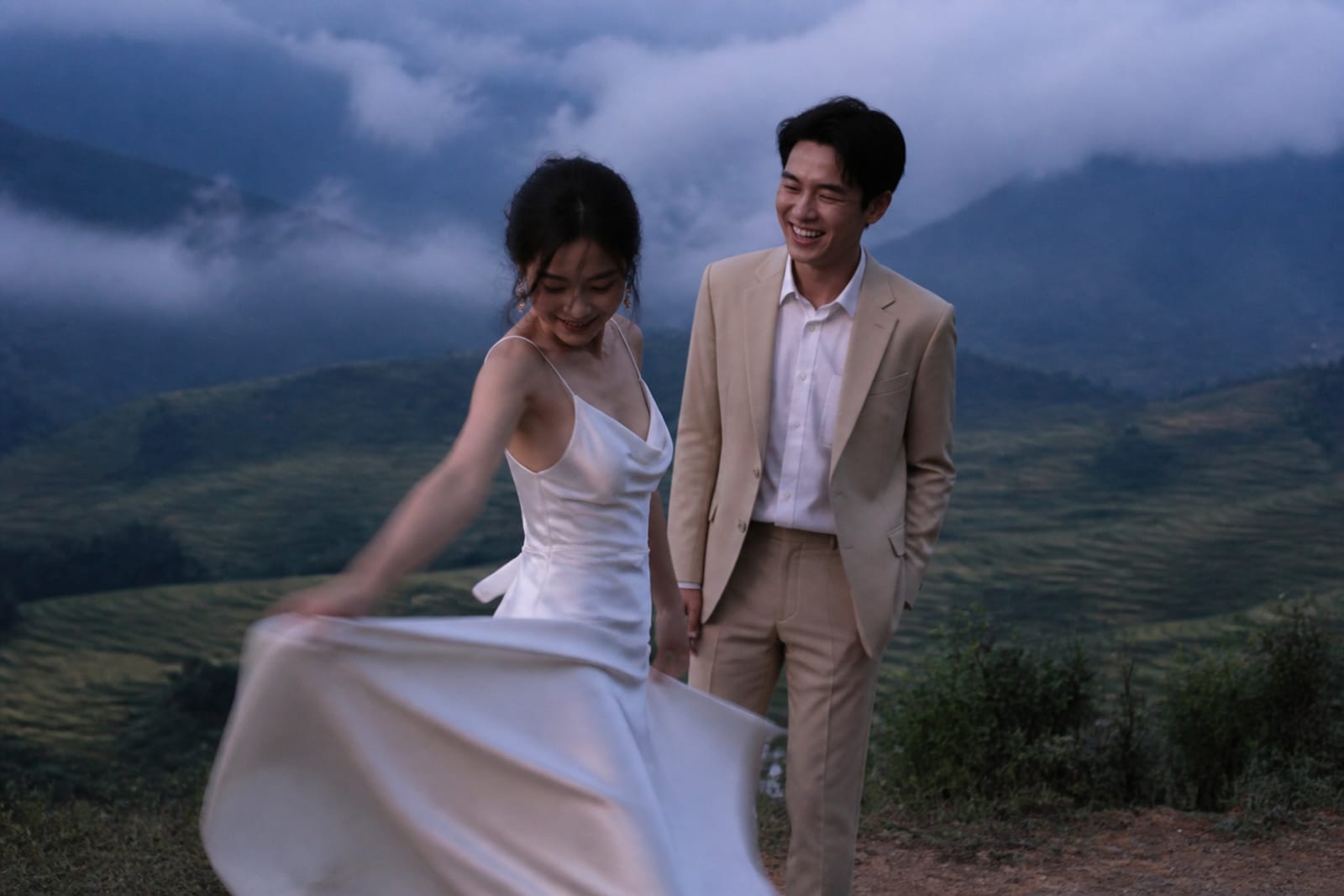
What does each season actually deliver for pre-wedding light and landscape?
| Season | Light quality | Rice terraces | Weather & comfort | Best for | Walking difficulty |
|---|---|---|---|---|---|
| Mar–May (spring) | Bright, soft-focus mornings; haze clears by 9 a.m. | Fresh green, water-filled | Warm days (18–24°C), cool mornings; no rain | Couples who value clear sky and warm comfort | Moderate; paths may be muddy |
| Jun–Aug (summer) | Diffuse, grey; afternoon rain dims light | Vibrant emerald, dense growth | Hot (25–30°C), daily 2–4 p.m. downpours; humid | Lovers of lush color; those who accept rain risk | Hard; muddy, slippery terrain |
| Sep–Oct (harvest) | Golden late-afternoon light; crisp air | Golden-brown harvest (mid-Sep to early Oct); green after harvest | Cool, clear (15–22°C); minimal rain | Photographers chasing that amber rice-field glow | Moderate; paths drier |
| Nov–Feb (winter) | Dramatic fog, strong side light when visible; cold shadows | Brown or bare; occasional frost | Cold mornings (0–5°C, sometimes below); rare but possible frost/snow | Adventurous couples; those wanting moody, ethereal frames | Easy; firm paths, but cold hands and feet |
The golden-harvest window (roughly mid-September to early October) gives the fewest trade-offs: clear light, warm enough for light layers, and terraces in their most photogenic color. Spring is the safest all-rounder. Winter draws couples who embrace mist and drama. Summer works only if you love emerald green and accept daily rain.
How do outfit and hair choices shift between seasons?
Winter (Dec–Feb) demands thermal layers beneath your ao dai or gown — a fitted inner long-sleeve tee and leggings, which change the drape of traditional fabric and can crowd your silhouette. Hair styling risks: wind is strong, humidity is low (hair holds shape but can look brittle), and cold makes hands stiff for touch-ups. Makeup sets quickly in the cold but can look flat without warmer tones.
Spring (Mar–May) is outfit-friendly: a single layer under an ao dai, or a light gown without a second skin, works. Morning mist adds romance without requiring extreme insulation. Hair responds well to humidity (it holds waves longer). Makeup looks fresh in softer light.
Summer (Jun–Aug) means humidity so high that makeup can feel heavy and hair frizzes. You'll want minimal undergarments but rain may soak your hem — a waterproof underlay or a second outfit in a dry location is practical, not romantic. Makeup touch-ups are frequent.
Autumn (Sep–Oct) is a sweet spot: light layers work, humidity is moderate (hair looks defined, makeup lasts), and wind is gentle. Consider this when a photographer pitches you "no wardrobe changes needed" — they may not be accounting for temperature and sweat.
📸 Book on WhatsApp — pre-wedding photoshoot
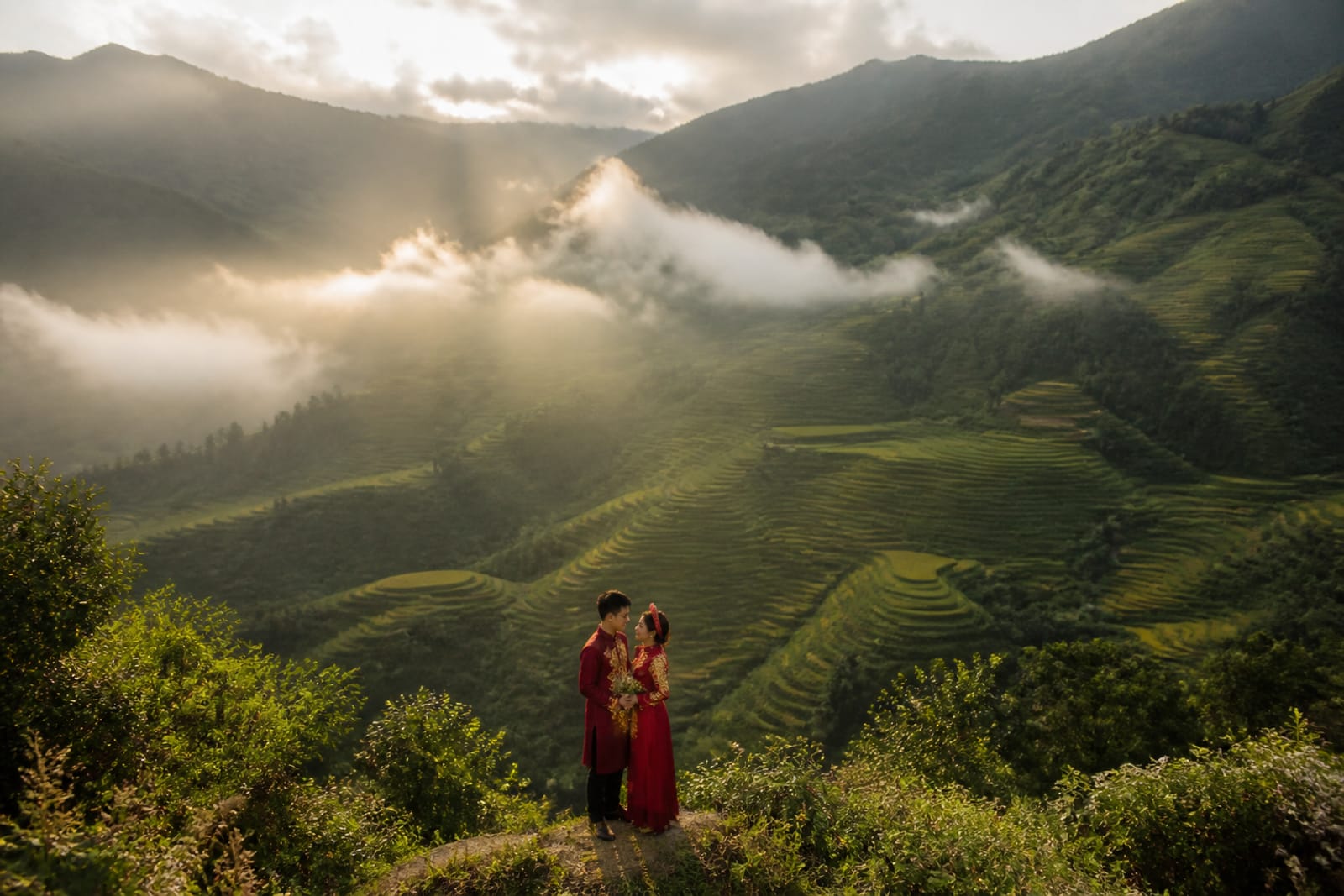
Should you book Cáo Studio for Sapa or hire a local photographer?
Cáo Studio operates in Hanoi, Ho Chi Minh City and Hoi An — we do not shoot in Sapa. If you want a full team (photographer, makeup artist, stylist) managing your pre-wedding day, ask on WhatsApp whether we can coordinate hair and makeup for you in Hanoi or another service area, then recommend a vetted local Sapa photographer for the location shoot. Many couples do this: one team for hair, makeup and outfit fitting; another for the mountain frames.
If you hire locally in Sapa, vet these: ask for a portfolio of other pre-wedding shoots (not just landscapes or tourist photos); check whether they own lighting gear (mist and shadows need reflectors or portable flash); confirm they've shot in winter fog or summer rain (technical skill changes in those conditions); and ask how many edited frames you receive and the timeline. A local photographer who knows Sapa's light-changes by hour is valuable — use that knowledge.
For those choosing our service areas instead, Hanoi pre-wedding photoshoots offer Old Quarter texture and Hoan Kiem light; Ho Chi Minh City gives colonial architecture and river-walk frames; Hoi An combines lantern light, river and ancient-town alleys — all within reliable season windows and team coordination.
How do you plan a Sapa shoot timeline around real weather patterns?
Morning light (5:30–9:00 a.m.): Mist is thickest, especially in winter and monsoon season. Some couples chase this for ethereal frames; others wait for it to lift. Morning light is soft but dimmed — you may need wider apertures or higher ISO. By 8 a.m., mist often breaks, revealing sharp outlines and color. Bring the couple to a high point (Fansipan viewing platform or a ridge path) early.
Afternoon light (3:00–5:30 p.m.): Clearest, warmest, and most predictable in spring and autumn. Summer thunderstorms often arrive 2–4 p.m.; a shoot that starts at 3 p.m. may hit rain. Winter afternoons are bright but cold gets sharper as sun lowers.
Rain contingency: June–August requires an alternative indoor location or rescheduled date. September–November and March–May are low-rain; December–February can have clear days or all-day fog. Ask your photographer: do they have a backup location? Can they postpone for free if weather is unsafe? Do they use weather apps to call off early?
Plan a 4–6 hour timeline if you're shooting multiple locations and outfit changes. Sapa paths can be steep and muddy — couples often underestimate walking effort in heels or heavy gowns. Allow rest and touch-up time.
What should you check before booking a Sapa pre-wedding photographer?
Ask these questions before committing:
- What month have they shot in most? A photographer strong in autumn may struggle in winter fog or summer rain. Specific experience matters.
- How many edited images do you receive? (And in what timeline?) Compare offers — some deliver 50, others 150+; some turn around 2 weeks, others 6 weeks.
- Do they handle outfit changes on-site or require a separate location? Winter and rain complicate this.
- What's included in the fee? (Hair and makeup artist? Outfit rental? Video? Prints?) Clarify scope so you're not surprised.
- Can they shoot in your chosen season without price surcharge? Some photographers charge more for winter or peak-season bookings.
- What's their rescheduling policy if weather forces a postponement?
- Do they know Sapa's light-angles by hour and location? Ask them which ridge catches morning side-light, or which paddy-field angle faces sunset. Real local knowledge shows.
For a pre-wedding photoshoot in Hanoi, Ho Chi Minh City or Hoi An, contact us on WhatsApp — Cáo Studio handles photographer, makeup, hair and outfit in one booking, removing coordination friction.
---
FAQ
Is November a good month for Sapa pre-wedding photos?
Yes. Early November is ideal: rice is golden or freshly harvested, weather is clear and cool (15–22°C), and rain is rare. By mid-November, terraces turn brown, but light remains sharp. Book early November if harvest color is important to you.
What happens if it rains during a Sapa pre-wedding shoot in summer?
Summer afternoon rain is expected (2–4 p.m., often brief). Ask your photographer before booking whether they have a covered location, can reschedule, or will shoot in rain (some couples love the drama). Confirm their policy — some offer free rescheduling, others charge a fee.
Do I need thermal underwear for a winter Sapa shoot?
Yes, if you're shooting before 10 a.m. or after 3 p.m. Mornings can drop to 0–5°C. Wear a fitted long-sleeve tee and leggings under your ao dai or gown — test the fit in advance, as layers change how fabric drapes. Bring hand warmers for your photographer's breaks.
Can Cáo Studio shoot a pre-wedding in Sapa?
No, we operate in Hanoi, Ho Chi Minh City and Hoi An. Ask on WhatsApp whether we can coordinate hair, makeup and outfit styling for you in one of those cities, then recommend a local Sapa photographer for the mountain shoot.
What's the difference between booking a local Sapa photographer versus coordinating with Cáo Studio elsewhere?
A local Sapa photographer knows the terrain, seasons and light intimately — ideal for location shoots. Cáo Studio manages photographer, hair, makeup and styling as one team, removing coordination friction — ideal if you want one point of contact and consistent creative direction. Many couples use both: our team for prep in Hanoi, a local pro for Sapa location work.
How many hours should I book for a Sapa pre-wedding session?
Plan 4–6 hours to cover multiple locations and outfit changes, account for walking time (paths can be steep), and capture golden light or mist properly. Shorter bookings (2–3 hours) work if you've chosen one location and one outfit.
FAQ
Is November a good month for Sapa pre-wedding photos?
Yes. Early November is ideal: rice is golden or freshly harvested, weather is clear and cool (15–22°C), and rain is rare. By mid-November, terraces turn brown, but light remains sharp. Book early November if harvest color is important to you.
What happens if it rains during a Sapa pre-wedding shoot in summer?
Summer afternoon rain is expected (2–4 p.m., often brief). Ask your photographer before booking whether they have a covered location, can reschedule, or will shoot in rain (some couples love the drama). Confirm their policy — some offer free rescheduling, others charge a fee.
Do I need thermal underwear for a winter Sapa shoot?
Yes, if you're shooting before 10 a.m. or after 3 p.m. Mornings can drop to 0–5°C. Wear a fitted long-sleeve tee and leggings under your ao dai or gown — test the fit in advance, as layers change how fabric drapes. Bring hand warmers for your photographer's breaks.
Can Cáo Studio shoot a pre-wedding in Sapa?
No, we operate in Hanoi, Ho Chi Minh City and Hoi An. Ask on WhatsApp whether we can coordinate hair, makeup and outfit styling for you in one of those cities, then recommend a local Sapa photographer for the mountain shoot.
What's the difference between booking a local Sapa photographer versus coordinating with Cáo Studio elsewhere?
A local Sapa photographer knows the terrain, seasons and light intimately — ideal for location shoots. Cáo Studio manages photographer, hair, makeup and styling as one team, removing coordination friction — ideal if you want one point of contact and consistent creative direction. Many couples use both: our team for prep in Hanoi, a local pro for Sapa location work.
How many hours should I book for a Sapa pre-wedding session?
Plan 4–6 hours to cover multiple locations and outfit changes, account for walking time (paths can be steep), and capture golden light or mist properly. Shorter bookings (2–3 hours) work if you've chosen one location and one outfit.
Ao dai, makeup, hair and a local photographer in Hanoi or Saigon — one WhatsApp message.