/pre-wedding-photoshoot
Bridal Hair and Makeup in Vietnam's Humidity
Bridal hair and makeup in Vietnam's humidity demands sweat-proof base primers, long-wear formulations rated for tropical conditions, and structural hairstyles that don't rely on hold alone—think pinned waves and braids over loose curls. The best approach combines a silicone-based primer (which repels moisture better than water-based versions), waterproof mascara and lip products, and a high-humidity hairspray applied in thin layers, not one heavy coat. Timing matters: get ready in an air-conditioned space, finish makeup within 30 minutes of photos starting, and avoid outdoor waiting. Cáo Studio – Makeup & Photoshoot works with brides across Hanoi, Ho Chi Minh City, and Hoi An using these exact protocols—your makeup artist will account for the shoot location's climate and duration, applying touch-up-friendly formulas and securing hair with structural techniques that survive both the heat and motion of a photoshoot.
Vietnam's humidity poses a genuine challenge to bridal beauty. The central coast (February–August) offers drier conditions, but even "dry season" days in Hanoi or Saigon carry 70–80% humidity. The rainy season (May–November in the north, September–December on the coast) amplifies the risk: sweat, salt spray from humidity-driven perspiration, and moisture in the air break down conventional makeup within 2–3 hours outdoors. Your wedding photos—shot before the ceremony or in the hours after—happen during peak body temperature and peak UV intensity. A bridal look that survives your getting-ready room may collapse during an outdoor walk or a beachside session.
The mechanics are straightforward: conventional primer is water-based and dissolves when sweat increases. Talc-heavy powder sits on the skin like a paste in humidity. Loose hairstyles—especially fine or thin hair—fall flat as humidity swells the hair shaft and breaks apart individual curl definition. Conventional hairspray crystallizes and flakes on the scalp. Waterproof mascara, if applied over a non-waterproof base, clogs and smudges as oils from heat-stimulated skin mix with moisture in the air.
Professional bridal makeup artists in Vietnam learn to work within the climate, not against it. That means accepting humidity, planning for sweat, and choosing formulations that set hard and remain intact even as the skin beneath shifts.
What base and primer actually work in tropical heat?
Silicone-based primers create an invisible waterproof barrier between skin and makeup. They don't absorb sweat; they repel it. Unlike water-based primers—which hydrate the skin and can feel tacky in heat—silicone primers dry to a semi-matte finish and hold makeup in place for 8+ hours outdoors. The application technique matters as much as the product: a thin, even layer (not a thick one) applied to the entire face, including eyelids and around the mouth, prevents pooling. Many brides apply primer to dry skin, which can feel uncomfortable in heat. A light spray of setting spray before primer—yes, before—locks down natural skin oils and gives the primer a stronger grip. Your makeup artist should apply primer, let it set for one minute, then begin foundation.
Foundation itself must be long-wear or transfer-resistant, formulated to set completely hard (not just "dry to the touch"). Cream foundations and liquid-to-powder formulas often outperform traditional liquids in humidity because they set to a rigid finish. The shade match is critical in tropical light: natural outdoor light at midday (10 a.m.–2 p.m.) is harsh and cool-toned, so a shade that looks perfect under salon lighting may appear orange or ashy in daylight. Most professional bridal artists in Vietnam do a shade match outdoors or near a north-facing window during the morning, not under warm indoor lights.
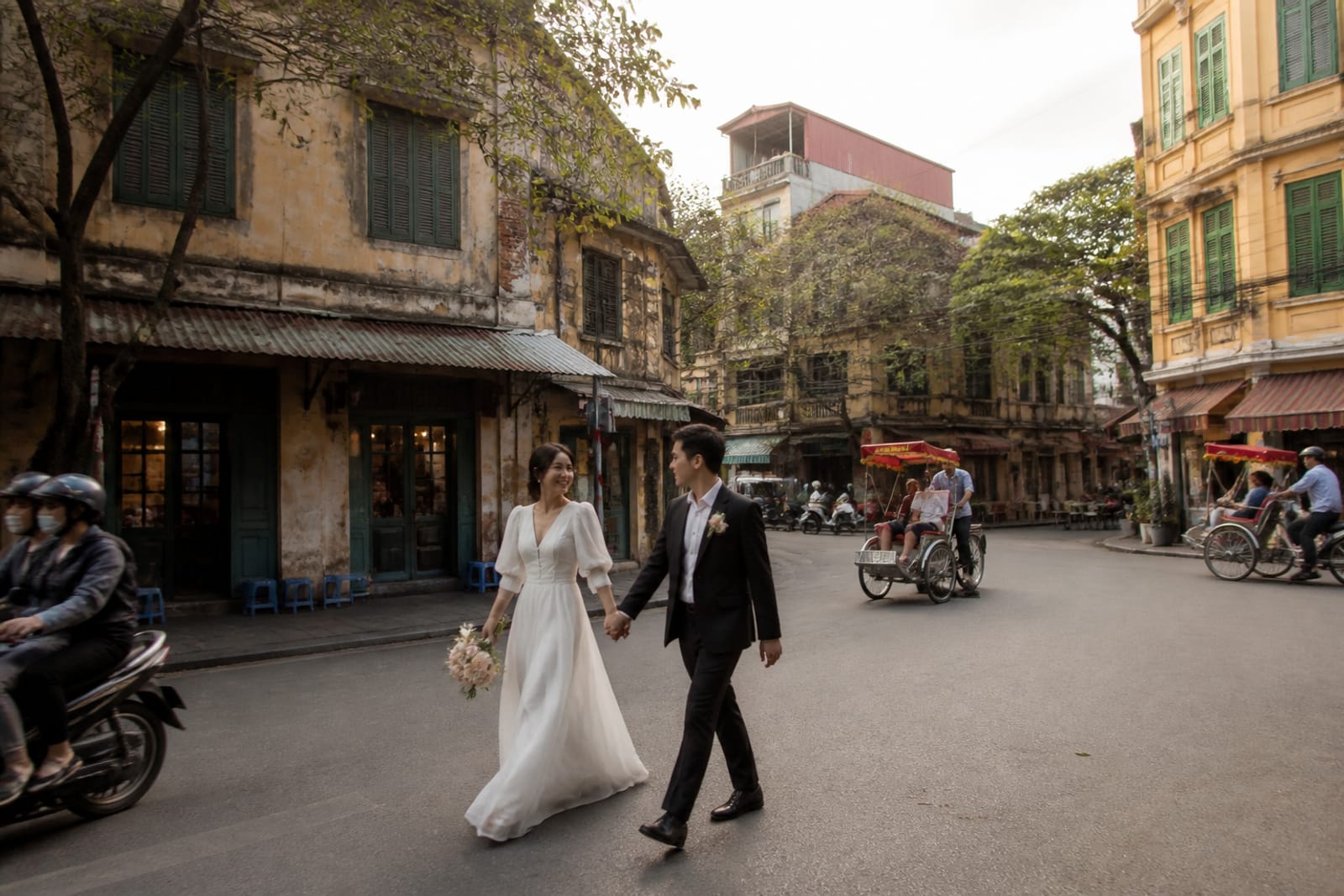
How do you stop makeup from sliding off during a photoshoot?
Setting spray is not optional in Vietnam's heat. A hydrating setting spray (despite its name) actually seals makeup with a fine film of polymers, not water. Applied in two thin layers—one after foundation and concealer, one after all makeup is complete—it creates a moisture barrier. The spray must be applied 6–8 inches from the face in a light mist, not a drench; a heavy mist can reactivate foundation and cause streaking. Wait 30–45 seconds between layers. A powder-based setting spray (or translucent powder applied with a damp beauty sponge) adds a second layer of grip for the T-zone and eye area, where sweat accumulates fastest.
Blotting papers are your touchstone during a shoot. A professional makeup artist leaves these with you or your attendant so that sweat can be removed without disturbing makeup. Blotting—not wiping—preserves the base layer. Makeup touch-ups during a photoshoot should happen every 45–60 minutes if you're outdoors. A small kit (blotting papers, a pot of translucent powder, a cream blush for fixing faded lips) lives in your helper's hands, not your own; this keeps your hands free and your makeup artist in control of adjustments.
| Setting approach | Best for | Why it works | Drawback |
|---|---|---|---|
| Silicone primer + liquid-to-powder foundation + hydrating setting spray | Long outdoor shoots (2+ hours), beachside or riverside locations | Waterproof layers repel sweat; hard-set finish resists humidity | Feels heavy on skin if reapplied; requires skilled blending |
| Silicone primer + cream foundation + powder setting spray | Shorter sessions (60–90 min), studio or indoor venues | Cream foundation doesn't thin with sweat; powder adds instant grip | Powder can emphasize texture; less flexible for touch-ups |
| Water-based primer + transfer-resistant liquid foundation + translucent powder only | Budget-conscious brides, low-humidity seasons (dry season, Nov–Jan) | Lightweight; easier to remove after shoot | Breaks down in sweat; requires frequent touch-ups |
Which hairstyles survive humidity and motion?
Loose, romantic waves—a bridal favorite—flatten within 20 minutes in Vietnam's humidity. A bride's hair will appear softer in photos if it's pinned in place, not held by hold alone. Braids, twisted knots, and structured waves (where each section is pinned to the scalp) defy humidity because the pins anchor the style, not the hairspray. A half-up, half-down style can work only if the "up" section is braided and secured with bobby pins, and the "down" section is either curled onto heated rollers moments before photos (so the curl is fresh and tight) or styled with a wand into loose waves that are then pinned at the base to prevent flattening.
Hair texture also matters. Straight, fine hair flattens faster than curly or coarse hair, which naturally resists humidity collapse. A bride with fine hair may opt for an updo with a few face-framing tendrils that are pinned (not loose) to maintain volume. Thicker hair can carry more elaborate styles, but even thick hair needs pins or clips to stay lifted. Hairspray in Vietnam's humidity should be a UV-protective, humidity-resistant formula (some are specifically labeled for tropical climates). Apply it in thin, even layers—three light coats are better than one heavy coat—and use a finishing spray (not the same as a hold spray) as your last step. Finishing spray has polymers that stiffen the entire structure, similar to setting spray for makeup.
The morning of your pre-wedding photoshoot, style your hair last, minutes before leaving for the shoot location. If you're getting ready at your hotel or a studio and then traveling to a beach or garden, ask your hair stylist to style you at the shoot location, not before travel. Even 15 minutes in a car (especially a hot one without air conditioning) can disturb waves and loosen pins. Cáo Studio – Makeup & Photoshoot offers makeup and hair at your hotel, which eliminates travel time between getting ready and shooting and keeps your hair fresh until the camera starts rolling.
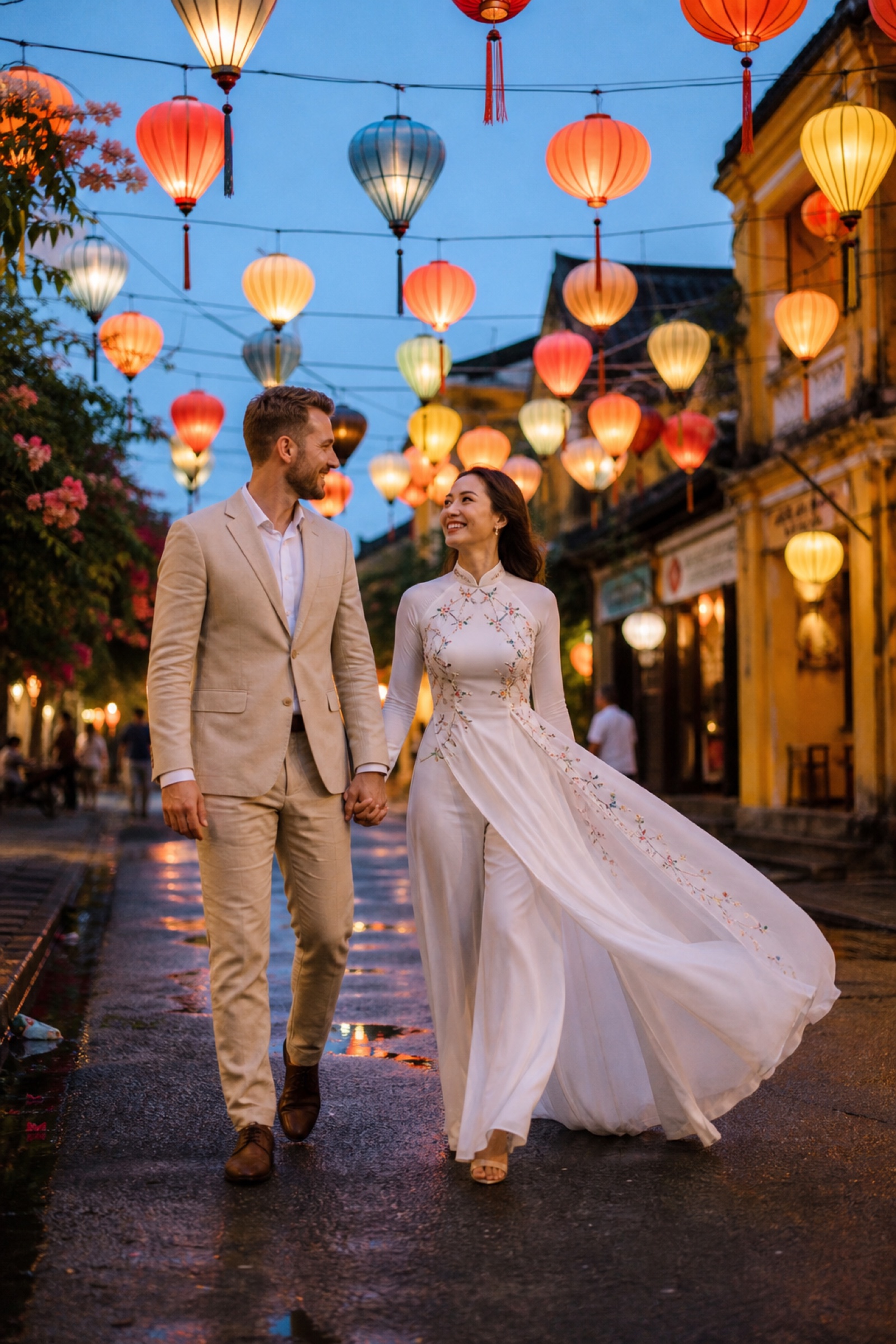
How does timing and location affect your bridal look?
Humidity peaks in the afternoon (12–3 p.m.) and is lowest in early morning (6–8 a.m.). A bridal shoot scheduled for 6–9 a.m. will experience the most stable humidity and the most flattering, soft light; makeup and hair will be under the least stress. Mid-morning shoots (9–11 a.m.) still offer good light and manageable humidity, though the sun is stronger. Afternoon shoots (2–5 p.m.) demand a more robust setup: heavier primer, more frequent touch-ups, and structural hair (updo or pinned waves, not loose). Evening shoots (after 5 p.m.) offer soft light but may require additional lighting and longer sitting times, during which sweat accumulates.
Location humidity varies widely. A riverside or beachside venue in a hot month (May–September) will be 80–95% humidity; a mountainous area around Hanoi or a well-ventilated studio will be 5–10% lower. If your pre-wedding photoshoot is planned for a beach in August, waterproof everything and expect makeup touch-ups every 45 minutes. If it's a Hoi An riverside session in March (dry season), standard long-wear makeup will likely suffice, though your artist will still use silicone primer and setting spray as a baseline.
💄 Makeup & hair at your hotel — minimize travel time, stay fresh.
Outdoor waiting between shots is a hidden humidity danger. If your shoot involves traveling between locations or waiting for the photographer to set up, you'll perspire in direct sun while stationary—a recipe for makeup creasing and hair collapse. A small tent, a shaded vehicle, or an interior waiting area keeps you cool and dry between setups. Your makeup artist should travel with you (or be on-call via WhatsApp) to make quick touch-ups. A spray bottle of setting spray and blotting papers are cheaper than re-doing a full face mid-shoot.
What products and formulations should a bride choose?
You don't need to buy products before your shoot; your makeup artist will bring professional-grade formulas. However, if you prefer to supply your own, request a consultation with your artist to confirm compatibility. Long-wear or "24-hour" formulas are the standard for bridal work in Vietnam. Avoid matte foundations in favor of satin or dewy finishes, which photograph better in natural light and don't cake in humidity (paradoxically, matte formulas oxidize faster when skin is damp). Mascara must be waterproof; a waterproof formula that's also lengthening or volumizing is ideal because sweat can thin conventional mascara. Blush and bronzer should be cream or liquid, not powder-only, for longevity; cream blush blends with skin and moves less as the face perspires.
Lip products are often overlooked in tropical settings. A long-wear liquid lipstick (or a traditional lipstick paired with a lip primer and setting spray) will outlast anything else. Avoid glosses and tinted balms, which separate and migrate in sweat. A lip stain under a clear or tinted lip balm offers a middle ground if you want a softer finish; the stain stays put even if the balm fades.
For hair, a silicone-based smoothing serum applied to damp hair before styling reduces frizz and prepares the hair shaft to resist humidity swelling. A lightweight hairspray (not a heavy-hold one) applied in thin coats will hold without flaking. Some hair artists in Vietnam use a light finishing hairspray that includes UV protection; this is worth asking for if you'll be in direct sun for 3+ hours.
📸 Book on WhatsApp — ao dai photoshoot — book your pre-wedding session today.
What should you check before committing to a bridal session?
Before booking a pre-wedding photoshoot, discuss humidity strategies with your makeup artist. Ask:
- Will the artist use silicone primer and waterproof formulas as a standard? This should be automatic in Vietnam, not an upsell.
- Has the artist worked in your chosen location before? A photographer familiar with beachside humidity or riverside shoots will know the specific challenges.
- What touch-up policy is in place? Is your artist on-site during the entire shoot, or will they leave once makeup is complete? Touch-ups are essential, so on-site presence matters.
- Can the artist style your hair at the shoot location, not before travel? This keeps your style fresh.
- Does the package include a touch-up kit (blotting papers, powder, lip product)? If not, ask what's provided and what you'll need to bring.
- What is the weather forecast, and how will the artist adapt? If rain is predicted, ask how waterproof products differ from your sunny-day backup plan.
- Are there shaded waiting areas at your chosen venue? Confirm this with your photographer and planner so you're not sitting in direct sun between setups.
Cáo Studio – Makeup & Photoshoot operates across Hanoi and Ho Chi Minh City, with Hoi An sessions by appointment. During your WhatsApp inquiry, share your shoot date, location, and duration; your artist will recommend a specific approach and confirm product choices. A pre-wedding photoshoot is a one-time event, so humidity-proofing your look is an investment in images that will last decades.
🌸 See the lookbook — view real bridal sessions in Vietnam's climate.
FAQ
Will waterproof makeup look different in my photos than regular makeup?
No. Waterproof and long-wear formulas are designed to photograph identically to conventional products; the difference is durability, not appearance. Modern waterproof mascara and liquid lipstick are indistinguishable in photos once applied by a professional.
Can I bring my own makeup artist from another country if I'm getting married in Vietnam?
Yes, but you'll need to coordinate with them on humidity-specific techniques and product availability in Vietnam. Cáo Studio artists can consult or collaborate via WhatsApp if you'd prefer.
Is dry season (November–January) significantly easier for bridal makeup in Vietnam?
Yes. Humidity is 10–15% lower, and outdoor conditions are more forgiving. However, the sun is still intense in midday light, and even dry-season shoots benefit from silicone primer and setting spray as a baseline.
How often should I expect touch-ups during a 2-hour outdoor photoshoot?
Typically 2–3 touch-ups: one after 45–60 minutes, and a final check before key shots (e.g., first look or outdoor group photos). Your makeup artist will recommend a schedule based on location humidity and the shoot itinerary.
What's the difference between humidity-resistant hairspray and regular hairspray?
Humidity-resistant formulas include polymers and UV filters that stiffen the hair structure and resist moisture swelling. Regular hairspray relies on hold alone and loses grip in sweat and damp air. Most professional artists in Vietnam stock humidity-resistant varieties as standard.
FAQ
Will waterproof makeup look different in my photos than regular makeup?
No. Waterproof and long-wear formulas are designed to photograph identically to conventional products; the difference is durability, not appearance. Modern waterproof mascara and liquid lipstick are indistinguishable in photos once applied by a professional.
Can I bring my own makeup artist from another country if I'm getting married in Vietnam?
Yes, but you'll need to coordinate with them on humidity-specific techniques and product availability in Vietnam. Cáo Studio artists can consult or collaborate via WhatsApp if you'd prefer.
Is dry season (November–January) significantly easier for bridal makeup in Vietnam?
Yes. Humidity is 10–15% lower, and outdoor conditions are more forgiving. However, the sun is still intense in midday light, and even dry-season shoots benefit from silicone primer and setting spray as a baseline.
How often should I expect touch-ups during a 2-hour outdoor photoshoot?
Typically 2–3 touch-ups: one after 45–60 minutes, and a final check before key shots (e.g., first look or outdoor group photos). Your makeup artist will recommend a schedule based on location humidity and the shoot itinerary.
What's the difference between humidity-resistant hairspray and regular hairspray?
Humidity-resistant formulas include polymers and UV filters that stiffen the hair structure and resist moisture swelling. Regular hairspray relies on hold alone and loses grip in sweat and damp air. Most professional artists in Vietnam stock humidity-resistant varieties as standard.
Ao dai, makeup, hair and a local photographer in Hanoi or Saigon — one WhatsApp message.