/pre-wedding-photoshoot
Cai Rang floating market wedding photos: best time and light
Cai Rang floating market is best shot between 5:30 and 6:30 am, when side light rakes across water and wooden boats are active but crowds are still light. The market sits on the Hau River in Can Tho, in the Mekong Delta's southern region. A session runs 2–3 hours including outfit changes and movement between boats and the riverbank. Light deteriorates after 7 am as the sun climbs; afternoon heat and midday glare wash out detail. Wear lightweight, breathable ao dai or casual linen—synthetic fabrics cling in humidity. Cáo Studio does not operate in the Mekong Delta, so you'll need to hire a local Can Tho or Ho Chi Minh City–based photographer who knows the market's access points, boat operators, and light patterns. This guide helps you plan and vet that choice. ---
Why does timing matter more than any other factor?
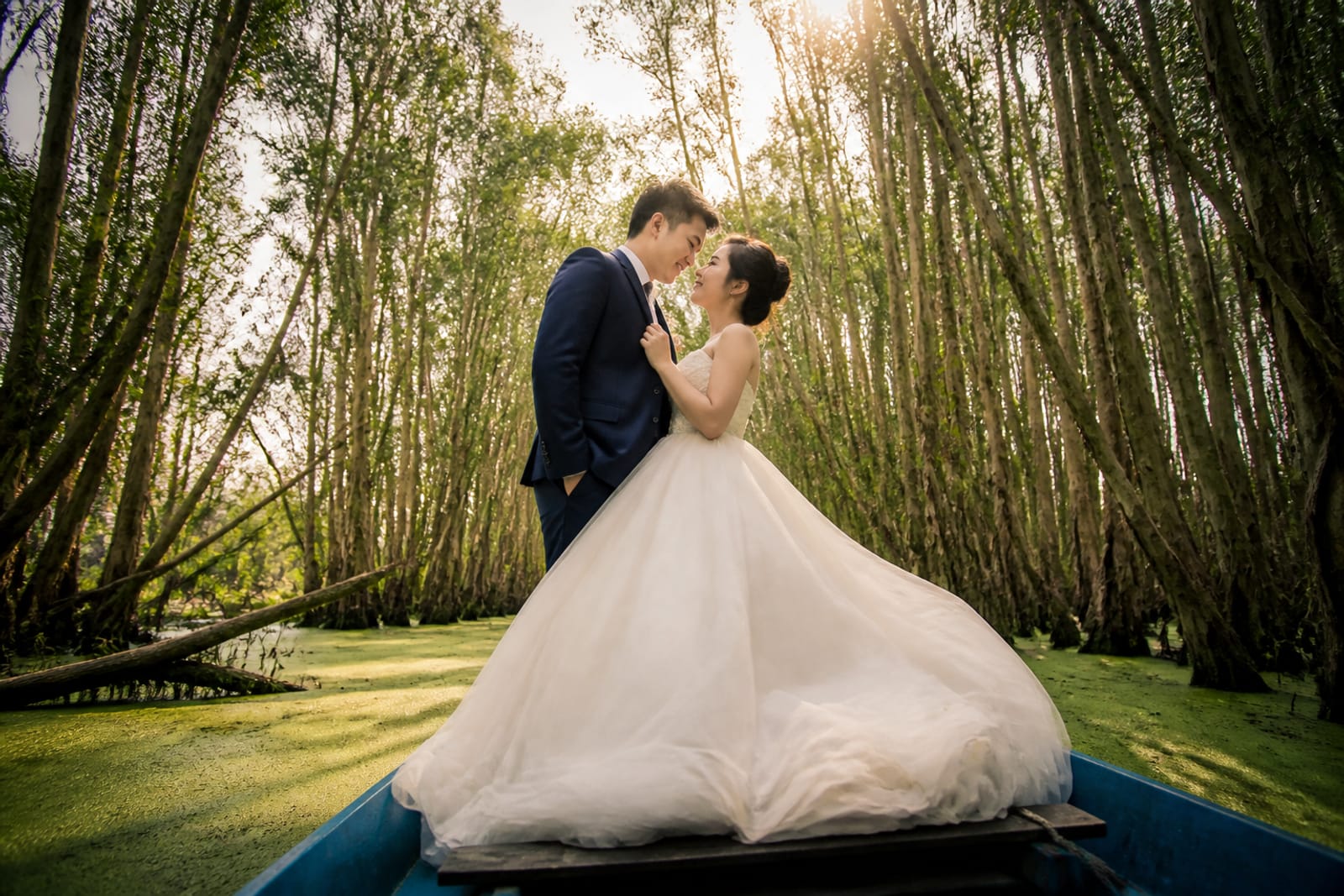
Light quality is everything in floating-market photography. At 5:30 am, the sun is low and to the side (in Oct–Nov, this means 90° from the water; in other months it varies slightly). That angle shapes water texture, defines boat silhouettes, and gives your skin a soft glow without harsh shadows under the eyes. By 7:30 am, the sun is high enough to flatten the scene—boats lose dimension, water becomes a bright white wash, and you'll squint. Most couples book a 6 am start and finish by 8 am. Skip the idea of a midday "golden hour" shoot; Cai Rang at noon is brutally hot, crowded, and photographically flat. The best light window is non-negotiable: get there early or choose a different backdrop. Local guides and boat operators are also fresher in the morning, making logistics smoother.
What outfits and colors work in this specific light?
Jewel tones—deep emerald, sapphire, burgundy—read better in the cool, early morning light than pale pastels do. If you wear an ao dai, silk catches light beautifully; cotton holds it more softly. Avoid all-white or cream on water—it blends with the reflected sky and loses shape in photographs. A contrasting dupatta (scarf) or second layer adds depth and movement as you walk along boats. Linen or silk trousers work better than heavy cotton in the humid delta climate; they breathe and drape with intention rather than clinging. Jewelry should be minimal—a simple ring or delicate bracelet reads better than ornate pieces that catch light and compete with the scene. Grooms in linen shirts (untucked or loosely tucked) match the casual, working-boat aesthetic better than formal suits. Sneakers are safer than sandals on wet wooden decks; the market's planks are slick. Choose one strong outfit, wear it authentically, and move rather than pose—that's what works on the water.
When is the market least crowded but still authentic?
Early October through November is the sweet spot: boats are numerous (high-water season means more activity), light is consistent, and monsoon rain is infrequent on any given dawn. December through February offers crisp light and low humidity but fewer boats and slower activity—you'll see fewer baskets, fewer vendors, fewer photographic layers. June through August is hot, the water level is lower (fewer boats), and occasional morning rain can delay shoots or force rescheduling. Tet (late January to mid-February) is chaotic; avoid it. Book a session in the dry-to-transition months (October, November, early December or February). Check the lunar calendar with your photographer; some boats may not operate on certain days for cultural reasons. Ask your local guide whether a specific date has high or low activity before you commit.
| Season | Best for | Light quality | Boat activity | Crowding | Why it works |
|---|---|---|---|---|---|
| Oct–Nov | Pre-wedding couples | Soft, side-lit at dawn | High; vendors active | Light at 5:30 am, busier by 7 | High water, frequent boats, cooler temps |
| Dec–Feb | Couples who value calm | Crisp, long shadows | Moderate to low | Minimal crowds any time | Clear skies, but fewer boats; formal outfits suit cool light |
| Mar–May | Couples flexible on light | Warm, flatter | Low | Few boats, few visitors | Water level drops; less photographic activity; heat rising by 5 am |
| Jun–Sep | Not recommended | Hot, hazy, rain risk | Low | Afternoon downpours likely | High humidity; wet decks; fewer boats; hard to reschedule |
How do you find and vet a local photographer for Cai Rang?
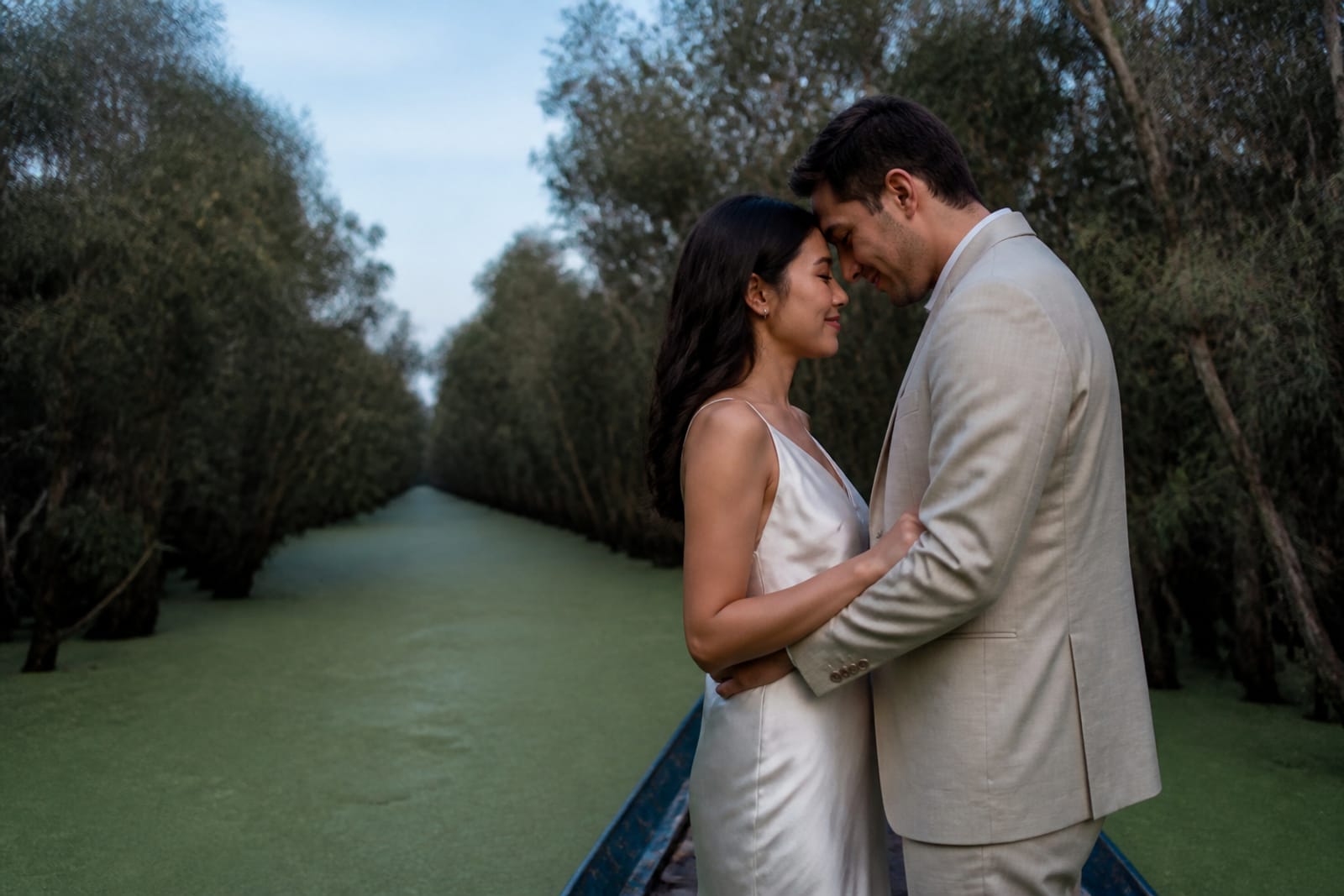
Search for photographers based in Can Tho or Ho Chi Minh City who specialize in floating-market shoots. Ask directly: Have you shot at Cai Rang before 6 am? Can you show me a portfolio from October or November? Red flags are generic stock photos of the market (not shot by them), no time-of-day specifics in their description, or promises of "any time works." Good signs are exact locations ("we shoot at Dock 5, upstream side"), awareness of boat-operator protocols ("we coordinate with Ong Hai for river access"), and portfolio images with side light and texture. Request a trial consultation via WhatsApp or video call—ask them to explain the light path on the date you're planning. A photographer who can't describe the sun angle at 5:45 am on your specific date may not know the spot well enough. Check if they offer a backup date in case of rain or if you need to reschedule; the delta's morning showers can happen fast. Get their cancellation and rescheduling terms in writing before you pay any deposit. Avoid photographers who don't know the market personally; they'll waste time figuring out where to stand and how to work with boat operators, eating into your best light window.
Why is Cai Rang harder to shoot than Hanoi or Ho Chi Minh City locations?
Accessibility is the main friction. Cai Rang requires a boat ride and coordination with market operators—you can't just walk up with a camera. Some boat operators are protective of their time and territory, especially if they don't know the photographer. The wooden planks are slippery in the morning dew, posing a safety and wardrobe risk. There's no dedicated "tourist photography zone," so you're working in an active, working market where vendors and logistics take priority over your shoot. The heat and humidity spike fast after 6:30 am, affecting both your comfort and how makeup holds. If Cáo Studio operated in Can Tho, our single-team model (photographer, makeup, hair, styling) would streamline this chaos—but we don't. You'll be coordinating a local photographer separately, then arranging your own makeup and hair, either at your hotel the night before or via a separate vendor in Can Tho. This fragmentation means more moving parts and more room for timing to slip. Cáo Studio's pre-wedding shoots in Hanoi, Ho Chi Minh City, and Hoi An handle this all as one team, which is faster and cleaner—but if your heart is set on Cai Rang, go in with clear communication, early arrival, and realistic expectations about complexity.
What should you check before you book a local photographer?
Logistics:
- Do they have reliable boat access? (Ask which operators they work with and get a name.)
- Can they confirm a backup time or date if weather forces a delay?
- How do they handle payment—deposit upfront, balance after? What's refundable?
Portfolio & craft:
- Show me three images from this location shot in the last 12 months.
- How do you plan the light for this date and time of year? (They should mention sun angle, side light, shadows.)
- Do you edit RAW files the same way for all clients, or do you adjust for each shoot's unique light?
Deliverables & timeline:
- How many edited photos do we get, and when?
- Do you provide a digital gallery, prints, an album, or video? (Confirm what's included and what costs extra.)
- Is a second shooter available if the market is crowded and we need wider coverage?
Makeup & hair:
- Will your photographer recommend a makeup artist, or do we find our own?
- Can they introduce you to someone who's worked on floating-market shoots? (Waterproof makeup is essential.)
On the day:
- What's the cancellation window if morning weather looks poor?
- Do you coach us on movement and natural poses, or do you work quietly?
Get answers via WhatsApp or video call, not text alone. A photographer who's thoughtful about logistics and light will spend 30 minutes answering these questions—that's a good sign.
---
📸 See pre-wedding shoots in Hanoi, Ho Chi Minh City & Hoi An | 💄 Makeup & hair at your hotel | 🌸 View our lookbook
---
If you're considering a shoot outside the Mekong Delta, Cáo Studio offers ao dai photoshoots and pre-wedding sessions in Hanoi, Ho Chi Minh City, and Hoi An. We handle photography, makeup, hair, and styling as one coordinated team—meaning faster turnaround, fewer scheduling conflicts, and consistent light direction across your session. For Cai Rang or other delta locations, use this guide to hire and vet a local photographer, and plan your outfit and timing around the dawn light window.
---
📸 Book a session with Cáo Studio on WhatsApp | 💄 Makeup & hair at your hotel | 🌸 See the lookbook
FAQ
Is Cai Rang the only floating market in the Mekong Delta worth photographing?
No. Cai Rang is the largest and most active at dawn, but Phong Dien floating market (also near Can Tho) is smaller and quieter—better if you prefer fewer boats and less crowds. Both require early-morning arrival and a local guide. Research both; choose based on your aesthetic: busy and energetic (Cai Rang) or intimate and slower (Phong Dien).
What if I arrive in Can Tho with no photographer lined up—can I hire someone last-minute?
Risky. Floating-market photographers book weeks ahead, especially in high season. You'd end up with a generalist or a boat-tour operator's recommendation, neither of whom may know the light or have a portfolio. Book your photographer at least 3–4 weeks before travel. If you're short on time, ask your hotel concierge for referrals with verifiable portfolios, and confirm availability by WhatsApp the same day.
Do I need an ao dai for Cai Rang, or can I wear Western clothes?
An ao dai reads beautifully on water and complements the setting, but you're not required to wear one. Lightweight linen dresses, tailored trousers, or casual silk work too. Avoid heavy fabrics or restrictive cuts—you'll be moving on wooden boats and the humidity is intense. Wear colors that contrast with the water and sky; pale pastels disappear in morning light.
What if it rains on the morning of the shoot?
Light rain at 5 am often clears by 6:30 am in the delta. Discuss a wait-and-see plan with your photographer beforehand—shoot if it clears, or reschedule for the next available dawn slot. Ask about the rescheduling terms and how many days you can extend your trip to accommodate a backup date. Some photographers offer a second photographer on standby to capture alternate angles in marginal light, at extra cost.
Can Cáo Studio shoot my Cai Rang pre-wedding session?
No. Cáo Studio operates in Hanoi, Ho Chi Minh City, and Hoi An only. We don't have a team in Can Tho or the Mekong Delta. Use this guide to hire a local photographer there, and if you'd like a pre-wedding or ao dai shoot in one of our service areas, reach out on WhatsApp to discuss Hanoi, Saigon, or Hoi An options.
FAQ
Is Cai Rang the only floating market in the Mekong Delta worth photographing?
No. Cai Rang is the largest and most active at dawn, but Phong Dien floating market (also near Can Tho) is smaller and quieter—better if you prefer fewer boats and less crowds. Both require early-morning arrival and a local guide. Research both; choose based on your aesthetic: busy and energetic (Cai Rang) or intimate and slower (Phong Dien).
What if I arrive in Can Tho with no photographer lined up—can I hire someone last-minute?
Risky. Floating-market photographers book weeks ahead, especially in high season. You'd end up with a generalist or a boat-tour operator's recommendation, neither of whom may know the light or have a portfolio. Book your photographer at least 3–4 weeks before travel. If you're short on time, ask your hotel concierge for referrals with verifiable portfolios, and confirm availability by WhatsApp the same day.
Do I need an ao dai for Cai Rang, or can I wear Western clothes?
An ao dai reads beautifully on water and complements the setting, but you're not required to wear one. Lightweight linen dresses, tailored trousers, or casual silk work too. Avoid heavy fabrics or restrictive cuts—you'll be moving on wooden boats and the humidity is intense. Wear colors that contrast with the water and sky; pale pastels disappear in morning light.
What if it rains on the morning of the shoot?
Light rain at 5 am often clears by 6:30 am in the delta. Discuss a wait-and-see plan with your photographer beforehand—shoot if it clears, or reschedule for the next available dawn slot. Ask about the rescheduling terms and how many days you can extend your trip to accommodate a backup date. Some photographers offer a second photographer on standby to capture alternate angles in marginal light, at extra cost.
Can Cáo Studio shoot my Cai Rang pre-wedding session?
No. Cáo Studio operates in Hanoi, Ho Chi Minh City, and Hoi An only. We don't have a team in Can Tho or the Mekong Delta. Use this guide to hire a local photographer there, and if you'd like a pre-wedding or ao dai shoot in one of our service areas, [reach out on WhatsApp](/book) to discuss Hanoi, Saigon, or Hoi An options.
Ao dai, makeup, hair and a local photographer in Hanoi or Saigon — one WhatsApp message.