saigon
Cholon Chinatown Photoshoot: Best Spots & Makeup Guide
Cholon Chinatown is Saigon's oldest and most photogenic district—but it's not a studio backdrop. The streets are tight, the air is warm and humid, and shrines demand respect. After shooting dozens of sessions here since our Saigon branch opened, we've learned which hours yield clean light, which makeup formulas survive the climate, and how to move through temples without disrupting worship or your frame.
This guide covers what you need to know before you book, how to prepare your skin and outfit, and when Cáo Studio can handle the full shoot—or how to hire a local photographer if you're working solo.
What's the actual light like in Cholon's alleys?
Cholon's architecture creates a lighting puzzle: narrow streets between 4–5 story shophouses mean direct sun hits only for 2–3 hours midday (harsh, unflattering shadows under eyes and cheekbones). Golden hour is shorter here than in open areas—roughly 6:00–6:45 am and 5:15–6:00 pm—because buildings block the sun earlier. Overcast days flatten colors but eliminate glare on silk fabrics.
The best-lit spots are courtyards (Thean Hau Temple forecourt, Quan Âm Pagoda's entrance) and wider streets like Nguyen Hue (west section, before it enters District 1). Alleys near Tran Hung Dao market (north Cholon) catch side-light beautifully around 4:30 pm. The trade-off: you're working against the clock, and midday requires fast shutter speeds (ISO 400–800) or reflectors to lift shadows.
📸 Book on WhatsApp — ao dai photoshoot
Will my ao dai hold up in this humidity?
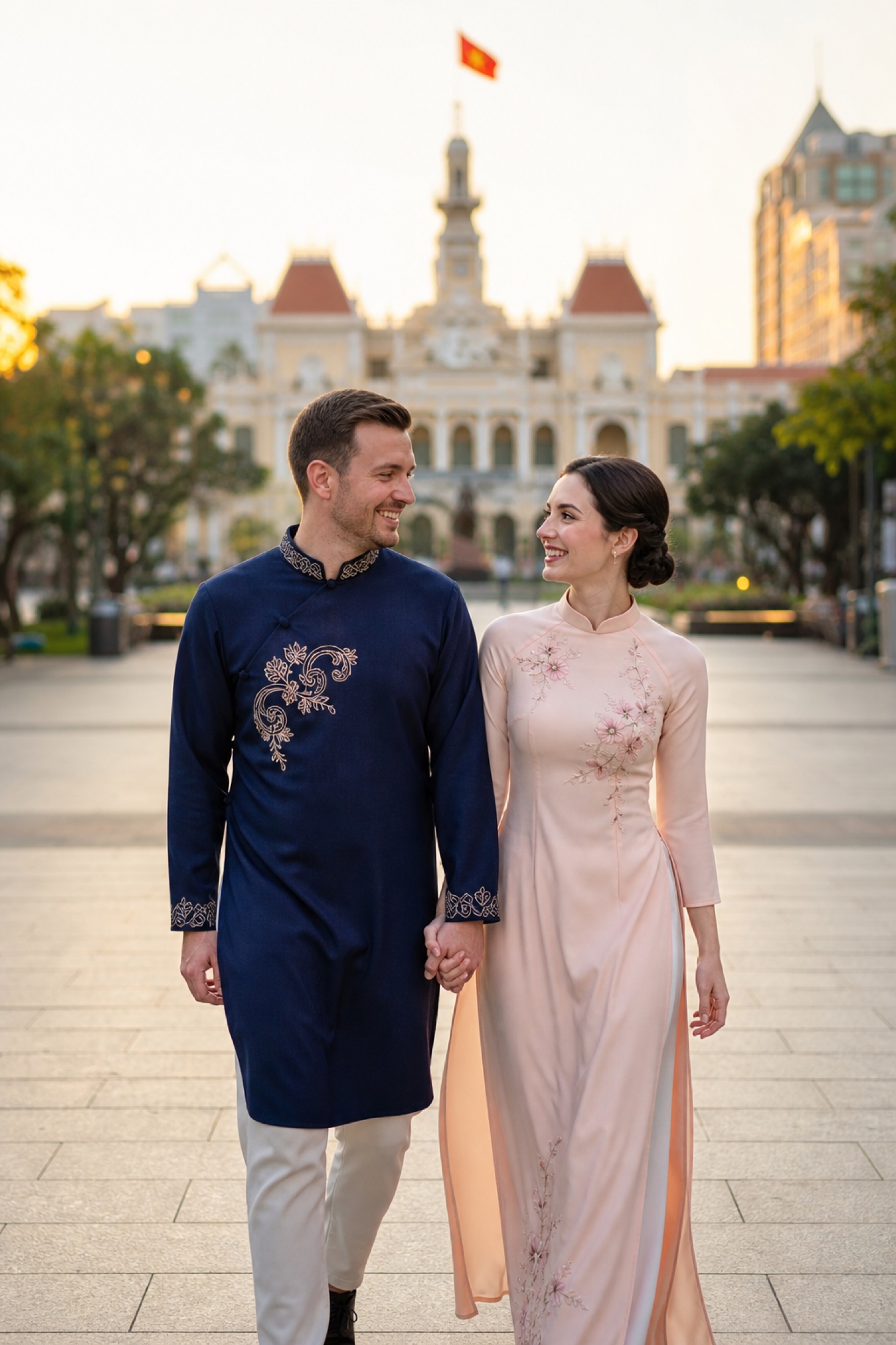
Humidity in Cholon sits at 75–85% year-round, peaking April–September. Silk ao dai will show sweat marks under the arms and back within 20 minutes of walking; synthetic blends (polyester-linen mix) are more forgiving. Lightweight cotton ao dai works if the weave is tight enough to read texture in photos (loose cotton gets wrinkled fast).
What to check before ordering or packing:
- Fabric weight: 100% silk = breathable but clings when damp; ask your tailor or rental shop for "lightweight summer blend."
- Lining: Full lining traps heat; half-lining (only from waist up) lets fabric breathe.
- Color: Lighter shades hide sweat better than navy or black; pastels and jewel tones photograph better at 5–6 pm when the sun is orange.
- Fit under the arm: If it's snug, movement causes bunching; ask for 1–2 finger widths of ease.
We've had clients rent ao dai the night before and request a half-day press at their hotel (5–6 hours before the shoot). Cáo Studio offers makeup & hair at your hotel, and we can steam the garment there too if your accommodation permits.
How do makeup and hair survive Cholon's heat?
Humidity breaks most makeup by hour two. Waterproof foundation (not just "water-resistant") is non-negotiable—silicone-based formulas set better than water-based in this climate. Powder goes on a damp face; expect touch-ups every 45–60 minutes.
Hair is trickier: straight blowouts fall flat; soft waves or braids last longer. Bridal-style updos with bobby pins + thread hold better than loose styles. Dry shampoo spray (applied the night before) absorbs excess scalp oil, reducing that damp-hair look in photos.
| Makeup choice | Why it works in Cholon | What to check |
|---|---|---|
| Waterproof powder foundation | Sets on humidity, doesn't separate | Shade match in daylight (not indoors) |
| Cream blush + powder topper | Blends without streaking, stays put | Blend before it dries (5–10 sec window) |
| Liquid eyeliner (waterproof) | Doesn't smudge; crisp lines survive humidity | Remove with micellar water, not water alone |
| Volumizing mascara (waterproof) | Lasts longest in sweat + incense smoke | Curl lashes first, apply from root to tip |
| Setting spray (alcohol-free) | Locks makeup without feeling stiff | Spray, wait 30 sec, don't touch face |
Cáo Studio's makeup team uses setting spray between locations and carries blotting papers—not blotting wipes, which remove foundation. We also prep skin the night before: light exfoliation, hydrating mask, 8-hour sleep. A rested face holds makeup better than dehydrated skin.
Which temples and shrines are photoshoot-friendly?
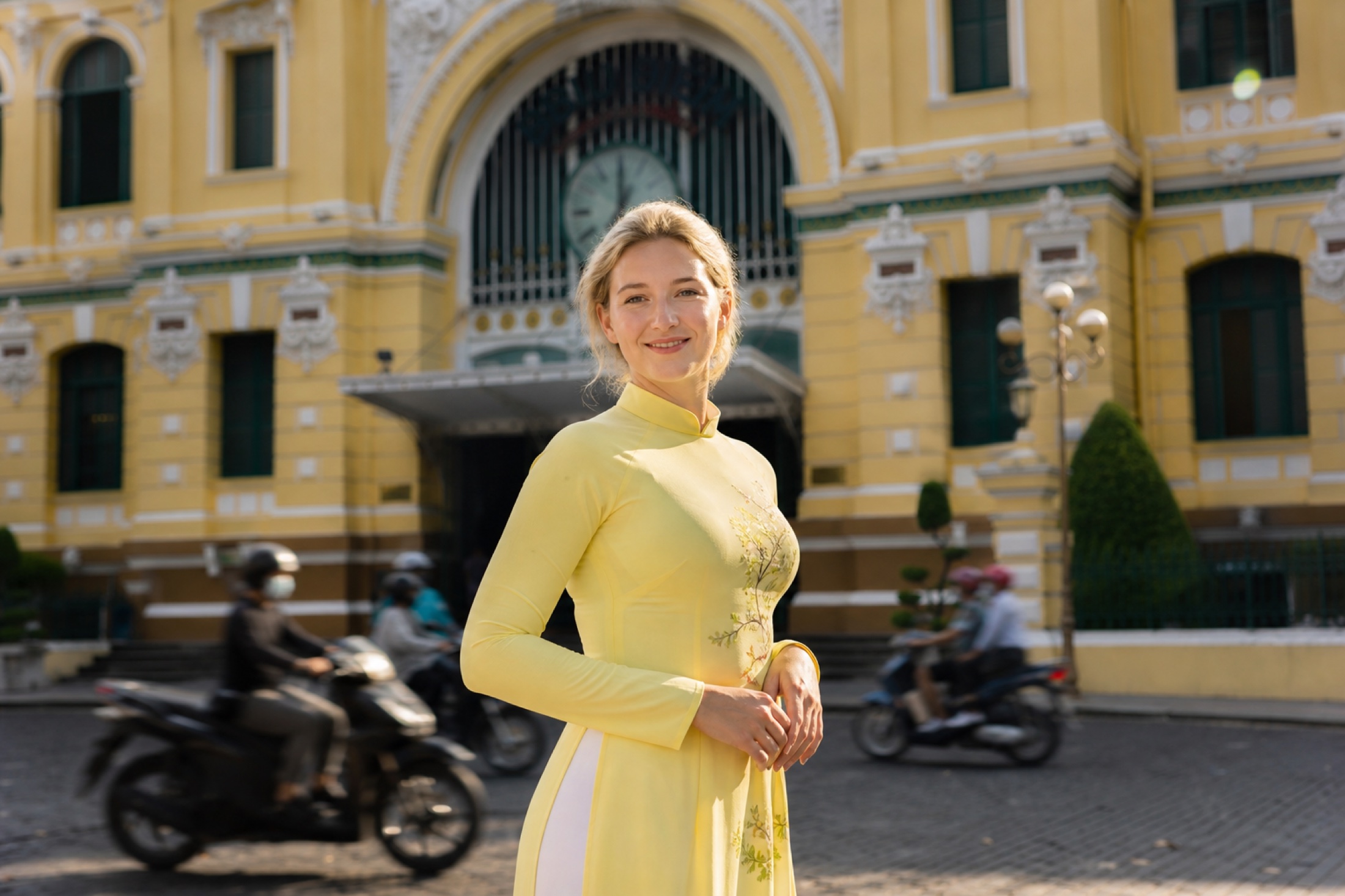
Not all Cholon shrines welcome cameras. Thean Hau Temple (Maccabee Street) is the largest and most tourist-familiar—prayer hours end by 10 am and 3 pm, so shoot before or after. Quan Âm Pagoda (Lao Tu Street) permits photos in the courtyard but not inside the sanctuary. Ong Bon Pagoda (Nguyen Trai Street) is active with worshippers; dress conservatively and ask staff before framing shots near the altar.
Etiquette checklist before entering:
- Wear clothes that cover shoulders, knees, and chest (ao dai satisfies this).
- Remove shoes if stepping past the threshold; if unsure, ask.
- Never photograph people at altars or monks in close-up without permission.
- Don't pose on altars or sacred thresholds.
- If incense is burning, don't blow it out or redirect it for framing.
- Visit between 9–11 am or 3–5 pm, when fewer worshippers are present.
Cholon's best "non-sacred" photo spots are the street markets (Cho Quan, early morning 6–8 am when vendors arrange produce), old shophouses with wooden shutters, and the flower district (Tran Hung Dao near Tran Phu, best January–February and before Lunar New Year). These require no permits and no etiquette constraints.
How to plan a session: studio vs. independent photographer
If you're booking a full shoot with Cáo Studio (Saigon-based ao dai photoshoot, couple & family photoshoot, or pre-wedding & elopement):
- We arrive 30 minutes early to scout light and check access to courtyards.
- We carry a reflector, backup makeup, water, and portable chair for outfit changes.
- We know temple staff and prayer schedules.
- We handle hair and makeup touch-ups on location.
- Turnaround is 2–3 weeks (preview gallery, edits, printed proofs optional).
If you're hiring a local independent photographer:
- Use Tipa (formerly TipAds) or Foody Influencer communities; ask for portfolios shot in Cholon, not generic Saigon landmarks.
- Confirm they've shot ao dai before (hand, fabric, and fabric-skin balance require skill).
- Meet them in Cholon a week before to walk the route and identify backup spots in case of crowds or rain.
- Ask their gear: do they carry a reflector, backup batteries, neutral-density filter (for shallow depth-of-field in bright light)?
- Agree on a rainy-day plan (reschedule, shoot indoors at your hotel, or switch to black-and-white for moody vibes).
- Request a contract specifying session length, number of edited photos, and delivery timeline.
Prices for independent Saigon photographers range widely; ask via their messaging app—don't rely on public pricing (often outdated). Budget 2–3 million VND for a 2-hour session if you're booking solo.
See Cáo Studio Saigon for studio rates and package details, or check the full pricing page.
What to check before you book or pack
For studio shoots (Cáo Studio):
- Confirm your ao dai or outfit 1 week before (we'll advise on fit and light compatibility).
- Book makeup & hair if you're uncomfortable managing humidity solo.
- Ask about the weather and light forecast; we'll suggest time slots and backup locations.
- Clarify if you want temple visits included (we'll handle etiquette and access).
For independent shoots:
- Verify the photographer has shot in Cholon before (ask to see 5+ recent examples).
- Confirm they own a reflector and waterproof gear.
- Agree on a reschedule or refund policy if rain cancels the session.
- Ask if they edit on-location proofs or just raw files.
For outfit prep:
- Have your ao dai cleaned and pressed 2 days before (wrinkles show under tight, raking light).
- Test your makeup formula and waterproof mascara at home before the shoot day.
- Bring a lightweight shawl (silk scarf) in case you enter a pagoda with exposed shoulders.
- Pack a portable battery bank, phone with offline maps (data is spotty in old alleys), and 1 liter of water per person.
Timing:
- Book 2–4 weeks in advance if you want a specific date (Tet, New Year, and weekends fill fast).
- Plan for 2–3 hours total (travel, setup, 60–90 min shooting, final location or outfit change).
- Arrive 15 minutes early; Cholon traffic is unpredictable.
📸 Book on WhatsApp — ao dai photoshoot
---
Need a pre-wedding or couple's session? Cholon's heritage architecture and incense-soaked air create moody, romantic backdrops. See our pre-wedding & elopement services or couple & family photoshoot options.
Traveling with family? Our family session guides cover group dynamics and how to pose kids in traditional dress without meltdowns (humidity is real for small children too).
Other Saigon districts worth shooting? Check our Saigon pillar page for guides to Ben Thanh, Binh Tay Market, and the French Quarter.
For destination shoots outside Hanoi, Ho Chi Minh City, and Hoi An, check our Hoi An photoshoot guide or ask on WhatsApp about coverage for custom locations.
FAQ
Can we shoot inside temples if we're in ao dai?
Yes, ao dai covers shoulders and knees, so you're dressed respectfully. Always ask permission, avoid photographing active altars or monks close-up, and remove shoes if monks or staff motion toward the threshold. Thean Hau Temple is most visitor-friendly.
What month has the best light in Cholon?
October–November (cool, lower humidity, clear skies). Avoid May–August (90%+ humidity, haze). April, September, and December–January are decent but rainier. Golden hour is your best bet any month.
Do we need a permit to shoot in Cholon alleys?
No permit for street photography. For commercial or professional gear (tripods, reflectors, crew), local police may ask you to move. Keep it casual; Cholon welcomes tourists. Sacred spaces (temples, shrines) require respect and permission, not paperwork.
How much should we pay a local independent photographer for a Cholon shoot?
Local photographers quote 2–4 million VND for 2–3 hours, depending on experience and edits included. Always confirm rates via messaging; ask what's included (travel to Cholon, number of edited photos, delivery timeline).
Will my phone photos be good enough, or do we need a pro camera?
Modern phones handle golden-hour light well, but narrow alleys and strong sidescaping shadows expose phone limitations (noise, blown highlights). A DSLR or mirrorless with a fast lens (f/1.8–2.0) and manual mode gives you control over depth and exposure. If budget is tight, borrow a friend's camera or hire a photographer rather than risking regret later.
FAQ
Can we shoot inside temples if we're in ao dai?
Yes, ao dai covers shoulders and knees, so you're dressed respectfully. Always ask permission, avoid photographing active altars or monks close-up, and remove shoes if monks or staff motion toward the threshold. Thean Hau Temple is most visitor-friendly.
What month has the best light in Cholon?
October–November (cool, lower humidity, clear skies). Avoid May–August (90%+ humidity, haze). April, September, and December–January are decent but rainier. Golden hour is your best bet any month.
Do we need a permit to shoot in Cholon alleys?
No permit for street photography. For commercial or professional gear (tripods, reflectors, crew), local police may ask you to move. Keep it casual; Cholon welcomes tourists. Sacred spaces (temples, shrines) require respect and permission, not paperwork.
How much should we pay a local independent photographer for a Cholon shoot?
Local photographers quote 2–4 million VND for 2–3 hours, depending on experience and edits included. Always confirm rates via messaging; ask what's included (travel to Cholon, number of edited photos, delivery timeline).
Will my phone photos be good enough, or do we need a pro camera?
Modern phones handle golden-hour light well, but narrow alleys and strong sidescaping shadows expose phone limitations (noise, blown highlights). A DSLR or mirrorless with a fast lens (f/1.8–2.0) and manual mode gives you control over depth and exposure. If budget is tight, borrow a friend's camera or hire a photographer rather than risking regret later.
Ao dai, makeup, hair and a local photographer in Hanoi or Saigon — one WhatsApp message.