services/special-concept
Cinematic Film Look Photoshoot Vietnam: Hanoi, Ho Chi Minh & Hoi An Gu
A cinematic film look photoshoot in Vietnam combines golden-hour location light, warm color grading, and shallow depth-of-field framing to mimic 35mm film stock. Cáo Studio – Makeup & Photoshoot in Hanoi and Saigon specializes in this aesthetic for ao dai, couple, and pre-wedding sessions. Success depends on location scouting, lens choice (50mm or 85mm prime), and post-processing color profiles.
What does "cinematic film look" actually mean for your shoot?
The cinematic film look mimics analog 35mm cinema stock: warm skin tones (orange-shifted shadows), creamy bokeh, crushed blacks, and lifted midtones. It's not oversaturated or filtered; it's intentional light control and color science. In Vietnam's tropical light, this means shooting during golden hour (6–7 a.m. or 4–5 p.m.), using diffusion to soften harsh overhead sun, and grading in post to push warm tones while maintaining skin detail. This style suits ao dai shoots, couple sessions, and pre-wedding work—anywhere storytelling matters more than bright, punchy colors.
📸 Book on WhatsApp — ao dai photoshoot
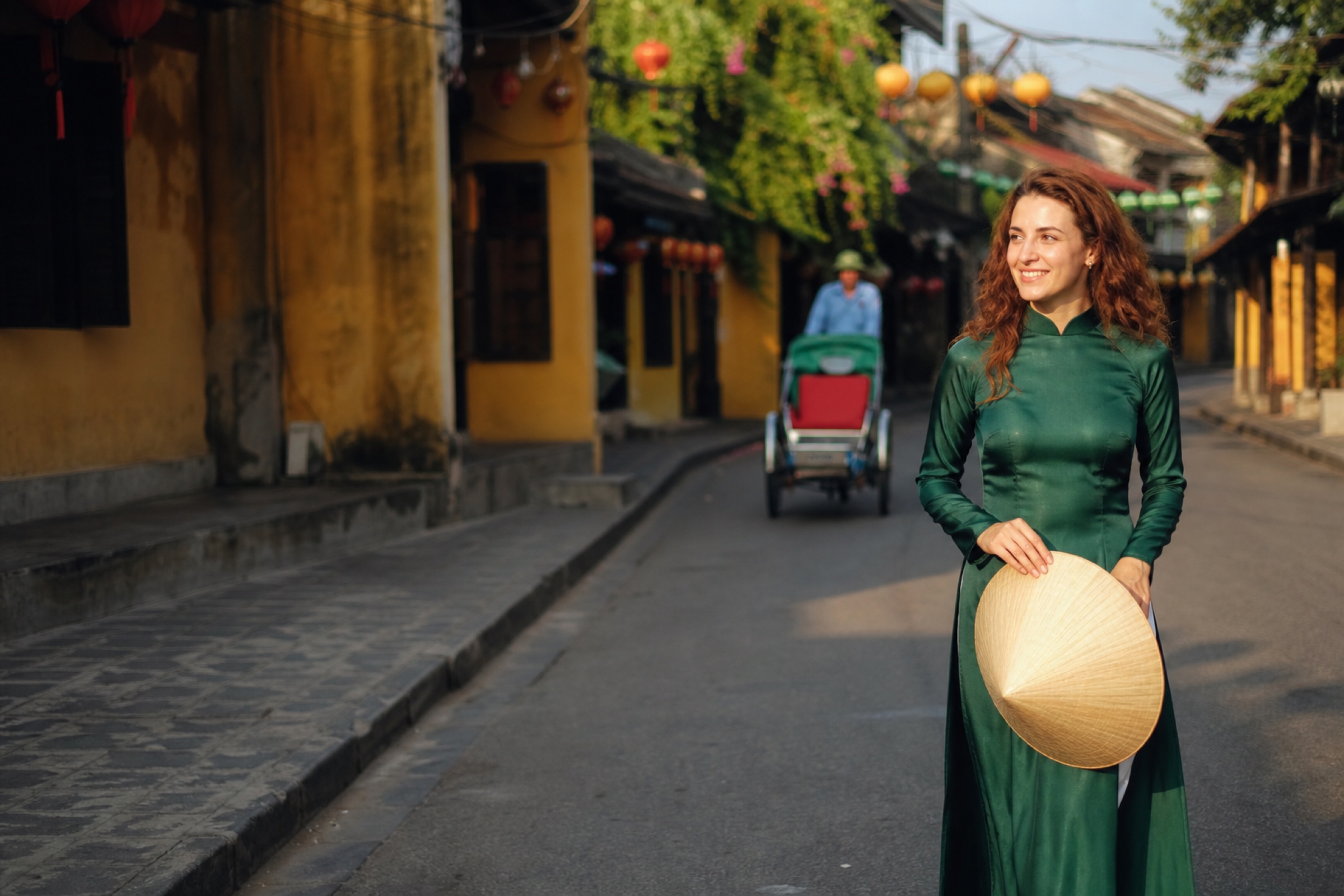
Where in Hanoi, Ho Chi Minh City, and Hoi An should you shoot?
Hanoi locations:
- Hoan Kiem Lake (early morning): soft directional light, colonial architecture backdrops, minimal crowds before 8 a.m. Best 6–7 a.m.
- Hoang Thanh Citadel walls: textured brick, deep shadows for cinematic contrast, protected from midday glare.
- Tran Quoc Pagoda: golden-hour light on water, temple silhouettes, spiritual framing (arrive 4:30 p.m., shoot until 5:45 p.m.).
- French Quarter (Bat Dan, Hang Gai): narrow streets channel soft directional light, cafe seating for natural moments.
Ho Chi Minh City:
- Binh Tay Market (very early): morning vendors, warm indoor tungsten light, cinematic grain potential.
- Saigon River (District 4): sunset reflections, French colonial villas, 4:30–6 p.m. window.
- Tan Dinh Church (evening): pink exterior catches late sun, street vendors add character, diffused light on steps.
Hoi An (by appointment): Ask on WhatsApp for current Hoi An dates. The ancient town's lantern-lit streets and evening neon require a different shooting strategy: 6–7 p.m. capture backlit lanterns with silhouettes; 7–8:30 p.m. shoot under ambient lantern and string light for deep, warm tones and film grain.
What gear and settings lock in the cinematic film look?
| Element | Best Choice | Why It Works | Budget Option |
|---|---|---|---|
| Lens | 50mm or 85mm f/1.4 prime | Shallow DOF (1.4–2.0), creamy bokeh, natural compression | 50mm f/1.8 (newer mirrorless) |
| Shutter Speed | 1/250–1/1000 sec | Freeze motion, meter for highlights without clipping skin | Auto ISO in aperture mode |
| ISO | 100–400 (shoot-to-grade, not ETTR) | Lift shadows in post without noise; film grain is intentional, not technical | Keep under 800 in daylight |
| White Balance | Tungsten (3200K) or custom | Pushes daylight warm; shifts skin orange-yellow (film-like) | Shoot RAW, grade in post |
| Color Space | ProPhoto or Adobe RGB (RAW) | Retains color info for grade; prevents clipping | sRGB if JPEG-only (avoid) |
| Film Simulation | Kodak Portra 400, Fuji Velvia (in-camera or LUT) | Warm shadows, lifted blacks, saturated reds—analog reference | Lookup table (LUT) preset library |
Cáo Studio shoots in RAW + ambient light. We meter for skin highlights, underexpose by 0.5–1 stop, and grade in-post to lift shadows and crush blacks slightly. This mimics how film stock holds detail across tonal range.
How do you choose: book a studio or shoot DIY?
| Shoot Type | Studio Session | DIY + Hired Photographer |
|---|---|---|
| Ao Dai Photoshoot | Cáo Studio: controlled light, makeup artist, curated locations, 2–3 hour session | Hire Hanoi freelancer: $200–400 USD, scout alone, may lack studio backup |
| Couple / Pre-Wedding | Cáo Studio special concept: cinematic color grade, backup outfits, 4–5 hour shoot | Local photographer + own locations: $300–600, timeline flexibility, no reshoot guarantee |
| Hotels + Travel Makeup | Makeup & hair at your hotel: travel no further, pro products, 1–1.5 hours | DIY makeup: saves money, risk of sweat/humidity fade, no pro lighting |
Studio books faster. Cáo Studio's Hanoi and Saigon teams have recce'd top light windows and know seasonal cloud patterns. They pack reflectors, diffusers, and backup gels. They've shot ao dai and couple sessions in rain—they know contingencies. Booking on WhatsApp confirms location, date, and mood board in 24 hours.
DIY works if: you're comfortable scouting alone, have a local photographer referral, plan 2–3 backup dates (weather), and accept one-shot results (no reshoot). Vietnam's monsoon (May–September) and dry season (December–February) shifts require location changes; a studio handles this.
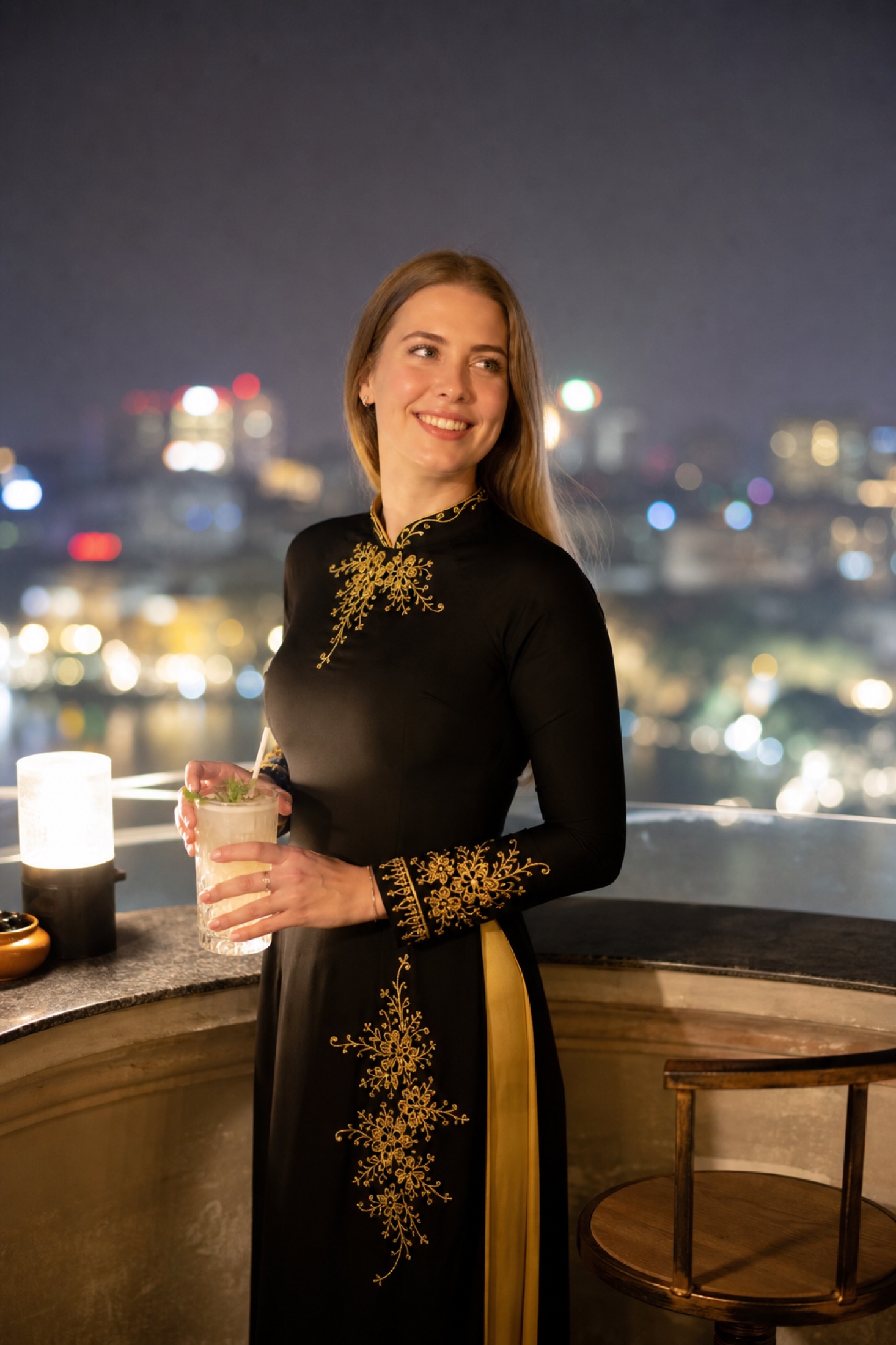
What's the step-by-step cinematic film look shot list?
Pre-shoot (1 week before):
- [ ] Confirm golden-hour time (check Google Maps for sun direction at your location).
- [ ] Scout location in similar light (e.g., visit at 5 p.m. if shooting 5 p.m., check for crowds, power lines, reflective surfaces).
- [ ] Test white balance: shoot a gray card in your venue's light; note custom WB if using in-camera LUT.
- [ ] Outfit fittings: ao dai silhouette under golden backlight (check for translucence; layer if needed), shoes for walking on uneven surfaces.
- [ ] If hiring makeup: share reference images (film stills, color grading links) to ensure warm, non-matte finish (film looks dewy, not dry).
On the day:
- [ ] Arrive 15 min. early; position subjects facing into or against light (not side-lit, which flattens cinema look).
- [ ] Shoot three "zones": backlit silhouettes (subject between you and sun), side-lit (subject at 45°), and front-lit with reflector (fill shadows, keep them warm).
- [ ] Take 5–10 frames per pose; slight wind or blink is fine (film captures motion, not perfection).
- [ ] Bracket exposure: one for highlights, one for midtones, one for shadows (pick the best in post, or blend in Lightroom).
- [ ] Capture moments (subject walking, laughing, looking away) not just posed stares—cinematic narratives need context.
Post-production:
- [ ] Import all files into Lightroom (or Capture One); apply one warm LUT or grade preset to ensure consistency.
- [ ] Lift shadows by +10–20 points; crush blacks to -5 to -10 to add contrast.
- [ ] Push warm tones: increase color temperature to +200–400K, add +10–20 to orange and yellow hue sliders.
- [ ] Reduce saturation slightly overall (–5), then bump reds and oranges (+10–15) for skin flattery.
- [ ] Add slight fade or vignette (–10 to –15 edges) to direct focus inward.
- [ ] Export at 100 DPI, sRGB, for Instagram or print.
Cáo Studio provides this grade as standard on special-concept packages. You receive RAW and JPEG files; JPEGs are pre-graded.
How does weather and season change your cinematic film shoot strategy?
December–February (cool, dry):
- Clear mornings; harsh midday sun (avoid 10 a.m.–3 p.m.).
- Golden hour is longer (6–7:30 a.m., 4–5:30 p.m.) due to lower sun angle.
- Skin doesn't sweat as much; makeup holds cinematic matte-to-dewy balance.
- Best for film look: consistent light, no clouds breaking continuity.
May–September (monsoon, hot-humid):
- Overcast skies act as a massive softbox; no golden hour window, but even front light works.
- Skin shines; allow 2–3 touch-ups per hour (makeup artist essential).
- Air is hazy (dust, humidity); this adds natural diffusion, softening the cinematic grade (film look becomes more forgiving).
- Sweat risks makeup fade; powder sparingly; use long-wear foundation.
Hoi An evening shoots (ganzheit note): Lantern-lit old town (June–Aug. especially) creates inherent cinematic mood. Shoot 6:30–8 p.m. to blend lantern tungsten with blue twilight sky—a natural cinema color grade. Rain adds reflections; plan for wet streets.
---
What to check before you book (honest checklist)
Before signing up:
- Do you want studio backup light, or DIY with a rental kit (mirror + reflectors)? Studio is faster.
- Have you scouted Vietnam locations before, or is this your first time? First-timers: book Cáo Studio for location curation.
- How many outfit changes? Cinematic shoots work best with 2–3 key looks; more dilutes the narrative.
- Is the date rainy season? If so, plan indoor/covered locations (old town, shophouse interiors, temples). Cáo Studio knows these.
- Do you need a makeup artist, or are you bringing a friend? Professional makeup holds better in humidity and photograph light.
Before hitting "book":
- Confirm location is open 6–7 a.m. (some temples, cafes, close early; Cáo Studio verifies access).
- Ask photographer: "Do you grade to warm skin tones?" (confirm they won't push cool-tone LUTs).
- Bring a backup outfit (ao dai often needs undergarments adjusted; cinema looks better in well-fitted silhouettes).
- Bring water and electrolyte—golden-hour shoots last 1.5–2 hours; Vietnam heat is real.
---
📸 Book on WhatsApp — cinematic film look special concept
FAQ
Can I achieve cinematic film look on a smartphone?
Yes, with limits. iPhone 14 Pro / Samsung S24 shoot in RAW if you use Lightroom mobile. Shoot in aperture mode (f/2.0 or lower), manual white balance at 3500K, and grade with a warm LUT. Results lack 85mm bokeh depth, but the color and mood are achievable. For premium cinema look, rent a 50mm f/1.4 on-site (Hanoi camera shops offer daily rentals).
What's the difference between film look and "indie film" or "moody" presets?
Film look targets specific stock simulation (Kodak Portra 400: warm, forgiving, lifted shadows). Indie film presets often over-crush blacks and add green/teal tones (modern YouTube aesthetic). Moody presets desaturate and add contrast. A true film look keeps skin warm and natural, never blue-shifted. If a preset is sold as "cinematic" but makes skin cool, pass.
If I book Cáo Studio for an ao dai shoot, can I request the cinematic film look grade?
Yes. When you WhatsApp to book an ao dai photoshoot, mention cinematic film look in your mood board. Cáo Studio includes color grading in special-concept packages; confirm which edit style is standard on pricing. If unsure, ask on WhatsApp—they'll advise package tier.
How do I find a photographer in Hoi An if Cáo Studio is fully booked?
Ask on WhatsApp for Hoi An dates first—the team travels for appointments. If unavailable, ask locals at your hotel for referrals. Check portfolios for warm-toned, shallow-DOF work (not blown-out white or cool-filtered). Agree on the grade style (film look, not Instagram cool tones) before deposit.
Can I use a cinematic film look preset from a preset pack, or do I need a photographer?
Presets are a starting point, not a finish. A good preset (Mastercolo, VSCO, Babel Color) adds warmth and structure—but it won't recover blown highlights or fix flat midday light. Hire a photographer for light control; use presets for consistency in personal shooting.
Does Hanoi have better light for film look than Ho Chi Minh City or Hoi An?
No. Hanoi's lakes and pagodas offer structured backdrops; Ho Chi Minh's river and market have deep character; Hoi An's lanterns are inherently cinematic. Light quality is seasonal, not regional. Choose by location mood (what story you want), not light alone. Cáo Studio shoots all three; the grade and mood board matter more than the city.
FAQ
Can I achieve cinematic film look on a smartphone?
Yes, with limits. iPhone 14 Pro / Samsung S24 shoot in RAW if you use Lightroom mobile. Shoot in aperture mode (f/2.0 or lower), manual white balance at 3500K, and grade with a warm LUT. Results lack 85mm bokeh depth, but the color and mood are achievable. For premium cinema look, rent a 50mm f/1.4 on-site (Hanoi camera shops offer daily rentals).
What's the difference between film look and "indie film" or "moody" presets?
Film look targets specific stock simulation (Kodak Portra 400: warm, forgiving, lifted shadows). Indie film presets often over-crush blacks and add green/teal tones (modern YouTube aesthetic). Moody presets desaturate and add contrast. A true film look keeps skin warm and natural, never blue-shifted. If a preset is sold as "cinematic" but makes skin cool, pass.
If I book Cáo Studio for an ao dai shoot, can I request the cinematic film look grade?
Yes. When you WhatsApp to book an [ao dai photoshoot](/services/ao-dai-photoshoot), mention cinematic film look in your mood board. Cáo Studio includes color grading in special-concept packages; confirm which edit style is standard on [pricing](/pricing). If unsure, ask on WhatsApp—they'll advise package tier.
How do I find a photographer in Hoi An if Cáo Studio is fully booked?
Ask on WhatsApp for Hoi An dates first—the team travels for appointments. If unavailable, ask locals at your hotel for referrals. Check portfolios for warm-toned, shallow-DOF work (not blown-out white or cool-filtered). Agree on the grade style (film look, not Instagram cool tones) before deposit.
Can I use a cinematic film look preset from a preset pack, or do I need a photographer?
Presets are a starting point, not a finish. A good preset (Mastercolo, VSCO, Babel Color) adds warmth and structure—but it won't recover blown highlights or fix flat midday light. Hire a photographer for light control; use presets for consistency in personal shooting.
Does Hanoi have better light for film look than Ho Chi Minh City or Hoi An?
No. Hanoi's lakes and pagodas offer structured backdrops; Ho Chi Minh's river and market have deep character; Hoi An's lanterns are inherently cinematic. Light quality is seasonal, not regional. Choose by location mood (what story you want), not light alone. Cáo Studio shoots all three; the grade and mood board matter more than the city.
Ao dai, makeup, hair and a local photographer in Hanoi or Saigon — one WhatsApp message.