/pre-wedding-photoshoot
Colonial Architecture Pre-Wedding Photos in Hanoi
Colonial architecture pre-wedding photos in Hanoi mean shooting the French Quarter (Hoan Kiem, Ba Dinh, Hai Ba Trung districts) in soft early light—typically 6–8 am or 4–6 pm—when tree shadows frame facades and crowds are thin. Best seasons are October–November (cool, dry, golden hour) and March–April (mild, before summer heat); avoid May–September (humidity, heat haze) and December–February (overcast, drizzle). Wear an ao dai over a slip, tailored trousers, or a wedding dress that moves; avoid white or pale fabrics in midday sun. Cáo Studio directs the full day—hair, makeup, outfit coordination, and photography—so your timeline stays tight and light is never wasted. Check season, outfit comfort, and transport time before booking; ask on WhatsApp for availability and what's included.
Colonial architecture in Hanoi captures a fleeting mood: French shutters softened by creeping vines, yellow stucco walls that glow at dawn, pavements where morning light pools under tamarind trees. For pre-wedding couples, these streets hold a quiet romance that doesn't rely on crowds or monuments. But the light, the heat, the crowds do matter—and the difference between a 6 am shoot and a noon one is the difference between frames you return to and frames you forget.
This guide walks you through the real choices: which colonial districts photograph best, when the light works, what to wear under an ao dai, how one team (hair, makeup, photographer) moves faster than vendors stitched together, and what to check before booking.
Why does colonial Hanoi photograph differently than temples or modern streets?
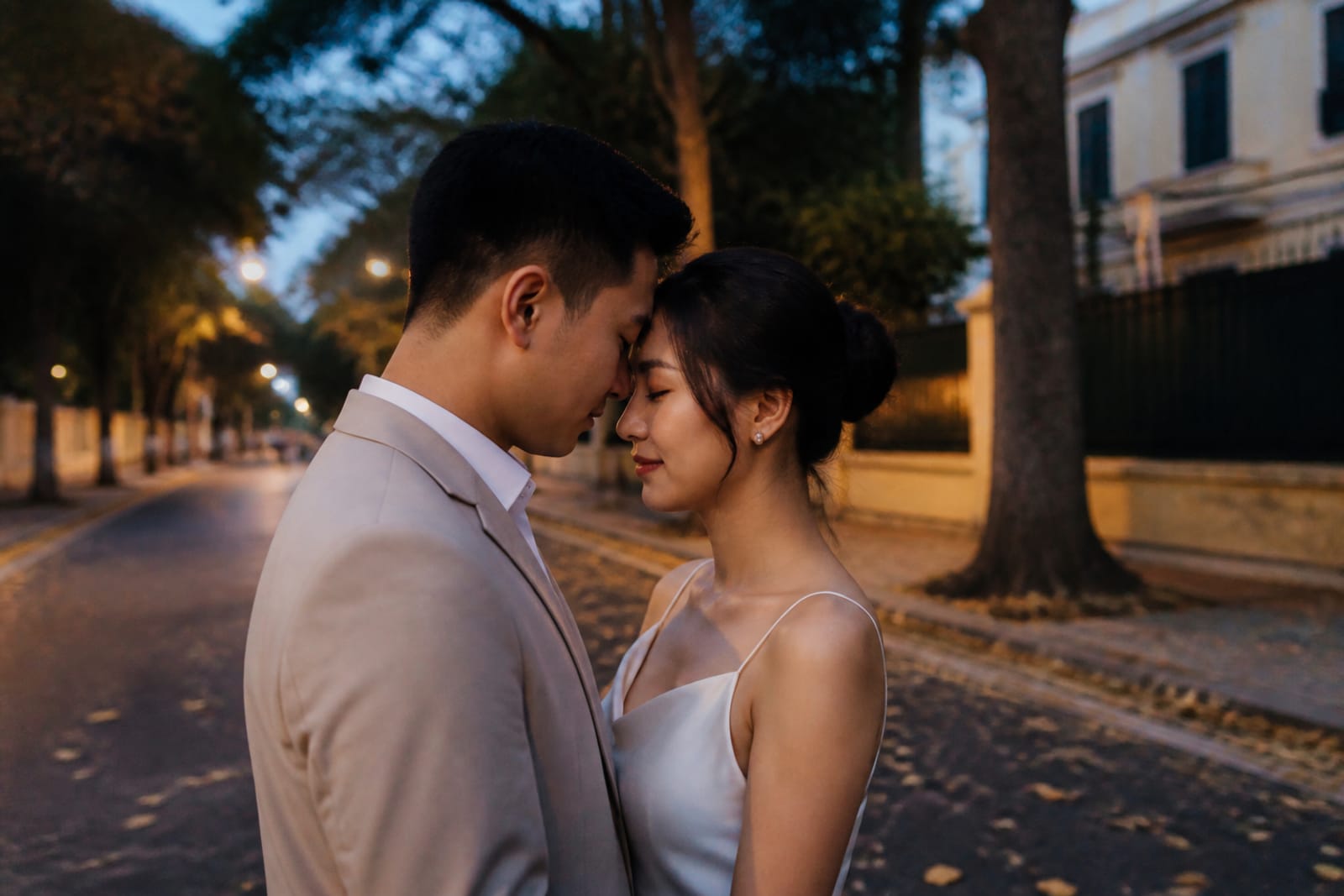
Colonial districts reflect light softly. Stone, weathered plaster, and shutters scatter harsh sun instead of concentrating it; tree canopies filter midday rays into dappled patterns. The streets are also quieter—fewer crowds than Hoan Kiem Lake's weekend throngs or the Old Quarter's vendor chaos. You're not fighting for a clean frame or stopping for motorbikes every ten seconds. The trade-off: colonial areas demand specific timing. Shoot at 1 pm and you get flat, scalding light. Shoot at 7 am and you get depth, colour, and the rare silence of Hanoi waking.
📸 Book on WhatsApp — ao dai photoshoot
Which colonial Hanoi neighborhoods photograph best for pre-wedding?
Three districts dominate: Phan Dinh Phung Street (Ba Dinh, west of Hoan Kiem) has the densest tree cover and softest morning light—tamarind canopies cast moving shadows across yellow walls. Trang Tien–Dinh Tien Hoang corridor (east side of Hoan Kiem) offers colonnaded shopfronts and quieter early morning. Hai Ba Trung district (south-east, near Tran Hung Dao) has fewer tourists, steeper tree shadows, and more weathered facades that read as intimate rather than postcard-perfect. Phan Dinh Phung works best for autumn shoots; Hai Ba Trung suits cooler months when tree leaf-fall exposes architectural detail. All three require arriving before 7 am or after 4 pm to avoid midday pedestrian traffic and overexposed facades.
What season makes colonial light work hardest for pre-wedding frames?
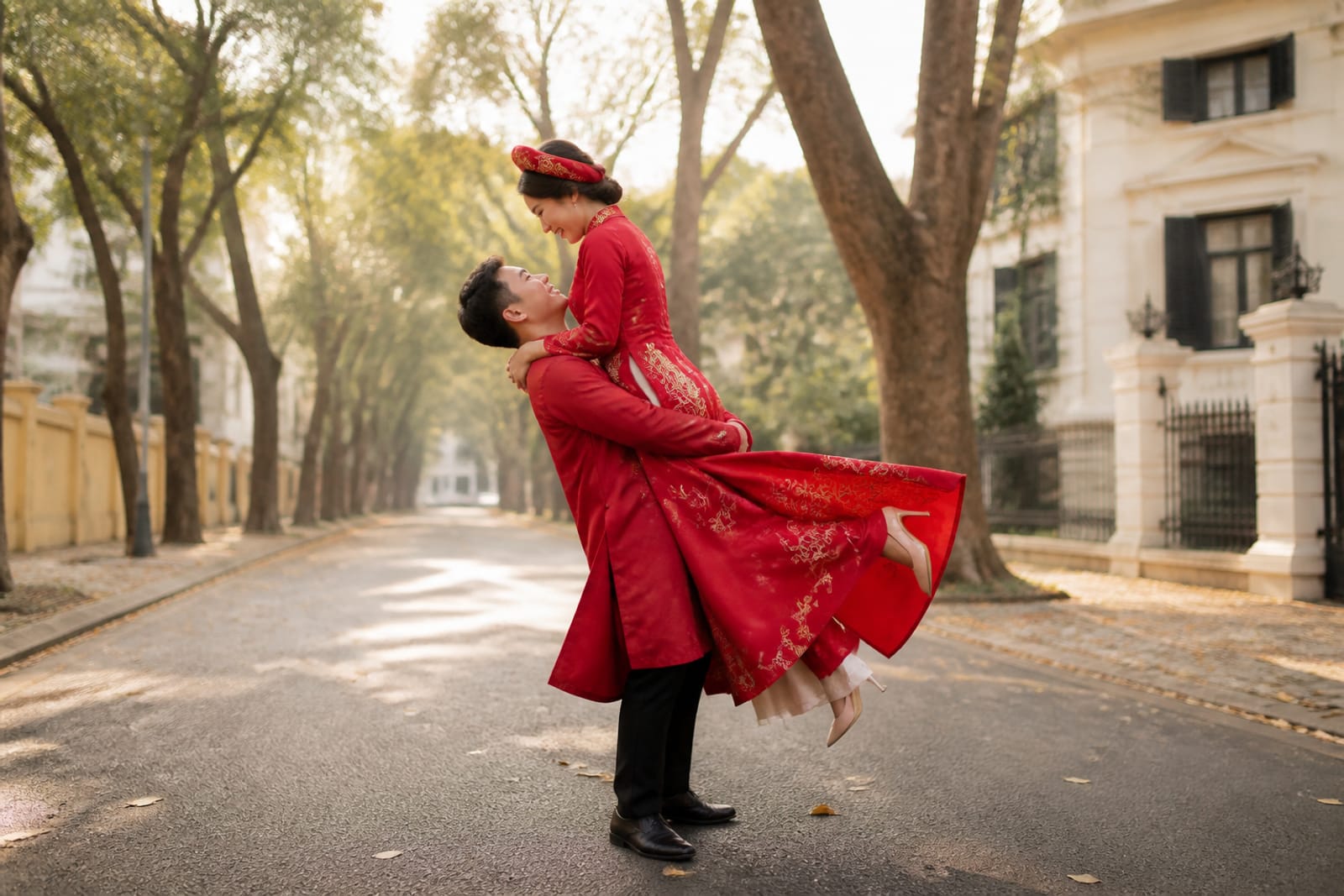
October–November is non-negotiable for colonial shoots. The air clears after summer rains; morning light arrives sharp and warm; tree shadows are deep enough to frame faces without flattening them. Humidity drops, so fabrics drape instead of clinging, and ao dai silk photographs with real sheen. December–February is cooler (10–20°C) but often overcast and drizzly—frames lose colour and contrast. March–April brings mild weather, but haze rolls in mid-morning and light becomes flat by 8 am. May–September: heat and humidity are hostile to colonial shoots. Midday temperatures exceed 35°C; ao dai clings; makeup sets poorly; light burns out stone and creates harsh shadows under eyes.
| Season | Light quality | Heat/humidity | Crowds | Best time to shoot |
|---|---|---|---|---|
| Oct–Nov | Golden, deep shadows | Low | Fewer tourists | 6–8 am, 4–6 pm |
| Dec–Feb | Overcast, diffuse | Cool but drizzly | Thin but grey | 8–10 am, 3–5 pm |
| Mar–Apr | Warm but haze-prone | Mild, rising humidity | Growing | Early 6–7 am only |
| May–Sep | Harsh, blown-out | High (35°C+) | Heavy, oppressive | Avoid entirely |
Conclusion: book October–November if possible; March–April if not; avoid the other months for colonial shoots.
What should you wear under an ao dai for movement and comfort?
An ao dai drapes beautifully if the slip underneath is smooth and doesn't shift. Wear a fitted white slip (bias-cut, not stretchy cotton—stretchy clings and creases show through silk). Avoid slips with elastic at the hem; they bunch under the long slit. For trousers beneath the ao dai, choose high-waisted tailored white or cream linen—they move without bunching and photograph as a clean line under the side slit. If wearing a Western wedding dress under an ao dai overlay, ensure the dress hem ends at or above the knee; longer skirts tangle with the ao dai's slit and break the line when you walk. Footwear: wear simple white flats or neutral sandals for fitting and transport; bring heels in your bag for final shots if the street surface is smooth (Phan Dinh Phung is smooth; older Hai Ba Trung streets are rougher). Avoid platforms or delicate heels on uneven pavement—one twisted ankle ends a shoot.
How does one team—hair, makeup, photographer—change the colonial pre-wedding workflow?
Three separate vendors means a 7 am hair slot, a 7:45 am makeup slot, a 9 am photographer arrival, and light that's already moved. One team (Cáo Studio's model) sends hair and makeup artists with the photographer from the start. They arrive at your hotel by 6 am, complete styling by 6:50 am, and you're shooting by 7 am—not scrambling to find the photographer or hoping makeup sets in moving air. If the first location has harsh light at 7:15 am, the team pivots to a shadowed street 50 meters away without breaking rhythm. If your ao dai needs a quick steam or safety pin, the makeup artist handles it; the photographer doesn't pause. At the second location (say, a shuttered colonial storefront), hair touch-ups and sun exposure checks happen between frames, not in a separate appointment. The result: tighter timeline, fewer gaps, and photographs that flow as a story, not disconnected shots from three different skill sets.
Read how Cáo Studio's one-team approach works.
What do you actually need to check before booking a colonial pre-wedding shoot?
Season and light: Confirm your wedding date or preferred shoot month. If it's May–September, ask if the studio has shaded colonial locations or indoor options (courtyards, galleries). October–November books fast; book 6–8 weeks ahead.
Outfit finality: Bring ao dai and dress samples to your consultation; discuss how each moves under the photographer's direction. Confirm what the studio provides (often hair and makeup) and what you bring.
Transport and access: Colonial streets are pedestrian-heavy early morning but motorable at 6–7 am. Ask if the studio arranges transport or if you meet at a location. Check that your chosen dress zips or buttons easily for in-vehicle comfort.
Edited timeline: Cáo Studio returns edited photos and a short vertical film within 48 hours; confirm this matches your timeline. Ask exactly what formats (digital files, prints, album) are included.
Weather backup: October–November can bring sporadic drizzle. Agree on a rain date or covered location (colonial hotel lobby, interior gallery) before the shoot day.
How does directing (not posing) work on colonial streets with architecture?
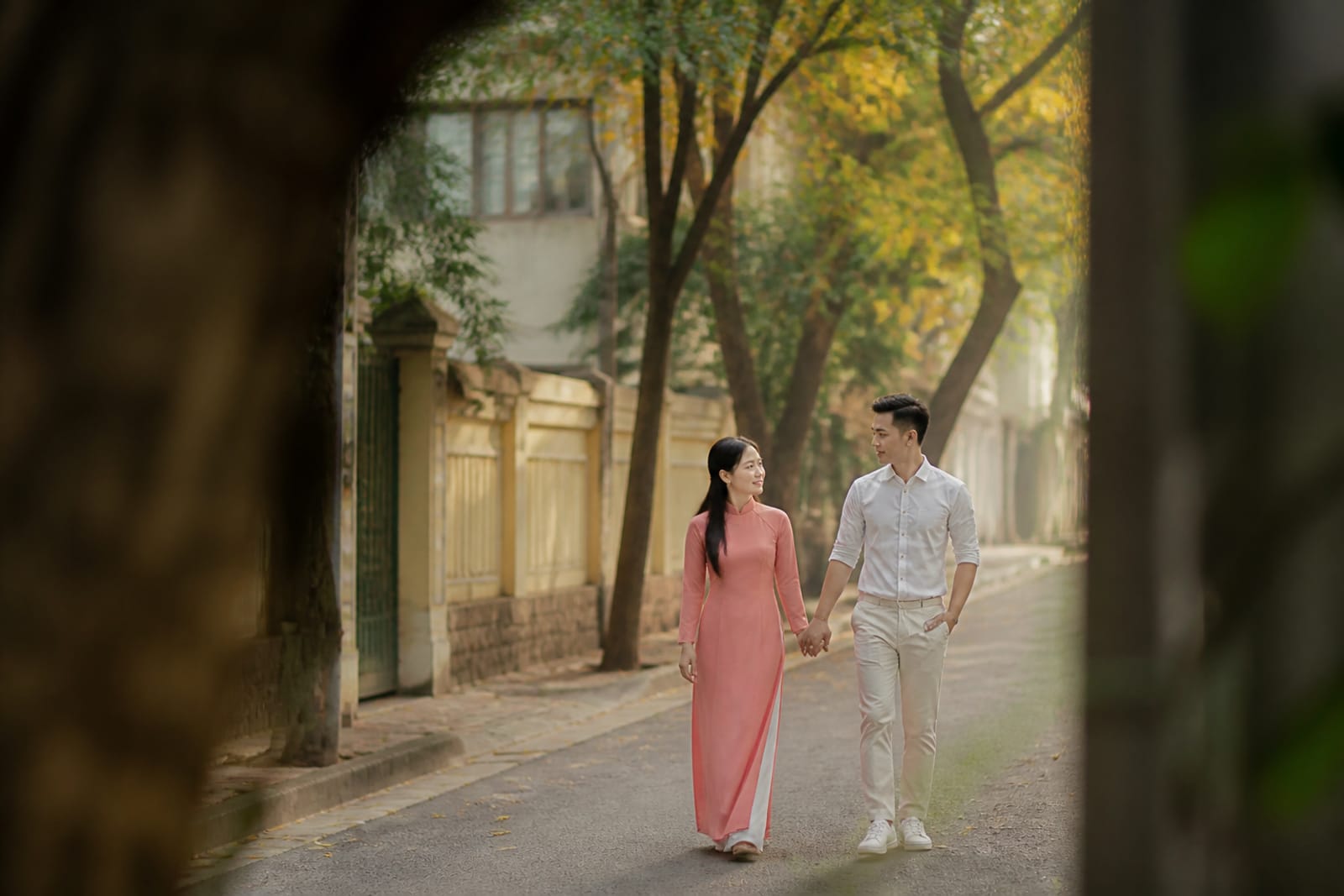
"Posing" in front of a colonial facade means standing stiffly, looking at the camera, waiting for the click. Directing means you're walking—down the street, toward a doorway, looking at each other—while the photographer captures real motion and real light. On Phan Dinh Phung Street at 6:30 am, this looks like: the couple walks slowly under the tamarind canopy, tree shadow moving across their faces as they look at each other; the photographer shoots wide first (the street, the trees, the scale), then medium (just above the waist as they move), then detail (hands linking, faces framed by shadow). The ao dai swings as you walk; the light changes naturally; your expressions aren't frozen. The frames tell a story—they are walking into their day together—not a static "smile for the camera." This method works on colonial streets because the architecture doesn't demand a heroic pose; it's the setting, not the stage.
Learn more: Colonial photoshoots are best directed, not posed.
For pre-wedding couples considering Hanoi, a full pre-wedding photoshoot package often includes multiple locations, outfit changes, and a video. First-time visitors or those short on time might prefer a focused couple photoshoot in one or two colonial spots.
---
What to check before you book
- Shoot date and season: October–November is best; confirm the studio has availability and understands your season choice.
- Your outfit: Bring samples (ao dai, dress, tailored trousers) to discuss fit, movement, and heat comfort.
- Inclusions: Ask exactly what hair, makeup, outfits, edited photos, and video are included. Confirm delivery timeline (Cáo Studio is 48 hours; compare to your deadline).
- Backup plan: Agree on a rain date or covered location before the shoot day.
- Transport: Clarify how you and the team move between colonial locations and whether the studio arranges it.
---
FAQ
Can I wear a Western wedding dress for a colonial Hanoi pre-wedding shoot?
Yes—many couples wear a Western dress as the main outfit and add an ao dai overlay for contrast. Ensure the dress hem ends at or above the knee so it doesn't tangle with the ao dai's slit. Confirm the dress moves and breathes in Hanoi's heat; heavy fabrics suffer in humidity even in October–November. Discuss dress comfort and steaming with your photographer during booking.
Is December–February okay for colonial photos if I can't shoot in autumn?
Possible but not ideal. December–February is cool (10–20°C) and dry, but overcast days are frequent and light lacks warmth. Frames tend toward muted tones and flatter shadows. If you must book this window, plan for early morning (8–9 am) before cloud deepens, and ask the studio if they use neutral or vintage film looks to add depth. March–April is often better if December doesn't work.
What happens if it rains on my colonial shoot day?
October–November rain is rare but sporadic drizzle happens. Agree on a backup plan before booking—either a rain date or a covered location (colonial hotel interior, gallery, shopfront overhang). Cáo Studio will know covered colonial spaces; ask during WhatsApp consultation. Wet pavements and wet ao dai create dramatic frames too, so don't assume rain is a total loss.
Do I need a permit to photograph on colonial Hanoi streets?
No formal permit is needed for personal pre-wedding shoots on public colonial streets (Phan Dinh Phung, Trang Tien, Hai Ba Trung). The studio may inform local authorities as courtesy, but it's not legally required. Avoid blocking traffic or setting up large equipment; keep the shoot intimate and mobile. If you plan to use a drone, ask the studio—drone permits are separate and complex.
How much time do I need for a colonial pre-wedding shoot—one morning, a full day, multiple days?
One morning (6–9 am) yields one to two colonial locations and 100–150 frames. A half-day (6 am–noon) allows two to three locations. A full day shoots colonial locations in morning/evening and a different district (lake, parks, modern architecture) midday when colonial light is harsh. Ask Cáo Studio what your package includes; most pre-wedding photoshoots offer flexible timing.
Can I do a colonial shoot and an ao dai photoshoot together or separate?
Both. A colonial pre-wedding shoot uses your personal wedding dress or tailored outfit. A standalone ao dai photoshoot is a separate session focused entirely on the ao dai in curated locations. Many couples do both: an ao dai session in autumn, a pre-wedding colonial shoot in their chosen season. Cáo Studio coordinates both; ask on WhatsApp which combination suits your timeline and budget.
FAQ
Can I wear a Western wedding dress for a colonial Hanoi pre-wedding shoot?
Yes—many couples wear a Western dress as the main outfit and add an ao dai overlay for contrast. Ensure the dress hem ends at or above the knee so it doesn't tangle with the ao dai's slit. Confirm the dress moves and breathes in Hanoi's heat; heavy fabrics suffer in humidity even in October–November. Discuss dress comfort and steaming with your photographer during booking.
Is December–February okay for colonial photos if I can't shoot in autumn?
Possible but not ideal. December–February is cool (10–20°C) and dry, but overcast days are frequent and light lacks warmth. Frames tend toward muted tones and flatter shadows. If you must book this window, plan for early morning (8–9 am) before cloud deepens, and ask the studio if they use neutral or vintage film looks to add depth. March–April is often better if December doesn't work.
What happens if it rains on my colonial shoot day?
October–November rain is rare but sporadic drizzle happens. Agree on a backup plan before booking—either a rain date or a covered location (colonial hotel interior, gallery, shopfront overhang). Cáo Studio will know covered colonial spaces; ask during WhatsApp consultation. Wet pavements and wet ao dai create dramatic frames too, so don't assume rain is a total loss.
Do I need a permit to photograph on colonial Hanoi streets?
No formal permit is needed for personal pre-wedding shoots on public colonial streets (Phan Dinh Phung, Trang Tien, Hai Ba Trung). The studio may inform local authorities as courtesy, but it's not legally required. Avoid blocking traffic or setting up large equipment; keep the shoot intimate and mobile. If you plan to use a drone, ask the studio—drone permits are separate and complex.
How much time do I need for a colonial pre-wedding shoot—one morning, a full day, multiple days?
One morning (6–9 am) yields one to two colonial locations and 100–150 frames. A half-day (6 am–noon) allows two to three locations. A full day shoots colonial locations in morning/evening and a different district (lake, parks, modern architecture) midday when colonial light is harsh. Ask Cáo Studio what your package includes; most [pre-wedding photoshoots](/pre-wedding-photoshoot) offer flexible timing.
Can I do a colonial shoot and an ao dai photoshoot together or separate?
Both. A [colonial pre-wedding shoot](/pre-wedding-photoshoot) uses your personal wedding dress or tailored outfit. A standalone [ao dai photoshoot](/ao-dai-photoshoot) is a separate session focused entirely on the ao dai in curated locations. Many couples do both: an ao dai session in autumn, a pre-wedding colonial shoot in their chosen season. Cáo Studio coordinates both; ask on WhatsApp which combination suits your timeline and budget.
Ao dai, makeup, hair and a local photographer in Hanoi or Saigon — one WhatsApp message.