lookbook
Couple Poses That Don't Feel Awkward: A Real Guide
Most couples freeze in front of the camera because they're told to "just be natural"—which isn't a pose at all. Real comfort comes from movement, genuine interaction, and poses that hide insecurity, not amplify it.
Awkward couple poses happen when partners face the camera directly or hold stiff hand-holds. At Cáo Studio – Makeup & Photoshoot, we use side-by-side angles, foreheads-touching frames, and walking shots that let you interact naturally instead of "smile at the lens." Movement and proximity ease tension fast.
---
Why Standing Face-On to the Camera Feels Awkward
Direct front-facing poses force you to maintain intense eye contact with the lens while your partner does the same. Your arms hang unnaturally. Smiles plateau after three seconds. The photographer's reminder to "relax" creates the opposite effect. This is the single most common cause of stiff couple photos—and why it dominates Instagram despite poor results.
---
What Angle Actually Works: Offset Framing
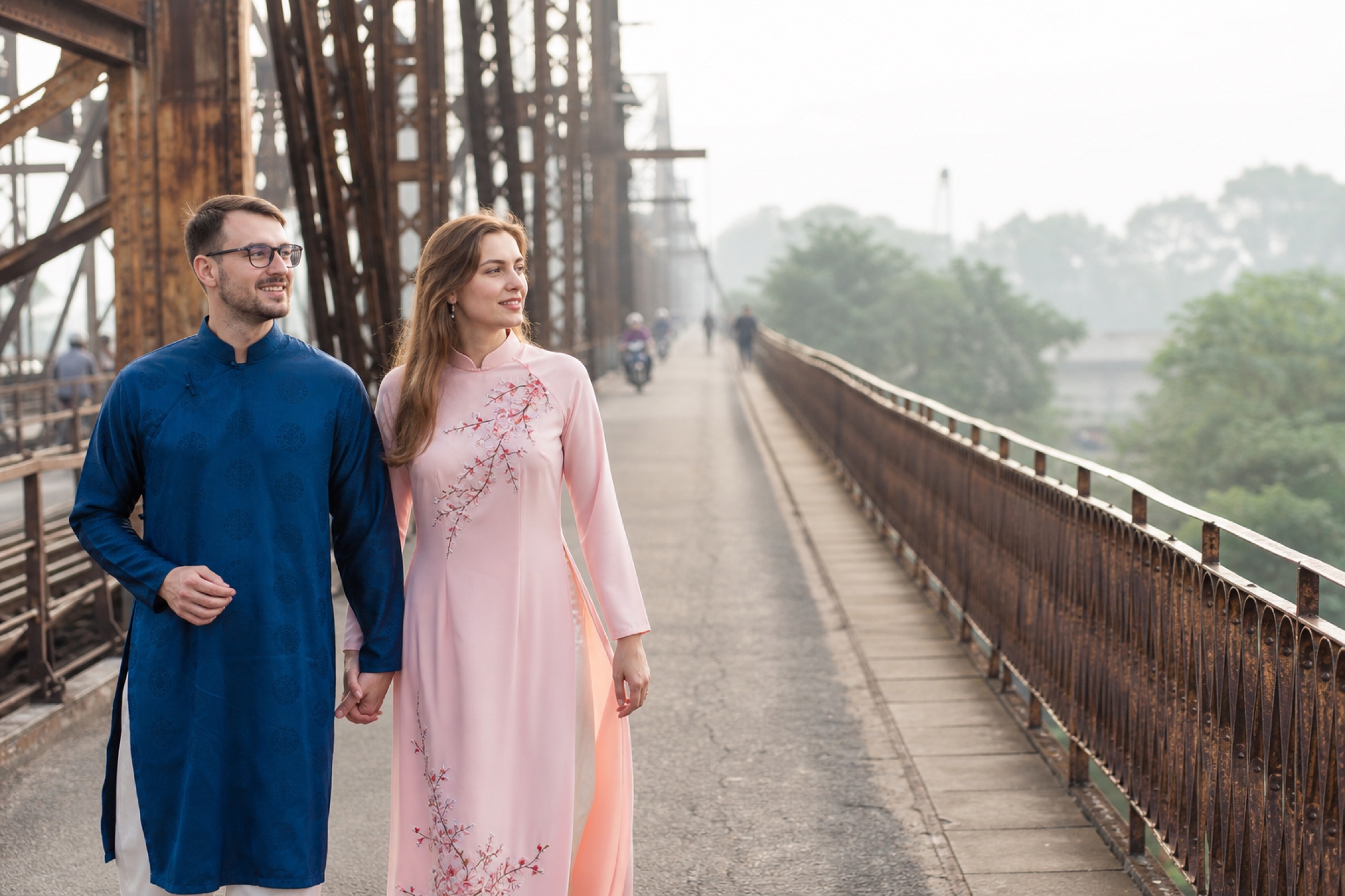
Side-by-side poses where one partner is 3–6 inches closer to the camera than the other hide body insecurity and reduce mirror-effect stiffness. You naturally look at each other rather than the lens. Foreheads touching, foreheads-to-cheek, or one partner's chin resting on the other's shoulder all photograph as genuine intimacy. The camera captures connection, not performance.
This works across all ae dai photoshoots, couple sessions at temples, and hotel makeup prepares—because it's the body language, not the outfit, that reads as real.
---
Movement Kills Awkwardness Faster Than Posing
Walking toward or past the camera, spinning together, or slow-dancing hand-in-hand gives you something to do instead of hold. Your face relaxes. Natural light catches you mid-motion. The photographer captures the 10 frames where you're laughing or talking, not the one where you're holding your breath. Planned walking routes (on temple steps, through lantern streets in Hoi An, along Hanoi lake paths) transform stiff sessions into storytelling.
Ask your photographer to frame wide enough that you can move through the shot rather than stand in it.
---
The Hands Problem: Where Do They Actually Go?
Hands are the hardest part of couple poses. Parallel hand-holds (both hands clasped front-center) photograph as formal or uncertain. Instead:
- Crossed-back embrace: his hand on her lower back, hers on his chest or arm. Weight on one leg. Feels like a real moment.
- Forehead-to-forehead, hands loose at sides or gently holding waists: intimate without performing closeness.
- Walking hand-in-hand while looking at each other, not the camera: the most natural-looking couple frame.
- One hand in his coat pocket, her hand in his other pocket: relaxed, modern, works in casual ao dai sessions.
Avoid: hand-holding with arms fully extended (creates distance), both hands on each other's faces (feels staged), or standing hip-to-hip with arms at sides (reads as separate, not connected).
---
Outfit and Setting Choices That Hide Awkwardness
What you wear and where you shoot matter more than pose technique. Matching colors (complementary, not identical) create visual cohesion without explicit "coupledom." An ao dai photoshoot in a historic setting gives you a narrative focus beyond just standing together. Hotel makeup and hair prep ensures you feel confident—confidence reads in every frame.
| Setting type | Best for | Why it works | Best poses |
|---|---|---|---|
| Temple or garden | Couple/family sessions | Built-in framing, quiet, romantic light | Walking, foreheads-touching, standing offset |
| Hanoi lakeshore | Casual, pre-wedding | Open space, golden hour, movement room | Walking hand-in-hand, spinning, sitting on steps |
| Hoi An lantern street | Ao dai photoshoot | Cultural context, warm light, alley frames | Facing each other with lanterns behind, side-by-side walking |
| Indoor hotel/studio | Proposal, anniversary | Controlled light, intimate scale, privacy | Sitting close, one standing/one sitting, forehead frames |
| Elopement outdoor | Pre-wedding, adventure | Minimal onlookers, natural light, movement | Walking, jumping, running toward camera |
📸 Book on WhatsApp — ao dai photoshoot
---
The Specific Difference: What Cáo Studio Sessions Include
Our couple & family photoshoots and pre-wedding sessions include a photographer who briefs couples on these angles before shooting starts. You walk through the location first, identify three spots, and shoot movement-based frames at each one. We pause between locations so you're not performing continuously. Our Hanoi, Saigon, and Hoi An teams tailor poses to your comfort level and outfit—ao dai sessions use different arm angles than Western dress.
Couples often ask: "Will I look weird if I'm not smiling the whole time?" No. Half our best frames are mid-laugh, mid-walk, or quiet moment. The "awkward" feeling you fear is what happens when you force a smile for 40 minutes.
---
What to Check Before You Book a Couple Photoshoot
Location & light timing: Ask your photographer what time of day they recommend your venue. Golden hour (1 hour before sunset) is flattering, but if you're shooting at a temple, midday side-lit frames often work better. Confirm the location has quiet corners—if it's crowded, poses that feel intimate become performative.
Pose guidance: Does the photographer show examples from past couple sessions? Can they explain why each pose works? A good photographer doesn't just say "put your arms here"; they explain the angle, distance, and direction of gaze.
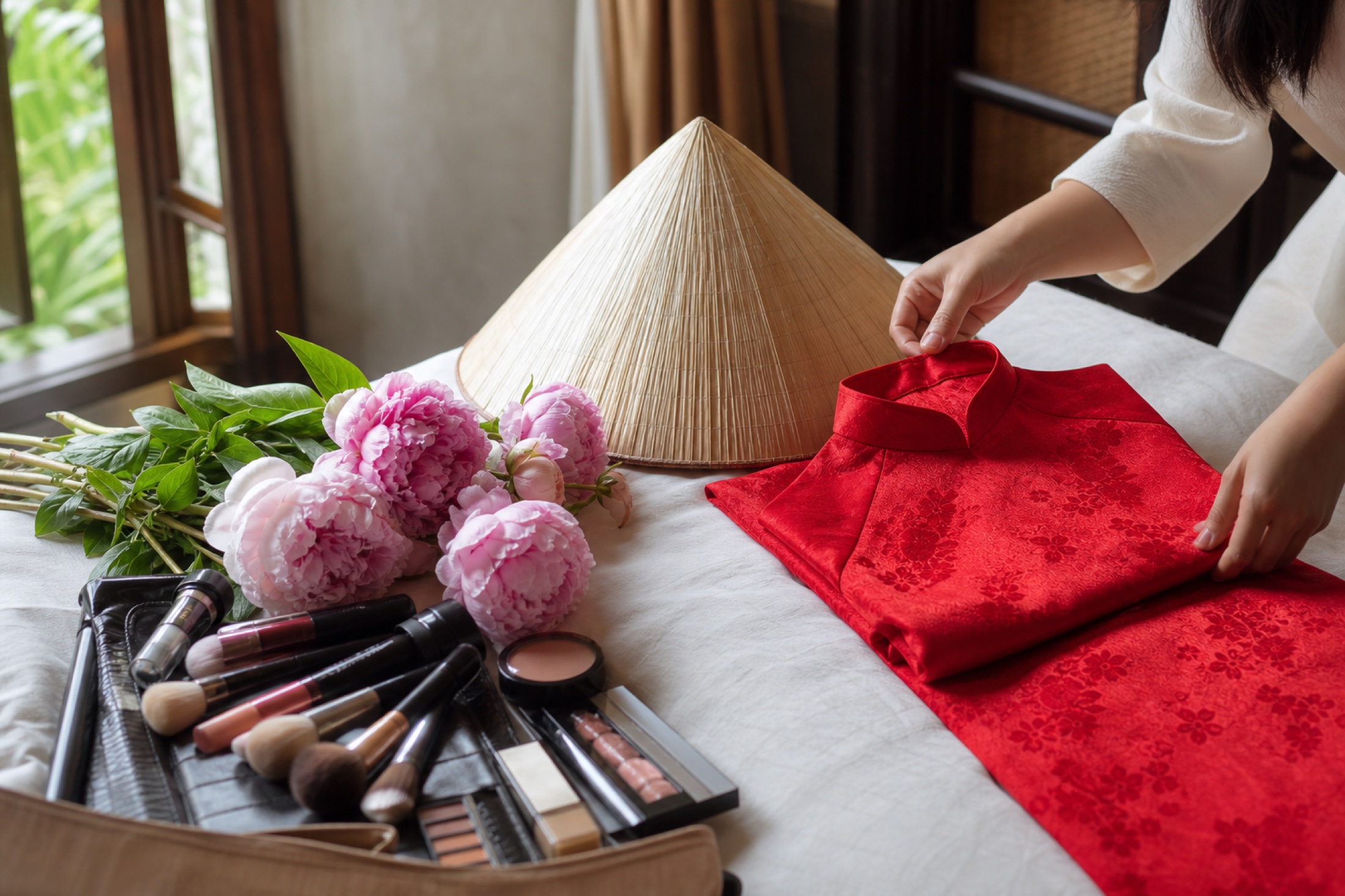
Outfit coordination: If booking a hotel makeup & hair session, brief the stylist on your outfit colors so lighting and makeup complement them. For ao dai shoots, ask whether sitting poses are planned—some ao dai positions look awkward because the fabric isn't arranged beforehand.
Backup scenarios: What if you're genuinely uncomfortable with a pose? Good photographers have 10 variations of "foreheads touching." They should never push you toward poses that feel wrong.
Delivery & retouching: How many final images do you receive? How quickly? Do edited images look like you, or over-smoothed? Check the photographer's recent lookbook for editing style.
---
Real Problems and How to Avoid Them
Problem: You're laughing at the poses themselves, killing the mood. Fix: Practice with your partner at home for five minutes. Silly poses feel less silly when you've done them once.
Problem: One partner is significantly taller or shorter. Fix: Offset standing (one on a step), sitting, or facing-each-other angles eliminate height differences in frame.
Problem: You both blink or look away in every frame. Fix: Shoot at least 15–20 frames per pose. Motion and natural eye contact can't be posed; they're captured, not created.
Problem: The location is too busy to feel intimate. Fix: Walk to a quieter corner, or book an indoor venue. Proposal and anniversary packages often include smaller, more private settings.
Problem: Your clothes feel wrong or restrictive. Fix: Wear what you'll feel confident in for 2–3 hours. Trying on an ao dai before booking? Do sitting, walking, and embracing tests in the fitting room. Uncomfortable outfits read in every frame.
---
Why This Matters for Lasting Photos
Awkward poses become the photo you hide. Natural poses become the frame you show for years. When you're offset, moving, or interacting with your partner instead of the camera, you're not performing couplehood—you're documenting it. That's the difference between a "couple photo" and a photo of your actual relationship.
See real examples in our lookbook across ao dai sessions, couple portraits, and pre-wedding shoots. Book a couple & family photoshoot to experience guided pose flow in person—or start with a quick pricing check to see which package fits your vision.
---
FAQ
How many times should we practice poses before the shoot?
Once. Five minutes at home. Overthinking poses kills spontaneity. On shoot day, your photographer will demo each angle so you see what's working in real-time. Trust the direction more than pre-practice.
What if we're self-conscious about physical affection?
Tell your photographer. Side-by-side offset frames, hand-in-pocket poses, and sitting shots work without full embraces. Comfort always comes first—an awkward pose you're unsure about will read as tense.
Should we match outfits or wear different colors?
Complementary colors (one warm, one cool; pastels and neutrals) photograph better than identical. Matching too closely reads as costumes. For ao dai shoots, coordinate tones so the couple reads as unified without looking like a wedding package.
How many outfit changes do we need?
One or two. More changes mean less time per outfit and more outfit-related delays. Ao dai or one outfit plus one casual change works. Quality over quantity in framing.
What if we hate our first photos after the session?
Share concerns with your photographer before editing is final. Pose issues are usually fixable: angles, backgrounds, or outfit arrangement. Light, weather, and location can't be changed, but pose execution can. A good photographer will re-shoot if poses genuinely missed the mark.
FAQ
How many times should we practice poses before the shoot?
Once. Five minutes at home. Overthinking poses kills spontaneity. On shoot day, your photographer will demo each angle so you see what's working in real-time. Trust the direction more than pre-practice.
What if we're self-conscious about physical affection?
Tell your photographer. Side-by-side offset frames, hand-in-pocket poses, and sitting shots work without full embraces. Comfort always comes first—an awkward pose you're unsure about will read as tense.
Should we match outfits or wear different colors?
Complementary colors (one warm, one cool; pastels and neutrals) photograph better than identical. Matching too closely reads as costumes. For ao dai shoots, coordinate tones so the couple reads as unified without looking like a wedding package.
How many outfit changes do we need?
One or two. More changes mean less time per outfit and more outfit-related delays. Ao dai or one outfit plus one casual change works. Quality over quantity in framing.
What if we hate our first photos after the session?
Share concerns with your photographer before editing is final. Pose issues are usually fixable: angles, backgrounds, or outfit arrangement. Light, weather, and location can't be changed, but pose execution can. A good photographer will re-shoot if poses genuinely missed the mark.
Ao dai, makeup, hair and a local photographer in Hanoi or Saigon — one WhatsApp message.