/pre-wedding-photoshoot
Destination elopement in Mekong Delta: a photographer's planning guide
An elopement photoshoot in the Mekong Delta—the nine provinces south of Ho Chi Minh City—works best Dec–Apr, when water is calm, light is warm, and floating markets open before crowds arrive. You'll need a local photographer (Cáo Studio does not operate there; see "How to find a photographer" below) or a Saigon-based team willing to travel 1–2 hours early and scout boat routes in advance. Plan 2–3 locations (market, temple, canal), 1 outfit (linen or silk wraps humidity well), and 48 hours for edits. Avoid Oct–Nov (typhoon season and flooding); bring a second camera battery, backup lenses, and ask your photographer if they've shot boats on water before—wind, glare, and motion require a specific workflow.
Why the Mekong Delta draws elopement photoshoots, and when the light actually works
The Mekong Delta is sold as "romantic" because of floating markets, wooden stilt houses, and the scale of water at dawn. The light truth: December through April offers warm side light and calm water by 5:30 am; any other month brings midday glare, afternoon clouds, and chop on the canals that blurs motion. May–November is wet season; Sept–Nov includes typhoon risk and flood closures at markets. If you're set on those months, book a photographer experienced in low-angle backlighting and accept that the shoot will be shorter and confined to sheltered channels. Cáo Studio is based in Hanoi and Saigon and does not operate elopement shoots in the Delta itself, but our Saigon team can advise on local partners and scouting timelines.
📸 Book on WhatsApp — pre-wedding photoshoot
What outfit choice does to your frames—and why linen beats silk in humidity
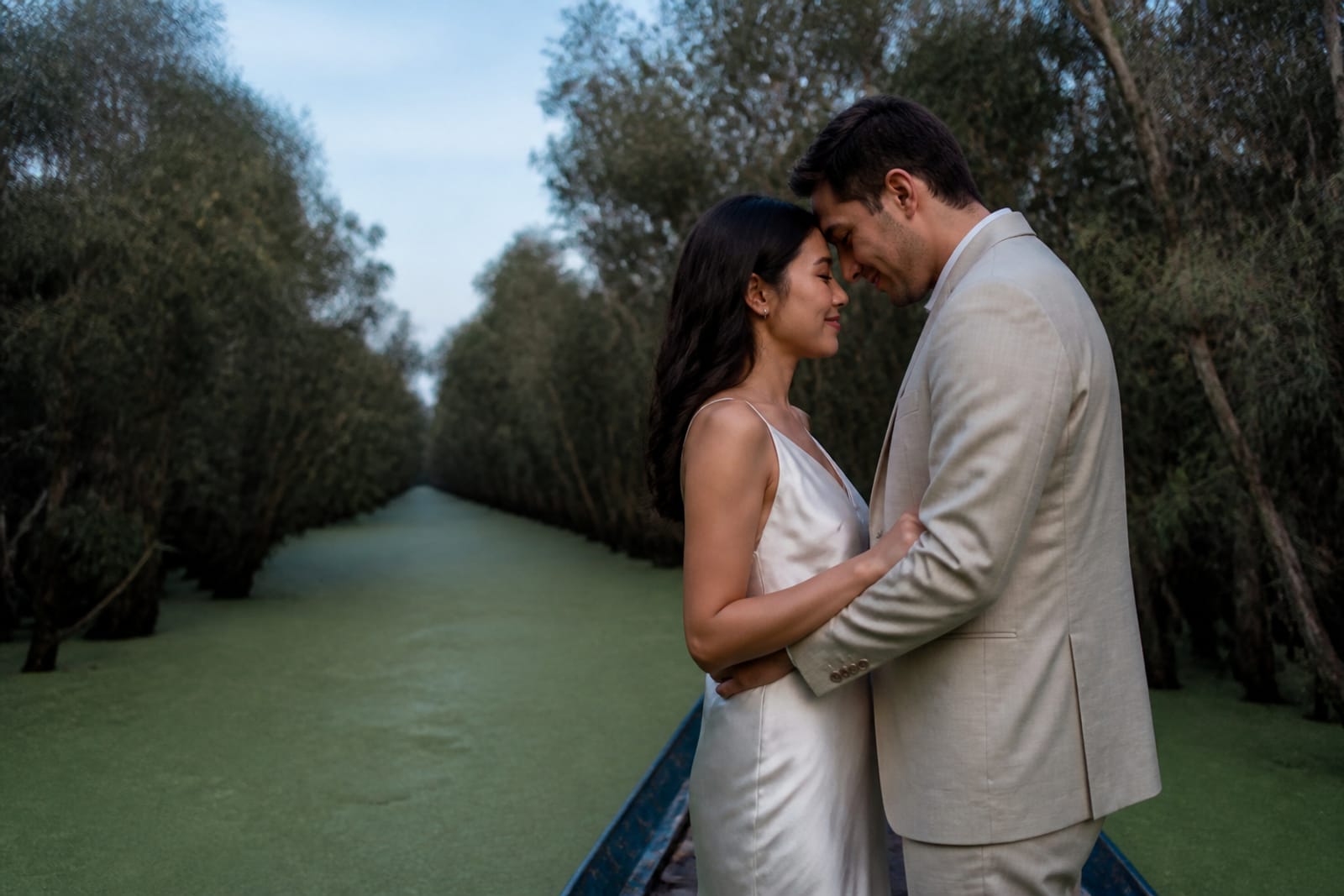
The Delta's humidity is 75–90% year-round. A heavy bridal gown absorbs sweat, creases fast, and tangles in boat railings; an áo dài (the traditional Vietnamese tunic) works in silk if woven tight, but linen áo dài or a bespoke linen slip dress over trousers is sharper and dries faster if you brush water spray. If you rent—and local Saigon rental shops do offer áo dài for day rates—ask for linen and test the fit on a boat, not in the studio. Layers matter: a thin long-sleeve tunic over a slip or bodysuit protects skin from sun and spray, and it photographs cleaner than a sleeveless gown against busy water and market backgrounds. Saigon-based makeup & hair at your hotel teams can tighten your style for wind and water, so your hair pins and makeup last 2–3 hours without retouch.
Which Mekong locations work for elopement light—and which ones are tourist traps
| Spot | Best season & light | Crowds | Why it works (or doesn't) |
|---|---|---|---|
| Cai Rang Floating Market (Can Tho) | Dec–Apr, 5:00–6:30 am | Busiest dawn, thinning by 6:45 | Vendors, small boats, natural foreground; miss the hour and you shoot between fuel drums and chaos. |
| Cai Be Floating Market (Tien Giang) | Dec–Apr, 5:00–6:30 am | Slightly less crowded than Cai Rang | Narrower channels, tighter boat work; easier for a couple to move, harder for a full crew. |
| Wooden temples (Saigon & Tien Giang) | Dec–Apr, morning; Sep–Nov if covered | Closed Tet week; light is harsh midday | Interior light is low; you need a fast lens and a tripod. Ask permission in advance. |
| Countryside canal routes | Any dry season hour | Almost none | Best for intimate framing, worst for "this is where we went" landmark photos. Boat hire is easier than market permit. |
Floating markets are busiest 5:00–6:30 am; after 7 am you're shooting around 20+ tour boats and vendors repacking. A photographer who doesn't scout Cai Rang or Cai Be before dawn will waste 30 minutes finding a clear frame. Wooden temples (like those in Tra On, Vinh Long, or Cho Moi) require a guide or local contact to confirm entry and ask permission for photography—some are still active prayer spaces, and shooting a couple in formal wear during a service can feel disrespectful. Countryside canals offer solitude but no landmarks, so frames feel generic unless the couple is doing something (feeding fish, stepping between boats, looking at each other mid-motion).
The photographer decision: solo local, Saigon-based team travel, or hybrid
Choosing who shoots is the biggest cost and logistics factor. You have three paths:
Solo local photographer (Mekong-based): Knows the markets, knows boatmen, low travel cost. Risk: may shoot 200 photos you filter yourself; turnaround is slow; if light changes or a boat route closes, there's no backup plan. Ask to see a full gallery of boat work (not just a best-of highlight reel) and confirm they've delivered edited files in 48 hours for another couple.
Saigon-based team travel (e.g., Cáo Studio): Brings an art director, hair and makeup artist, photographer, and an editing workflow in one booking. Cáo Studio does not operate elopement shoots in the Delta itself, but the Saigon base can coordinate scouting, timing, and outfits for a Mekong shoot if you book through the main pre-wedding photoshoot page and ask about Delta availability on WhatsApp. Cost factors: early morning travel (1–2 hours from Saigon), a boatman who knows the route, and a full-day rate. Benefit: if light dies or a market closes, you pivot to a backup canal or temple; you get hair and makeup touch-up between locations.
Hybrid: Hair & makeup in Saigon, photographer in the Delta: You handle makeup and styling at your hotel before dawn, then meet a local photographer at the boat dock. Fastest turnaround, lowest logistics cost, but you're relying on two strangers to coordinate timing via phone, and if makeup smudges on the boat, you have no touch-up artist on-site.
Season, weather, and what actually goes wrong on the water
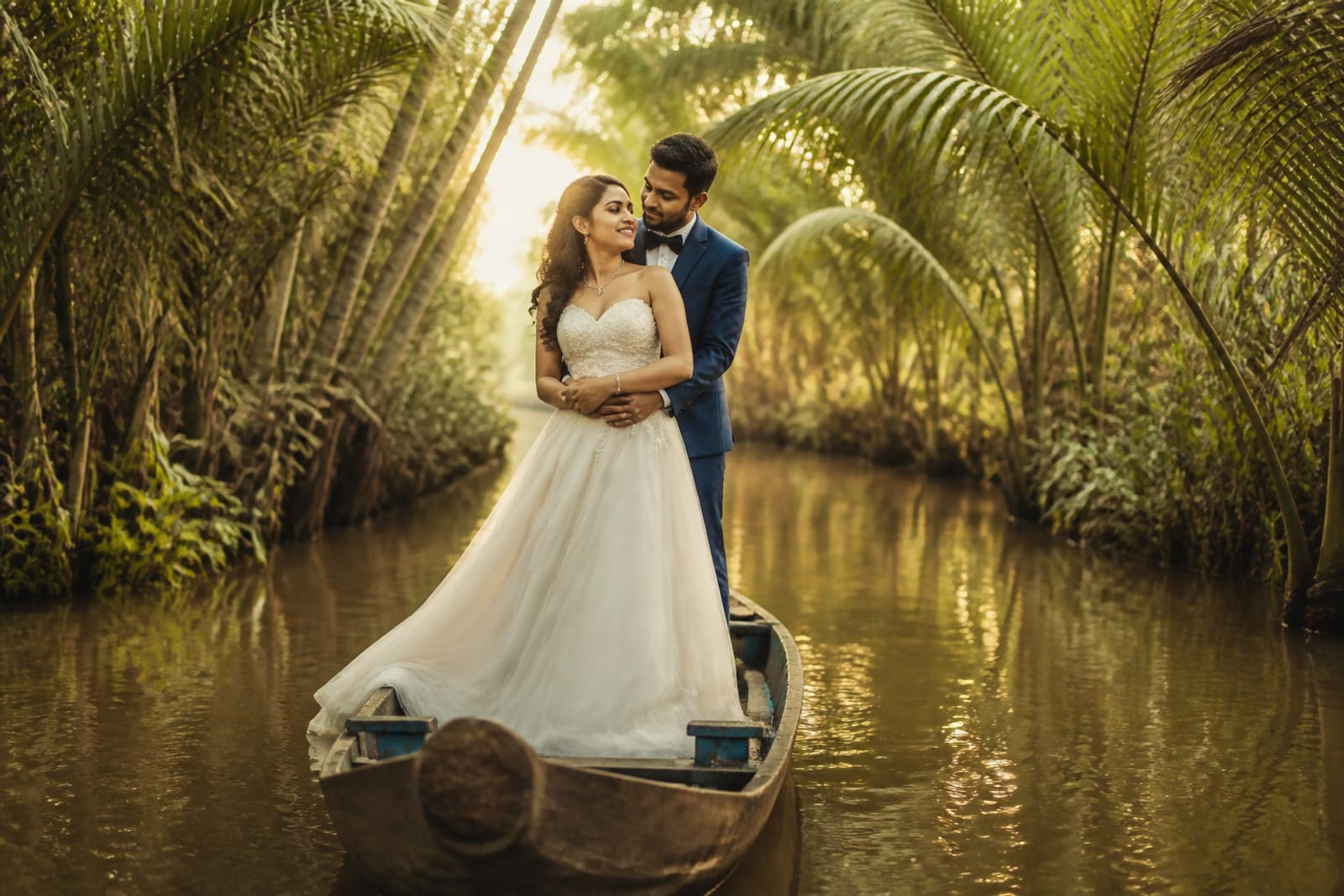
December–April (dry season, best): Water is calm, light is warm, skies are mostly clear. Boats run reliably; markets open. Wind is light; spray is rare. This is peak season; book 4–6 weeks ahead.
May–August (hot, intermittent afternoon rain): Humidity peaks; afternoon downpours close markets for 1–2 hours. Light midday is harsh and flat. You're shooting pre-dawn or late afternoon, which cuts your window to 1.5 hours. Boatmen are accustomed to the season but so are tourists—markets are packed.
September–November (typhoon and flood season, avoid): Many markets close or shift to backup locations. Water is high and choppy; wind sprays salt and sediment. Humidity is 85%+; lenses fog. Some stilt-house routes are inaccessible. A photographer caught in a sudden squall has to retreat; you lose the shoot. Don't book elopement shoots here unless you have 2–3 backup dates lined up.
What goes wrong on the water (and how to avoid it):
- Lens fogging: Bring a lens pen, microfibre cloth, and a waterproof lens cap. Ask your photographer if they've packed a second camera body—if one fogs, they switch.
- Motion blur from boat rocking: A fast shutter speed (1/500 or faster) and a stabilized lens are non-negotiable. Ask your photographer about shutter speed workflow before booking.
- Makeup and hair melting in humidity: Use a long-wear primer, waterproof mascara, and a lightweight moisturizer instead of primer alone. Re-pin your hair before the boat; wet hair won't hold an updo.
- Boom of the boat engine in video: If you want a video edit, ask the photographer to record wildtrack (audio of the market without speech) separately, so the edit isn't drowned out by diesel noise.
- Permit or access issues at markets: Floating markets technically allow photography for personal use, but tour guides sometimes claim you need a permit. Clarify this with your photographer and your boatman in advance—verbal confirmation from either one isn't enough.
What to check before you book a Mekong Delta elopement shoot
Before signing on with any photographer—local, Saigon-based, or hybrid—ask these specific questions:
- Have you shot an elopement or couple session on boats in this market before? Show me frames from that shoot. Not a highlight reel—a full sequence showing real light, motion, and how you handled wind or people in the frame. If they say "I shoot nature, not people on water," they're not ready for this.
- What's your plan if the market is closed or the market vendors ask us to leave? A professional has a backup canal route or temple in mind, confirmed with a boatman beforehand.
- Do you have a second camera body and lenses? If one camera fogs or a lens fails on the water, what happens? A solo photographer with one camera is a risk you don't need.
- What's your editing and delivery timeline, and is it in writing? "About 2 weeks" isn't enough. Confirm 48 hours or 1 week in a signed quote.
- Will hair and makeup be on the boat, or do I arrange that separately? If separately, who coordinates timing if makeup runs or you want a touch-up? Get that answer before the shoot date.
- Does your fee include travel time from Saigon, boatman hire, and a scout day? Understand what's included before you're quoted. Boatman hire and scout logistics can shift the cost factor significantly.
- Do you shoot video or stills only? Some couples want a short edit for Instagram; make sure you know the deliverable before booking.
Ask these in writing (WhatsApp, email, or a signed quote) and keep the answers. A photographer who dodges specifics or says "we'll figure it out" on the shoot day is expensive risk you can't measure later.
Why Cáo Studio is not the answer for Mekong Delta—and how to find someone who is
Cáo Studio is based in Hanoi, with a Saigon base for Ho Chi Minh City and Hoi An shoots. We do not operate regular elopement photoshoots in the Mekong Delta itself. The Delta requires a photographer or team with established boatman relationships, permits with market vendors, and a deep workflow for low-light boat interiors and water glare. A Saigon-based team (ours or another) can travel to the Delta if you book 4–6 weeks ahead and discuss Delta-specific rates on WhatsApp, but a local Mekong photographer who knows the tides, light patterns, and market rhythms is often the faster, smarter choice.
To find a local Mekong photographer:
- Ask your hotel (Can Tho, Vinh Long, or Tien Giang) for a photography contact they've used for weddings.
- Search Facebook for "Can Tho photographer" or "Mekong elopement" and look for galleries with full boat sequences, not just markets.
- Ask a local travel guide who works with couples—they know who's reliable.
- Confirm they've worked with a couple at your same market, in the same season, and delivered edited files on time.
If you're planning a broader Vietnam shoot (e.g., áo dài photos in Hanoi, a couple session in Ho Chi Minh City, and then Mekong for an elopement), reach out on WhatsApp and we can coordinate the parts we cover and advise on the Delta portion.
FAQ
Is the Mekong Delta worth an elopement shoot, or should I just stay in Ho Chi Minh City?
The Delta offers unique water-light and market atmosphere you don't get in the city. If you have 1–2 extra days and book Dec–Apr, it's worth it. May–Nov adds complexity and risk; stay in the city unless you're flexible on dates or prefer low-light boat interiors.
Do floating markets require a permit to photograph a couple?
Markets allow personal photography. A formal permit (if vendors claim one is needed) is rare; clarify this with your photographer and boatman in advance, in writing. Respect vendors by asking before framing them in shots.
Can I wear a traditional áo dài on a boat, or will it get wet?
A linen áo dài over trousers works well; silk is heavier and dries slower. Boat spray is light if the water is calm (Dec–Apr). Avoid a full bridal gown—it catches on railings and absorbs spray. Test the outfit on a calm day before the shoot.
How early do we need to start to avoid crowds at Cai Rang?
Arrive by 5:00 am for the busiest, most photogenic 90 minutes. After 6:30 am, tour boats multiply. A photographer who isn't scouting by 4:30 am will waste your time.
Can I book a Saigon photographer to travel to the Mekong for just a few hours?
Yes, but travel time (1–2 hours from Saigon) counts as a cost factor. A half-day shoot may be shorter than the travel budget justifies—discuss this with your photographer before booking. A full-day rate often makes more sense.
What happens if it rains on the shoot day?
Dec–Apr: rare. May–Nov: afternoon downpours close markets for 1–2 hours. If you're shooting at dawn, a downpour ends quickly; if afternoon, you lose the light. Confirm a rain reschedule policy in writing before booking.
Do I need a second outfit change on a boat?
One solid outfit works for 2–3 hours. Changing on a moving boat is awkward; use that time to move between locations instead. A touch-up (hair pin, lipstick) is faster and more practical.
Is there a Cáo Studio team in the Mekong Delta?
No. Cáo Studio operates from Hanoi and Saigon. For a Delta elopement, book a local Mekong photographer or ask us on WhatsApp if a Saigon travel arrangement fits your timeline.
FAQ
Is the Mekong Delta worth an elopement shoot, or should I just stay in Ho Chi Minh City?
The Delta offers unique water-light and market atmosphere you don't get in the city. If you have 1–2 extra days and book Dec–Apr, it's worth it. May–Nov adds complexity and risk; stay in the city unless you're flexible on dates or prefer low-light boat interiors.
Do floating markets require a permit to photograph a couple?
Markets allow personal photography. A formal permit (if vendors claim one is needed) is rare; clarify this with your photographer and boatman in advance, in writing. Respect vendors by asking before framing them in shots.
Can I wear a traditional áo dài on a boat, or will it get wet?
A linen áo dài over trousers works well; silk is heavier and dries slower. Boat spray is light if the water is calm (Dec–Apr). Avoid a full bridal gown—it catches on railings and absorbs spray. Test the outfit on a calm day before the shoot.
How early do we need to start to avoid crowds at Cai Rang?
Arrive by 5:00 am for the busiest, most photogenic 90 minutes. After 6:30 am, tour boats multiply. A photographer who isn't scouting by 4:30 am will waste your time.
Can I book a Saigon photographer to travel to the Mekong for just a few hours?
Yes, but travel time (1–2 hours from Saigon) counts as a cost factor. A half-day shoot may be shorter than the travel budget justifies—discuss this with your photographer before booking. A full-day rate often makes more sense.
What happens if it rains on the shoot day?
Dec–Apr: rare. May–Nov: afternoon downpours close markets for 1–2 hours. If you're shooting at dawn, a downpour ends quickly; if afternoon, you lose the light. Confirm a rain reschedule policy in writing before booking.
Do I need a second outfit change on a boat?
One solid outfit works for 2–3 hours. Changing on a moving boat is awkward; use that time to move between locations instead. A touch-up (hair pin, lipstick) is faster and more practical.
Is there a Cáo Studio team in the Mekong Delta?
No. Cáo Studio operates from Hanoi and Saigon. For a Delta elopement, book a local Mekong photographer or ask us on WhatsApp if a Saigon travel arrangement fits your timeline.
Ao dai, makeup, hair and a local photographer in Hanoi or Saigon — one WhatsApp message.