/pre-wedding-photoshoot
Destination elopement in Phu Quoc: a photographer's planning guide
A destination elopement in Phu Quoc means a one-day shoot capturing you and your partner on the island—usually during the dry season (Nov–Apr) when the west coast light is softest and the sea calm. The best light windows are sunrise (6–7 am, soft on the eastern beaches) and sunset (5–6:30 pm, warm on the western cliffs and Kiss Bridge). Most shoots run 4–6 hours and cover 2–3 locations: a beach, a temple or village street, and a scenic viewpoint. Cáo Studio does not operate in Phu Quoc, but this guide explains how to vet a local photographer, plan your outfits, and avoid common mistakes—so your frames tell a story, not a pose.
Why is November to April the only season that works for Phu Quoc elopement shoots?
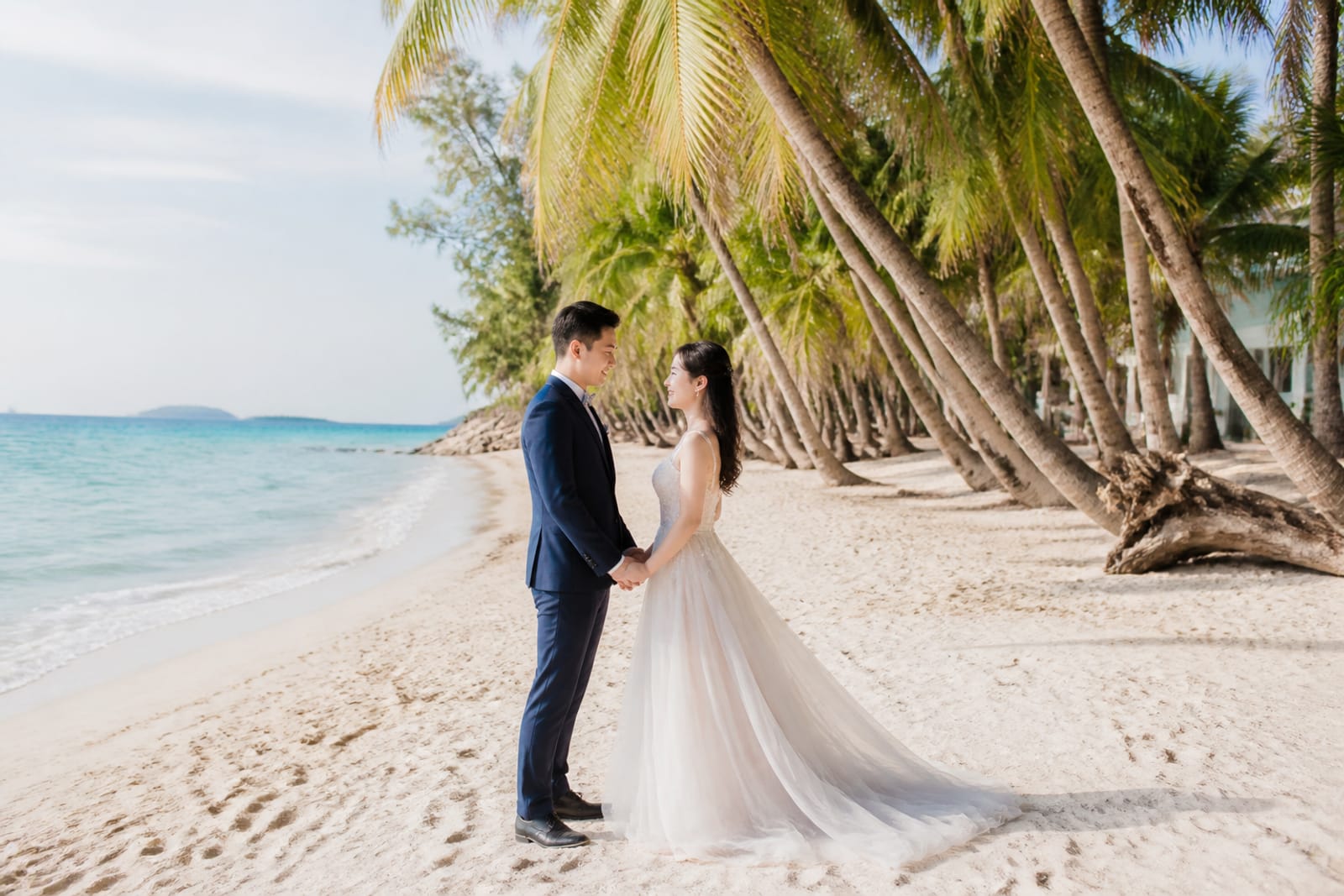
The island's west coast—where the best light and dramatic sunsets happen—faces into rough seas and afternoon squalls from May through October. Storms, grey skies and overcast conditions dominate. Between November and April, the dry season locks in clear mornings, predictable sunsets and calm water, meaning the photographer can frame reflections in wet sand and shoot long golden-hour takes without chasing shelter. Typhoons are rare in these months. Book your shoot between mid-November and mid-March for the sharpest light and the fewest weather cancellations.
What time of day captures the most usable frames on Phu Quoc?
Sunrise (5:45–7:15 am) works best on the eastern beaches—Bai Sao, Bai Kem—where soft, side-lit morning light flatters skin and minimises shadows on faces. The sea is glassy; few tourists arrive before 7 am. Sunset (4:45–6:30 pm) on the western cliffs and Kiss Bridge gives you warm, directional light that wraps around figures and turns the sky amber-to-pink. Mid-day (10 am–3 pm) produces harsh overhead light and blown-out sky—most elopement photographers skip it. Plan your shoot to start at dawn or arrive at your final location by 4:30 pm. This single timing choice determines whether your frames look cinematic or flat.
Should your elopement wear an áo dài, a dress, or both?
| Outfit choice | Best for | Phu Quoc fit | Why it works |
|---|---|---|---|
| Áo dài (traditional) | cultural story, temple scenes, heritage | flows in beach breeze; clings wet if you wade | tells a story; photogenic drape; stands out against sand |
| Western wedding dress | classic romance, international aesthetic | heavy in heat; sand clings to hem; wet = weight | timeless frames; symbolism clear to all viewers |
| Casual/linen blend | comfort, long shoot, multiple locations | breathes in humidity; sand shakes off easily | sustainable energy; authentic wandering shots |
| Combination (change mid-shoot) | best of both | requires 10–15 min outfit change; need a private space | gives you narrative variety; no regrets |
Phu Quoc heat (28–32°C in season) and salt spray matter. An áo dài in silk or linen is cooler than a structured Western gown and dries faster if you walk in shallow water. If you want both, ask your photographer to budget outfit-change time and find a private spot (a bungalow or car) to transition. One outfit works fine if it aligns with your story—choose it, own it, and let the light do the work.
How do you find a photographer who directs instead of poses?
Most tourist-facing Phu Quoc photographers do "just show up, we pose you"—stiff facing the camera, forced smiles, monument backdrop. A real director does this: walks the location first (alone or with you) before shooting, identifies light angles and foreground interest, then asks you to walk, look at each other, or do something genuine while they frame you into the scene. Look for these signals when vetting:
- Portfolio: frames show couples mid-action (walking, laughing, kissing) in real light—not all standing facing the camera.
- Initial chat: they ask you about your story, what light you prefer, how you move together—not just "how many people, which package?"
- Location scouting: they mention specific times ("we shoot at Kiss Bridge 5:15 pm when the sun is left of frame") and ask about your comfort level with water or hiking.
- Setup on the day: they shoot wide first (context), then move closer (emotion), then capture detail (hands, rings, texture)—not the reverse.
- Honest about limits: they'll say "if the sky turns grey, we shift to village streets where overcast light actually works better" instead of promising a perfect sunset.
Ask to see their lookbook or 3–4 full elopement shoots. If every frame is a posed duo facing the lens, keep looking.
What logistics and costs shape a Phu Quoc elopement shoot decision?
Travel to the island: flights or ferry from Hanoi or Ho Chi Minh City add 2–4 hours each way. Most couples fly in the day before and leave the day after the shoot, giving the photographer one full morning or evening light window. Some build a 3–5 day "elopement trip" and shoot on day 2, leaving buffer for beach time or a ceremony.
Photographer base and travel: a Phu Quoc–based photographer saves you a day of their travel time; a Saigon-based team charges more if they must fly in (factor their airfare into your quote, which you request on WhatsApp). Cáo Studio operates from Hanoi and Saigon with a Hoi An base by appointment—Phu Quoc is outside our service area, so you'll work with a local team.
Outfit logistics: if you're renting an áo dài locally, book 2–3 weeks ahead; if bringing your own, pack it flat or in a steamer-friendly bag (hotel irons cause creases). Makeup and hair can be done at your hotel or a salon in Duong Dong town; factor 1.5 hours into your schedule.
Location permits: temples and some viewpoints may require small donations or local permissions. Your photographer should know these and handle coordination; if they don't mention it, ask.
Edited delivery time: most photographers deliver 30–80 edited images within 2–4 weeks. Clarify turnaround before you book so you know when to expect frames.
These factors don't determine price directly, but they inform your quote. WhatsApp a local photographer or Cáo Studio (for Hanoi/Saigon comparison) with your dates, outfit choices, and preferred locations to receive a transparent quote.
Comparison: Phu Quoc elopement vs. pre-wedding shoots in Hanoi or Saigon
Many couples ask whether to elope on Phu Quoc or book a pre-wedding photoshoot in a city. Here's the real trade-off:
| Factor | Phu Quoc elopement | Hanoi/Saigon pre-wedding |
|---|---|---|
| Light & weather | Predictable dry-season sun; one golden-hour window | Grey-winter or hot-humid summer; multiple neighbourhoods = backup light |
| Outfit range | Beach/temple focus; usually 1–2 changes | Urban + village; 3+ outfit changes common |
| Travel fatigue | Fly 4 hours, shoot 1 day, rest | Shoot in-city; no jet lag |
| Narrative | Intimate, island escape, one story | Multiple moods (old city, markets, architecture) |
| Photographer speciality | Beach, sunset, salt light | Urban framing, crowd management, layered backgrounds |
If your story is "just us two at sunset," Phu Quoc wins. If you want "our life together in different places," a city pre-wedding shoot tells a richer narrative. Both are valid. Book on Hanoi or Saigon with Cáo Studio if you choose a city; for Phu Quoc, find a local photographer using the vetting checklist above.
📸 Book on WhatsApp — pre-wedding photoshoot | 💄 Makeup & hair at your hotel | 🌸 See the lookbook
What to check before you book a Phu Quoc elopement shoot
- Dates and season: confirm the photographer is available Nov–Apr and understands that May–Oct is off-season for shoots. If you must shoot outside dry season, discuss weather backup plans.
- Itinerary and light windows: ask them to map out your 3–4 locations and their preferred light times (e.g., "Sunset Town at 5:20 pm, Kiss Bridge at 6:00 pm"). If they can't be specific, they're guessing.
- Outfit plan and logistics: agree on whether they're sourcing an áo dài rental, whether makeup and hair happens at your hotel (and who coordinates), and how many outfit changes fit your timeline.
- Edited delivery and format: get in writing how many edited images, what format (digital, prints, album), and when they'll deliver. Don't assume "50 photos in 2 weeks"—ask.
- Cancellation and weather policy: if a storm hits, do they reschedule or refund? This matters on an island.
- Portfolio reference: ask for 2–3 past elopement shoots in Phu Quoc or similar beach/sunset settings, not just a "best of" highlights reel.
If a photographer dodges these questions or gives vague answers ("lots of photos, very beautiful"), move on. The right team is transparent about logistics, light and what they'll deliver.
---
🌸 See the lookbook | 💄 Makeup & hair at your hotel | 📸 Book on WhatsApp — pre-wedding photoshoot
FAQ
Does Cáo Studio shoot elopements in Phu Quoc?
No. Cáo Studio operates in Hanoi, Ho Chi Minh City, and Hoi An. For a Phu Quoc shoot, find a local photographer using the vetting checklist in this guide. We can book you a pre-wedding photoshoot in Hanoi or Saigon instead.
What is the best month for a Phu Quoc elopement?
November to March offers the clearest light, calmest sea, and fewest storms. December–February is peak dry season. Avoid May–October entirely; grey skies and afternoon rains dominate those months.
Can I wear an áo dài on a beach shoot?
Yes. Silk or linen áo dài flows beautifully in ocean breeze and photographs well against sand. It dries faster than a structured Western gown. Plan for sand in the hem and saltwater spray; have a rinse or change ready if you wade.
How long does a Phu Quoc elopement shoot take?
Most runs 4–6 hours, covering sunrise or sunset light at 2–3 locations. A single golden-hour window (sunset, for example) can work in 2–3 hours if you're flexible about outfit changes and travel time between spots.
What should I ask a photographer before booking?
Request their 3–4 past Phu Quoc elopement shoots, their specific light-time itinerary, their edited-photo count and delivery date, their weather cancellation policy, and whether they coordinate makeup and hair or you source it separately.
Is Phu Quoc cheaper than a Hanoi or Saigon elopement shoot?
Not necessarily. A Phu Quoc shoot requires the photographer's travel and airfare; a Hanoi or Saigon shoot may cost less because the photographer is local. Request quotes from both and compare inclusions—travel, outfits, edit turnaround—not just the headline price.
FAQ
Does Cáo Studio shoot elopements in Phu Quoc?
No. Cáo Studio operates in Hanoi, Ho Chi Minh City, and Hoi An. For a Phu Quoc shoot, find a local photographer using the vetting checklist in this guide. We can book you a [pre-wedding photoshoot](/pre-wedding-photoshoot) in Hanoi or [Saigon](/saigon) instead.
What is the best month for a Phu Quoc elopement?
November to March offers the clearest light, calmest sea, and fewest storms. December–February is peak dry season. Avoid May–October entirely; grey skies and afternoon rains dominate those months.
Can I wear an áo dài on a beach shoot?
Yes. Silk or linen áo dài flows beautifully in ocean breeze and photographs well against sand. It dries faster than a structured Western gown. Plan for sand in the hem and saltwater spray; have a rinse or change ready if you wade.
How long does a Phu Quoc elopement shoot take?
Most runs 4–6 hours, covering sunrise or sunset light at 2–3 locations. A single golden-hour window (sunset, for example) can work in 2–3 hours if you're flexible about outfit changes and travel time between spots.
What should I ask a photographer before booking?
Request their 3–4 past Phu Quoc elopement shoots, their specific light-time itinerary, their edited-photo count and delivery date, their weather cancellation policy, and whether they coordinate [makeup and hair](/makeup-and-hair) or you source it separately.
Is Phu Quoc cheaper than a Hanoi or Saigon elopement shoot?
Not necessarily. A Phu Quoc shoot requires the photographer's travel and airfare; a Hanoi or [Saigon](/saigon) shoot may cost less because the photographer is local. Request quotes from both and compare inclusions—travel, outfits, edit turnaround—not just the headline price.
Ao dai, makeup, hair and a local photographer in Hanoi or Saigon — one WhatsApp message.