/pre-wedding-photoshoot
Elopement Photos at Ban Gioc Waterfall: Season, Light & Booking Guide
Ban Gioc Waterfall elopement shoots work best from late July through early October—when rainfall feeds the cascade and autumn light softens the granite cliffs. A typical session runs 4–6 hours on-site (leaving Cao Bang town before dawn, returning by late afternoon) and covers the main falls, the border marker, and quieter pool areas upstream. Cáo Studio does not operate in Cao Bang; you will need to hire a local photographer experienced with waterfall logistics, border protocols, and flash/modifier use in wind and mist. The trade-off is simplicity (one vendor handles outfit changes, hair, makeup and camera) versus the practical reality that Ban Gioc requires a team with access to local guides, permits, and real-time weather calls—factors a Hanoi studio cannot guarantee. Plan 2–3 months ahead if you want a specific date, confirm water levels 2 weeks before, and pack a rain contingency outfit. ---
Why Is Ban Gioc Fullest and Most Photogenic July Through October?
Ban Gioc's water volume and photographic appeal hinge entirely on the northeast monsoon cycle. From July onward, tropical storms and mountain runoff swell the waterfall to its peak—creating the volume and mist that reads as drama in photographs. By late September, autumn high pressure begins clearing the sky; light becomes sharper and more directional, especially in the early morning (6–7 am). October extends this window if rain continues, but November onward sees the cascade shrink to a trickle as the dry season sets in. Conversely, April–June (hot and dry) renders Ban Gioc a thin ribbon—unsuitable for elopement framing. Plan your shoot for August or September for maximum water and softer light.
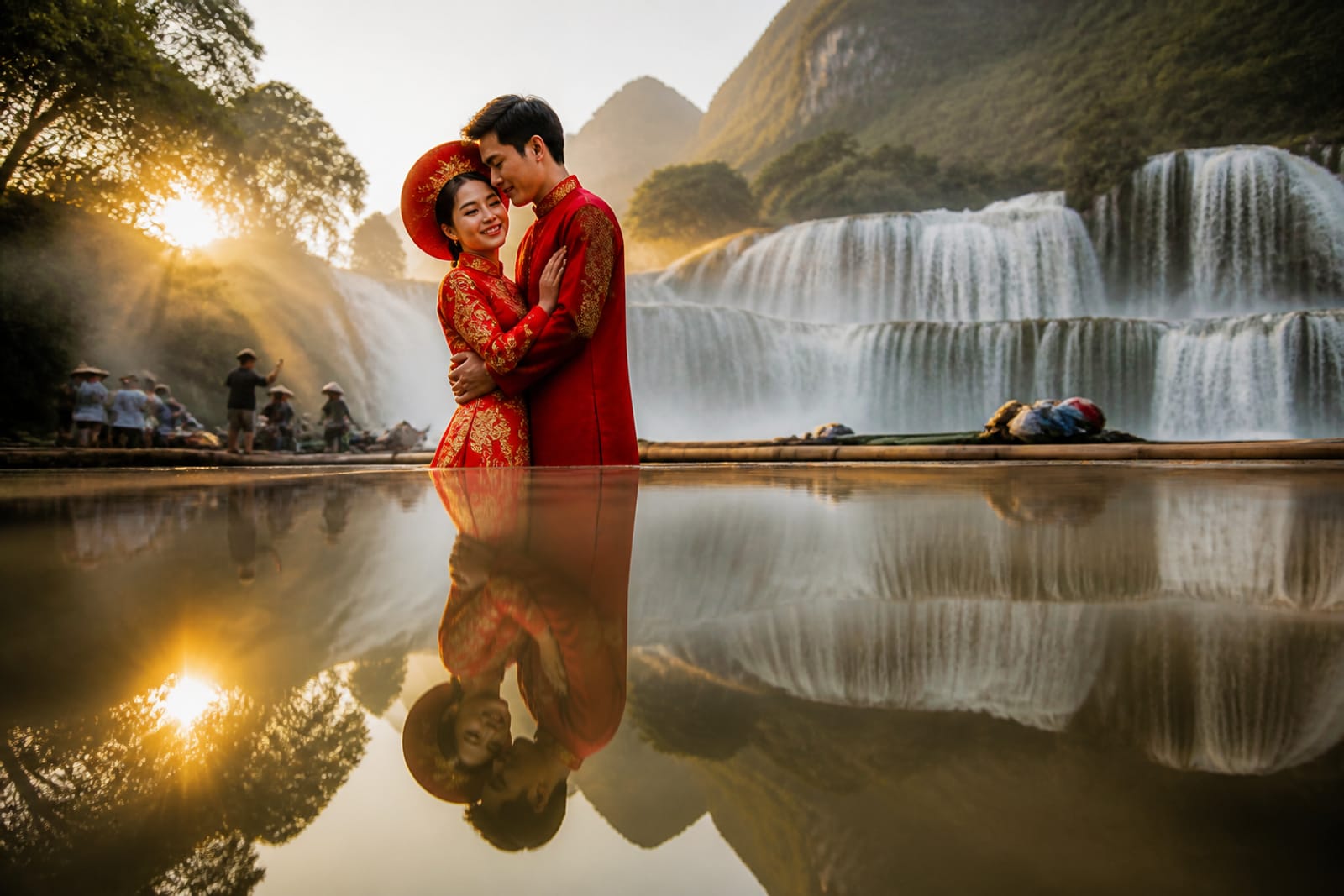
What Is the Realistic Schedule for a Ban Gioc Elopement Session?
A Ban Gioc shoot is a full-day commitment, not a 2-hour city session. Expect to leave your Cao Bang accommodation by 4:30–5:00 am, drive 60–90 minutes to the trailhead, change into your first outfit (often an ao dai or wedding dress—unpack carefully, as humidity and dust are real), and shoot from first light (6:15–7:30 am) when mist rises and crowds are minimal. Midday (11 am–2 pm) is too harsh and crowded; most teams break for lunch. Afternoon shots (3–5 pm) use side or back light across the falls. Total time on-site: 4–6 hours. Return to town by 6–7 pm. Fatigue and heat build quickly; bring electrolyte tablets, insect repellent, and a change of underclothes. A local guide is essential—trails are steep, slick and poorly marked.
How Do Outfits and Hair/Makeup Survive the Waterfall Environment?
Ban Gioc presents unique costume challenges. Mist and spray drift 50+ meters from the cascade, so moisture will reach fabric, hair and skin within the first 30 minutes. An ao dai worn near the falls requires a water-resistant underdress and careful tucking; a traditional wedding dress is impractical unless you're shooting only at the pool (not near the spray). Hair and makeup must be set for humidity—waterproof foundation, long-wear mascara, and a hairstyle that tolerates moisture (loose waves hold better than tight updos in mist). Many couples wear a second, lighter outfit for the pool shots and reserve the formal dress for the border marker or nearby dry vantage points. Bring a microfiber cloth and a travel-size setting spray; a crew with hair and makeup experience will pack these. Shoes: non-slip soles are mandatory (loose rock and wet stone are a fall risk).
| Outfit choice | Best for | Light/conditions | Why it works |
|---|---|---|---|
| Ao dai + underdress | Pool & upstream | Early morning, side light | Breathes, dries fast; cultural anchor |
| Wedding dress (light fabric) | Border marker, high vantage | Mid-late afternoon | Framed by cliff, not spray; photo-only |
| Casual second outfit (linen shirt, cropped trousers) | Transitions & walking | Golden hour | Practical; eases outfit fatigue; reads authentic |
| Swimsuit under ao dai | Water-based shots | Noon onward | Backup if spray-heavy; hidden beneath skirt |
Which Photographer Type Works Best for Ban Gioc?
Cáo Studio operates in Hanoi, Ho Chi Minh City and Hoi An, not Cao Bang. For Ban Gioc, you must hire a local or northern-based photographer. Evaluate three types:
Type A: Local Cao Bang guide with a camera phone or basic DSLR. Cost factor: lowest. Knows terrain, permits, best times. Limitation: inconsistent lighting skill, no editing turnaround, no backup gear if weather turns. Use only if you prioritize local knowledge and candid framing.
Type B: Freelance photographer from Hanoi or online platform who's shot Ban Gioc once or twice. Cost factor: mid-range. Carries professional gear and editing software. Limitation: unfamiliar with changing weather, border protocols, mud risks. May deliver after 1–2 weeks; ask for a portfolio and client references from Ban Gioc shoots specifically.
Type C: Local tourism operator with in-house or partner photographer and makeup artist. Cost factor: highest, but bundled. Handles transport, guide, outfit changes, and real-time weather pivots. Limitation: less individualized framing; you're part of a small group. Suits couples who want logistics managed end-to-end.
Ask any candidate: Have you shot Ban Gioc during the rainy season? Do you carry backup batteries and weather-sealed bodies? Can you work with a guide's pace and a group's schedule? Request a contract with a rain date or rescheduling clause.
What Weather, Permit and Safety Factors Should You Know Before Booking?
Ban Gioc sits on the Vietnam–China border; both countries require you to respect the demarcation line and stay within designated tourist zones—your photographer must know these boundaries. August–September brings afternoon thunderstorms that can intensify runoff (dramatic for photos, risky for footing). October is safer weather-wise but water levels drop. Permits are handled by the National Park office or your guide; do not attempt to cross into Chinese territory or shoot from restricted angles.
Physical demand: the trail to the main falls is 500+ meters downhill with uneven stone steps and chains; return is uphill in heat and humidity. Elopement couples often underestimate fatigue—wear broken-in hiking shoes and pace yourself. Insect-borne illnesses (dengue, leptospirosis) are rare but real; repellent with DEET is standard. Bring a small first-aid kit; leeches are possible in the rainy season—remove by touch, not pulling.
Reschedule if a typhoon warning is issued 3–5 days before your date. Water levels can spike dangerously; local guides will call this. Do not treat "bad weather" as atmospheric charm—it becomes a safety issue quickly.
---
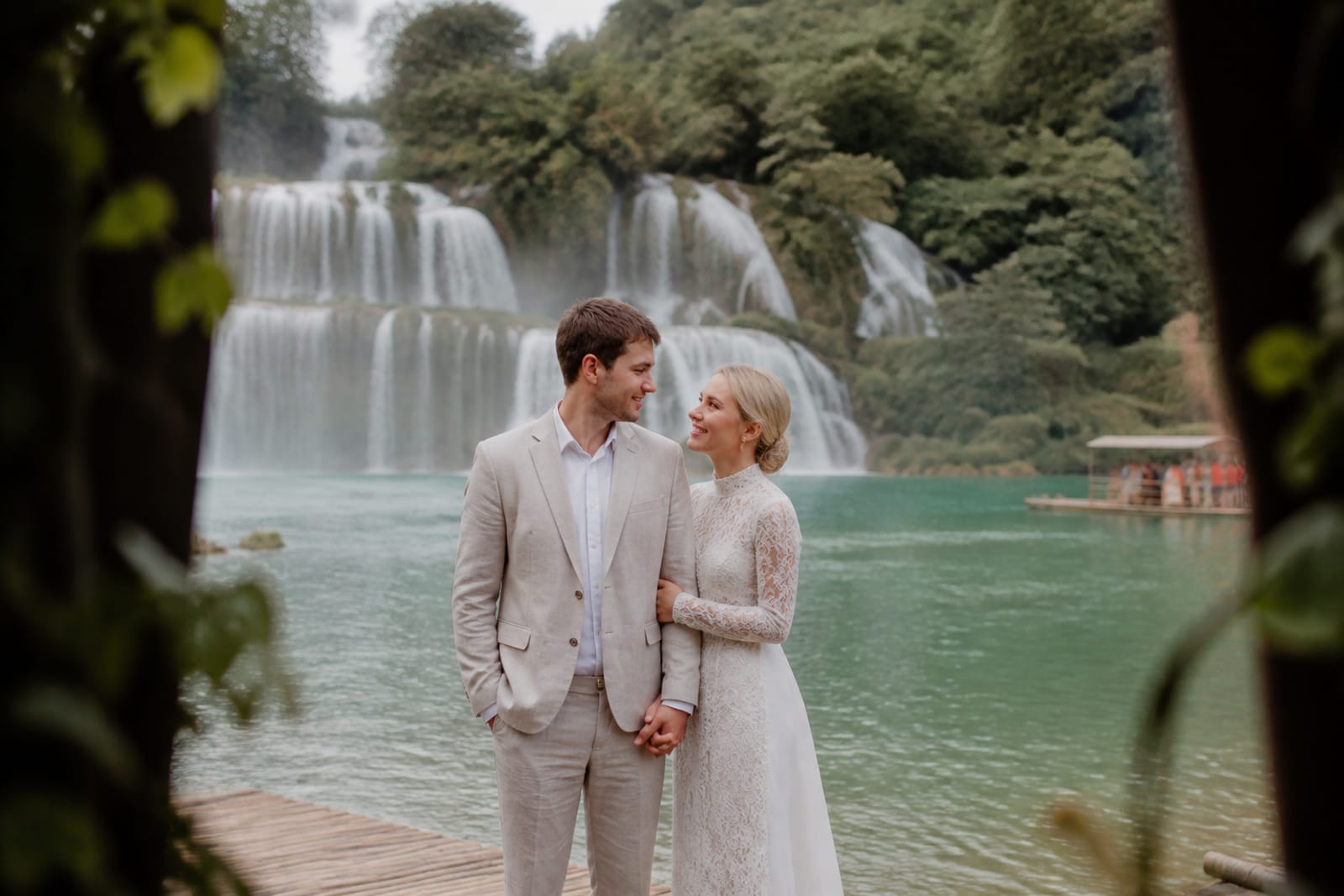
How Does a Ban Gioc Elopement Shoot Compare to Studio or Urban Pre-Wedding Options?
| Option | Light & framing | Season/weather risk | Outfit & logistics | Duration | Best for |
|---|---|---|---|---|---|
| Ban Gioc waterfall | Natural, dramatic; mist, volume, side light | Jul–Sep best; typhoon risk; water variables | 2–3 outfit changes; spray exposure; humidity sweat | 8–10 hours total | Couples prioritizing epic backdrop & adventure |
| Hanoi street & lake | Urban light; reflects off water; golden hour sharp | Oct–Nov, Dec–Feb ideal; gray winter limits drama | 1–2 outfits; no weather exposure; air-conditioned breaks | 3–4 hours | Speed, accessibility, multiple locations |
| Hoi An ancient town & lantern | Lantern glow, warm; narrow lanes; built-in framing | Feb–Aug safest; Dec–Jan cooler; Sep–Oct typhoon risk | 1–2 outfits; cobblestone fatigue; crowded evenings | 4–5 hours | Cultural narrative, compact, walkable |
| Studio with composite backdrop | Controlled, consistent; no weather delay | Year-round | 1–2 outfit tries; no physical strain | 2–3 hours | Couples with limited time or clear creative vision |
Ban Gioc wins on scale and authenticity; it loses on predictability and comfort. Hanoi and Hoi An offer balance. Choose based on whether you prioritize the landscape or the ease.
📸 Book on WhatsApp — pre-wedding & elopement
---
What Should You Check Before Booking a Ban Gioc Elopement Photographer?
- Portfolio specificity: Request 3+ full sessions shot at Ban Gioc, not just a few waterfall frames mixed with other locations. Ask for unedited before-and-afters; this shows editing skill.
- Contingency plan: Confirm what happens if weather forces a reschedule—do you pay a rescheduling fee? Is the deposit refundable?
- Team scope: If makeup and hair are "included," where are they applied? (On-site near the falls in humid conditions, or in Cao Bang town?) Confirm all personnel, not just the photographer.
- Editing timeline: Ask for a delivery date in writing. Ban Gioc humidity can delay post-processing workflows; expect 1–3 weeks, not 48 hours.
- Guide and permits: Who arranges the certified trail guide and border/park permits? Does the fee cover these, or are they separate?
- Backup equipment: Does the photographer carry a second camera body and weather-sealed lenses? Mist kills electronics; redundancy is critical.
- Communication: Confirm WhatsApp or email contact; agree on a 48-hour weather call to finalize or reschedule.
For a comparison, Cáo Studio's pre-wedding shoots in Hanoi and Hoi An follow a controlled workflow (48-hour turnaround, full team, zero weather delays); Ban Gioc trades that certainty for landscape grandeur.
---
When Is the Best Light Window at Ban Gioc, and How Does Season Shift It?
July–August: Sunrise 5:45–6:00 am; mist peaks 6:15–7:30 am (cloudy overall, so diffuse light throughout the day). Side light off the cliff face emerges 7–8 am. Midday is overcast, flat—use for detail shots. Afternoon back-light appears around 4–5 pm as clouds break. Storm light (dark clouds, silver edges) is dramatic but unpredictable.
September: Sunrise shifts earlier; mist clears faster (clearer sky pressure building). 6:00–6:45 am is prime; side light is sharper. Afternoon light extends further west, 4–6 pm is golden but crowds peak (weekends worse). October light is crispest but water levels drop by week 2.
Practical note: Shoot early (6–8 am) for mist and solitude, break for lunch, then return 3–5 pm for warmer tones. Avoid 11 am–2 pm entirely—flat, harsh, and crowded with tour groups.
💄 Makeup & hair at your hotel — or coordinate with your photographer to confirm on-site application logistics.
---
How Do You Arrange Transport, Permits and a Guide?
Most couples book a Cao Bang-based tourism agency (search "Ban Gioc elopement package" or ask your accommodation) which bundles transport from town, a certified guide, and often a photographer. Cost factors include distance from your hotel, group size (private van vs. shared), and whether permits and guide fees are itemized or flat. Request a written itinerary: pickup time, arrival time at trailhead, shooting hours, lunch location, return time.
Alternatively, hire a photographer directly and ask them to coordinate the guide and transport separately—this splits accountability but gives you flexibility on timing.
Do not attempt to reach Ban Gioc without a guide. The trail network is unmarked, border sensitivity is real, and you will get lost or cited.
Confirm 2 weeks before: current water levels (ring the National Park office or your guide), weather forecast, and a rain date. Do not book a domestic flight home the same day—buffer 1–2 days for rescheduling.
🌸 See the lookbook — inspiration for outfit choices and framing at water-centric shoots.
---
What Keepsakes and Album Formats Suit a Ban Gioc Elopement?
Because Ban Gioc is a full-day, high-effort shoot, couples often want durable, heirloom-quality output. After your photographer delivers edited files, consider:
- Wedding photo album: A bound album (leather or linen cover) feels right for an adventurous narrative; Ban Gioc's scale reads well in large-format prints.
- Photo prints & frames: 16×20 or larger single-page prints of the main cascade shot—this is the keepsake moment.
- Wall canvas or acrylic panel: Waterfall mist and volume translate beautifully to oversized canvas; a professional print-and-mount service (ask your photographer for recommendations) preserves detail.
- A short vertical film or video edit: Many photographers offer a 1–2 minute highlight reel (music, transitions, clips of you walking, the cascade, sunset return). This captures energy that stills cannot.
Cáo Studio does not shoot Ban Gioc, but for shoots in Hanoi, Ho Chi Minh City, or Hoi An, we include edited files and a short film as standard. If you book a Ban Gioc photographer, ensure the contract specifies file formats (RAW and JPEG?), copyright (yours or theirs?), and revision rounds before final handover.
FAQ
Can we shoot Ban Gioc in the dry season (November–May) and reschedule if water is low?
Water levels drop sharply after October, making the cascade thin and visually weak by November. Rescheduling into the rainy season is wise, but availability tightens July–September. Book 2–3 months ahead and treat July–August as your primary window; plan a backup Hanoi or Hoi An shoot if Ban Gioc water levels disappoint on your chosen date.
Is an ao dai practical to wear at Ban Gioc, or should we choose a wedding dress?
An ao dai is more practical—it dries faster, tolerates spray better, and celebrates Vietnamese culture. A traditional wedding dress works if you frame shots at dry vantage points (border marker, elevated pools) and avoid the main cascade. Wear moisture-wicking underclothes and bring a microfiber towel; humidity will cling to any fabric within 30 minutes of the falls.
How much walking and climbing is involved in a Ban Gioc session?
Expect 500+ meters of uneven stone steps downhill to the main falls and uphill on return—roughly 1.5–2 hours of hiking over the full day. Trails are steep, slick in wet season, and have hand chains in places. Wear broken-in hiking shoes (non-slip soles mandatory) and pace yourself; elopement couples often underestimate fatigue in heat and humidity. Your photographer and guide will move at this pace, too.
What happens if a typhoon or heavy rain warning is issued before our Ban Gioc date?
Reschedule immediately. Typhoon-linked storms create dangerous runoff and landslide risk; authorities will close trails. A reputable photographer will offer a full reschedule at no extra cost if conditions are unsafe 3–5 days before your date. Confirm this in your contract; do not push forward for dramatic storm photos.
Do we need a permit or visa to shoot near the China border at Ban Gioc?
No special visa is required if you stay within the designated tourist zone (managed by the National Park office). Your guide will brief you on the border marker and restricted angles. Do not cross the demarcation line or shoot from unauthorized vantage points; this triggers enforcement action. A local guide or tourism operator handles permits as part of their standard service.
How long does it take to receive edited photos after a Ban Gioc shoot?
Most photographers deliver edited files within 1–3 weeks, longer than Hanoi studio shoots (48 hours). Humidity and travel logistics slow post-processing. Confirm a delivery deadline in your contract before booking, and budget for 2–3 revision rounds before final handover.
FAQ
Can we shoot Ban Gioc in the dry season (November–May) and reschedule if water is low?
Water levels drop sharply after October, making the cascade thin and visually weak by November. Rescheduling into the rainy season is wise, but availability tightens July–September. Book 2–3 months ahead and treat July–August as your primary window; plan a backup Hanoi or Hoi An shoot if Ban Gioc water levels disappoint on your chosen date.
Is an ao dai practical to wear at Ban Gioc, or should we choose a wedding dress?
An ao dai is more practical—it dries faster, tolerates spray better, and celebrates Vietnamese culture. A traditional wedding dress works if you frame shots at dry vantage points (border marker, elevated pools) and avoid the main cascade. Wear moisture-wicking underclothes and bring a microfiber towel; humidity will cling to any fabric within 30 minutes of the falls.
How much walking and climbing is involved in a Ban Gioc session?
Expect 500+ meters of uneven stone steps downhill to the main falls and uphill on return—roughly 1.5–2 hours of hiking over the full day. Trails are steep, slick in wet season, and have hand chains in places. Wear broken-in hiking shoes (non-slip soles mandatory) and pace yourself; elopement couples often underestimate fatigue in heat and humidity. Your photographer and guide will move at this pace, too.
What happens if a typhoon or heavy rain warning is issued before our Ban Gioc date?
Reschedule immediately. Typhoon-linked storms create dangerous runoff and landslide risk; authorities will close trails. A reputable photographer will offer a full reschedule at no extra cost if conditions are unsafe 3–5 days before your date. Confirm this in your contract; do not push forward for dramatic storm photos.
Do we need a permit or visa to shoot near the China border at Ban Gioc?
No special visa is required if you stay within the designated tourist zone (managed by the National Park office). Your guide will brief you on the border marker and restricted angles. Do not cross the demarcation line or shoot from unauthorized vantage points; this triggers enforcement action. A local guide or tourism operator handles permits as part of their standard service.
How long does it take to receive edited photos after a Ban Gioc shoot?
Most photographers deliver edited files within 1–3 weeks, longer than Hanoi studio shoots (48 hours). Humidity and travel logistics slow post-processing. Confirm a delivery deadline in your contract before booking, and budget for 2–3 revision rounds before final handover.
Ao dai, makeup, hair and a local photographer in Hanoi or Saigon — one WhatsApp message.