/pre-wedding-photoshoot
Elopement photos at Dong Van Karst Plateau: light, season, and booking
Dong Van Karst Plateau elopement shoots work best Sep–Nov, when the stone formations hold soft morning light and the air clears after summer rain. The plateau sits 1,000+ meters high in Ha Giang province, 5+ hours northeast of Hanoi by road — terrain is rocky, paths wind between limestone peaks, and crowds stay light. For elopement framing, your director scouts the plateau before dawn, positions you walking toward or into the light (wide shot of the landscape first, then medium, then details of your expressions), and uses the raw geology as your stage, not a backdrop. Cáo Studio does not operate in Ha Giang; this is a multi-day expedition requiring a local photographer and a guide. Read on to plan it properly.
Why Dong Van Karst Plateau suits elopement photography, and when
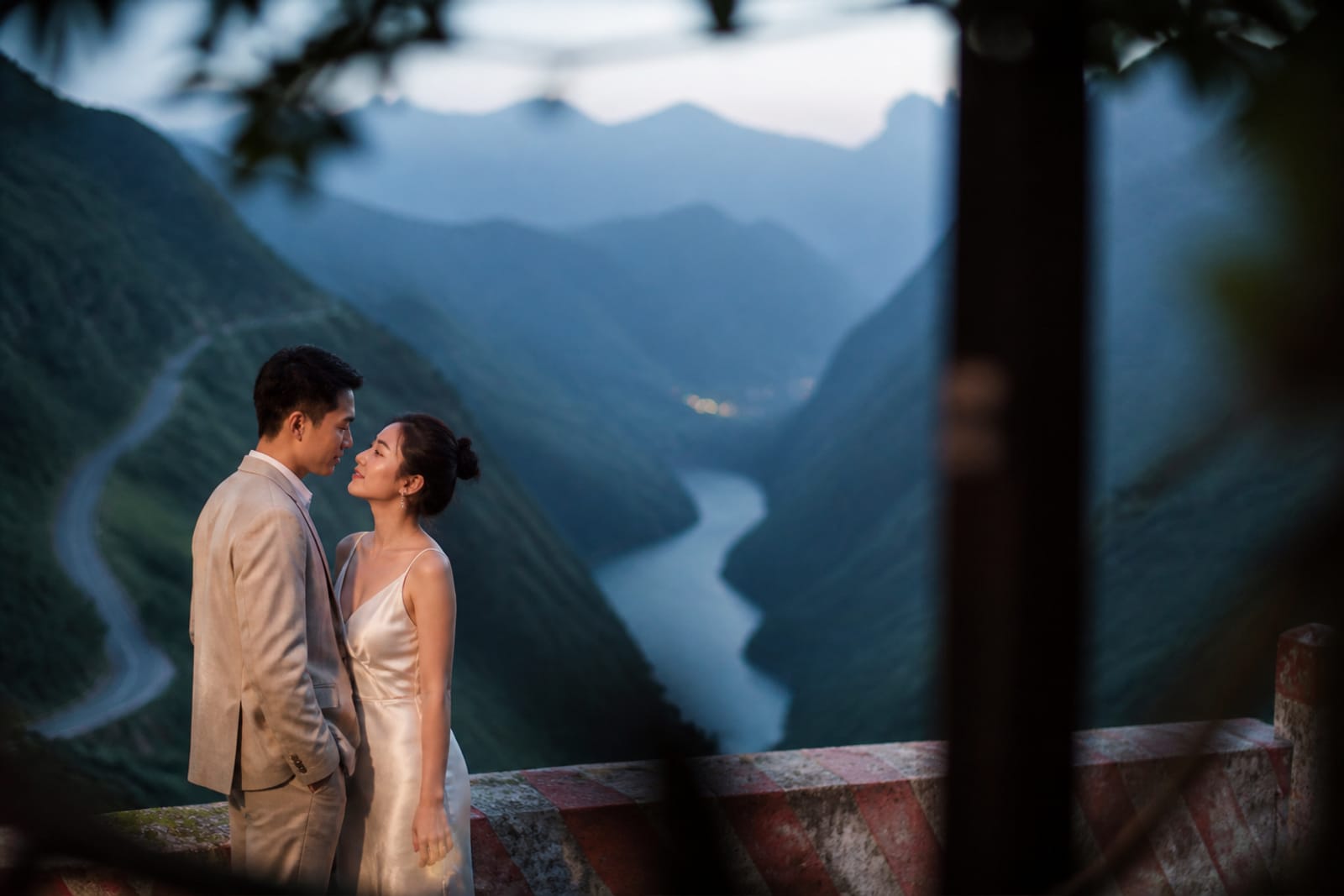
Dong Van Karst Plateau is a designated UNESCO Geopark 5+ hours from Hanoi. The landscape is treeless, open, and textured — ancient limestone peaks rise from the earth without the clutter of trees or structures. Morning light hits the stone surfaces at low angles, casting sharp shadows and defining every ridge. This works for elopement because you are the only moving subject; the landscape doesn't distract. Best light window: Sep–Nov. By September the rainy season slackens; the air clears day-to-day. Buckwheat flowers bloom Oct–Nov, adding soft white and pink to the grey stone, though the plateau is photogenic even without flowers. Dec–Feb brings cold and fog — possible, but risky for light predictability and guest comfort. May–Aug is summer heat, rain, and landslide risk on mountain roads. Early morning shoot (5:30–8:30 am) captures the softest, most directional light; afternoon side light is harsher and less romantic for elopement frames.
What outfits work on rocky, high-altitude terrain
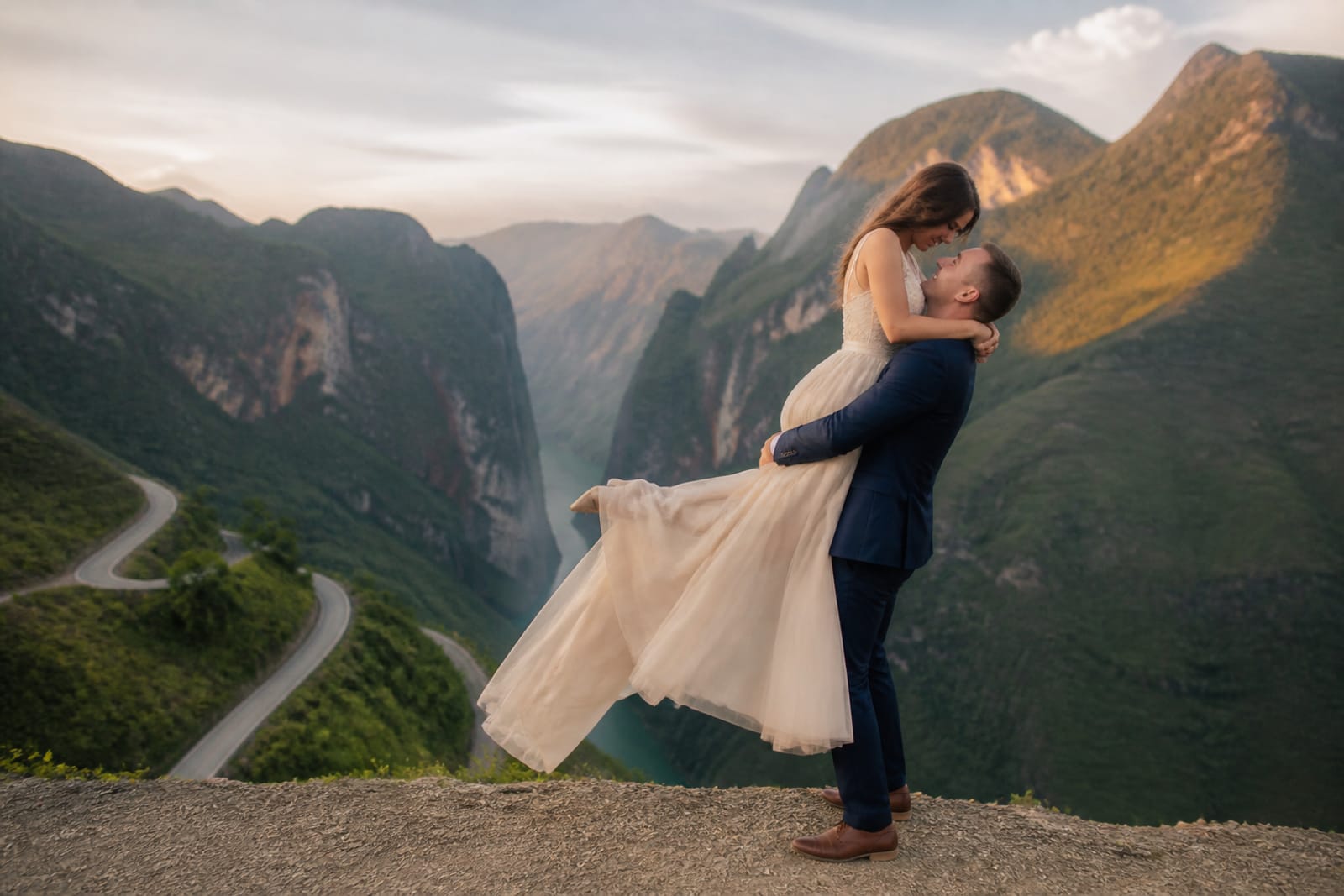
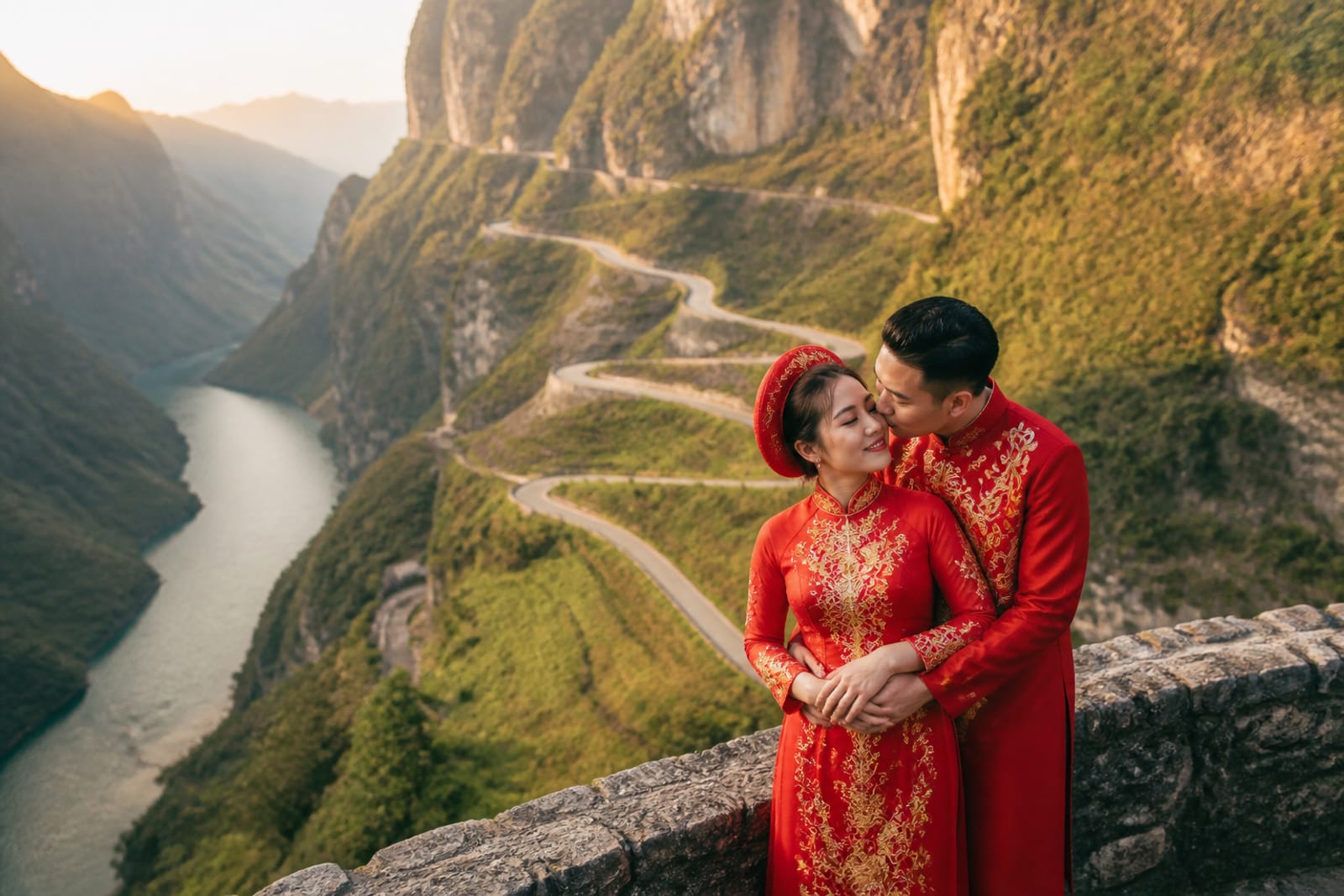
Traditional wedding dresses — long skirts, trains, delicate fabrics — snag on stone, tear on scrub, and restrict movement on uneven ground. An ao dai fitted at the legs works because the fabric is structured and the slit allows stride; pair it with flat or low-heel shoes with grip (not wedding heels). Grooms wear tailored trousers and a linen or cotton shirt, sleeves rolled — the plateau wind is real, and layering protects against temperature swings (morning can be 10°C; by noon, 18–20°C). Consider a vest or unstructured blazer for formality without overheating. Avoid white or cream on bare stone at midday — the contrast reads flat in photos. Jewel tones (emerald, sapphire, burgundy) and warm neutrals (terracotta, cream on an ao dai, charcoal) hold dimension against grey limestone. Your director will brief you on how to move over rocky paths without looking stiff — walk, pause, look at each other, adjust your outfit — never stand still in front of the view.
🌸 Browse ao dai rentals | 💄 Add makeup & hair
Season and weather: the trade-offs for Dong Van shoots
The plateau spans three climate zones (north face is cooler; south face holds sun longer). Weather shifts fast — a clear dawn can cloud by 9 am, or vice versa. Your director must check forecasts 5 days out, scout the site 2 days before, and be ready to pivot the route if fog rolls in. Sep–Nov is most reliable: Sep has clearer air post-monsoon; Oct–Nov adds buckwheat color and stable-ish conditions. Dec–Feb risks fog and cold — you may wait hours for a break in cloud, and frost on stone makes paths treacherous. May–Aug rains (May–Sep monsoon) soften the light but cause landslides on Ha Giang roads; the road to Dong Van can close without warning. Plan a 3-day trip: day 1 travel and rest, day 2 scout at dusk and shoot at dawn, day 3 drive out. Any local guide or photographer you hire should have live weather tracking and a backup light window (either a second dawn, or a repositioned afternoon route).
Comparison: Dong Van Karst vs. other northern elopement sites
| Site | Best for | Light quality | Outfit fit | Travel time from Hanoi | Season |
|---|---|---|---|---|---|
| Dong Van Karst Plateau | Vast, raw geology; isolation | Soft morning side light; dramatic shadows at sunrise | Structured ao dai, flat shoes, layers | 5+ hours | Sep–Nov best; Dec–Feb risky |
| Ninh Binh (Trang An, Mua) | Rice paddies + limestone; day trip | Golden hour on water; sunset reflections | Long dress okay on boats; heels risky on climbs | 2–3 hours | Year-round; Oct–Apr clearest |
| Sapa (Fansipan, Ham Rong) | Mountain mist + villages; multi-day | Overcast soft light; mist frames subjects | Sturdy pants, hiking shoes; dress impractical | 6+ hours | Sep–Nov, Mar–Apr |
| Red River Delta (near Hanoi) | Rice fields + rural temples; close | Golden hour on flatland | Any outfit; easy terrain | 30 min–1 hour | Oct–Apr clearest |
Dong Van suits elopement because the landscape is dramatic but not crowded, and the terrain demands a skilled director who can frame you without your having to shout instructions over wind.
Logistics: what a Dong Van elopement shoot actually requires
Your team is a director, a local guide, and you two — minimum three people. The director must be someone who has shot on the plateau (knows the paths, the best light angles, the terrain hazards) and speaks your language. Cáo Studio does not operate in Ha Giang; you will need a local Hanoi-based photographer who regularly works in northern mountain zones, or a freelancer recommended by a Hanoi studio. To find one: (1) ask Hanoi photoshoot studios if they shoot Dong Van and how often; (2) ask for a portfolio of plateau shots, not studio work; (3) confirm they provide a guide or work with a licensed local guide (guides can be arranged via Hanoi hotels or tour operators); (4) check their experience with elopement pacing (they should prioritize movement and light over posing). Logistics: rent a vehicle (minivan or car) with a driver, or book a 3-day tour operator who adds a photographer to the itinerary (unusual, but some Hanoi tour companies partner with photographers). Budget for: vehicle rental, driver, guide, and photographer as separate line items. Confirm the photographer will shot in RAW (not JPEG only), deliver edits within 7 days, and provide a full download of originals or high-res files — this is non-negotiable for elopement photos you may print or display.
📸 Book a Hanoi-based director for pre-wedding shoots | 🌸 See our lookbook
What to check before booking a Dong Van elopement photographer
Before you commit, ask these questions:
- Have you shot Dong Van Karst in Sep–Nov? Ask to see a portfolio of 10+ plateau frames, not one-off landscape shots.
- Do you direct movement, or do you pose? A good answer: "I'll have you walk toward the light, pause, look at each other. I shoot movement, not poses."
- What happens if the weather breaks? They should have a backup light window (second dawn, or afternoon repositioning) and a refund or reschedule option if sunrise is fogged out three days running.
- What's included in the delivery? Edited files, originals, turnaround time (48 hours for initial edits is standard; 7 days for full delivery is realistic). Get this in writing.
- Do you provide a local guide, or do I hire one separately? Many independent photographers work with a guide; confirm who handles this.
- What's the cancellation and weather policy? Multi-day trips involve travel commitments; you need a clear rain-out refund or reschedule clause.
Cost factors (not prices): Multi-day Dong Van shoots cost more than a Hanoi day-shoot because they require travel time, lodging logistics, and a guide. The best photographers book months ahead for Sep–Nov; book 4–6 months early if you have a specific date. If you prefer a studio team that handles everything (outfit fitting, makeup, hair, direction), Cáo Studio shoots elopements in Hanoi, Ho Chi Minh City, and Hoi An — multi-day plateau trips are outside our service area, but we can advise you on preparation and outfit choices via WhatsApp.
💬 Ask Cáo Studio for photog recommendations | 📸 Or book an elopement in our service area
---
FAQ
Is Dong Van Karst Plateau walkable in a wedding dress?
Long Western dresses snag and tear on limestone. An ao dai (slit to the leg) works; choose flat shoes with grip. Grooms wear tailored trousers and a linen shirt; avoid heavy jackets. The terrain is rocky and uneven — your outfit must allow stride.
What's the best time to photograph on Dong Van Plateau?
Sep–Nov offers the clearest air and most predictable light. Oct–Nov adds buckwheat flowers. Dec–Feb risks fog and cold. Summer (May–Aug) brings monsoon rain and landslide risk on Ha Giang roads.
Can Cáo Studio shoot my elopement at Dong Van?
No, Cáo Studio does not operate in Ha Giang province. We shoot elopements in Hanoi, Ho Chi Minh City, and Hoi An. We recommend hiring a local Hanoi photographer with a portfolio of Dong Van plateau work and a trusted guide.
How long does a Dong Van elopement shoot take?
Plan a 3-day trip: travel (day 1), scout and dawn shoot (day 2), return (day 3). The actual shoot is 2–3 hours, but the plateau demands early starts and flexible timing if weather shifts.
What should I bring for a high-altitude plateau shoot?
Layers (morning is 10°C, midday 18–20°C), sunscreen, water, a windbreaker, and grip-soled shoes. Your photographer should brief you on terrain hazards and outfit choices before the trip.
How much does a Dong Van elopement photographer cost?
Pricing varies by photographer, season, and travel distance. Request quotes from 2–3 local Hanoi-based photographers with plateau portfolios. Budget for vehicle rental, guide, and photographer separately; ask WhatsApp if you want recommendations.
FAQ
Is Dong Van Karst Plateau walkable in a wedding dress?
Long Western dresses snag and tear on limestone. An ao dai (slit to the leg) works; choose flat shoes with grip. Grooms wear tailored trousers and a linen shirt; avoid heavy jackets. The terrain is rocky and uneven — your outfit must allow stride.
What's the best time to photograph on Dong Van Plateau?
Sep–Nov offers the clearest air and most predictable light. Oct–Nov adds buckwheat flowers. Dec–Feb risks fog and cold. Summer (May–Aug) brings monsoon rain and landslide risk on Ha Giang roads.
Can Cáo Studio shoot my elopement at Dong Van?
No, Cáo Studio does not operate in Ha Giang province. We shoot elopements in Hanoi, Ho Chi Minh City, and Hoi An. We recommend hiring a local Hanoi photographer with a portfolio of Dong Van plateau work and a trusted guide.
How long does a Dong Van elopement shoot take?
Plan a 3-day trip: travel (day 1), scout and dawn shoot (day 2), return (day 3). The actual shoot is 2–3 hours, but the plateau demands early starts and flexible timing if weather shifts.
What should I bring for a high-altitude plateau shoot?
Layers (morning is 10°C, midday 18–20°C), sunscreen, water, a windbreaker, and grip-soled shoes. Your photographer should brief you on terrain hazards and outfit choices before the trip.
How much does a Dong Van elopement photographer cost?
Pricing varies by photographer, season, and travel distance. Request quotes from 2–3 local Hanoi-based photographers with plateau portfolios. Budget for vehicle rental, guide, and photographer separately; ask WhatsApp if you want recommendations.
Ao dai, makeup, hair and a local photographer in Hanoi or Saigon — one WhatsApp message.