/pre-wedding-photoshoot
Elopement photos at Hoa Lu ancient capital: how to shoot
Hoa Lu elopement shoots thrive on early light and stillness. The site sits in Ninh Binh's northern dry season (best Mar–May, Sep–Nov); stone temples stay cool and uncluttered before 9 a.m. A shoot here typically runs 3–4 hours—enough time to walk between Dinh Tien Hoang and Le Dai Hanh temples, catch side light on carved gates, and frame you two moving through rice paddies. Cáo Studio covers elopements in Hanoi and Ho Chi Minh City; for a Hoa Lu session, the team can coordinate with vetted local photographers who know the site's light angles and have standing permission from temple stewards. Avoid midday flat light, plan shoes for 400+ uneven stone steps, and confirm with monks which temple areas permit photography—rules vary by shrine.
Why Hoa Lu works for intimate elopement frames
Hoa Lu is a walled temple complex, not a single monument. Two main shrines (Dinh Tien Hoang and Le Dai Hanh) sit 500 meters apart, connected by a stone pathway flanked by rice fields and small pavilions. This layout gives a photographer multiple "acts"—an arrival shot at the outer gate, intimate frames inside shadowed courtyards, and open-air walking sequences as you move between temples. The moss-covered stone, weathered by a thousand years, creates layers of texture; morning side light turns carved details golden without flattening faces. Unlike Hoi An's crowded Ancient Town or Ha Long Bay's boat congestion, Hoa Lu attracts fewer international visitors. A 7 a.m. start means you shoot the first light without waiting for other couples to clear the frame.
The trade-off: the site is sacred. Local monks live and pray here. Photography is permitted in outer courtyards and temple exteriors, but not all inner sanctums. A photographer who respects this boundary—asking permission, moving quietly, never posing you over altars—builds the calm that reads in the final images.
Which season gives you the sharpest light?
| Season | Light quality | Crowds | Rain risk | Walking comfort |
|---|---|---|---|---|
| Mar–May (spring dry) | Soft side light, haze clears by 8 a.m. | Sparse before 10 a.m. | Rare | Warm but bearable; stone holds morning cool |
| Jun–Aug (summer) | Harsh midday; storms most afternoons | Moderate | Frequent afternoon downpours | Hot, humid; moss slippery after rain |
| Sep–Nov (autumn dry) | Golden hour longer; crisp air | Very sparse | Rare until late Oct | Ideal—cool mornings, sharp light, firm ground |
| Dec–Feb (winter cool) | Grey, diffused; no hard shadows | Few tourists | Occasional drizzle | Cool, clear stone; still walkable in dry spells |
Spring and autumn are safest. Light turns warm and directional by 8 a.m.—enough time to shoot the first temple, walk the path, and move to the second before the sun climbs too high. If you book a summer elopement, plan for an afternoon downpour to interrupt the session; a local photographer knows which covered pavilions work as shelters and will build that into timing. Winter light is flat and cool but crowds vanish; if you accept grey tones and mist in the frames, December through early February offers solitude.
📸 See elopement inspiration in our lookbook
How do you navigate stone steps and keep your outfit intact?
Hoa Lu demands practical footwear. The entrance path has about 400 uneven stone steps; the temple inner courtyard adds another 100. Climbing in a wedding dress or formal suit is possible but requires:
- Shoes: flat, closed-toe, grippy sole (not heels; wet or worn stone is slippery). Many couples bring a second pair—heeled sandals for static shots, flat shoes for walking.
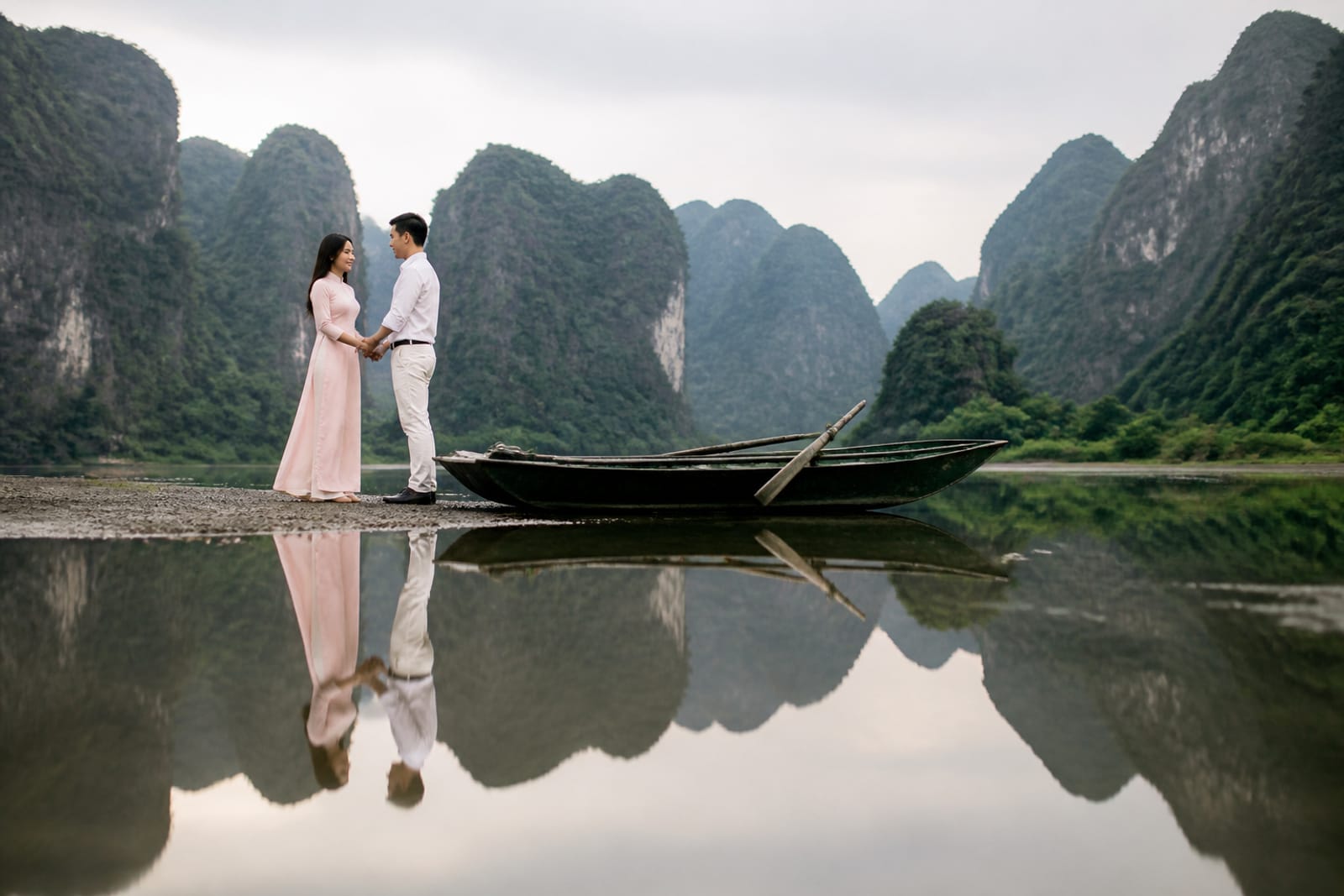
- Dress length and train: if you're wearing a traditional áo dài, the long silk moves beautifully in motion, but plan for the photographer to lift fabric at your waist during uphill stretches; a rented áo dài from a rental service sits higher than a custom gown, making steps easier. If wearing a Western wedding dress, consider a shorter second option (knee-length or midi) for the walking sequences, and save the full gown for posed frames in flat courtyards.
- Undergarments and foundation: wear breathable, anti-slip undergarments; you'll sweat during the climb. A local photographer will position you to hide any staining during transitions.
- Hair and makeup prep: early heat and humidity will test your styling. Cáo Studio's makeup and hair service works at your hotel, so you're fully ready when the photographer arrives; makeup should include long-wear foundation and waterproof elements for the humidity and perspiration of temple steps.
A photographer who knows Hoa Lu will plan shot sequences around the climb—wide establishing frames at lower points, intimate close-ups in shaded temple niches, then walking-toward-camera shots once you've both caught your breath at the upper level.
What does a local photographer cost, and how do you vet them?
Hoa Lu elopement shoots are not offered by Cáo Studio (the team is based in Hanoi, Ho Chi Minh City, and Hoi An). If you choose to book a local Ninh Binh photographer, here are the factors that affect the quote:
- Travel distance: Hoa Lu sits about 100 kilometers south of Hanoi; a photographer traveling from Hanoi or Ninh Binh town charges for transport time and fuel. A local Ninh Binh resident will quote lower.
- Session length: 2-hour sessions (one temple) cost less than 4-hour elopements (both temples, walking sequences, outfit changes). Longer sessions may include editing turnaround time in the fee.
- Outfit and styling changes: if you bring multiple looks (áo dài, Western gown, casual second outfit), sessions run longer. Some photographers charge per outfit change.
- Editing scope: ask whether the quote includes edited finals and a short video clip, or only raw selects. Turnaround time (48 hours vs. two weeks) affects the price.
How to vet a local photographer:
- Ask your hotel or the Hoa Lu temple office for referrals—they work with photographers regularly and know who respects the site's rules.
- Review their portfolio for temple light, stone texture, and natural movement (not stiff poses). Look for frames shot before 10 a.m. and after 3 p.m., when side light is directional.
- Confirm their experience with couples in formal dress—áo dài and Western gowns both require different handling on uneven ground.
- Ask how they manage temple etiquette: do they ask permission, do they know which areas prohibit photography, have they worked with the monks before?
- Request a detailed session plan (which temples, what time, which outfit changes, where you'll stand for light) before paying any deposit. Vague promises ("We'll see where the light is best") often mean wasted time in crowds.
If you're based in Hanoi or Ho Chi Minh City and prefer a photographer who understands your vision before arrival, Cáo Studio can recommend and coordinate with trusted local partners—ask on WhatsApp for Ninh Binh connections.
💄 Start with professional hair & makeup
How do you build a 3–4 hour session that tells a story, not just poses?
The strongest elopement shoots follow a narrative arc, not a shot list. A Hoa Lu elopement typically unfolds as:
Act 1: Arrival and temple approach (7:00–8:00 a.m.) You walk toward the outer gate in early golden light. The photographer shoots wide first—you two entering the frame, stone walls framing the scene—then tightens to medium shots of you walking together, then close-ups of hands or expressions. No posed smiling; the movement is real, the light is real.
Act 2: Inside the first temple (8:00–9:30 a.m.) You move through shadowed courtyards, stand before carved gates, sit on stone benches. The photographer frames you looking at each other, looking at the architecture, walking deeper into the complex. Carved details and moss-covered stone become compositional layers behind you.
Act 3: The walk between temples (9:30–10:30 a.m.) This is the strongest emotional section. You walk a tree-lined path with rice paddies on one side; side light rakes across the landscape. The photographer captures you mid-step, laughing, pausing to look back—no direction, just real moments. This sequence often becomes the video sequence because the movement is natural.
Act 4: Second temple and detail work (10:30–11:30 a.m.) You enter Le Dai Hanh shrine. Light is higher now, so the photographer shifts focus to intimate details—your hands on carved wood, a close frame of you two in a shadowed alcove, or a wide shot showing the temple's inner courtyard as a backdrop. This is where slower, quieter moments live.
A photographer who understands this structure doesn't need to direct you. You walk, stop to breathe, look at each other. The camera catches the real seconds in between. That's an elopement frame worth keeping.
What to check before you book a local photographer
Before handing over a deposit, verify these specifics:
- Temple access and permissions: Have they shot at Hoa Lu before? Do they have any restrictions or permissions already in place with the temple stewards? Some photographers pay a small courtesy fee to the monks; confirm whether this is included in their quote.
- Editing timeline and final deliverables: Ask for the exact number of edited photos, delivery date, and format (digital files, prints, video). A 48-hour turnaround is faster than industry standard; check if that's realistic for their editing process.
- Backup plan for weather: Hoa Lu is in Ninh Binh's northern dry zone, but rain can appear suddenly in Jun–Aug. What happens if it rains? Will they reschedule, shelter-and-shoot, or offer a partial refund?
- Session flexibility: Can you request a different temple, a rice paddy walk, or a nearby Tam Coc boat trip as a second location? Some photographers offer multi-location elopements; others are temple-only.
- Communication language: If you don't speak Vietnamese, confirm the photographer speaks English or your language, and that they can understand your aesthetic via email or WhatsApp before the session.
- Outfit handling: Ask how they'll manage áo dài folds, dress trains, and shoe changes during transitions. A photographer who's done this before will have a system.
If you're already based in Hanoi and want a shoot with a team that handles hair, makeup, and photography all at once (like Cáo Studio does for Hanoi couples), consider booking a pre-wedding photoshoot at nearby Trang An or Ninh Binh's rice fields through the studio's network. Ask on WhatsApp whether the team can coordinate a Hoa Lu session with a preferred local partner.
🌸 Explore couple photoshoot options
FAQ
Can Cáo Studio shoot an elopement at Hoa Lu?
Cáo Studio operates in Hanoi, Ho Chi Minh City, and Hoi An. For a Hoa Lu elopement, the team can recommend and coordinate with vetted local photographers who know the temple's light and etiquette. Contact us on WhatsApp to discuss.
What's the best time of day to shoot at Hoa Lu?
Early morning (6:30–9:00 a.m.) offers soft side light and minimal crowds. Avoid 10 a.m.–3 p.m. when light is harsh and tourists peak. Late afternoon (4:00–5:30 p.m.) also works if you're shooting the second temple with golden backlight.
Do I need permission from monks to photograph at Hoa Lu?
Yes. Outer temple courtyards and exteriors are generally open to photography, but inner sanctums and active prayer areas are not. A local photographer who knows the site will ask permission and respect boundaries; disrespecting these rules damages the emotional integrity of the shoot.
Should I wear an áo dài or a Western wedding dress for Hoa Lu?
Both work, but plan accordingly. An áo dài moves beautifully on stone steps and is lighter for the climb; a Western gown photographs well in static frames but is harder to manage upstairs. Many couples bring both and change between temples.
How long does a Hoa Lu elopement shoot take?
Plan 3–4 hours to cover both temples, walking sequences, and outfit changes. A compressed 2-hour session works if you focus on one temple and one outfit. Earlier start times (7 a.m.) maximize light before crowds arrive.
How much does a local Hoa Lu photographer charge?
Costs depend on session length, outfit changes, travel distance, and editing scope. A Ninh Binh-based photographer will quote lower than one traveling from Hanoi. Ask for a detailed quote after discussing your vision and session plan on WhatsApp.
FAQ
Can Cáo Studio shoot an elopement at Hoa Lu?
Cáo Studio operates in Hanoi, Ho Chi Minh City, and Hoi An. For a Hoa Lu elopement, the team can recommend and coordinate with vetted local photographers who know the temple's light and etiquette. Contact us on WhatsApp to discuss.
What's the best time of day to shoot at Hoa Lu?
Early morning (6:30–9:00 a.m.) offers soft side light and minimal crowds. Avoid 10 a.m.–3 p.m. when light is harsh and tourists peak. Late afternoon (4:00–5:30 p.m.) also works if you're shooting the second temple with golden backlight.
Do I need permission from monks to photograph at Hoa Lu?
Yes. Outer temple courtyards and exteriors are generally open to photography, but inner sanctums and active prayer areas are not. A local photographer who knows the site will ask permission and respect boundaries; disrespecting these rules damages the emotional integrity of the shoot.
Should I wear an áo dài or a Western wedding dress for Hoa Lu?
Both work, but plan accordingly. An áo dài moves beautifully on stone steps and is lighter for the climb; a Western gown photographs well in static frames but is harder to manage upstairs. Many couples bring both and change between temples.
How long does a Hoa Lu elopement shoot take?
Plan 3–4 hours to cover both temples, walking sequences, and outfit changes. A compressed 2-hour session works if you focus on one temple and one outfit. Earlier start times (7 a.m.) maximize light before crowds arrive.
How much does a local Hoa Lu photographer charge?
Costs depend on session length, outfit changes, travel distance, and editing scope. A Ninh Binh-based photographer will quote lower than one traveling from Hanoi. Ask for a detailed quote after discussing your vision and session plan on WhatsApp.
Ao dai, makeup, hair and a local photographer in Hanoi or Saigon — one WhatsApp message.