/pre-wedding-photoshoot
Elopement Photos at Hon Thom Cable Car: Plan the Shoot
Hon Thom cable car (Phu Quoc, Kien Giang) delivers one of Vietnam's most cinematic elopement backdrops: a 21-minute ride over turquoise shallows, island views, and light that shifts hour by hour. An elopement session here means arriving before midday crowds, working the ascending cabin light, stepping onto the island for wide frames and detail shots of rings or ao dai folds, then timing the descent for golden-hour silhouettes. Most couples shoot 2–3 hours total: cable car ascent, 60–90 minutes on Hon Thom, descent at sunset. Wind is the main obstacle—platform sway and hair movement require a director who anticipates gusts and frames tighter on windy days. Choose a photographer who has shot cable cars before (light flattens at 11 am–2 pm, gold arrives 4:30–5:30 pm). Cáo Studio's base is in Ho Chi Minh City and Hanoi; for Hon Thom elopement coordination and local logistics (permits, cable car timing, island access), message us on WhatsApp to confirm availability and dates. 📸 Book on WhatsApp — pre-wedding & elopement ---
Why Hon Thom Cable Car Stands Out for Elopement Photography
Most elopement venues anchor couples to one spot—a temple, a lake, a street. Hon Thom's cable car is a transition: 21 minutes of changing light, altitude, and emotion, then a solid island platform for detail and couple portraits. The water below reads as a colour gradient from sand-bar white to deep teal, creating depth even in flat midday light. An ascending cabin at 6 am catches side light that sculpts faces; the island platform allows wide environmental shots with the cable car receding in the frame; the descent at 5 pm or later turns the cabin into a silhouette against an orange or pink sky. No monument, no street chaos—just you two, a photographer trained to direct movement through changing light, and a backdrop that moves. This is why couples choose it over static Phu Quoc landmarks.
Conclusion: Hon Thom cable car works because light, movement, and isolation align in one booking.
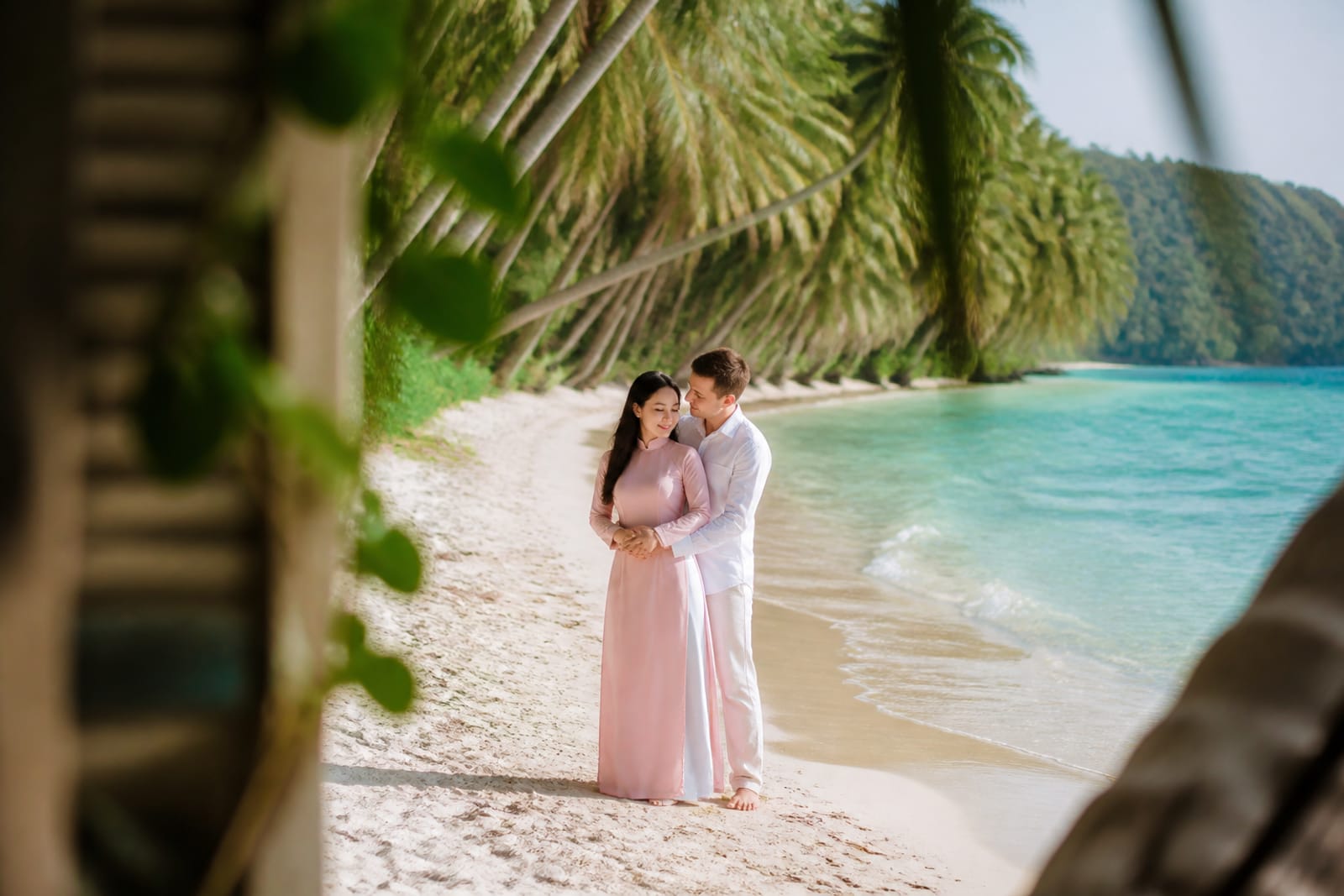
What Time of Day Delivers the Best Cable Car Light?
Ascending first light (5:30–7 am) offers soft, directional side-light that sculpts faces without flattening features—ideal for cabin interior and couple portraits mid-ride. The island platform from 7–9 am sees even, overhead light; wind is often calmer. By 11 am–2 pm, direct overhead sun creates harsh shadows under eyes and nose; this slot requires a director who shoots wide environmental frames (ao dai silhouettes, water reflections) and avoids close portraits. Golden hour (4:30–5:30 pm) is the descent's payoff: the cabin becomes a glowing frame, and backlit ao dai or suits read with texture. Factor in: ticket times run on a schedule (check locally), and you cannot hold a cabin or island indefinitely. A typical elopement session books the ascending cabin, spends 60–90 minutes on the island, and times the descent for last light.
Conclusion: Ascent at dawn or descent at dusk frames couples best; midday suits wide environmental shots only.
How Do You Manage Wind and Platform Movement on the Cable Car?
Wind gusts the cabin and sways the island platform—hair lifts unpredictably, and wider lenses distort tilting horizons. A director who has shot cable cars frames tighter, keeps ao dai and hair work (curls pinned, sides tied back) in place, and shoots bursts to catch between-gust frames where faces are still and fabric settles. On the cabin, stay seated for stability; the director positions the camera low (looking up at faces) to use the window frame as a border and reduce background swing. On the island, step onto the lee side of structures; even on the platform, a slight crouch and wind-aware posture prevents motion blur. Avoid flowing, unanchored fabrics unless they're part of the story (a veil release, a scarf arc). Bring hair spray, pins, and a light jacket to stay warm; the wind cools faster than ground level. A crew of one (photographer + hair/makeup assistant) is tighter than a scattered team; alert your booking to wind sensitivity beforehand.
Conclusion: Tight framing, pinned hair, lee-side positioning, and bursts beat fighting the elements.
Cable Car vs. Island Resort: Which Elopement Style Suits Your Photos?
| Option | Best for | Light window | Why it works |
|---|---|---|---|
| Ascending cable car (dawn) | Couple portraits, cabin intimacy, soft faces | 5:30–7:30 am | Side-light sculpts; fewer crowds; intimate enclosed space |
| Island platform (mid-morning) | Environmental wide frames, ao dai movement, water reflection | 7–10 am | Even light, styled ao dai pops, water gradient visible, no harsh shadows |
| Descent cable car (golden hour) | Silhouettes, backlighting, cinematic frames | 4:30–5:30 pm | Warm, directional light; cabin becomes a lantern; story-driven single images |
| Resort beach (full day flexibility) | Relaxed timeline, multiple outfit changes, no platform access stress | 6–11 am, 4–5:30 pm | No schedule lock; you own the location; light is predictable; slower pace suits fatigue |
Conclusion: Cable car is cinematic and time-locked; resort beach is flexible and intimate. Cable car suits couples who want one message (directed motion + light); resort suits couples who want choices (multiple outfits, no pressure).
---
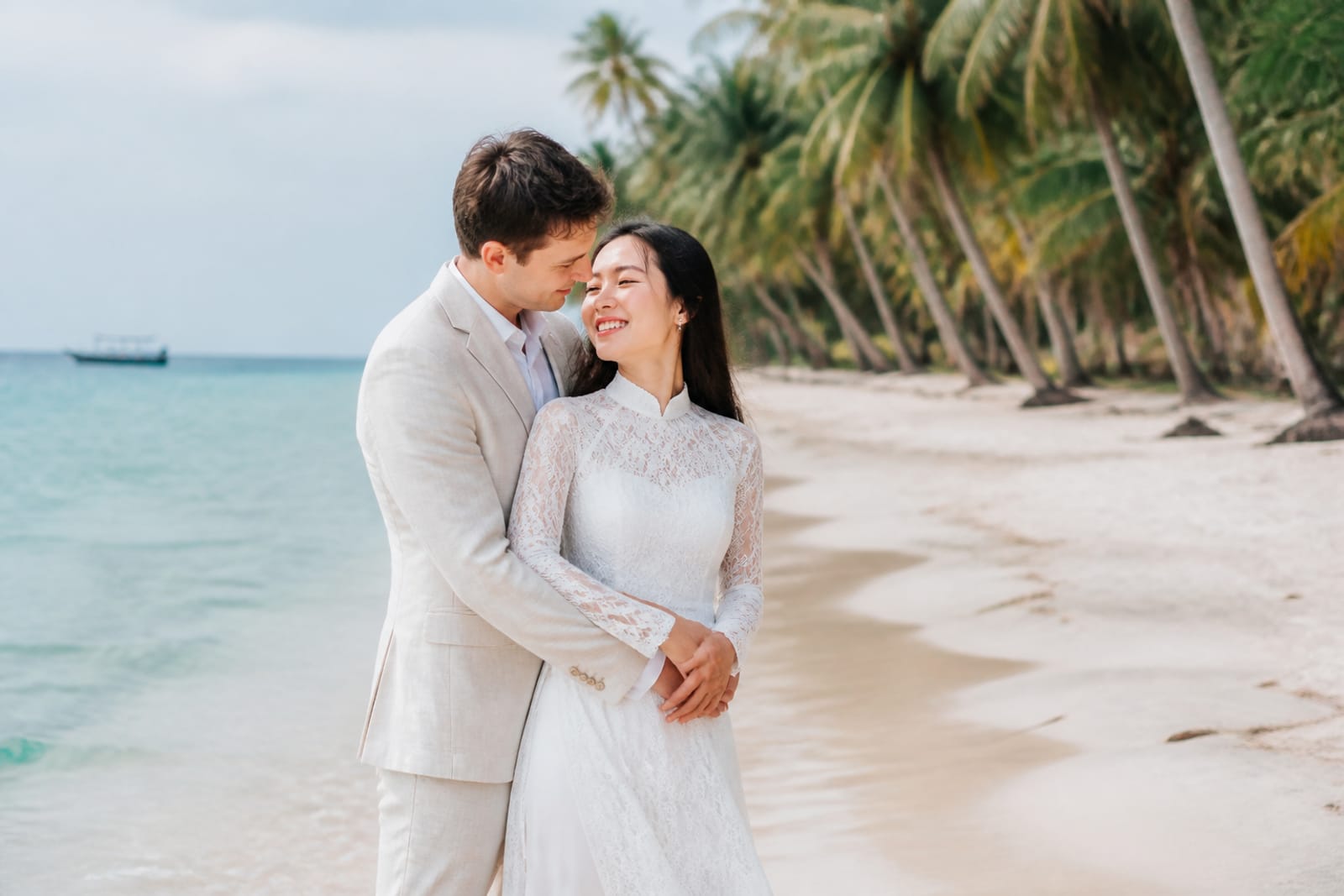
What Permits or Pre-Booking Do You Need for an Elopement Session There?
Hon Thom operates as a ticketed cable car and island attraction under private management. A photographer cannot bypass tickets or platform rules—everyone, including crew, buys entry (check current pricing locally; ask Cáo Studio on WhatsApp what applies to professional bookings). Some operators allow crew to shoot from the cabin or platform without extra permits; others charge a "commercial use" or "photography crew" fee. Booking a specific departure time is not always possible—you buy tickets for a general time slot and board the next cabin. This unpredictability is why a director who has shot there before is crucial: they know which departure slots typically have fewer tourists, which cabin angles work, and how to communicate with staff. Before confirming a Cáo Studio elopement session at Hon Thom, message us on WhatsApp to confirm: our familiarity with local access, current permit status, and whether the shoot suits your timeline and budget (logistics may add cost compared to a Hanoi temple or Hoi An street elopement).
Conclusion: Permits are minimal but timing is rigid; book a photographer who knows the site's rules.
---
What Should You Wear Under an Ao Dai for a Cable Car Elopement?
Wear fitted, neutral-toned shorts or leggings (black or white) under your ao dai: a cable car cabin has windows and crowds below, and wind can lift fabric unexpectedly. The undergarment should not show or bunch—a single-panel ao dai (the traditional straight cut) hides a slim foundation layer; a split-front ao dai (more modern) needs invisible support underneath. Avoid loud patterns or thick seams that create visible ridge lines. Grooms: wear tailored trousers in a solid colour (navy, charcoal, or cream) under a classic or contemporary áo groom (or Western suit, if your style); ensure the jacket length and shoulder fit work for sitting and standing in a moving cabin. For hair and makeup at altitude and wind, stick to waterproof mascara and a long-wear lip colour; bring powder and blotting sheets for touch-ups between cabin and island. Hair should be pinned or braided; loose waves will not survive the wind and look restless in frames. Coordinate with a makeup artist beforehand—ask Cáo Studio's makeup & hair service to discuss cable car specifics (they can prep you in your hotel before the shoot, or travel with the photographer if you're on a multi-day session).
Conclusion: Fitted undergarments, pinned hair, and waterproof makeup survive cable car conditions.
---
How Long Does a Full Hon Thom Elopement Session Take, and What's the Cost Range?
A typical session spans 3–4 hours: 30 minutes of logistics and briefing, 21-minute ascent with photography, 60–90 minutes on the island (framing, detail shots, couple interactions, ao dai or suit moments), 21-minute descent, and buffer for crowds or weather. Edited images are delivered in 48 hours (per Cáo Studio standard); a short vertical film clip is included. Do not ask Cáo Studio for a price here—cost factors include: distance from Hanoi or Ho Chi Minh City (Phu Quoc requires travel time and coordination), the number of outfits, whether makeup and hair are booked, and whether you want a second crew member for hair/makeup on-site. Couple sessions vary by these factors, and Cáo Studio confirms exact inclusions on WhatsApp. Ask for a quote that specifies: what's included (number of edited images, video, outfits, hair/makeup), delivery date, and any travel or permit costs.
Conclusion: Timeframe is clear; cost depends on crew, outfits, and location logistics—get a bespoke quote.
---
What to Check Before You Book an Elopement Photographer for Hon Thom
Photographer experience:
- Have they shot cable cars or moving vehicles before? Ask for a portfolio clip—do they frame the movement, or does it look static?
- Do they know Hon Thom's operator, crowd patterns, and departure times? Can they explain how they'll book your slot?
Team size:
- Is it one photographer, or a photographer + hair/makeup assistant? Cable car platforms are tight; a larger crew creates logistical friction.
- Can they do hair and makeup, or will you book separately? See Cáo Studio's hotel makeup & hair service if you need it.
Timing flexibility:
- Can they guarantee a specific departure time, or is it a time window? (Usually it's a window—this matters if you have a ceremony or second location after.)
- What happens if weather (wind, fog) cancels the shoot or delays the descent? Is there a reschedule date?
Outfit and styling:
- Do they provide or advise on ao dai rental and undergarments? See Cáo Studio's ao dai rental for details.
- Can they advise on hair and pins for wind? Cable car wind is not typical—a crew experienced with it will prep differently than a studio or street photographer.
Deliverables clarity:
- How many edited images do you receive? When?
- Do you get a short film clip, or is that extra?
- Are raw files included? (Cáo Studio does not include raw files—ask what your photographer offers.)
Travel and logistics:
- If your photographer is based in Hanoi or Ho Chi Minh City, what's the travel time to Phu Quoc, and is it factored into cost or timeline?
- Who coordinates tickets and access for the crew? (Often the photographer handles this; confirm in advance.)
Ask these questions on WhatsApp before you commit. Cáo Studio's base is Ho Chi Minh City and Hanoi; for Hon Thom sessions, message us to confirm availability and scope.
FAQ
Can I wear a traditional ao dai on the cable car without it blowing away?
Yes, if it's tailored to fit snug at the waist and hips, and you wear fitted undergarments. A split-front ao dai may lift more—ask your photographer or rental provider (like Cáo Studio's ao dai rental) how to style it for wind. Pinned hair and a calm posture help; movement in the cabin is unavoidable.
Is the cable car descent at sunset actually golden hour, or does it look overexposed?
The descent from 4:30–5:15 pm catches side and backlighting that silhouettes the cabin and creates a glowing frame—not overexposed if your photographer exposes for the sky or cabin interior, not the water below. This slot is chosen deliberately for elopement frames.
Do I need a permit or special booking to have a photographer shoot on the cable car?
Check with the Hon Thom operator locally for current rules on commercial photography. Most operators allow crew to shoot as paying passengers; some charge an extra "photography crew" or "commercial use" fee. Ask Cáo Studio on WhatsApp for current permit status before booking.
What if the wind on the day of my shoot is too strong to stay calm in photos?
A director who has shot cable cars frames tighter (closer on faces), uses the cabin window frame as a border, and positions you on the lee side of structures on the island. Tight framing, bursts between gusts, and pinned hair all reduce visible wind impact. Reschedule only if wind is dangerous (rare).
How do I coordinate my elopement at Hon Thom if I'm traveling from overseas and don't speak Vietnamese?
Message Cáo Studio on WhatsApp with your dates and shoot details. Our Saigon base handles Phu Quoc logistics: tickets, timing, crew travel, and any local coordination. We'll confirm availability and send a bespoke quote. No language barrier—we speak English and manage the details.
Can I do two outfits—a Western wedding dress on the way up and an ao dai on the island?
Yes, but outfit changes on an island platform are tight—you need a space to change (a cabin or private shelter), a mirror, and time. Factor this into your session length and discuss with your photographer in advance. See Cáo Studio's pre-wedding & elopement service for multi-outfit sessions; confirm logistics on WhatsApp.
Is Hon Thom better for elopement photos than a Hoi An or Hanoi location?
It depends on what you want: Hon Thom offers cinematic movement and isolation; Hanoi temples and Hoi An streets offer cultural framing and intimacy. Cable car is visual spectacle; temples are narrative. Choose based on your story. For comparison, explore Cáo Studio's pre-wedding photoshoot service across all locations.
FAQ
Can I wear a traditional ao dai on the cable car without it blowing away?
Yes, if it's tailored to fit snug at the waist and hips, and you wear fitted undergarments. A split-front ao dai may lift more—ask your photographer or rental provider (like [Cáo Studio's ao dai rental](/ao-dai-rental)) how to style it for wind. Pinned hair and a calm posture help; movement in the cabin is unavoidable.
Is the cable car descent at sunset actually golden hour, or does it look overexposed?
The descent from 4:30–5:15 pm catches side and backlighting that silhouettes the cabin and creates a glowing frame—not overexposed if your photographer exposes for the sky or cabin interior, not the water below. This slot is chosen deliberately for elopement frames.
Do I need a permit or special booking to have a photographer shoot on the cable car?
Check with the Hon Thom operator locally for current rules on commercial photography. Most operators allow crew to shoot as paying passengers; some charge an extra "photography crew" or "commercial use" fee. Ask Cáo Studio on WhatsApp for current permit status before booking.
What if the wind on the day of my shoot is too strong to stay calm in photos?
A director who has shot cable cars frames tighter (closer on faces), uses the cabin window frame as a border, and positions you on the lee side of structures on the island. Tight framing, bursts between gusts, and pinned hair all reduce visible wind impact. Reschedule only if wind is dangerous (rare).
How do I coordinate my elopement at Hon Thom if I'm traveling from overseas and don't speak Vietnamese?
Message Cáo Studio on WhatsApp with your dates and shoot details. Our Saigon base handles Phu Quoc logistics: tickets, timing, crew travel, and any local coordination. We'll confirm availability and send a bespoke quote. No language barrier—we speak English and manage the details.
Can I do two outfits—a Western wedding dress on the way up and an ao dai on the island?
Yes, but outfit changes on an island platform are tight—you need a space to change (a cabin or private shelter), a mirror, and time. Factor this into your session length and discuss with your photographer in advance. [See Cáo Studio's pre-wedding & elopement service](/pre-wedding-photoshoot) for multi-outfit sessions; confirm logistics on WhatsApp.
Is Hon Thom better for elopement photos than a Hoi An or Hanoi location?
It depends on what you want: Hon Thom offers cinematic movement and isolation; Hanoi temples and Hoi An streets offer cultural framing and intimacy. Cable car is visual spectacle; temples are narrative. Choose based on your story. For comparison, explore [Cáo Studio's pre-wedding photoshoot service](/pre-wedding-photoshoot) across all locations.
Ao dai, makeup, hair and a local photographer in Hanoi or Saigon — one WhatsApp message.