/pre-wedding-photoshoot
Elopement photos at Mai Chau valley: light, season & booking
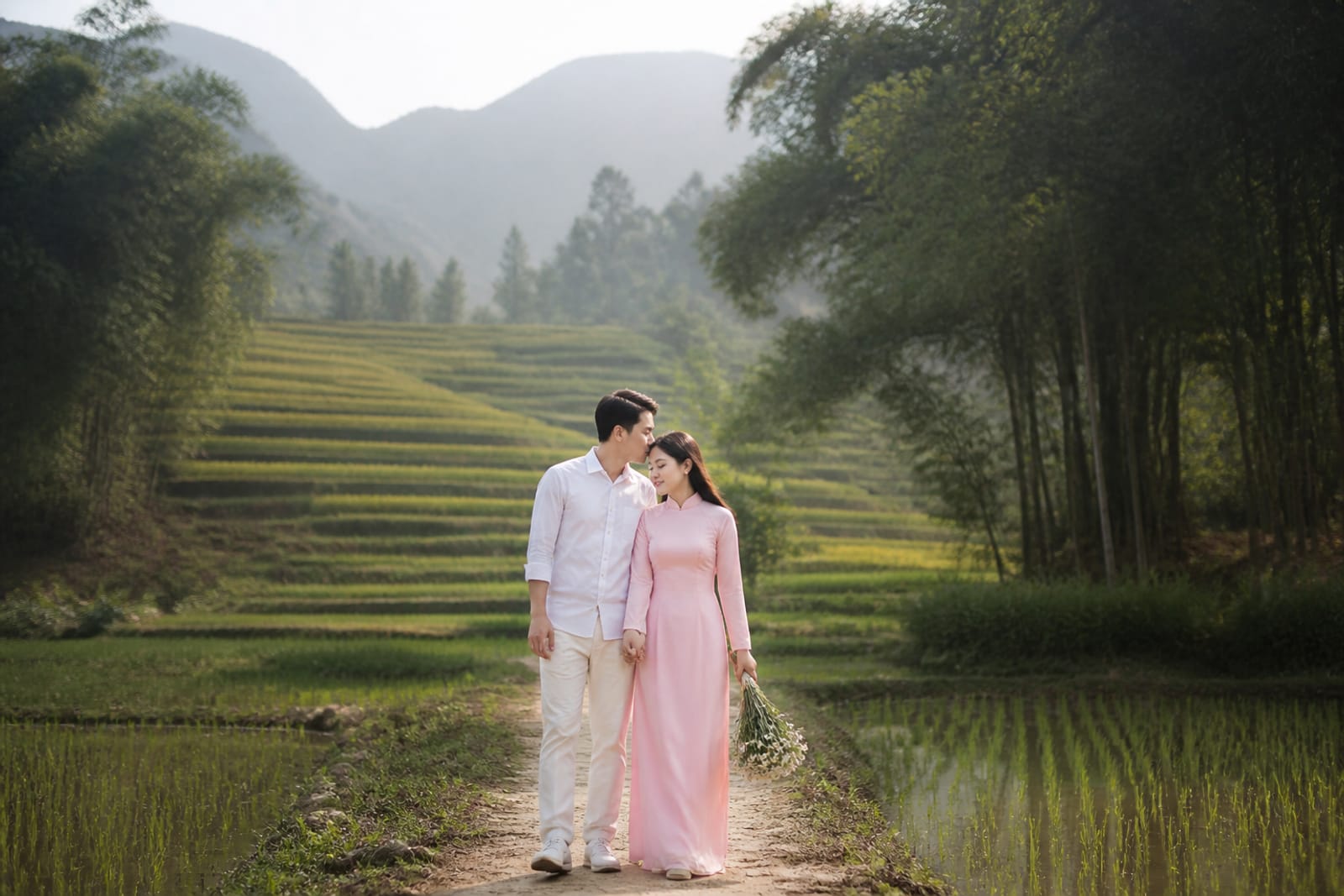
An elopement photoshoot at Mai Chau means you, your partner and one director shooting across the valley's rice terraces and villages for a few hours—usually early morning or late afternoon, when side light sculpts the landscape. Cáo Studio does not operate in Mai Chau; you'll hire a local photographer based in Hoa Binh or Hanoi who knows the access roads, village permissions and best light angles. Plan for May–June or September–October (golden rice); dress in layers (mist rises, then burns off); budget travel time from Hanoi (2 hours each way) and a permit fee for rice field access. The difference between a snapshot and a frame worth printing comes down to light hour, where you walk, and whether your photographer directs you into the story rather than posing you in front of it.
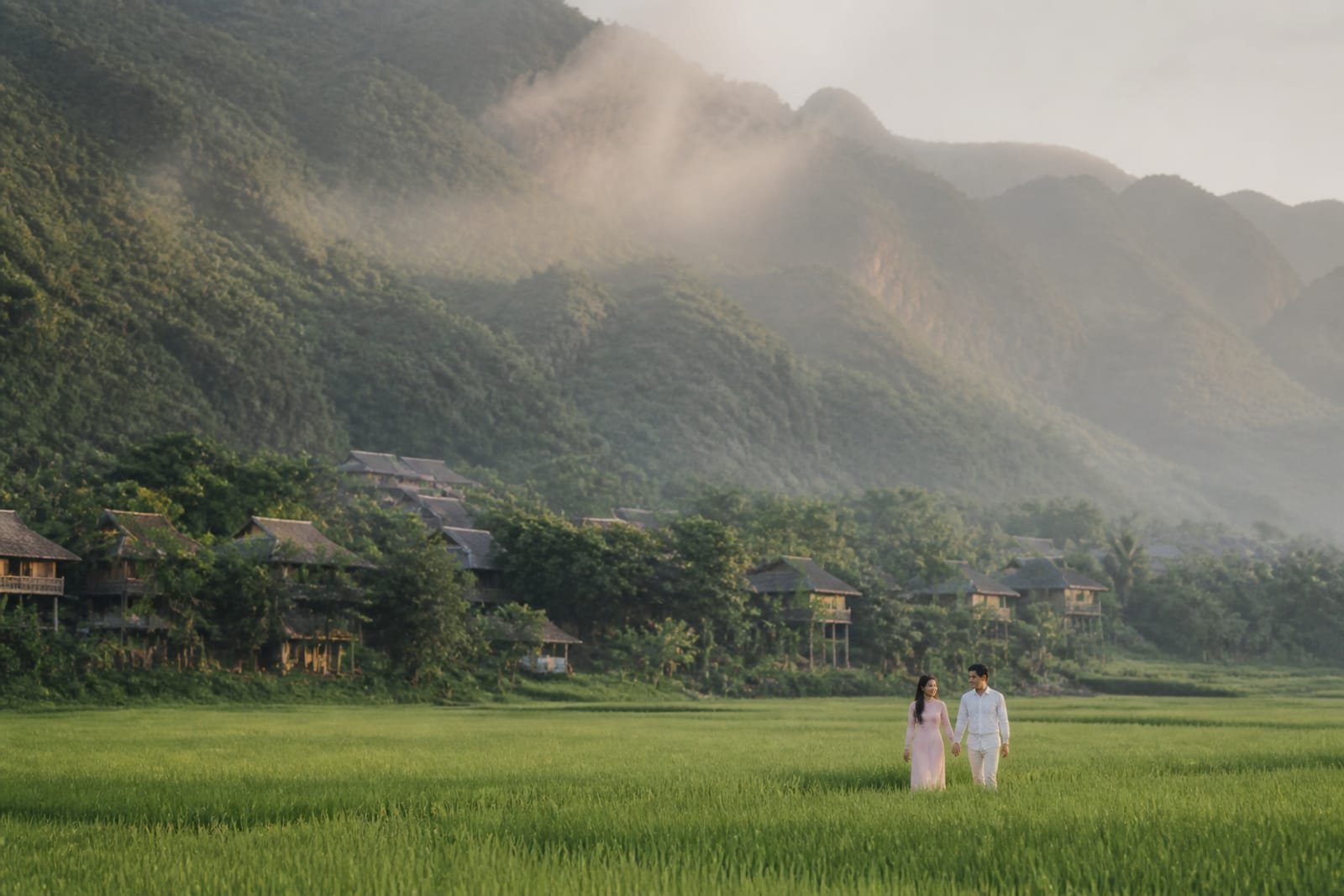
Mai Chau's rice terraces and stilt villages sit three hours south of Hanoi—remote enough to feel undiscovered, close enough for a day trip. Elopement shoots here work because the landscape does half the storytelling: mist pooling in valleys at sunrise, rice turning butter-gold in late May or early October, and stone-grey mountains framing every walk. The catch is timing, access and the right guide. Here's how to plan one that ends with frames you'll print.
Why Mai Chau works for an intimate shoot, but timing changes everything
Mai Chau's light quality depends entirely on season and hour. Golden rice (late May–June and September–October) gives the warm, directional light that makes elopement frames feel cinematic—shoot at 6 am or 5 pm, and the sun sits low across the valleys. Winter (December–February) brings mist that can last until 9 am, then clears to flat midday light; spring (March–April) brings haze; summer (July–August) turns grey and wet. The conclusion: pick your season first, then lock the hour.
📸 Book on WhatsApp — pre-wedding photoshoot
Do you need a Hanoi-based photographer or hire locally in Mai Chau?
Cáo Studio operates from Hanoi and Saigon, but does not shoot in Mai Chau—the logistics of one-day travel from the city and village permissions require a photographer embedded locally. A Hoa Binh-based photographer (the nearest town, 30 km north) or a Hanoi day-tripper who has scouted Mai Chau will know which roads are passable after rain, which villages allow photography without friction, and the exact sunrise and sunset times for your date. Before booking, ask: Have you shot here in this season? Can you show 5–10 frames from Mai Chau taken in the same month? Do you handle permits, or do we arrange them? A one-team shoot (photographer + hair/makeup + styling) runs smoother than hiring separate vendors in a remote valley—if you want a hair or makeup artist, confirm they've worked at altitude and in changing light before committing.
What should you wear to make the valley the star, not the outfit?
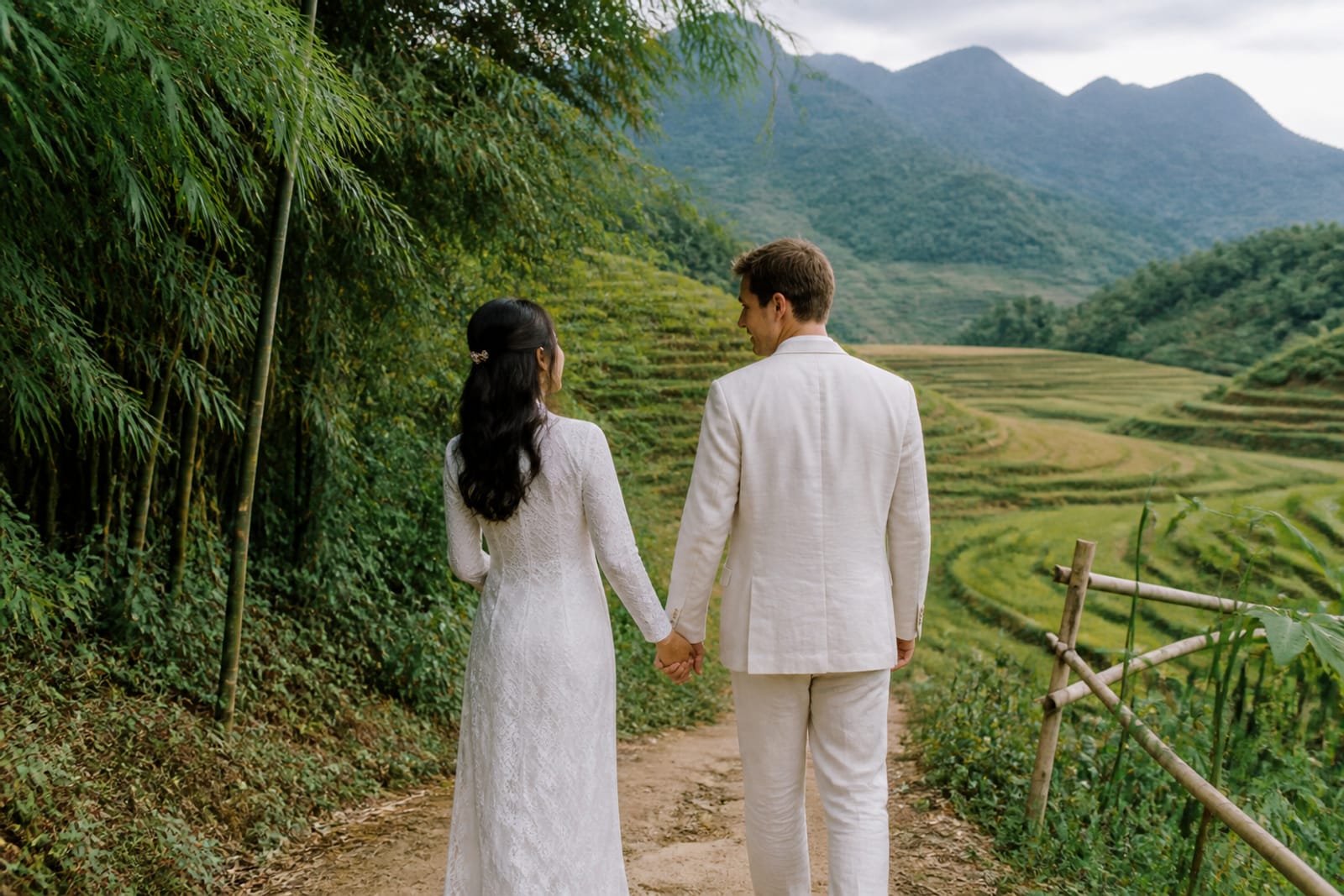
Elopement dresses in Mai Chau either blend into the landscape or fight it. A full white gown risks looking out of place against stone villages and muddy paths; a slip dress, linen suit or embroidered ao dai works better. Many couples choose an ao dai rental—it breathes in humidity, photographs beautifully in side light, and feels local without feeling costume. If you wear Western dress, muted earth tones (cream, sage, grey) or jewel tones (emerald, burgundy) read better in unfiltered natural light than pure white. Shoes: wear something you can walk in for two hours—the paths between rice terraces are uneven and often muddy. Layers matter: even in "warm" May, mist at 6 am means you'll need a light jacket for the first hour. Ask your photographer which villages you'll walk through, then decide on footwear and a second outfit for variety.
What makes the difference between a generic valley shot and a frame you'll frame?
The frames that stop people come from three things Cáo Studio applies in every shoot: directed movement (not poses), real light (not forced golden hour), and a single story per sequence. Instead of standing in front of the rice terrace and smiling, you'll walk along the edge, look at each other, or sit on a stone wall while the photographer captures the moment light hits your faces. This requires a director who watches light more than the camera—someone who says, "Stop here, walk toward that village, and don't look at the camera yet," not "Stand here and smile." The difference in the final frame is immediate: one feels like a moment, the other feels like a shot. Check your photographer's lookbook for movement, not poses; if every frame is a couple facing the camera straight-on, keep looking.
Season and cost: what factors change between a May and an October shoot?
| Factor | May–June rice | September–October rice | December–February mist | July–August rain |
|---|---|---|---|---|
| Rice color | Golden, full height | Golden, harvest time | None (stubble) | Green or standing water |
| Morning light | 5:30 am sunrise, direct | 6:10 am, still direct | 7:00 am, mist until 8:30 | 6:00 am, often grey |
| Walking comfort | Warm, humid | Mild, best light | Cool, muddy paths | Wet, flash floods possible |
| Permit availability | High—peak season | High—peak season | Available | Travel risky Oct–Nov |
| Photographer availability | Book 6–8 weeks ahead | Book 6–8 weeks ahead | Book 2–4 weeks ahead | Book 2–4 weeks ahead |
Conclusion: Golden-rice seasons (May–June and Sep–Oct) cost more because demand is higher and light is most forgiving; winter and spring cost less but require a photographer who can work in flat or obscured light, and your frames won't have that signature valley glow.
How to plan the half-day itself without wasting light or exhausting yourself
Start by confirming the exact sunrise time with your photographer for your date (it shifts week to week). Arrive in Mai Chau the evening before, or very early (4:30 am) if you're coming from Hanoi—two hours of driving is not restful before a shoot. Hair and makeup should be done before you leave for the valley (at your hotel in Hoa Binh or a salon in Hanoi, or with a makeup artist who travels with your photographer). The first hour of light (6 am–7 am, roughly) is usually the clearest and most directional—this is when you'll shoot the wide frames of the landscape with you in it. By 8–8:30 am, mist clears and light flattens; this is when you walk to a village or up to a higher terrace for medium and close frames. By 9:30 am, light is too bright and flat—stop. Afternoon light returns around 4 pm; if you want two sessions, plan a break and a change of outfit, then shoot again at 5 pm until sunset (around 6:30 pm in summer, 5:30 pm in winter). The logistics: confirm the route, parking, and which villages you'll enter; confirm permits 1 week in advance; bring water, snacks and a light jacket; brief your photographer on any shots that matter to you (the two of you in the village market, or silhouetted on a ridge) the day before, not on shoot day.
What to check before you commit to a Mai Chau elopement shoot
Before booking, ask your photographer these questions:
- Have you shot elopement sessions in Mai Chau in [your chosen month]? Can you show a gallery?
- What permits or fees do I need, and do you arrange them or do I?
- What's your backup plan if mist doesn't clear by 8 am, or rain hits?
- How many hours is the session, and does travel time (Hanoi–Mai Chau–Hanoi) count as part of it?
- Do you edit and deliver within a promised timeframe (e.g., 2 weeks), and how many photos do you deliver?
- If I want hair/makeup, do you work with a local artist or can I book one from Hanoi who knows elopement shoots?
- What's included in the quote—outfit rental, transportation, permits—and what's extra?
For comparison, explore Cáo Studio's pre-wedding photoshoot service in Hanoi or Hoi An (where we operate) to see how a one-team approach simplifies logistics; many couples elopement with us in Hanoi and Hoi An because the team handles hair, makeup, styling and photography in one booking, with delivery in 48 hours.
Alternative: Why some elopers choose Hanoi or Hoi An instead of Mai Chau
Mai Chau's appeal is solitude and landscape—but it requires travel planning, local knowledge and a photographer comfortable with remote logistics. If you want simplicity, consider an elopement in Hanoi's Old Quarter (intimate, accessible, historic streets) or Hoi An's lantern-lit riverside (moody, photogenic, no rice field permits). Both are closer to Cáo Studio's home base and allow you to book makeup, hair and photography in one package. The tradeoff: you get an urban story instead of a valley story. Neither is "better"—it depends on what story you want to tell.
FAQ
Does Cáo Studio shoot elopements in Mai Chau?
No. Cáo Studio operates from Hanoi and Saigon. We recommend hiring a local Mai Chau photographer who knows permits, access and seasonal light. If you'd prefer to shoot in Hanoi or Hoi An with us, ask on WhatsApp—we handle everything in one booking.
What's the best month for elopement photos at Mai Chau?
May–June and September–October, when rice is golden and morning light is directional. Avoid July–August (rain and grey light) and October–November (typhoon risk and flooding). December–February is cooler and clearer but rice terraces are stubble, not gold.
Do I need a permit to shoot in Mai Chau rice fields?
Yes. Each village charges a small fee to photograph in the terraces. A local photographer will know current fees and handle arrangements. Confirm this when you book.
How early do I need to wake up for elopement photos at Mai Chau?
Plan to be in the valley by 5:30 am to catch sunrise light (6–7 am). Travel from Hanoi takes 2 hours, so leave at 3:30 am or stay overnight in Hoa Binh and wake at 4 am.
Can I wear a full wedding dress in Mai Chau?
A traditional white gown risks looking disconnected from the landscape and is impractical on muddy paths. Consider an ao dai, linen suit, or muted slip dress instead—they photograph better in natural light and blend with the setting.
What if mist doesn't clear on my shoot day?
Mist can last until 8–9 am, especially in winter or rainy season. Confirm your photographer has a backup plan: shooting through mist (which can be atmospheric) or rescheduling. Lock this in writing before you book.
FAQ
Does Cáo Studio shoot elopements in Mai Chau?
No. Cáo Studio operates from Hanoi and Saigon. We recommend hiring a local Mai Chau photographer who knows permits, access and seasonal light. If you'd prefer to shoot in Hanoi or Hoi An with us, ask on WhatsApp—we handle everything in one booking.
What's the best month for elopement photos at Mai Chau?
May–June and September–October, when rice is golden and morning light is directional. Avoid July–August (rain and grey light) and October–November (typhoon risk and flooding). December–February is cooler and clearer but rice terraces are stubble, not gold.
Do I need a permit to shoot in Mai Chau rice fields?
Yes. Each village charges a small fee to photograph in the terraces. A local photographer will know current fees and handle arrangements. Confirm this when you book.
How early do I need to wake up for elopement photos at Mai Chau?
Plan to be in the valley by 5:30 am to catch sunrise light (6–7 am). Travel from Hanoi takes 2 hours, so leave at 3:30 am or stay overnight in Hoa Binh and wake at 4 am.
Can I wear a full wedding dress in Mai Chau?
A traditional white gown risks looking disconnected from the landscape and is impractical on muddy paths. Consider an ao dai, linen suit, or muted slip dress instead—they photograph better in natural light and blend with the setting.
What if mist doesn't clear on my shoot day?
Mist can last until 8–9 am, especially in winter or rainy season. Confirm your photographer has a backup plan: shooting through mist (which can be atmospheric) or rescheduling. Lock this in writing before you book.
Ao dai, makeup, hair and a local photographer in Hanoi or Saigon — one WhatsApp message.