/pre-wedding-photoshoot
Elopement photos at Moc Chau tea hills: a planning guide
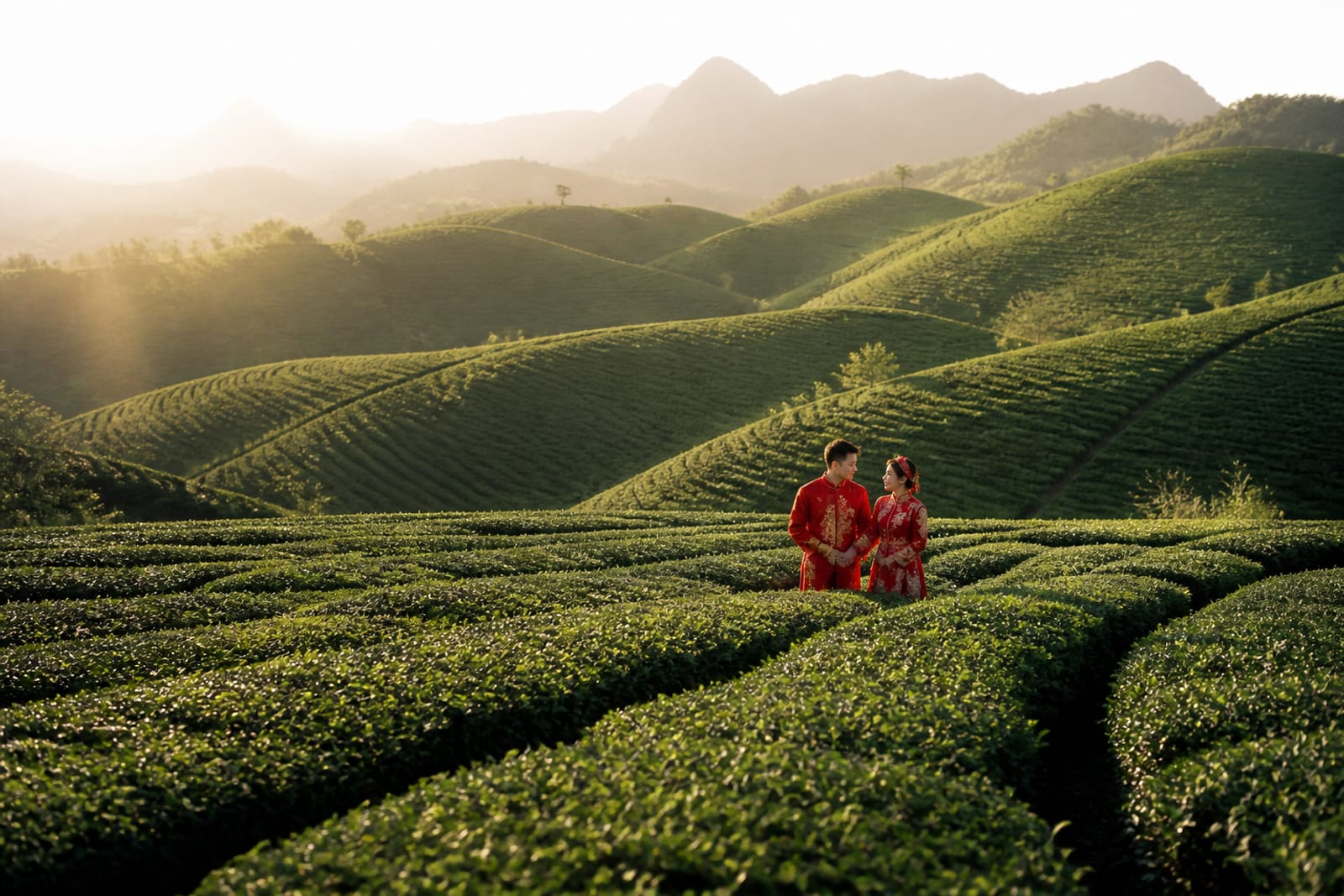
Elopement photos at Moc Chau tea hills work best in winter (November to February), when misty mornings and cool light flatten the landscape into layers. The tea gardens sit at 1,000 metres elevation in northern Vietnam's Son La province, roughly 4 hours from Hanoi by car. Shoots run 4–6 hours and cover wide frames of you walking through rows, medium shots at golden hour, and detail work on the ao dai against green slopes. An ao dai suits the setting better than Western dress—the fabric photographs well in mist, and the silhouette reads clearly against rows of plants. Cáo Studio shoots elopement and pre-wedding sessions in Hanoi and offers transport coordination for Moc Chau; confirm availability on WhatsApp, as the location requires early planning and a team that understands how light moves through tea terraces.
Why does Moc Chau work for elopement photography?
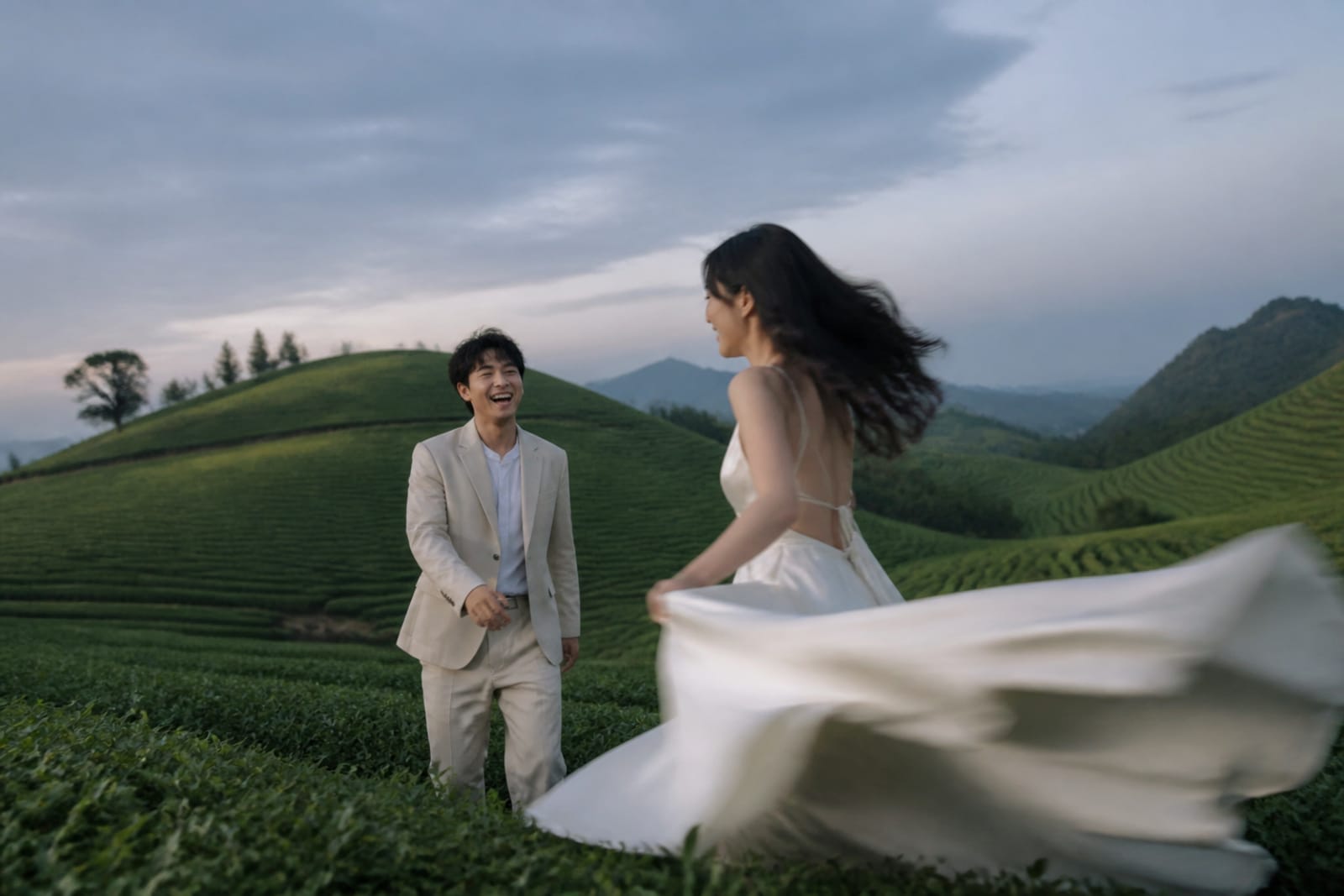
Moc Chau offers what most Vietnam destinations don't: isolation. The tea hills are large enough that a couple and a two-person crew can find quiet frames without tour buses. The landscape is geometric—rows of pruned shrubs create natural leading lines that make walking shots feel cinematic even if you're simply stepping forward. Light here is softer than Hanoi or Ho Chi Minh City because of elevation and morning mist; at 6 a.m. in winter, the sun rises over the hills and bathes tea rows in side light that's already diffused. The scale matters too—a tea garden is measured in dozens of hectares, not metres, so you're not posed in front of a monument; you're moving through a real place. A couple who wants frames that feel private and unhurried should consider Moc Chau as their first choice, especially if they prefer a landscape-heavy shoot over urban backdrops.
📸 Book on WhatsApp — pre-wedding photoshoot | 🌸 See the lookbook
When is the best season for Moc Chau elopement shoots?
Winter (November to February) is the only season to shoot here. During this period, Moc Chau sits under a cool, grey sky; temperatures drop to 10–15°C in the early morning. The mist doesn't clear until 8 or 9 a.m., which means you have a 2–3 hour window before harsh midday light. Spring (March–April) brings rain and cloud cover, which sounds good for soft light but actually creates flat, featureless skies. Summer (May–October) is hot and the tea plants are dusty from lack of rain. Around Tet (late January to mid-February), the region closes for Lunar New Year, so book outside those dates. Cold means you'll need layers under the ao dai or a supplementary shawl—this is not a problem, but it changes how the fabric moves and drapes, so tell your photographer in advance.
What outfit choices work best in a tea landscape?
An ao dai reads better than a Western wedding dress in Moc Chau because the silhouette is slender and the fabric photographs cleanly against the geometric rows behind you. A neutral or jewel-tone ao dai—think cream, charcoal, navy or deep emerald—holds visual weight without competing with the green of the tea plants. Avoid bright white or pastels, which merge into the mist and flatten the composition. If you wear a dress instead, choose a fabric that moves in wind; Moc Chau wind is constant at elevation, and stiff fabrics look pinned rather than flowing. Layers matter. Wear a silk slip or thermal base under the ao dai to trap warmth; a shawl or structured overshirt helps you stay comfortable during 4–6 hours on uneven ground. The groom or partner should wear dark trousers and a textured top (linen, cotton, wool blend) that contrasts with the landscape without shouting. Practical shoes are non-negotiable—the terrain is loose soil and grass, uneven in places, and you'll walk hundreds of metres over the morning.
How does a Moc Chau elopement shoot actually run?
A typical Moc Chau session starts before dawn. The team (photographer, stylist, sometimes a driver) meets you at your hotel in Son La town (nearest hub, 45 minutes away) or collects you from Hanoi and travels together. You arrive at the tea garden by 5:30–6:00 a.m., when the landscape is still mist-covered and few workers are on site. Hair and makeup happen in a car or a temporary shelter with a mirror and battery-powered lamp; plan 45 minutes for this. Shooting begins at 6:30–7:00 a.m. The photographer shoots wide first—you walking away from camera, framed by tea rows and mist—then medium shots as you turn to look at each other, then close detail on the ao dai and faces as light hardens. Around 8:30–9:00 a.m., the mist burns off and the light shifts; you move to a different section with more sunlight (usually a higher ridge or a clearing). A midday break happens around 11:00 a.m. The team may move again for late afternoon light, which is golden but direct and harder to work with. Edited photos arrive within 48 hours, plus a short vertical film. The whole day takes 5–6 hours of active shooting, not counting transport.
Moc Chau elopement vs. other northern Vietnam settings: which suits you?
| Setting | Best for | Light & season | Why it works |
|---|---|---|---|
| Moc Chau tea hills | Couples seeking landscape isolation, geometric frames | Soft mist, winter Nov–Feb | Rows frame you; light is already diffused; few crowds |
| Hanoi Old Quarter + Red River | Urban intimacy, architecture, local texture | Golden hour year-round, best Oct–Apr | Streets are narrow; light bounces off walls; history in every frame |
| Hoa Binh Lake (near Moc Chau) | Couples who want water, dramatic cliffs, fewer tea-field shoots | Clear winter mornings, Nov–Feb | Water reflects light; cliffs create depth; less tourism infrastructure |
| Ha Long Bay | Epic scale, limestone drama, boat intimacy | Winter & spring best, avoid Sep–Nov | Karsts are legendary; light dances on water; but crowds are heavy |
| Hoi An Ancient Town | Soft yellow lantern light, narrow lanes, heritage dress | Sep–Dec (dry season), 5–7 p.m. golden hour | Lanterns glow at dusk; town is compact; architecture is UNESCO-protected |
Moc Chau suits couples who prioritize solitude and landscape geometry over architectural heritage or water drama. Hanoi Old Quarter works for urban storytelling. Ha Long Bay is for couples who want scale and iconic backdrops despite crowds. Hoi An is for those who want heritage and romantic evening light. Your choice depends on whether you value light quality (Moc Chau, Hoi An) or architectural context (Hanoi, Hoi An) or epic scale (Ha Long).
What do you need to check before booking a Moc Chau elopement shoot?
Before committing, confirm these points:
- Transport coordination: Moc Chau is 4 hours from Hanoi. Will the photographer meet you in Hanoi, or do you travel to Son La and meet them there? Who pays for fuel and driver time? Ask on WhatsApp.
- Tea garden access: Private tea gardens require permission from the owner. Confirm the photographer has a relationship with a garden owner and can guarantee access at your chosen time.
- Weather backup: If mist doesn't clear by 8:30 a.m. or rain arrives, what is the plan? A professional team will have a secondary location or a rescheduling option.
- Outfit and layers: Tell the photographer your ao dai colour and fabric weight. They will advise on a shawl or overshirt that complements the aesthetic.
- Edited photo timeline: Confirm you receive edited photos within 48 hours, not "1–2 weeks." This is Cáo Studio's standard, but ask any photographer directly.
- Crew size: Will one photographer shoot, or will there be a stylist and assistant? A two-person crew (photographer + stylist/director) works better for elopements because one person can style while the other shoots.
- Number of locations: Some teams promise "3 locations in one day." Moc Chau is a single large garden; you'll move within it, but don't expect to drive to three separate sites. Clarify this upfront.
Cáo Studio operates from Hanoi and Saigon and coordinates Moc Chau shoots from its Hanoi base. Message on WhatsApp to discuss your dates, outfit, and transport needs.
📸 Book on WhatsApp — pre-wedding photoshoot | 🌸 See the lookbook
---
How do you prepare an ao dai for a tea hills shoot?
An ao dai needs specific care before a mist-and-elevation shoot. Iron it the night before to remove wrinkles that will show in close detail frames. If the ao dai is silk, bring a steamer—humidity at Moc Chau means fabric can look damp and limp if not freshened just before the shoot. Wear a slip or thermal base underneath; a flimsy slip will ride up if you're walking on uneven ground for hours. If the ao dai has a train or long hem, discuss with the photographer whether you'll hike the hem up slightly for mobility or keep it full-length for frames where you're standing still. A cream or navy ao dai will photograph better than white in mist; white reads as overexposed and blends into the sky. Bring the dress in a garment bag and keep it in a cool car until it's time to change into it, especially if you're shooting in February when warmth is precious.
What happens after the Moc Chau shoot? How do you receive and use the photos?
Edited photos arrive within 48 hours of your shoot day—this is a Cáo Studio commitment. You'll receive digital files (high-resolution and screen-resolution versions for social sharing) plus a short vertical film (15–30 seconds) suitable for Instagram Reels or TikTok. The number of edited photos depends on your package; confirm the exact count on WhatsApp when you book. Many couples order prints or a photo album after the shoot; these can be processed once you've selected your favourite frames. If you want enlargements for home display, photo prints and frames are available through Cáo Studio. Some couples also license images for wedding website, invitation design, or thank-you cards—ask about usage rights when you receive files.
---
FAQ
Can we shoot at Moc Chau if we're not staying in Son La?
Yes. Cáo Studio can coordinate transport from Hanoi (4 hours each way) or arrange a meeting point in Son La town. Confirm logistics on WhatsApp; transport time affects your shoot schedule and cost factors (fuel, driver hours).
What if weather is bad on our shoot day?
Winter mist is normal and photographs well. Heavy rain or thick fog that doesn't clear by 8 a.m. is a problem. Ask your photographer about rescheduling or a backup location within Moc Chau or a nearby site like Hoa Binh Lake.
Do we need permits to shoot in tea gardens?
The tea garden owner grants permission. Your photographer should have existing relationships with garden owners. Confirm before booking that the specific garden is secured for your date.
Can we shoot in ao dai and Western dress for the same session?
Yes, but it requires time. Two outfit changes add 1–2 hours to the session. Discuss with the photographer; this affects your total shooting time and is a cost factor (additional styling time).
Is Moc Chau elopement photography more expensive than Hanoi shoots?
Cost factors include transport (fuel, driver hours, 4-hour travel), location access (garden permission), and extended day length. Confirm a quote on WhatsApp; pricing depends on your exact needs, not on destination alone.
How many people can a photographer bring to Moc Chau?
A minimal crew is photographer and stylist (2 people). Larger teams with videographers or assistants are possible but less agile on tea-garden terrain. Ask what crew size your package includes.
FAQ
Can we shoot at Moc Chau if we're not staying in Son La?
Yes. Cáo Studio can coordinate transport from Hanoi (4 hours each way) or arrange a meeting point in Son La town. Confirm logistics on WhatsApp; transport time affects your shoot schedule and cost factors (fuel, driver hours).
What if weather is bad on our shoot day?
Winter mist is normal and photographs well. Heavy rain or thick fog that doesn't clear by 8 a.m. is a problem. Ask your photographer about rescheduling or a backup location within Moc Chau or a nearby site like Hoa Binh Lake.
Do we need permits to shoot in tea gardens?
The tea garden owner grants permission. Your photographer should have existing relationships with garden owners. Confirm before booking that the specific garden is secured for your date.
Can we shoot in ao dai and Western dress for the same session?
Yes, but it requires time. Two outfit changes add 1–2 hours to the session. Discuss with the photographer; this affects your total shooting time and is a cost factor (additional styling time).
Is Moc Chau elopement photography more expensive than Hanoi shoots?
Cost factors include transport (fuel, driver hours, 4-hour travel), location access (garden permission), and extended day length. Confirm a quote on WhatsApp; pricing depends on your exact needs, not on destination alone.
How many people can a photographer bring to Moc Chau?
A minimal crew is photographer and stylist (2 people). Larger teams with videographers or assistants are possible but less agile on tea-garden terrain. Ask what crew size your package includes.
Ao dai, makeup, hair and a local photographer in Hanoi or Saigon — one WhatsApp message.