services/special-concept
Film Camera Photoshoot Hanoi: Guide to Booking & Styling
Film photography in Hanoi has become the choice for travelers who want portraits that feel lived-in rather than polished. Unlike digital, film renders skin tones with a softer warmth and introduces organic grain that feels genuine. Whether you're celebrating an ao dai moment, documenting a couple's trip, or capturing pre-wedding frames, film adds emotional weight to every shot.
This guide draws on studio experience working with international travelers: what actually works before you book, what to pack, how to prepare, and the differences between film stock options.
---
What film stocks should I choose for Hanoi's light?
Film stock choice shapes your entire aesthetic. Hanoi's humid, diffused light—especially in morning and late-afternoon hours—plays well with slower films (ISO 100–400) that preserve detail in highlights and render greens richly. Tungsten-balanced films add warmth indoors; daylight film works best during golden hour. Ask your photographer which films they carry and stock regularly; inconsistent availability mid-session wastes time. Book on WhatsApp to discuss stock preferences before your session.
| Film Stock | Best Time in Hanoi | Color Tone | Grain | Who It's For |
|---|---|---|---|---|
| ISO 100 daylight | Morning, golden hour | Neutral, clean | Fine | Detail lovers, fine art |
| ISO 400 daylight | Cloudy, indoor natural light | Warm, forgiving | Visible, character | Travelers, couples |
| Tungsten (e.g., 320T) | Sunset, indoor tungsten | Orange-gold warmth | Fine to medium | Romantic moods, proposals |
| Black & white (e.g., Tri-X, HP5) | Any time; works in all light | Timeless, high contrast | Medium to coarse | Conceptual, editorial style |
Before you commit to a film stock, know that Hanoi's humidity can affect processing. Work with photographers who send film to reliable labs (or handle processing in-house). Ask upfront: Where is my film developed, and what's the turnaround?
---
How long does a typical film photoshoot session run?
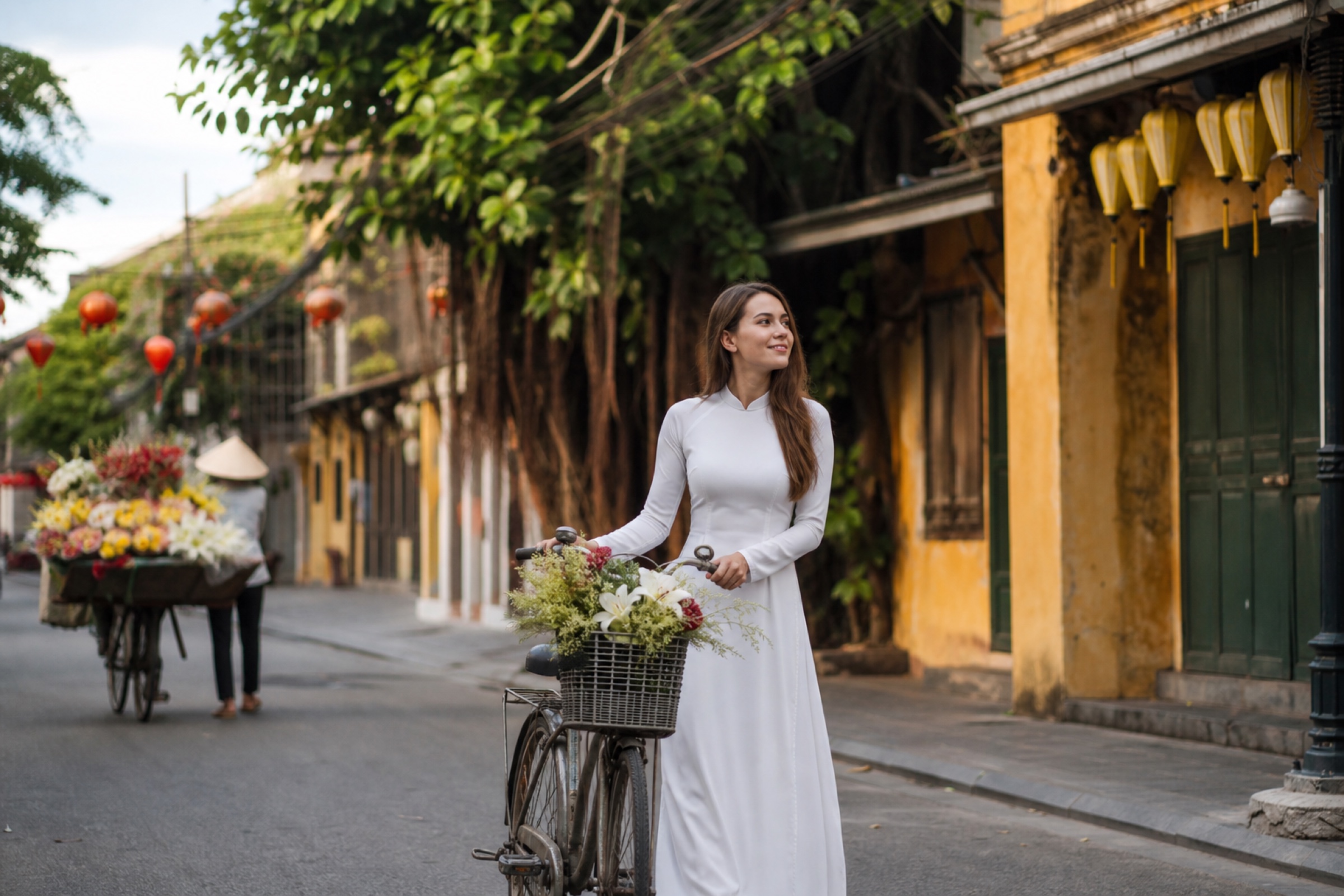
A film session in Hanoi typically runs 1–3 hours depending on concept and location. Studio shoots (ao dai sessions, couple portraits, makeup-inclusive bookings) take 90–120 minutes: 15–20 minutes for setup and makeup, 60–90 minutes for shooting, 10 minutes for final adjustments. Location shoots (temple grounds, old-town streets, lakeside) often run 2–3 hours to account for travel time and multiple backdrops.
Film rolls hold 24 or 36 frames. A 90-minute session shoots 2–3 rolls; a 3-hour session shoots 4–5 rolls. This isn't a drawback—the constraint forces intentionality. You and the photographer move deliberately between poses. No endless digital trigger-mashing; every frame costs something, so both parties stay present.
Expect a 2–4 week turnaround from shoot to final scans (longer if film is sent overseas for processing). Some studios offer contact sheets within a week and hi-res scans within 3–4 weeks.
---
What should I wear under my ao dai for a film photoshoot?
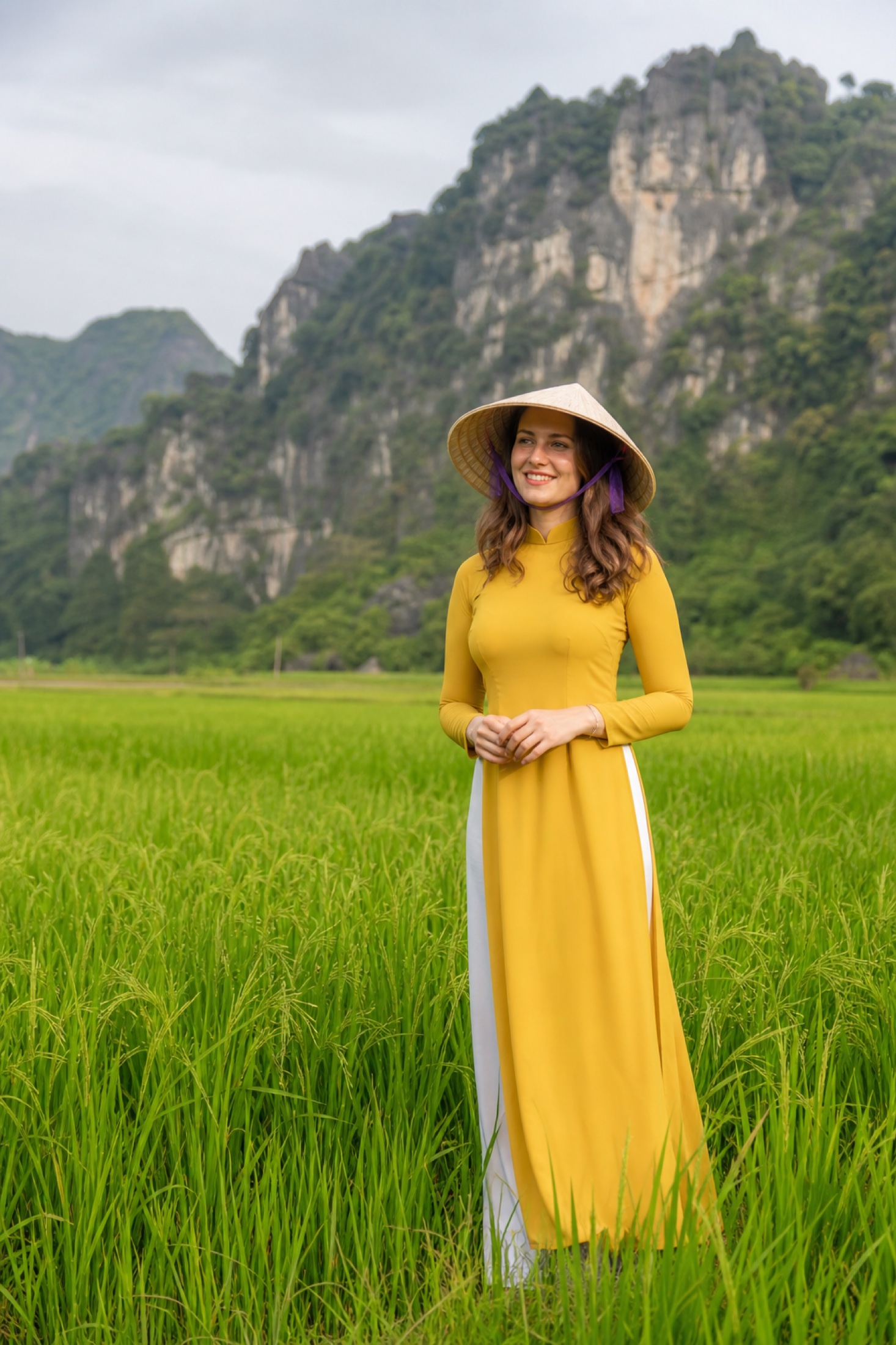
Ao dai sessions are Cáo Studio's signature offering—and film renders them beautifully. Wear a fitted white silk slip or body-hugging base layer underneath; the ao dai's high side slits need a sleek undergarment so fabric doesn't bunch or gap. Avoid thick bras with visible lines; wear a soft, thin bra or body-shaper tank. Nude, white, or black work depending on ao dai color (ask your stylist on WhatsApp before the shoot).
For trousers: tailored white silk, cotton, or linen pants. Loose fabric creates unflattering billows in film's grainy texture. Ensure a clean hem that skims your ankle.
Hair: Long hair works film beautifully—waves hold dimension in grain. Short hair needs deliberate styling; slicked-back bobs photograph sharply, tousled styles feel more relaxed. Makeup should be heavier than everyday (film dulls color slightly); warm bronzes, warm reds, and defined brows translate best to analog.
Film's fixed ISO means less leeway for exposure than digital. If you wear pale colors, makeup must compensate or you'll look washed out in final scans. Converse with your photographer about this trade-off.
---
Where should I shoot film in Hanoi—studio, temples, or streets?
Studio sessions (Cáo Studio's 3 Hanoi branches) give controlled light and consistent results. Ideal for ao dai portraits, couples, and makeup-heavy concepts. Film's slower speed needs stable light; studios eliminate Hanoi's unpredictable cloud cover. Typical duration: 1.5–2 hours.
Temple grounds (Ngoc Son Temple, Tran Quoc Pagoda) offer authentic Hanoi backdrop but unpredictable light and crowds. Shoot early morning (6–8 a.m.) or late afternoon (4–6 p.m.) to avoid midday glare bouncing off stone. Film underexposure is harder to recover than digital; metering matters. Many temples ask photographers to book in advance or request modest dress (shoulders, knees covered even in ao dai).
Old Quarter streets (silk alley, narrow lanes near Hoan Kiem Lake) are atmospheric but congested. Film's fixed-frame constraint forces you to work fast before foot traffic thickens. Best windows: 7–9 a.m., 5–7 p.m. Reflective brick and narrow shade create uneven exposures; prepare for contrast.
Hoi An trips require advance planning—Cáo Studio's team travels there by appointment. Ask about Hoi An dates on WhatsApp; the ancient town's saturated lantern light and softer architecture suit film's color rendition beautifully.
---
What's the real cost and timeline for a film photoshoot in Hanoi?
Film sessions cost more than digital for one reason: material expense. Each roll of quality film (24–36 frames) runs $5–10 depending on stock. A 3-roll session means $15–30 in film alone, plus processing (typically $8–15 per roll in Hanoi labs). That's $40–75 in consumables before the photographer's time.
Get a quote on WhatsApp; pricing varies by session length, location (studio vs. travel), and whether makeup/styling is included. Visit /pricing for service packages; film sessions may fall under special-concept or ao dai photoshoot depending on your theme.
Timeline:
- Book & pay deposit: 1 day
- Pre-shoot consultation (styling, stock choice): 3–7 days before
- Shoot day: 1.5–3 hours
- Film processing: 5–14 days
- Scanning & retouching: 5–10 days
- Delivery of high-res scans: 3–4 weeks from shoot
Total: Plan 4–5 weeks from booking to final images. If you need prints, add 2 weeks (film printing runs slower than digital in Hanoi; expect turnaround from overseas labs).
📸 Book on WhatsApp — ao dai photoshoot
---
What should I check before booking a film photoshoot?
Photographer's film portfolio: Does their existing work show consistent exposure, good color grading, and intentional composition? Film forgives some technical slop (that's part of the charm), but sharp focus and proper metering still matter. Ask to see contact sheets or multiple frames from past sessions—digital can hide soft frames; film can't.
Film stock confirmation: Which stocks do they regularly carry? Do they allow you to request specific film (Portra 400, Tri-X, etc.), or is it their choice? Consistency matters for a series; if your photographer shoots different stocks session-to-session without telling you, your final images won't match.
Processing & lab: Where is film processed? In-house, at a local Hanoi lab, or sent overseas? Overseas processing is slower (10–14 days) but often better quality. Local labs are fast but variable. Ask for a sample scan from their lab; color cast, dust, and scratches reveal lab quality.
Retouching policy: Film doesn't need heavy digital retouching, but scanner dust, dust spots, and minor blemishes do appear. Does the photographer offer basic dust removal, or is that a paid extra? Clarify upfront.
Deposit & cancellation: Film is ordered before your shoot. If you cancel, that film is sunk cost. Confirm whether deposit is refundable and under what conditions.
Scan resolution & format: Will you receive high-res scans (300 dpi, suitable for 16x20 prints)? Digital copies, or just physical prints? Ask about file formats (TIFF vs. JPG) and whether you get copyright permission for personal use, social media, and reprints.
---
How do film photoshoots fit into a pre-wedding or proposal plan?
Film adds narrative depth to milestone moments. For proposals, film's slower pace means candid reactions aren't rushed—the photographer has time to reset between frames, catch genuine emotion, and create a photojournalistic feel. Proposal & anniversary packages can incorporate film aesthetics.
For pre-wedding sessions in Hanoi or Hoi An, film works beautifully for save-the-date and invitation imagery. Its vintage warmth suits the ao dai particularly well; couples often do one digital session for variety and one film session for keepsake prints. Explore pre-wedding photoshoot options.
Couple & family photoshoots can be fully film-based or a hybrid (film for portraits, digital for movement/candids). Discuss your priorities with the studio.
---
What does the session feel like in practice?
You arrive at the studio (or meeting point) 15 minutes early. Makeup & hair runs 20 minutes if included; you'll discuss color, style, and film's rendering with the makeup artist. Hair should be dry or freshly set; humidity frizzes quickly in Hanoi.
Once styled, the photographer loads the first roll into the camera (you might hear it)—this is intentional theater, grounding the session in analog reality. They meter your face and the background, set aperture and shutter speed, and frame the first shot. No LCD preview; they're relying on skill and experience.
The first few frames feel strange if you've only done digital. No immediate feedback, no "let me check the back." Instead, you hold poses slightly longer; the photographer directs with precision ("shoulders back, eyes to the left, breathe"). This creates a meditative rhythm.
Thirty minutes in, they might reload—a small pause, a moment to reset. By the end, most travelers say it felt more intimate, less performative than digital sessions. That's the film effect.
---
Where can I see examples and learn more?
Visit the lookbook to see film and digital sessions side-by-side. Check the FAQ for logistical questions. Hanoi branches are at /hanoi; if you're traveling to Ho Chi Minh City or Hoi An, see /saigon and /hoi-an.
Direct all booking and film-specific questions to WhatsApp—that's where the real conversation happens.
FAQ
Can I get a digital backup of my film images?
Yes. Your photographer delivers high-resolution scans (300 dpi TIFF or JPG) suitable for digital sharing and large prints. Some studios include this; others charge a scanning fee. Confirm before booking on WhatsApp.
What if the film is damaged or underexposed?
Accidental light leaks or metering errors do happen; it's a risk of analog. Ask your photographer's policy: do they reshoot for free, or is it a one-time shoot? This is worth clarifying upfront.
How does film look compared to digital after editing?
Film's organic grain and color rendering differ from digital even after heavy retouching. Film feels "warmer" and less crisp; digital feels "cleaner" and sharper. Neither is better—it's aesthetic preference. Many travelers choose film for its uniqueness.
Can I request black & white film only?
Yes. Black & white film (Tri-X, HP5) works beautifully in Hanoi and often costs slightly less than color stock. Discuss this with your photographer when booking.
How many final images will I receive from a film session?
Typically 30–50 edited scans from a 1.5–2 hour session (2–3 rolls). A 3-hour session yields 50–100 images. Ask your photographer for exact frame count before booking.
FAQ
Can I get a digital backup of my film images?
Yes. Your photographer delivers high-resolution scans (300 dpi TIFF or JPG) suitable for digital sharing and large prints. Some studios include this; others charge a scanning fee. Confirm before booking on WhatsApp.
What if the film is damaged or underexposed?
Accidental light leaks or metering errors do happen; it's a risk of analog. Ask your photographer's policy: do they reshoot for free, or is it a one-time shoot? This is worth clarifying upfront.
How does film look compared to digital after editing?
Film's organic grain and color rendering differ from digital even after heavy retouching. Film feels "warmer" and less crisp; digital feels "cleaner" and sharper. Neither is better—it's aesthetic preference. Many travelers choose film for its uniqueness.
Can I request black & white film only?
Yes. Black & white film (Tri-X, HP5) works beautifully in Hanoi and often costs slightly less than color stock. Discuss this with your photographer when booking.
How many final images will I receive from a film session?
Typically 30–50 edited scans from a 1.5–2 hour session (2–3 rolls). A 3-hour session yields 50–100 images. Ask your photographer for exact frame count before booking.
Ao dai, makeup, hair and a local photographer in Hanoi or Saigon — one WhatsApp message.