/pre-wedding-photoshoot
Getting to Ma Pi Leng Pass on photoshoot day: transport, timing and lo
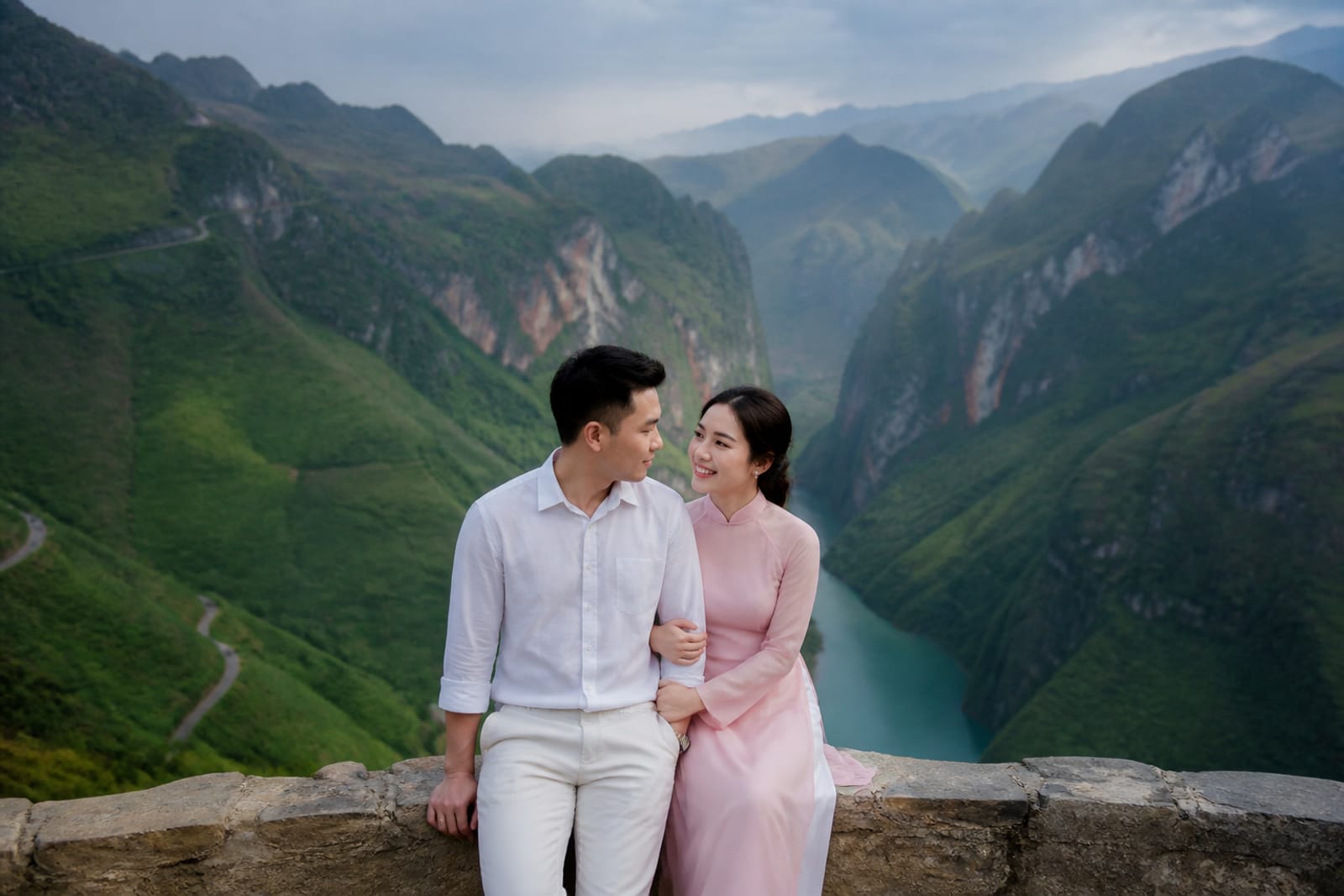
Ma Pi Leng Pass is a 5–6 hour drive northeast from Hanoi, accessed via a single switchback road carved into the cliff face. Most photographers and couples hire a minivan or private car with a driver for the full day, leaving Hanoi at dawn to shoot during golden light before cloud cover rolls in by mid-morning. The pass sits at high altitude in a cool, wet climate (Dec–Feb is cold, May–Sep brings afternoon rain and landslide risk on roads). A full shoot—outfit changes, hair and makeup—works best as a multi-day trip: one day driving and acclimatizing, one day shooting. Cáo Studio does not operate in Ha Giang; read on for transport options, timing and how to vet a local photographer for this destination. ---
How far is Ma Pi Leng Pass and how long does transport actually take?
Ma Pi Leng lies roughly 260 km north of Hanoi by road, in the heart of Ha Giang province. The journey takes 5–6 hours one-way in a private car or minivan with a driver familiar with mountain roads; minibus services take 7–8 hours with stops and local passengers.
The road is single-lane, steep, winding and narrow in places. Landslides occur in the rainy season (May–Sep, especially after heavy rain), and sections close without warning. The switchback at Ma Pi Leng itself is dramatic but well-maintained and relatively safe for still photography (drone use requires a permit and local coordination—check with your driver and photographer before arrival).
If you leave Hanoi at 5 am, you arrive around 11 am, missing the soft morning light. For dawn light (6–7 am at the pass), you must sleep in Ha Giang town the night before, staying in a guesthouse 2–3 hours closer. Most photoshoot couples budget 2–3 nights: one night before arrival to acclimatize, one night at the pass, one night travel home. The time cost is substantial; frame this as a destination pre-wedding trip, not a day excursion.
Which transport option suits your photoshoot schedule and budget?
| Option | Best for | Timing | Why it works or doesn't |
|---|---|---|---|
| Private car + own driver | Couples with flexible schedule, multiple outfit stops | 5–6 hrs Hanoi to pass, shoot 1–2 days | Direct timing; can pause for light; driver knows roads; cost factor is fuel, driver overnight stay, vehicle hire |
| Hired minivan + Cáo Studio coordination | International couples wanting one team | Same as above | Studio cannot staff Ha Giang; must hire local driver + local photographer separately; coordination by WhatsApp |
| Local tour operator (Ha Giang) | Backpackers, budget travelers | 7–9 hrs with group stops | Shared rides; cheapest fuel cost; no photoshoot personalization; light timing missed |
| Motorbike with local guide | Adventure couples, light packs | 4–5 hrs (faster, riskier) | Cold at altitude; limited outfit/makeup logistics; risky in rain; not recommended for formal pre-wedding shoot |
The cost factor—not a fixed price—depends on vehicle type, driver overnight stay, fuel distance, and whether you hire a photographer separately or book a Hanoi studio that coordinates locally. Private car hire often costs more than minivan; a local guide costs less than both but offers no creative direction.
📸 Book on WhatsApp — pre-wedding photoshoot
What time of year gives the best light and clearest weather at Ma Pi Leng?
Dry season (Feb–Aug) is best for predictable light; late Sep–Dec brings cloud cover and rain risk.
- Feb–Apr (cool, clear): Soft morning light, clear skies, temperature 10–15 °C. Cloud cover typically arrives by 9–10 am. Early dawn shoots work; plan to finish by mid-morning. Outfit choices: lightweight layers, an ao dai in a bold colour (not white—washes out in overcast). This is peak season for Ha Giang tourism.
- May–Sep (hot, rainy): Afternoon thunderstorms common; roads may close after heavy rain. Morning light is softer but shorter (sunset around 6–6:30 pm). Mountain top often shrouded in cloud by noon. High humidity makes makeup touch-ups frequent.
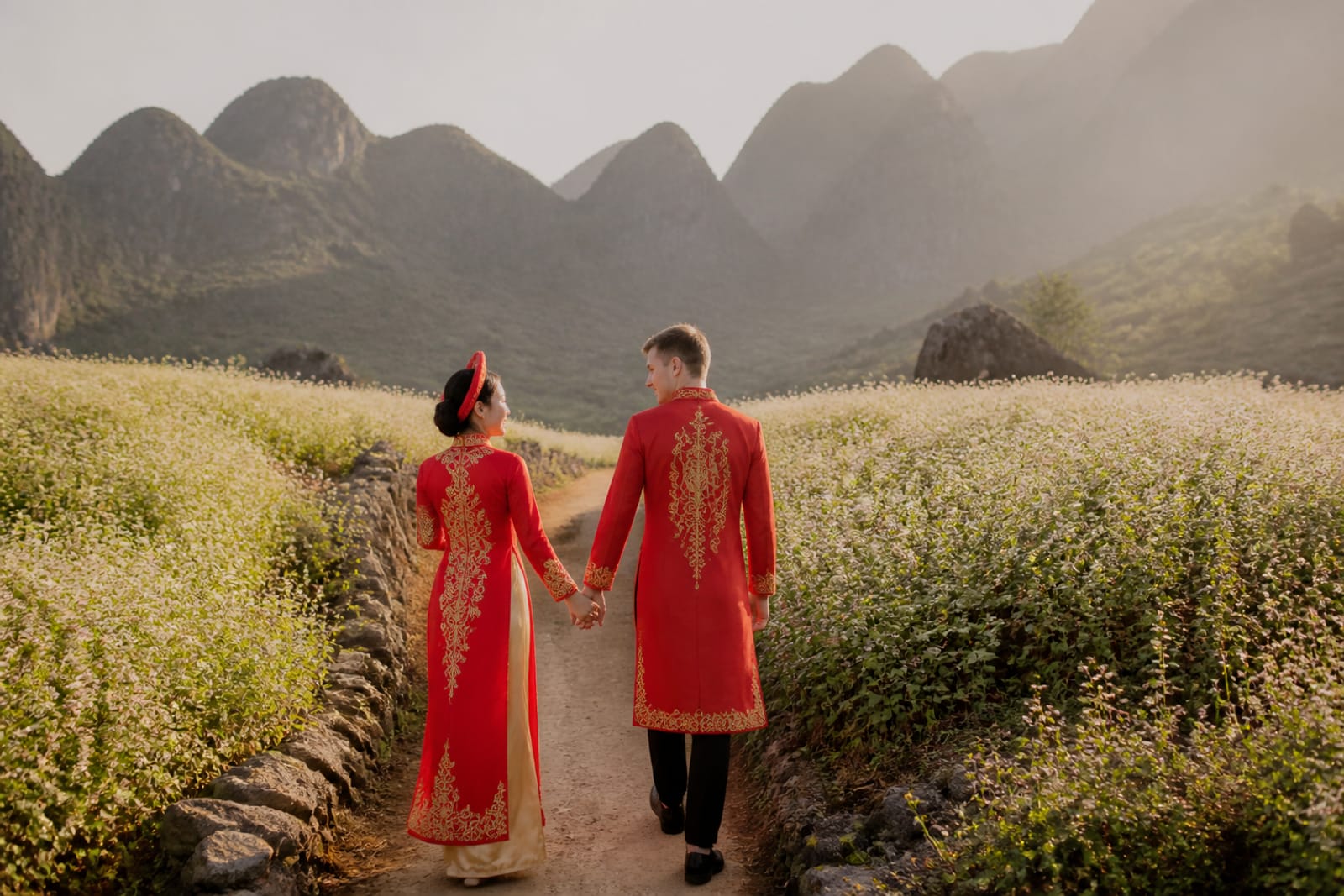
- Oct–Nov (buckwheat flowers, cold mornings): Golden light lasts longer; temperatures drop to 8–12 °C at dawn. Buckwheat flowers carpet nearby fields (Hoang Su Phi), adding foreground colour. Mist clears by 7–8 am. Road conditions generally safe. This is the sweet spot: light, weather, and botanical backdrop align.
- Dec–Jan (cold, grey): Temperatures 5–10 °C. Morning grey light works for moody, intimate shots; by mid-day, direct sun creates harsh shadows on steep cliff faces. Short day length (sunset ~5 pm) limits shoot window.
Ask a local photographer: Does the forecast show rain? Have roads reopened after recent storms? These matter more than season averages.
What logistical steps must you take before booking a photoshoot at Ma Pi Leng?
1. Hire transport with a driver who knows the road. Book a private car, minivan or tour operator at least 2 weeks ahead. Confirm the driver has winter tyres (Nov–Feb) and has driven the road recently. Ask: When was the road last closed? Are any sections under repair? Get a WhatsApp contact for your driver; confirm departure time and meeting point the day before.
2. Hire or coordinate a photographer—Cáo Studio does not shoot in Ha Giang. If you want a Hanoi studio team to manage the shoot, ask on WhatsApp whether we can help you vet and brief a local photographer; we cannot staff the day itself. If you hire a Ha Giang photographer independently, ask them:
- How many shoots have you done at Ma Pi Leng?
- Do you own editing software and deliver edited files within 48 hours?
- Will you scout the location at dawn the day before to pick light angles?
- Can you direct movement (walking, looking at each other) or do you pose people stiffly?
3. Book accommodation in Ha Giang town 2–3 nights before the shoot. This gives you time to rest, acclimatize to altitude (1,600 m), and prepare makeup and outfits. Guesthouses cluster near the market; book direct or via a travel site. Confirm wifi and hot water—both are standard but worth checking.
4. Arrange makeup and hair. If you're traveling with a makeup artist from Hanoi, budget an extra hotel night for them. If you hire a local makeup artist in Ha Giang, meet them in person at your accommodation the evening before to discuss outfit colours and lighting. Test makeup under the actual light you'll shoot in (dawn is blue; direct noon sun is harsh).
5. Confirm weather 3 days before. Check a 10-day forecast and ask your driver about road closures. If heavy rain is forecast for your shoot day, consider postponing rather than driving in landslide risk.
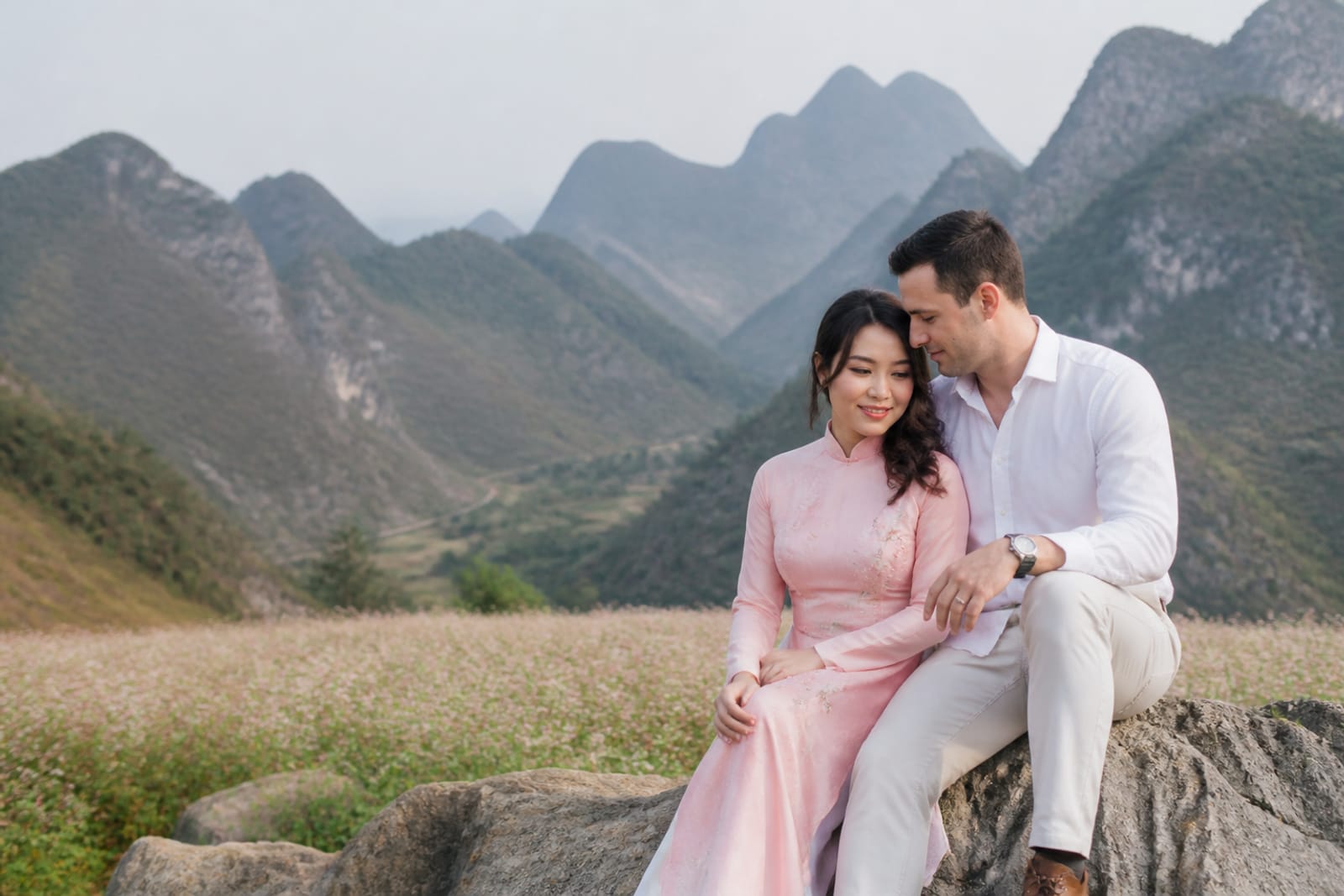
6. Get outfit and styling decisions finalized. Ma Pi Leng's light is intense and directional (soft east-facing cliff in early morning; harsh south-facing cliff by noon). Colours matter: jewel tones (emerald ao dai, deep burgundy suit) photograph better than pastels in mountain light. Bring layers (fleece, light jacket) under your ao dai; you'll change in a car, and mornings are cold.
---
How should you compare hiring a local photographer vs. coordinating through a Hanoi studio?
Local Ha Giang photographer:
- Advantage: Knows the pass intimately, understands seasonal light patterns, can scout beforehand, lives nearby so no travel fee, often costs less than Hanoi coordination.
- Risk: No guarantee of editing speed or file format; may not speak English fluently; portfolio may be limited to hiking or tourism, not directed pre-wedding work. Hard to vet without visiting in person or seeing real examples.
- How to vet: Ask for 3 past couple/family shoots (not landscapes or hiking groups). Request low-res sample files to check colour grading and framing. Video-call them to discuss your vision; if they answer vaguely, move on.
Hanoi studio coordinating a local photographer (Cáo Studio role):
- Advantage: Studio briefs the photographer on your vision, outfit, timeline, and editing standard before the shoot. You have a familiar contact if anything goes wrong. Files are edited to studio standard within 48 hours.
- Limitation: Cáo Studio cannot staff Ha Giang shoots; coordination is advice and vetting only, done on WhatsApp. You still hire the local photographer directly. The cost factor includes a coordination fee on top of the photographer's rate.
- Best for: Couples who want studio-level direction but accept a local photographer must execute it, and who value the brief and quality check over being present.
Decision framework:
- Solo traveler or couple on a tight budget? Hire local; ask for portfolios and check references online.
- Couple who wants creative direction and quality assurance? Ask Cáo Studio on WhatsApp to vet and brief a local photographer for you.
- Couple traveling with a hair and makeup artist? Hire local to keep costs down; the artist can direct movement while the photographer focuses on light.
What should you pack and wear on a Ma Pi Leng photoshoot day?
Outfit choices depend on light timing and temperature. Mornings at the pass (6–7 am, Feb–Apr or Oct–Nov) are 8–12 °C; by 9 am it may warm to 15 °C, and by noon, 18–20 °C. Plan two looks: a formal ao dai or suit for the pre-dawn shoot, and a lighter option for mid-morning if you're changing outfits.
Under the ao dai: Wear thermal leggings or microfibre tights (not cotton—cold and damp in mountain air). Slip a thin fleece or cotton long-sleeve shirt under the áo dài. Bring a lightweight scarf or shawl to wrap over your shoulders between shots; it keeps you warm and adds visual interest without hiding the dress.
Footwear: Comfortable walking shoes with good grip. The pass has paved areas but uneven stone and gravel edges. Heels are risky on steep, narrow paths; reserve them for a flat, controlled spot. Bring a second pair of shoes for transport and downtime.
Groom outfit: Suit jackets work in Feb–Apr; in Oct–Nov, layer a gilet or wool jacket over a shirt and trousers. Avoid heavy coats that hide tailoring. Bring a beanie or cap for warmth; it's photogenic against the sky.
Accessories and backup items: Hairpins, makeup touch-up kit (powder, lipstick, blotting paper—wind and sun fade makeup fast). Bring a small hand towel; sweat and wind-blown hair are real. Sunscreen (UV is strong at altitude). A portable phone charger (no signal in some sections, but download offline maps before arrival). Snacks and water (the pass has a small vendor, but prices are high).
Luggage: Use a soft daypack, not a rolling suitcase. You'll change in a car, walk uneven paths, and possibly sit on rocks for repositioning.
---
What can go wrong on a Ma Pi Leng shoot day and how do you avoid or recover from it?
Road closure or delay:
- Risk: Heavy rain, landslides, or accident ahead closes the road for hours.
- Avoid: Check the forecast 3 days ahead; ask your driver if the road has been closed recently. Have a backup shoot date in mind. Leave Hanoi at 4 am instead of 5 am to build a time buffer.
- If it happens: Contact your photographer immediately. Either delay the shoot by a day (if you booked accommodation flexibly) or move to an alternate location on the outskirts of Ha Giang with similar light (e.g., a quieter valley or rice terrace).
Cloud cover or mist obscures the view:
- Risk: At altitude, clouds roll in unexpectedly, especially May–Sep or Dec–Feb.
- Avoid: Shoot before 8 am; ask the photographer to have a backup spot 10 minutes' drive away, lower in elevation, where light breaks through.
- If it happens: Shoot moody, close-up frames (portrait, detail, gesture) instead of wide landscape shots. Mist can add atmosphere to intimate couples work.
Makeup runs or hair falls flat in wind:
- Risk: Altitude, wind, and dry air stress makeup and hair.
- Avoid: Use long-wear makeup (waterproof mascara, setting spray, powder foundation). Braid hair loosely or pin it low so wind doesn't dismantle it. Bring hairspray and makeup blotting paper.
- If it happens: Accept movement and imperfection as part of the story. The photographer should frame close shots between wind gusts or use the windblown hair as a narrative detail (realness, not artifice).
Altitude sickness or exhaustion:
- Risk: Unacclimatized visitors feel headachy or tired at 1,600 m.
- Avoid: Arrive 1–2 days early; rest, eat well, drink water. Avoid alcohol the night before. Move slowly during the shoot.
- If it happens: Take a 15-minute break in the car, hydrate, eat fruit or a snack. The photographer should plan short bursts of shooting (15–20 min) with rest in between, not a 3-hour marathon.
Photographer or driver cancels last-minute:
- Risk: Illness or emergency; you arrive at the pass with no one to shoot.
- Avoid: Confirm via WhatsApp with your photographer and driver 24 hours before departure. Have a backup photographer's contact in Ha Giang, obtained from your accommodation or tour operator.
- If it happens: Call your accommodation manager or driver; they likely know another photographer. Expect a rushed shoot and lower quality, but it's better than canceling. This is why arriving a day early matters—you have time to regroup.
Light arrives late or ends early (Dec–Jan):
- Risk: Short days mean sunset is 4–5 pm; if you start late, you lose time.
- Avoid: Shoot only in Oct–Nov or Feb–Apr when day length is longer. In Dec–Jan, schedule a dawn shoot (depart at 3 am) to capture 2–3 hours before noon cloud cover.
- If it happens: Focus on one outfit and one angle; accept fewer frames. Plan a follow-up shoot at a closer location (e.g., Hanoi or Hoi An) to complete the pre-wedding series.
---
What to check before you commit to a Ma Pi Leng pre-wedding shoot
- Road status: Ask your driver if the pass has been closed in the last 30 days and when it reopened.
- Photographer's pre-wedding portfolio: Request 2–3 past couple shoots (not landscapes). Check for directed movement, clear exposure, and editing consistency.
- Weather forecast: Check 10 days ahead; plan for cloud cover or postpone if heavy rain is forecast.
- Accommodation availability: Book 3 nights (one buffer before, one shoot day, one after) as soon as you choose your date.
- Makeup and hair coordination: If hiring locally, meet the artist in person; if traveling with your own, confirm arrival date and accommodation.
- Communication plan: Get WhatsApp contacts for your driver, photographer, and accommodation. Confirm departure time and meeting point 24 hours before.
- Backup plan: Know an alternate shoot location in Ha Giang (closer to town, lower altitude) if weather or roads fail on the day.
---
📸 Book on WhatsApp — pre-wedding photoshoot | 💄 Makeup & hair at your hotel | 🌸 See the lookbook
For a full pre-wedding series that spans multiple locations and a Hanoi or Hoi An studio team, explore our pre-wedding and elopement package. If you'd like us to help vet and brief a local photographer in Ha Giang, reach out on WhatsApp: we can guide you on questions to ask and what to expect from the shoot day. Couples shooting in Hanoi, Ho Chi Minh City or Hoi An can book directly with Cáo Studio.
---
FAQ
Can Cáo Studio shoot my pre-wedding at Ma Pi Leng Pass?
No. Cáo Studio operates in Hanoi, Ho Chi Minh City and Hoi An only. For Ha Giang shoots, hire a local photographer. Contact us on WhatsApp if you'd like help vetting and briefing them.
What's the best month for light and weather at Ma Pi Leng?
Oct–Nov offers clear skies, golden morning light, cool temperature (8–12 °C), and buckwheat flowers in nearby fields. Feb–Apr is also good but busier. Avoid May–Sep (rain, landslide risk) and Dec–Jan (short days, grey light).
How do I avoid altitude sickness on shoot day?
Arrive 1–2 days early to acclimatize. Drink water, eat light meals, avoid alcohol the night before. Move slowly during the shoot. If you feel headachy or tired, take a 15-minute break in the car and snack.
Should I hire a local photographer or book through a Hanoi studio?
Local photographers are cheaper and know the pass; vet their pre-wedding portfolio first. Hanoi studios can brief and quality-check a local photographer but cannot staff the day. Choose local if you're budget-conscious; choose studio coordination if you want creative direction and assurance.
What if the road is closed or weather is bad on my shoot day?
Check the forecast 3 days ahead and ask your driver about recent closures. Have a backup shoot date if you booked accommodation flexibly, or move to an alternate location lower in elevation. This is why arriving a day early matters—you have time to regroup.
What should I wear under an ao dai at Ma Pi Leng in winter?
Thermal leggings or microfibre tights, plus a thin long-sleeve shirt underneath. Bring a scarf or shawl to wrap over your shoulders. Wear warm, grippy shoes (not heels). At 1,600 metres, mornings are 8–12 °C.
FAQ
Can Cáo Studio shoot my pre-wedding at Ma Pi Leng Pass?
No. Cáo Studio operates in Hanoi, Ho Chi Minh City and Hoi An only. For Ha Giang shoots, hire a local photographer. Contact us on WhatsApp if you'd like help vetting and briefing them.
What's the best month for light and weather at Ma Pi Leng?
Oct–Nov offers clear skies, golden morning light, cool temperature (8–12 °C), and buckwheat flowers in nearby fields. Feb–Apr is also good but busier. Avoid May–Sep (rain, landslide risk) and Dec–Jan (short days, grey light).
How do I avoid altitude sickness on shoot day?
Arrive 1–2 days early to acclimatize. Drink water, eat light meals, avoid alcohol the night before. Move slowly during the shoot. If you feel headachy or tired, take a 15-minute break in the car and snack.
Should I hire a local photographer or book through a Hanoi studio?
Local photographers are cheaper and know the pass; vet their pre-wedding portfolio first. Hanoi studios can brief and quality-check a local photographer but cannot staff the day. Choose local if you're budget-conscious; choose studio coordination if you want creative direction and assurance.
What if the road is closed or weather is bad on my shoot day?
Check the forecast 3 days ahead and ask your driver about recent closures. Have a backup shoot date if you booked accommodation flexibly, or move to an alternate location lower in elevation. This is why arriving a day early matters—you have time to regroup.
What should I wear under an ao dai at Ma Pi Leng in winter?
Thermal leggings or microfibre tights, plus a thin long-sleeve shirt underneath. Bring a scarf or shawl to wrap over your shoulders. Wear warm, grippy shoes (not heels). At 1,600 metres, mornings are 8–12 °C.
Ao dai, makeup, hair and a local photographer in Hanoi or Saigon — one WhatsApp message.