/pre-wedding-photoshoot
Getting to Pu Luong rice terraces on photoshoot day: transport, timing
Pu Luong sits 150 km southwest of Hanoi in a steep limestone valley; reaching it takes 3–4 hours by van or private car over winding roads. The best photoshoot light falls before 9 am (soft side light on terraces) and after 4:30 pm (golden hour into shadow). Travel the night before or leave Hanoi at 4:30 am; monsoon rains (May–Sep, worst July–August) churn roads to mud and obscure the layers with cloud, so choose February–April or September–October for clarity. Cáo Studio does not operate in Pu Luong—the journey is too remote for our based teams—but this guide helps you hire a local photographer and plan realistic timing.
Why Pu Luong needs a different approach than city shoots
Pu Luong is not Hanoi. No metro, no taxis, no nearby hotels with hair and makeup services. A photoshoot here runs on mountain schedules: light arrives late, clouds move fast, and the only reliable way down is the road you drove up. Unlike ao dai photoshoot sessions in Hanoi where you walk between locations in an hour, Pu Luong shoots are built on one or two fixed spots chosen days before, timed to the exact minute the sun hits a ridge. Transport is not a detail—it is the shoot.
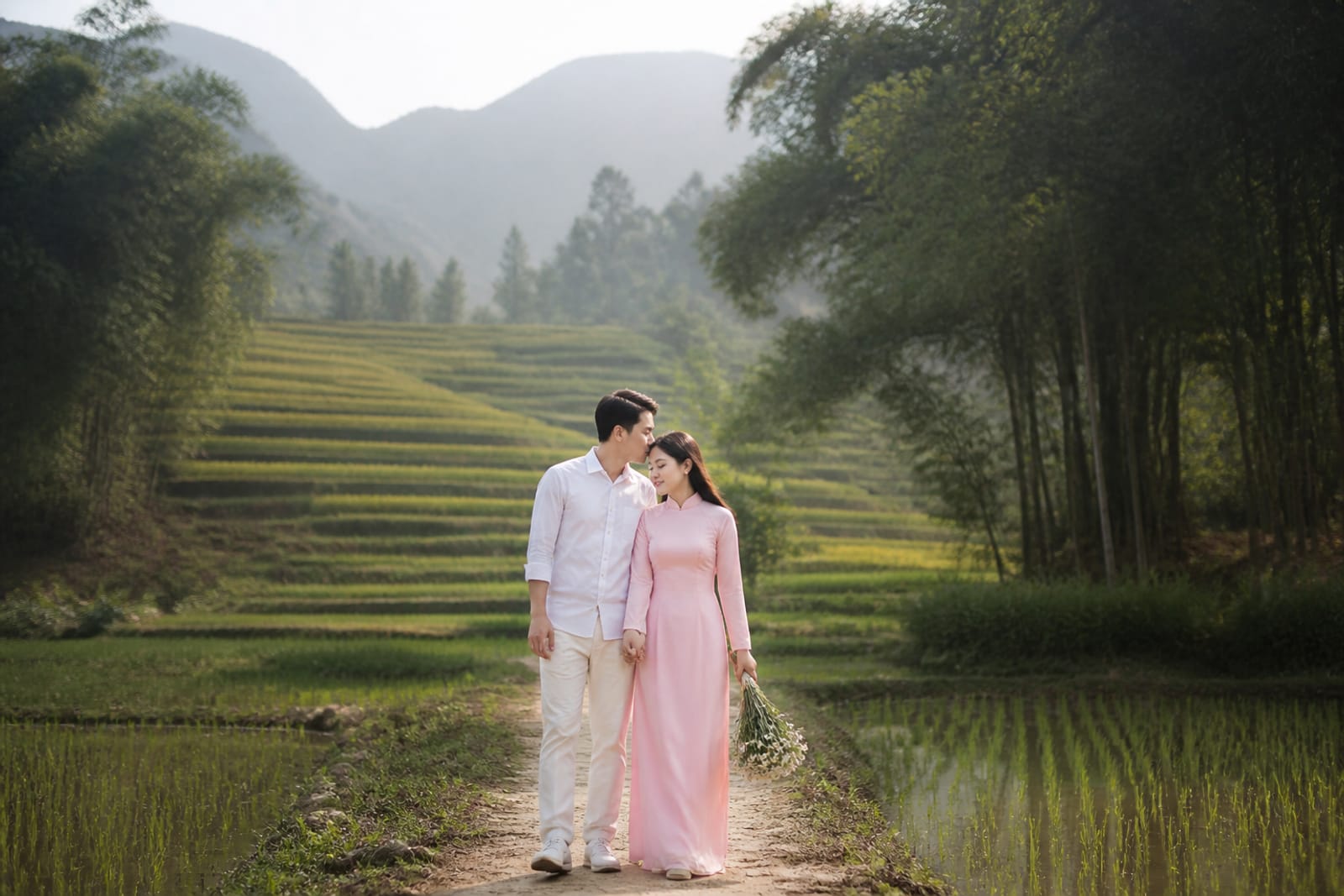
What transport option fits your photoshoot style?
| Option | Best for | Travel time | Road condition | Why it works |
|---|---|---|---|---|
| Private car, driver booked locally | Couples, elopements, flexible timing | 3–4 hours Hanoi to valley | Paved to Pu Luong town; dirt tracks to terraces | Driver knows shortcuts, waits 4+ hours, speaks local dialect |
| Hired minivan with guide & photographer | Groups, pre-wedding parties, all-in logistics | 4–5 hours with stops | Same | Guide scouts light, photographer in van, driver handles road stress |
| Stay overnight in valley, local guide next morning | Relaxed schedule, multiple locations, best light | 3–4 hours day 1; 1–2 hours day 2 | Fresh tires, rested crew | Avoids dawn drive fatigue; light perfect 6–8 am and 5–7 pm |
| Self-drive rental car from Hanoi | Solo, adventurous, budget-conscious | 3–4 hours | Winding, potholed in monsoon; GPS unreliable | Saves driver cost; high stress on unfamiliar roads; no local knowledge |
The overnight option delivers the strongest images: photographers arrive rested, light is predictable, and you can shoot two peaks (early golden, late shadow) without rush. Couples we've advised who stayed in a valley guesthouse report calmer shoots and better photos than dawn-only visits.
How to plan timing so you hit the right light window
Pu Luong's best light is narrow and hour-specific. Soft, directional sun on terraced slopes happens at sunrise (5:30–7:30 am, depending on season) and into golden hour (5:00–6:30 pm). Midday (9 am–4 pm) flattens the layers—you lose depth, shadow, and the dimensional quality that draws viewers in. If you drive from Hanoi at 4:30 am and arrive at 8 am, you've missed the peak by an hour and will shoot flat light all day.
Timing checklist:
- Book accommodation in Pu Luong valley the night before (not in Hanoi).
- Arrange wake-up call 4:45 am; leave guesthouse 5:15 am to scout light.
- Brief your photographer on which terrace faces and which direction (north, northeast, south) the sun hits first.
- Shoot wide establishing shots 5:30–6:30 am (layers crisp, shadows deep).
- Pivot to medium and detail frames 6:30–7:30 am as light lifts into faces.
- Return to guesthouse, rest, regroup for 5 pm shoot (golden into blue hour).
What season and weather actually change about Pu Luong shoots
Pu Luong sits in the northern climate zone. February–April is cool and dry; light is sharp, terraces are green or gold depending on harvest, and roads are passable. May–September brings daily afternoon downpours and persistent cloud; the monsoon peak (July–August) floods valleys and makes roads impassable for 2–3 days after heavy rain. September–October clears gradually; October is ideal (dry, cool mornings, clear skies).
Season impact on shoots:
- Feb–Apr: Clear skies, cold mornings (bring a light layer). Terraces either freshly planted (bright green) or pre-harvest (pale gold). Roads paved and dry. Best predictability.
- May–Jun: Monsoon begins; afternoon clouds and rain increase. Mornings still often clear. Road risk moderate.
- Jul–Aug: Worst time. Roads muddy, visibility poor, cloud cover 70%+. Reschedule if possible.
- Sep–Oct: Monsoon ends; clarity improves week by week. October is peak season for terraces, light and access.
- Nov–Jan: Dry and cool; mist common in early mornings. Terraces harvested (golden stubble or ploughed brown). Roads excellent.
Rice harvest color matters: golden harvest (late May, September–October) photographs warmer than mid-growth green. Ploughed earth (November) is rich brown. Plan the season to match your vision—then commit to transport timing that fits the light.
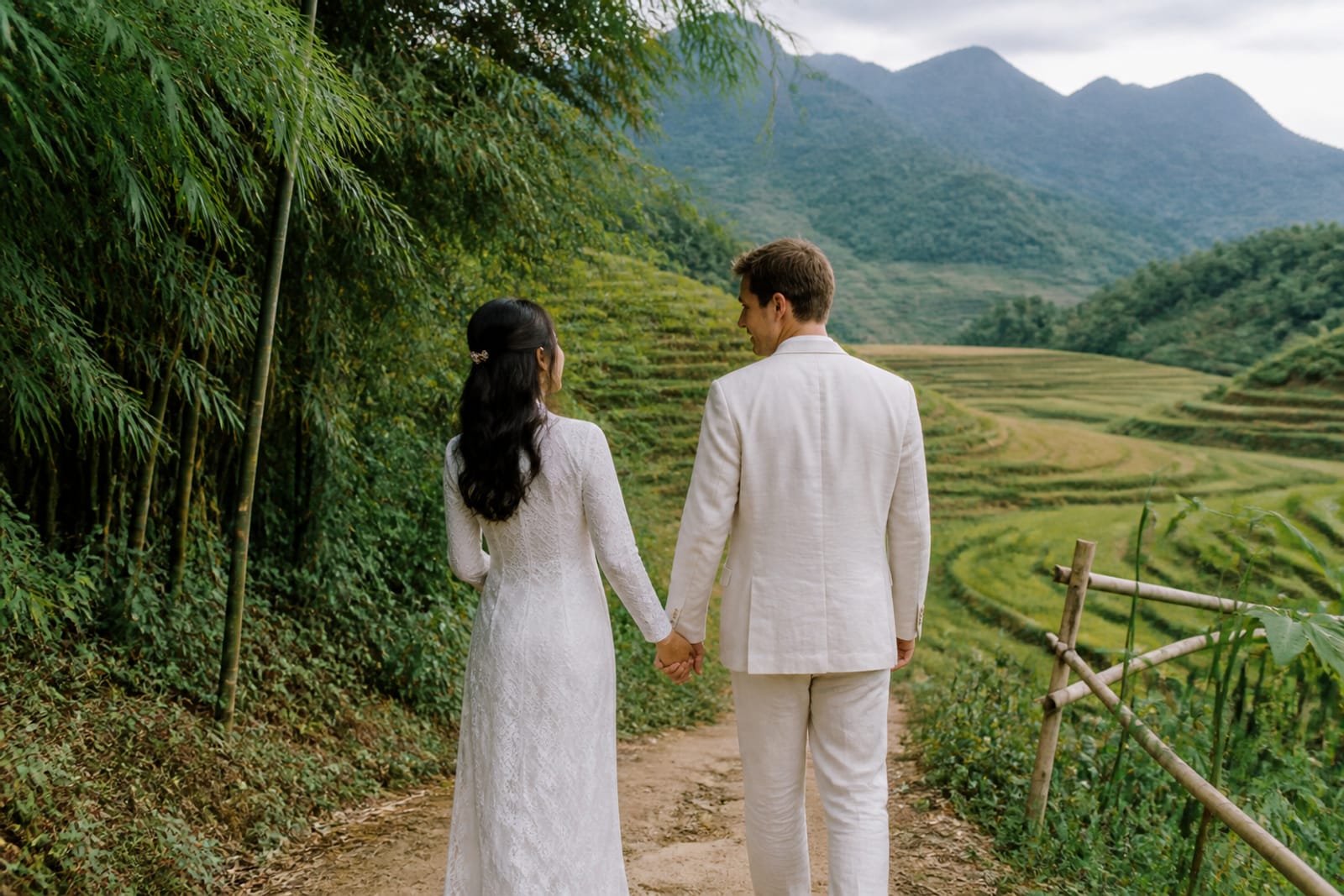
Hiring a local photographer and scout in Pu Luong
Cáo Studio operates in Hanoi, Ho Chi Minh City, and Hoi An (by appointment—ask on WhatsApp for Hoi An dates). We do not have a Pu Luong team; the valley is too remote for our logistics. Instead, find a local Pu Luong guide photographer through:
- Pu Luong homestay or guesthouse: Ask staff to recommend a photographer who knows light and has shot couples and elopements before. Most homestays can arrange one for the day.
- Facebook groups for Pu Luong tourism: Search "Pu Luong photography" or "Pu Luong guide"; hire individuals with portfolio samples (not just landscape shots).
- Vet by message first: Ask the scout to describe the best terrace for 6 am light, the road condition this week, and whether they bring a second camera as backup. Real scouts answer with specifics, not enthusiasm.
What to check before you book a local photographer:
- Portfolio shows people (couples, families, details) not just landscapes.
- They own at least two cameras (backup if one fails on a mountain road).
- They speak some English or have a translator.
- They've worked with international couples before (different aesthetic, feedback style).
- They offer edited digital files within 1 week (not 3–4 months).
- They know which terrace is accessible (some require steep climbs or private land permission).
If you're booking a pre-wedding photoshoot for Hanoi or Ho Chi Minh City, Cáo Studio handles all logistics—transport, timing, makeup, outfit coordination. For Pu Luong, accept that you're hiring local, which means lower cost but higher coordination burden on you.
Common logistics mistakes and how to avoid them
Mistake 1: Assuming roads are like Hanoi highways. Pu Luong roads are winding, narrow, and potholed. A 150 km journey takes 3.5–4 hours, not 2. Book an extra 45 minutes of buffer time. Bring motion-sickness medication if you're sensitive.
Mistake 2: Dressing for Hanoi weather, not mountain weather. Pu Luong sits 600+ meters up. Even in March, mornings are 10°C cooler than the city. Wear layers; bring a light jacket for the van and terraces before 7 am. Humidity is lower in dry season; bring sunscreen and lip balm.
Mistake 3: Booking an ao dai shoot without testing the fit in advance. An ao dai rental at valley level may not fit if you've ordered it from Hanoi without a fitting. Arrange a fitting before you leave the city, or bring a simple backup outfit (linen shirt, cotton trousers, scarf). Wet rice terraces destroy silk; choose cotton or hemp blends for Pu Luong.
Mistake 4: Not scouting the location the evening before. Arrive in the valley by 4 pm the day before the shoot. Walk the terrace with your photographer. Spot which way shadows fall at 6 am. Identify hazards (loose edges, flooded sections, private fields). A 30-minute evening scout saves an hour of fumbling on shoot day.
Mistake 5: Expecting to shoot both "morning" and "evening" light in one day and leave by noon. You cannot. Golden hour in the evening takes 1–2 hours. If you leave before 3 pm, you forfeit your best second light window. Plan to stay until 7 pm or don't book an evening shoot.
📸 Book on WhatsApp — pre-wedding photoshoot | 💄 Makeup & hair at your hotel | 🌸 See the lookbook
Coordination checklist: what to confirm with your Pu Luong photographer before the day
Write these down in a message; ask for written confirmation:
- Date and exact start time (e.g., "5:45 am at Ta Phin village terrace").
- Number of locations (one terrace, two spots, or moving shoot).
- Duration (e.g., "3 hours morning light, break, then 2 hours evening").
- Outfit changes (how many, where to change—no dressing rooms in fields).
- Backup plan if rain (reschedule, move to covered area, or shoot anyway in moody light).
- Edited files delivery (turnaround time, format, number of photos).
- Payment method (cash only in rural areas; confirm exchange rate, bring Vietnamese đồng).
- Transport: who drives, who pays for fuel/tolls, will the photographer ride in your van or meet you on-site.
A written checklist prevents miscommunication. If your photographer hesitates to confirm details, find another.
📸 Book on WhatsApp — ao dai photoshoot | 💄 Makeup & hair at your hotel | 🌸 See the lookbook
If you're planning a pre-wedding shoot in accessible terrain—Hanoi's Red River, Hoi An's lantern town, or Ho Chi Minh City's colonial villas—Cáo Studio handles scouting, transport, and one-team logistics so you focus on light and connection. For Pu Luong's mountain complexity, hire locally, plan a day earlier than you think you need, and leave the shoot day unrushed. The best Pu Luong frames come from crews who arrived rested and know the light by memory.
FAQ
Can Cáo Studio do a Pu Luong photoshoot for us?
No. Cáo Studio operates in Hanoi, Ho Chi Minh City, and Hoi An (by appointment). Pu Luong's remote location is outside our logistics. We recommend hiring a local guide photographer and using this article to plan transport and timing yourself.
What's the cheapest way to get to Pu Luong for a photoshoot?
Self-drive a rental car (saves driver cost) or book a shared minivan from Hanoi. Cost varies by vehicle, fuel, and tolls—ask your accommodation or local guide for current rates. Overnight stays cost more but yield better light and less fatigue.
Is it safe to drive Pu Luong roads in rain?
Mountain roads become slippery and pothole-ridden during monsoon (May–September). Avoid July–August. If rain is forecast within 48 hours of your shoot, reschedule. Washed-out roads can trap cars for hours.
Can we shoot ao dai in Pu Luong?
Yes, but prepare carefully. Silk ao dai stains and tears on muddy terraces. Wear a cotton or hemp blend ao dai, or bring a simple linen outfit as backup. Bring extra shoes for the van and terraces; mud is unavoidable.
How early do we really need to leave Hanoi?
Leave by 4:30 am to arrive in the valley by 8 am, missing the best light. Instead, stay overnight and wake at 4:45 am in Pu Luong. This lets you shoot 5:30–7:30 am (peak light) and evening golden hour (5–7 pm) without a dawn sprint.
What if the photographer we hire doesn't show up?
Confirm contact details (phone number, Facebook, WhatsApp) the evening before. Agree on a meeting point (guesthouse or specific terrace). Leave a 30-minute grace window for mountain delays, then contact your guesthouse staff to locate them. Book a backup local photographer if possible.
FAQ
Can Cáo Studio do a Pu Luong photoshoot for us?
No. Cáo Studio operates in [Hanoi](/hanoi), [Ho Chi Minh City](/saigon), and Hoi An (by appointment). Pu Luong's remote location is outside our logistics. We recommend hiring a local guide photographer and using this article to plan transport and timing yourself.
What's the cheapest way to get to Pu Luong for a photoshoot?
Self-drive a rental car (saves driver cost) or book a shared minivan from Hanoi. Cost varies by vehicle, fuel, and tolls—ask your accommodation or local guide for current rates. Overnight stays cost more but yield better light and less fatigue.
Is it safe to drive Pu Luong roads in rain?
Mountain roads become slippery and pothole-ridden during monsoon (May–September). Avoid July–August. If rain is forecast within 48 hours of your shoot, reschedule. Washed-out roads can trap cars for hours.
Can we shoot ao dai in Pu Luong?
Yes, but prepare carefully. Silk ao dai stains and tears on muddy terraces. Wear a cotton or hemp blend ao dai, or bring a simple linen outfit as backup. Bring extra shoes for the van and terraces; mud is unavoidable.
How early do we really need to leave Hanoi?
Leave by 4:30 am to arrive in the valley by 8 am, missing the best light. Instead, stay overnight and wake at 4:45 am in Pu Luong. This lets you shoot 5:30–7:30 am (peak light) and evening golden hour (5–7 pm) without a dawn sprint.
What if the photographer we hire doesn't show up?
Confirm contact details (phone number, Facebook, WhatsApp) the evening before. Agree on a meeting point (guesthouse or specific terrace). Leave a 30-minute grace window for mountain delays, then contact your guesthouse staff to locate them. Book a backup local photographer if possible.
Ao dai, makeup, hair and a local photographer in Hanoi or Saigon — one WhatsApp message.