/pre-wedding-photoshoot
Hang Mua viewpoint wedding photos: best time of day and light
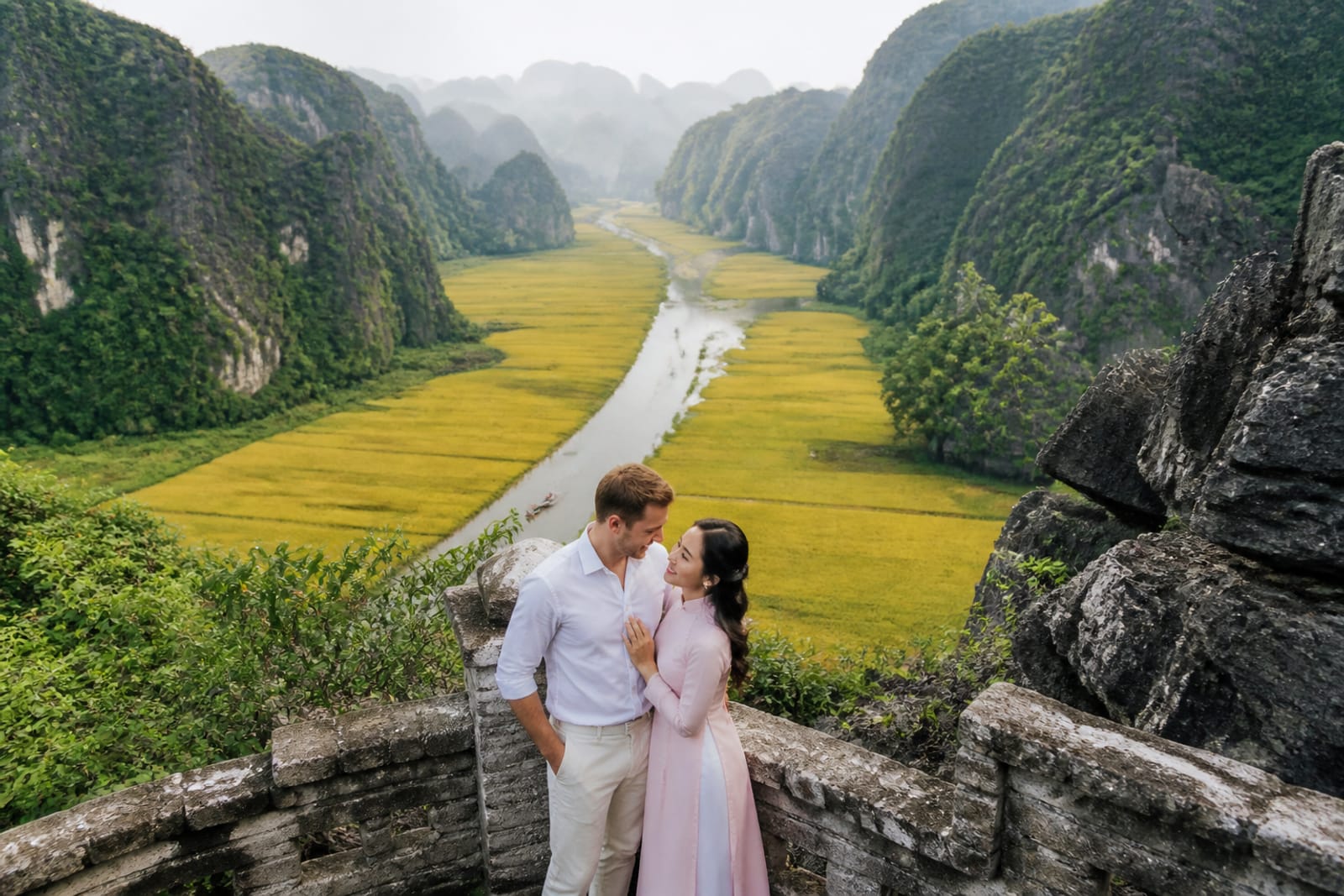
Hang Mua's golden light peaks two hours before sunset (roughly 16:00–17:30 in winter, 18:00–19:30 in summer), when side-lit cliffs glow amber and rice fields below reflect warmth. The viewpoint sits atop approximately 500 stone steps in Ninh Binh Province, central Vietnam; the hike takes 30–45 minutes depending on fitness and ao dai fit. Cáo Studio – Makeup & Photoshoot does not operate in Ninh Binh but coordinates pre-wedding shoots in Hanoi, Ho Chi Minh City, and Hoi An. For Hang Mua, hire a local Ninh Binh photographer experienced with uneven terrain, and plan your season: March–May and September–November offer cool, clear skies; June–August brings heat and afternoon storms; December–February is grey and cool. Avoid Tet (late January–mid February), when crowds peak and many services close. Bring backup shoes, test the ao dai fit on steps beforehand, and scout the viewpoint at your chosen time of day to confirm light angles before your shoot date. --- Hang Mua's view from the top—a 360° vista of karst peaks and patchwork rice fields—draws hundreds of couples each season. But timing is everything: arrive too early and you're shooting in flat, harsh midday light; arrive too late and you'll lose detail as the sun drops below the ridge. This guide walks you through selecting your shoot time, understanding the seasons, and finding the right photographer for Ninh Binh's trickiest landscape.
Why golden hour at Hang Mua is non-negotiable for pre-wedding light
Golden hour (two hours before sunset) bathes the limestone cliffs in warm, directional light that sculpts the peaks and flatters skin tones. The low angle catches the stone's texture, turning it amber and bronze, while the sky behind stays bright enough to hold detail. During winter (December–February), this window opens around 16:00 and closes by 17:30; in summer (May–September), it runs from 18:00 to 19:30. Outside this window, the overhead sun washes out color and casts harsh shadows under eyes and chins—problematic on a hike where you're already tired. The rice fields below act as a natural reflector, bouncing light back onto your face and filling shadows without the artificial look of a flash. If you shoot midday or in the grey afternoon, you lose the cliffs' drama and the emotional warmth that makes Hang Mua images sell the romance of a pre-wedding story.
📸 Book on WhatsApp — ao dai photoshoot
What seasons deliver clear skies and comfortable shooting conditions?
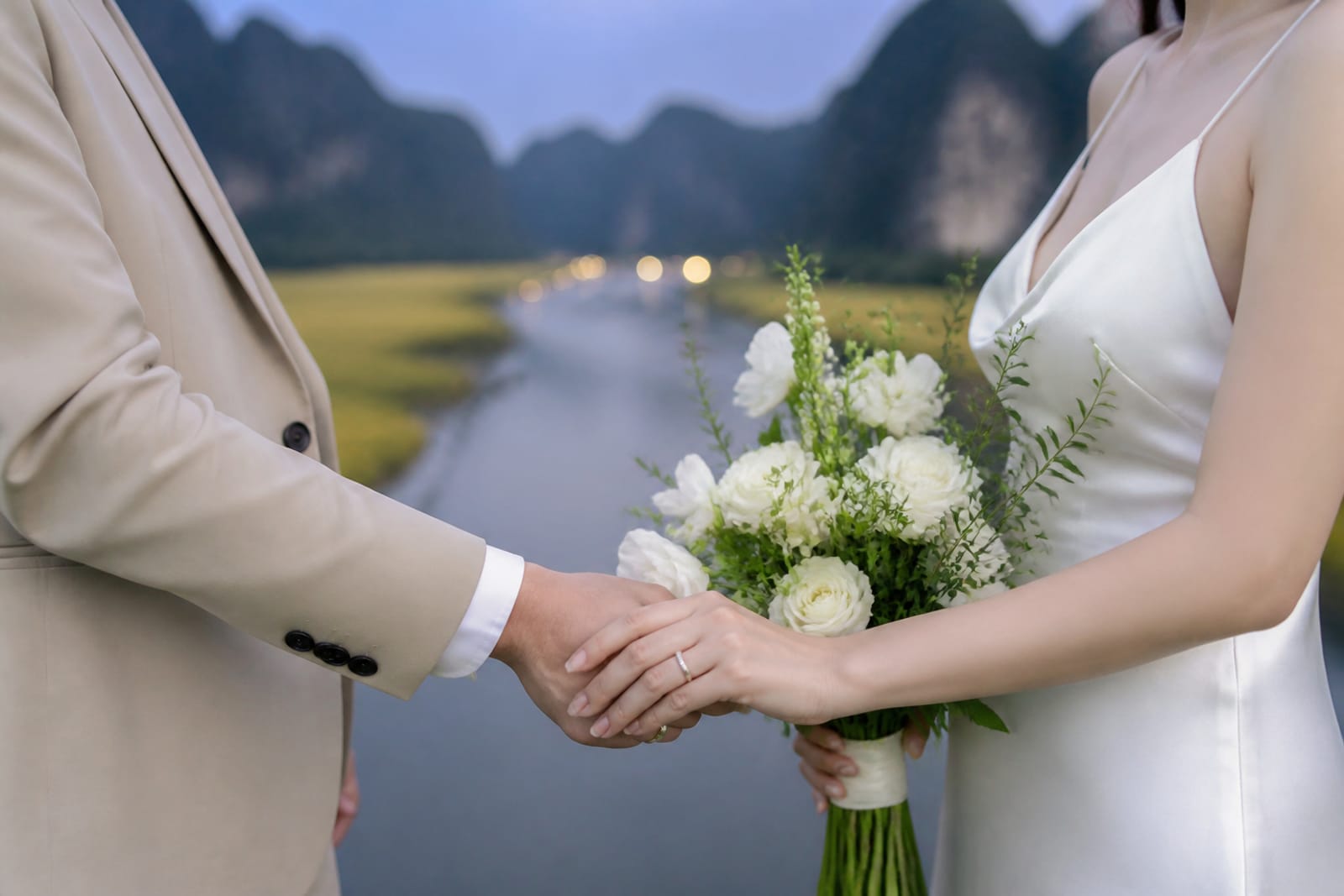
The central coast's dry window runs February through August; Ninh Binh follows this pattern but also experiences grey winters. March through May brings warm, clear skies, low humidity, and minimal rain—ideal for energy and skin comfort on 500 steps. By June, heat spikes above 30°C and afternoon thunderstorms roll in daily, cutting golden hour short and leaving paths muddy. September through November mirrors spring: temperatures drop, rain is sparse, and light is crisp. December through February is cooler (sometimes damp, always grey) but feasible if you accept softer, less dramatic light; crowds are lighter. Tet (late January to mid-February) closes some services and floods the viewpoint; avoid if possible. Golden rice fields appear around late May–early June and again around September–October—if a golden crop is non-negotiable for your concept, confirm planting dates with your local photographer before booking.
The table below compares shooting windows head-to-head:
| Season | Light quality | Crowds | Physical comfort | Ao dai wrinkles | Best for |
|---|---|---|---|---|---|
| Mar–May | Golden, crisp | Moderate | Cool, energetic | Minimal sweat | Primary choice—clear skies, comfortable pace |
| Jun–Aug | Warm but hazy; afternoon storms | Heavy weekends | Hot, humid; sweat damage | Significant | Skip if possible—heat, unpredictable rain |
| Sep–Nov | Golden, clear | Light–moderate | Cool, pleasant | Minimal | Strong alternative—fewer crowds, same light |
| Dec–Feb | Soft, grey; low-angle sun | Light | Cool, damp | Minimal | Only if grey aesthetic matches your vision |
How does the 500-step hike affect your ao dai fit and photographer mobility?
Approximately 500 stone steps—uneven, steep in sections—demand shoes with grip and an ao dai fit that allows movement without tearing. Before booking, walk the route in your ao dai (or rent one locally and test it) to confirm the hem clears your ankles and the back slit doesn't catch underfoot. Most couples opt for a tailored ao dai with a higher hem or a looser fit at the legs; traditional floor-length cuts work but require careful footwork and slow pacing. Budget an extra 10–15 minutes of hike time if you're in traditional dress. Your photographer must be fit and experienced with uneven terrain—they'll be climbing backward, sideways, and balancing on narrow steps while framing shots. Ask any local photographer you vet: "Have you shot Hang Mua with couples in ao dai? Do you have a backup route for weather or crowds?" A photographer who knows three or four vantage points and can work quickly in tight spaces is invaluable. If the full climb is physically risky, some photographers scout a mid-point rest area (around step 250–300) where light is still strong and the view is stunning; discuss this trade-off when briefing.
How to vet and book a Ninh Binh photographer for Hang Mua shoots
Cáo Studio – Makeup & Photoshoot specializes in pre-wedding and elopement shoots in Hanoi, Ho Chi Minh City, and Hoi An—not Ninh Binh. For a Hang Mua shoot, you'll need a local photographer based in Ninh Binh or a Hanoi-based team willing to travel (roughly 2 hours from Hanoi). Request portfolios showing: multiple couples on Hang Mua (to confirm familiarity with light angles and crowding patterns), ao dai in motion (to show they understand fabric management), and consistency in editing style. Red flags: only one or two Hang Mua samples, no ao dai experience, vague on shoot duration or inclusions, or responses via chat apps other than WhatsApp. Ask directly:
- "What do you include: edited files, prints, a slideshow, or a video?"
- "How many outfit changes or locations within Hang Mua?"
- "If weather forces cancellation, what's the rebooking policy?"
- "Do you have examples shooting in March–May golden light specifically?"
Expect the photographer to discuss timing: a typical shoot starts at the base around 14:00–14:30, climbs slowly with pauses for portraits, and reaches the viewpoint by 15:30–16:00 to catch golden hour at the top. The descent and final portraits run until 18:00–19:00. A serious operator will confirm light conditions the night before and suggest a 48-hour rebooking window if storms threaten.
What mistakes ruin Hang Mua pre-wedding shoots and how to prevent them?
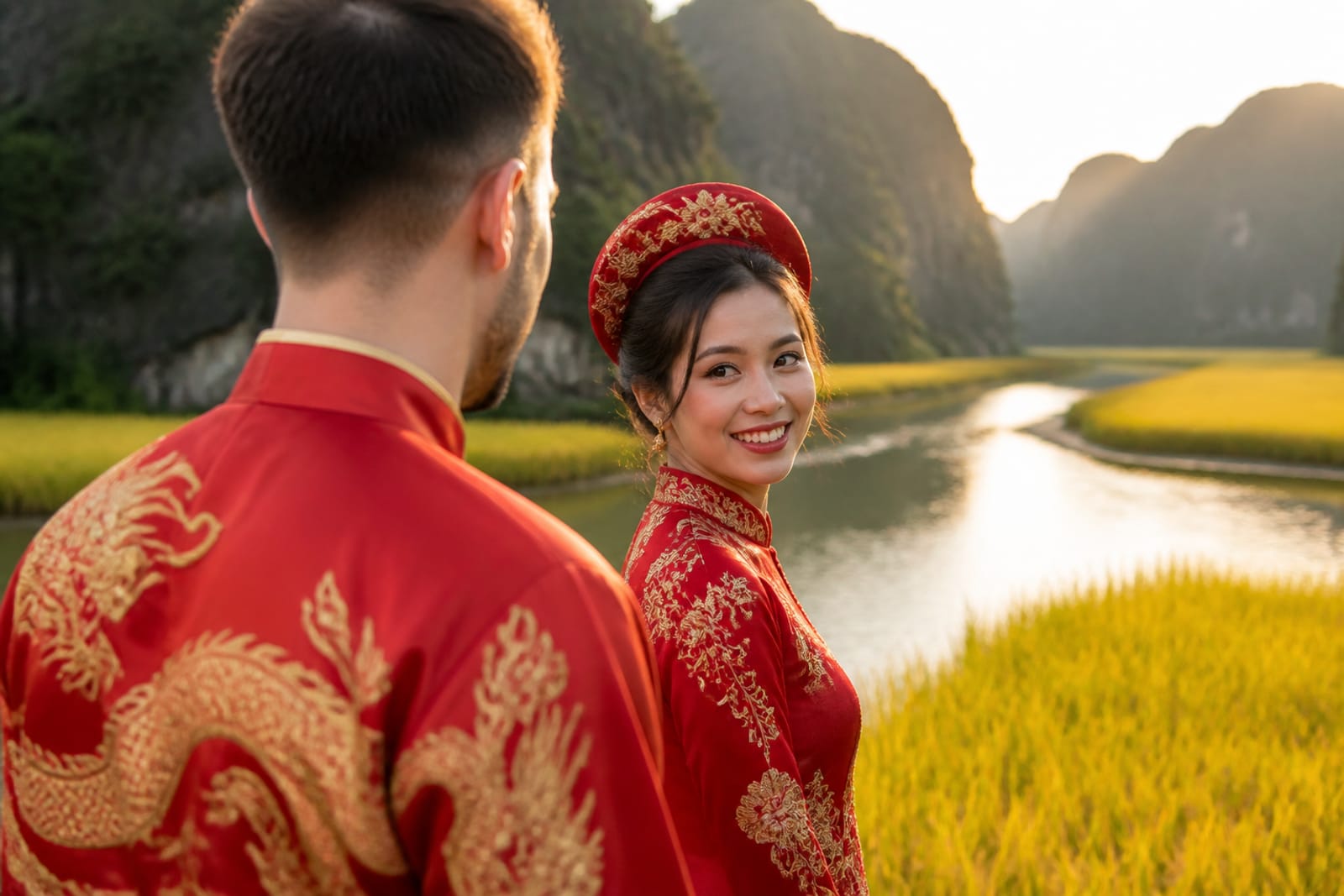
Timing mistakes: Arriving at the viewpoint after 17:30 in winter or 19:30 in summer means shooting in direct, low-angle sun that creates blinding glare and harsh shadows. Arriving too early (before 15:00) traps you in flat, overhead light. Solution: schedule your shoot to place you on the viewpoint 60–90 minutes before sunset; the photographer should confirm this in your contract.
Ao dai fit: A floor-length, tightly fitted ao dai risks tearing on rocky steps and limits movement—couples end up stiff and uncomfortable in photos. Solution: rent or tailor an ao dai in Hanoi or Ho Chi Minh City weeks ahead; test it on stairs or a steep hill.
Footwear: Slippery shoes or high heels cause falls and photo pauses. Solution: wear flat, rubber-soled shoes (sandals with grip, clean sneakers, or special "ao dai heels" with rubberized soles). The photographer should also wear gripped shoes.
Crowds: Weekends and afternoon hours (15:00–18:00) attract domestic tourists, especially during holidays and school breaks. Solution: shoot on a weekday or negotiate an early-morning start (sunrise shooting is less dramatic but far quieter; confirm light quality with your photographer first).
Weather gaps: Afternoon thunderstorms (June–August) and sudden fog (December–February) kill light. Solution: book during dry season (March–May, September–November); discuss a backup date or alternative location with your photographer before signing.
Underestimating fatigue: Couples climbing 500 steps in makeup and formal wear often look exhausted by the time they reach the top. Solution: start with a slower pace, rest at the mid-point, and schedule key portraits for when energy is highest (usually 30–45 minutes after arrival at the viewpoint).
Comparing Hang Mua to other Ninh Binh and northern pre-wedding options
Hang Mua dominates pre-wedding portfolios but it's not the only choice in the region. Tam Coc (rowed boats through a three-cave system with green water) offers water-based shoots with no climbing—ideal for comfort but with limited sky drama and less predictable light reflection. Trang An (similar boat system, karst scenery) works year-round and suits couples wanting movement and novelty. Mua Cave viewpoint at 300 steps (a lower option on the same complex) captures some of the cliffs without full exertion. Rice fields in late May–early June (the golden crop period) allow ao dai shoots on flat land with seasonal color, but lack the landmark focal point. For Hanoi-based couples, pre-wedding shoots in Hanoi with urban backdrops (Old Quarter, Hoan Kiem, French colonial architecture) offer logistics and makeup support through Cáo Studio. If you're drawn to limestone drama, Hang Mua is the clear choice; if comfort and ease matter more, Tam Coc or Trang An are smarter alternatives. Discuss trade-offs—location prestige vs. physical exertion vs. light consistency—with your photographer when shortlisting.
What to check before you book a Hang Mua pre-wedding shoot
Photographer's contract: Does it confirm shoot date, start/end time, number of edited files, and a rebooking policy for weather?
Light and season guarantee: Does the photographer commit to golden-hour timing, or is timing "weather permitting"? (It should be guaranteed.)
Ao dai fit and footwear: Have you tested your ao dai on 50+ steps and chosen shoes with grip?
Backup plan: If crowds or weather force a change, does the photographer offer an alternative time or location (e.g., Tam Coc, mid-level Hang Mua)?
Makeup stability: If you're doing makeup in Hanoi and traveling to Ninh Binh, confirm that makeup will hold through humidity and sweat. Consider booking makeup & hair at your hotel with a Hanoi team that travels, or hire a makeup artist in Ninh Binh to touch up on-site.
Travel and setup time: Budget at least 2 hours for travel from Hanoi (or more if starting from Ho Chi Minh City). Confirm with your photographer whether they cover travel costs or expect a separate fee.
Insurance and liability: Ask if the photographer carries liability insurance (useful if a fall or accident occurs on the steps).
Portfolio consistency: Request to see multiple complete shoots (3–5 couples) from the same photographer, not just highlight reels. Check that lighting, color grading, and pose direction feel cohesive.
The key is clarity: vague contracts and "we'll figure it out on the day" attitudes lead to disappointing light, missed moments, and stressed couples. A professional Ninh Binh photographer will answer every question in writing.
---
FAQ
What is the best time of day to shoot at Hang Mua for pre-wedding photos?
Golden hour (two hours before sunset) delivers warm, directional light that sculpts the limestone cliffs. In winter, this runs 16:00–17:30; in summer, 18:00–19:30. Plan to reach the viewpoint 60–90 minutes before sunset to maximize this window.
Which months have the clearest skies and fewest crowds at Hang Mua?
March–May and September–November are ideal: warm, clear skies, light rainfall, and manageable weekend crowds. June–August brings heat and afternoon thunderstorms; December–February is cool and grey. Avoid Tet (late January–mid-February) entirely.
Can I wear a traditional floor-length ao dai on the Hang Mua steps?
Yes, but it requires careful footwork and adds 10–15 minutes to your climb time. Test your ao dai on stairs beforehand to confirm the hem clears your ankles and the back slit doesn't catch. A tailored, looser-fitting ao dai works better than a tight, floor-length cut.
How do I find a reliable local photographer in Ninh Binh for Hang Mua shoots?
Request portfolios showing multiple couples on Hang Mua, experience with ao dai, and consistency in editing. Ask about shoot duration, inclusions, cancellation policy, and light timing guarantees. Red flags: vague contracts, no ao dai examples, or reliance on chat apps other than WhatsApp.
What mistakes do couples make on Hang Mua and how do I avoid them?
Common errors: arriving after sunset (harsh light), wearing loose or tight ao dai (movement problems), choosing slippery footwear (falls), and underestimating fatigue. Prevent these by booking golden-hour timing, testing your ao dai in advance, wearing grip-soled shoes, and starting your hike early with planned rest stops.
Does Cáo Studio – Makeup & Photoshoot shoot at Hang Mua or other Ninh Binh locations?
No. Cáo Studio operates in Hanoi, Ho Chi Minh City, and Hoi An. For Ninh Binh, hire a local photographer and use this guide to vet their experience and plan your shoot. If you'd like a pre-wedding shoot in Hanoi, we can coordinate makeup, ao dai rental, and photography—contact us on WhatsApp.
FAQ
What is the best time of day to shoot at Hang Mua for pre-wedding photos?
Golden hour (two hours before sunset) delivers warm, directional light that sculpts the limestone cliffs. In winter, this runs 16:00–17:30; in summer, 18:00–19:30. Plan to reach the viewpoint 60–90 minutes before sunset to maximize this window.
Which months have the clearest skies and fewest crowds at Hang Mua?
March–May and September–November are ideal: warm, clear skies, light rainfall, and manageable weekend crowds. June–August brings heat and afternoon thunderstorms; December–February is cool and grey. Avoid Tet (late January–mid-February) entirely.
Can I wear a traditional floor-length ao dai on the Hang Mua steps?
Yes, but it requires careful footwork and adds 10–15 minutes to your climb time. Test your ao dai on stairs beforehand to confirm the hem clears your ankles and the back slit doesn't catch. A tailored, looser-fitting ao dai works better than a tight, floor-length cut.
How do I find a reliable local photographer in Ninh Binh for Hang Mua shoots?
Request portfolios showing multiple couples on Hang Mua, experience with ao dai, and consistency in editing. Ask about shoot duration, inclusions, cancellation policy, and light timing guarantees. Red flags: vague contracts, no ao dai examples, or reliance on chat apps other than WhatsApp.
What mistakes do couples make on Hang Mua and how do I avoid them?
Common errors: arriving after sunset (harsh light), wearing loose or tight ao dai (movement problems), choosing slippery footwear (falls), and underestimating fatigue. Prevent these by booking golden-hour timing, testing your ao dai in advance, wearing grip-soled shoes, and starting your hike early with planned rest stops.
Does Cáo Studio – Makeup & Photoshoot shoot at Hang Mua or other Ninh Binh locations?
No. Cáo Studio operates in Hanoi, Ho Chi Minh City, and Hoi An. For Ninh Binh, hire a local photographer and use this guide to vet their experience and plan your shoot. If you'd like a [pre-wedding shoot in Hanoi](/hanoi), we can coordinate makeup, ao dai rental, and photography—contact us on WhatsApp.
Ao dai, makeup, hair and a local photographer in Hanoi or Saigon — one WhatsApp message.