/pre-wedding-photoshoot
Hidden photo corners near Ha Giang buckwheat flowers for couples
Ha Giang buckwheat fields offer couples a raw alternative to crowded beaches—white flowers, mist, winding roads and real backlighting at sunrise. The blooms last roughly 3–4 weeks from late October through November, peaking around the third week when the landscape is fullest and light is still soft. Hidden pockets exist along the Yen Minh plateau and near Hoang Su Phi, accessible only by scooter or hired car with a local who knows which turns yield private rows and which lead to crowds. Cáo Studio does not shoot in Ha Giang—the studio operates from Hanoi, Ho Chi Minh City and Hoi An. For a mountain shoot, hire a local photographer (ask your lodging for a vetted contact) and use this guide to plan spots, timing and what to wear under your ao dai so the fabric moves with you on the bike. 📸 Book on WhatsApp — couple photoshoot ---
Why does Ha Giang beat coastal couple sessions for autumn light?
Buckwheat blooms create a textured landscape that gives you depth—foreground flowers, middle-distance rolling rows, far ridges in mist. Coastal shoots flatten against sand or water; here, layers work for you. The flowers bloom only in cool months (Oct–Nov); this scarcity means fewer couples arrive on the same week, so you claim solitude that a beach in April never offers. Light during blooming season arrives softer (less harsh shadows at noon) because cloud cover is common. The catch: roads are unpaved, weather is unpredictable, and a session takes half a day of travel, not one hour. Best for couples who see the shoot as part of a Ha Giang loop, not an add-on to Hanoi.
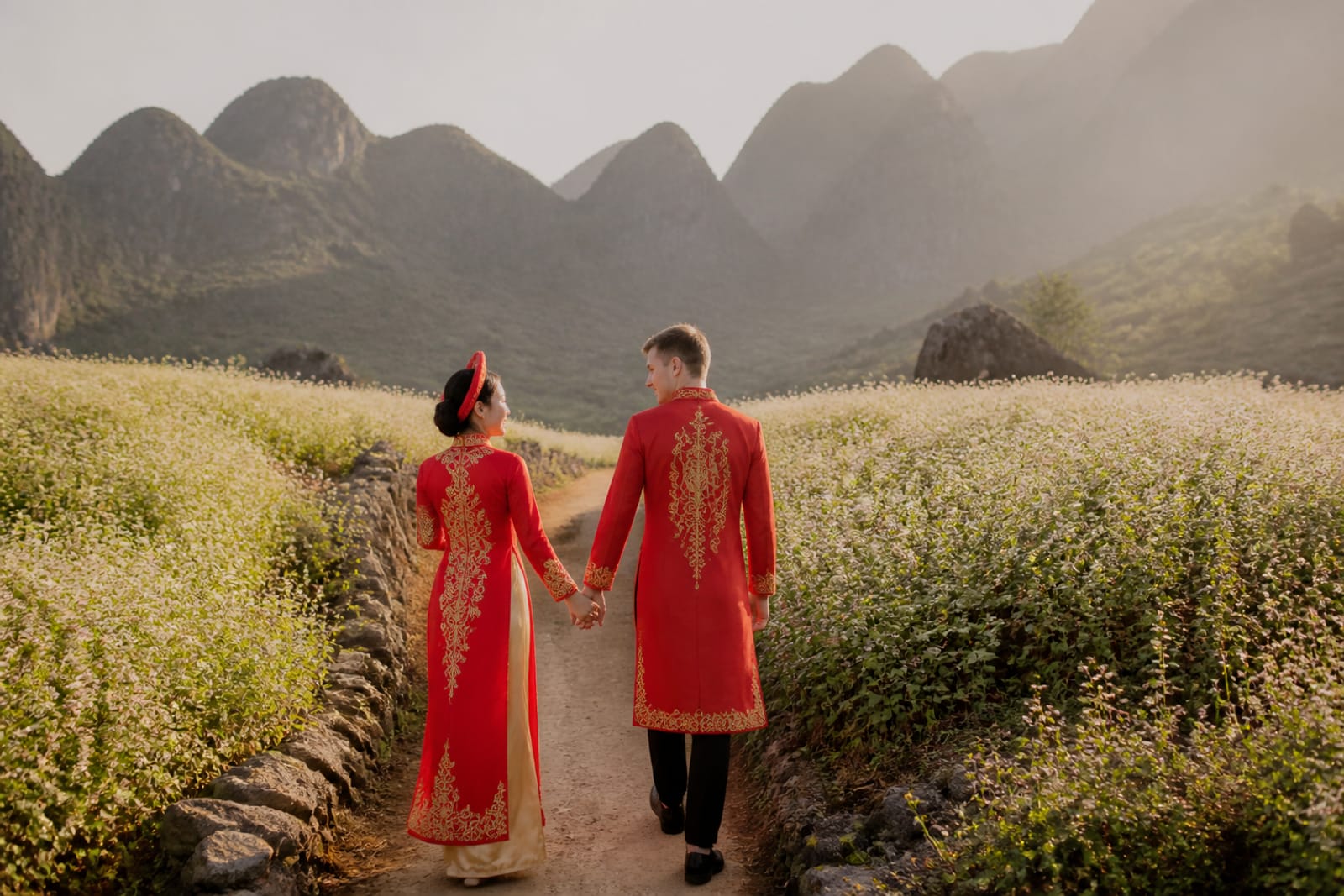
Which corner of the Yen Minh plateau actually stays empty in October?
The plateau runs east–west near Yen Minh town; most tourists follow marked roads to the viewpoint cluster. Flower rows south of the main road (accessed via smaller dirt tracks near Km 36–38 markers) see traffic only on peak Sundays. Early morning (before 7 am) clears all spots. Avoid the central viewpoint area after 9 am—coaches park there. North-facing slopes catch soft side light around 6:30–7:00 am; by 9 am, sun is overhead and flowers lose dimension. The real secret: walk into the fields rather than shooting across them from the road. This means wearing sturdy shoes, not heels—and an ao dai fitted at the hem so you can stride. Most couples stay on asphalt; ten minutes on foot into the rows separates you from everyone else.
How do Hoang Su Phi terraces compare to Yen Minh for a buckwheat shoot?
| Spot | Best for | Light window | Why it works |
|---|---|---|---|
| Yen Minh plateau | Open, rolling rows; wide-angle frames | 6–7:30 am (side light); golden hour 5–6 pm | Gentle slopes, minimal trees; light wraps evenly; crowds thin before 8 am |
| Hoang Su Phi terraces | Intimate, layered depth; detail shots | 6:30–7:30 am (mist in valleys); late afternoon 4–5 pm | Stacked rows create leading lines; mist adds mystery; fewer tourists know the access roads |
| Xuan Son area (south of Yen Minh) | Drama, moody tones; golden couple frames | Sunrise 5:45–6:30 am; pre-sunset 4:30–5:30 pm | Steeper slopes, better silhouette backlight; fewer lodgings nearby = fewer day-trippers |
Yen Minh suits couples who want classic landscape-and-you shots—the flowers frame you without you framing them. Hoang Su Phi demands more hiking but rewards you with foreground-to-background geometry that makes two people feel centred in the scene. Xuan Son is hardest to reach but offers drama that Instagram-normal doesn't—steep angles, fewer tourists, moodier light. Choose based on how much time you have and how much walking your ao dai (and shoes) can handle.
What actually goes wrong on a Ha Giang mountain shoot—and how to avoid it?
Rain and cloud. October–November is dry relative to summer, but afternoon showers arrive fast and fog rolls into valleys without warning. Solution: shoot in the first three hours after sunrise. Clouds can add mood, but heavy mist erases your couple from the landscape. Check the 10-day forecast and book a date in the middle of the window, not the edges.
Wrong footwear or outfit fit. Buckwheat rows are not flat; you'll slip on stems if you wear flip-flops or if your ao dai hem wraps your ankles. A fitted ao dai (tailored narrow at the hem, or pinned) lets you walk; loose fabric snags on flowers and mud. Wear flat boots or trainers (sturdy soles; mud is real), not sandals. The photographer should ask you to change into these before the session starts, then shoot your ao dai clean and pressed—the worn look comes after, not during.
Photographer without local knowledge. Yen Minh and Hoang Su Phi are not marked on every GPS; you need a driver or photographer who has been there in previous October–Novembers and knows which turns yield private rows. A "mountain photographer" from a tourism site may have shot Ha Giang once in summer; that's not the same as knowing where crowds gather in flower season. Ask your photographer: "Have you shot buckwheat fields in October? How many times? Can you show me?" A local Ha Giang guide (ask your hotel) paired with a hired photographer from Hanoi (who handles direction and framing) often works better than a single vendor who claims expertise everywhere.
Timing misread. Sunrise on a mountain is 15–20 minutes later than in the city because ridges block the sun. If your guide says "meet at 6 am," they may mean 6 am in town—not 6 am at the field. Agree on exact meeting time and location (hotel name, address), then add 30 minutes to the quoted sunrise time for buffer.
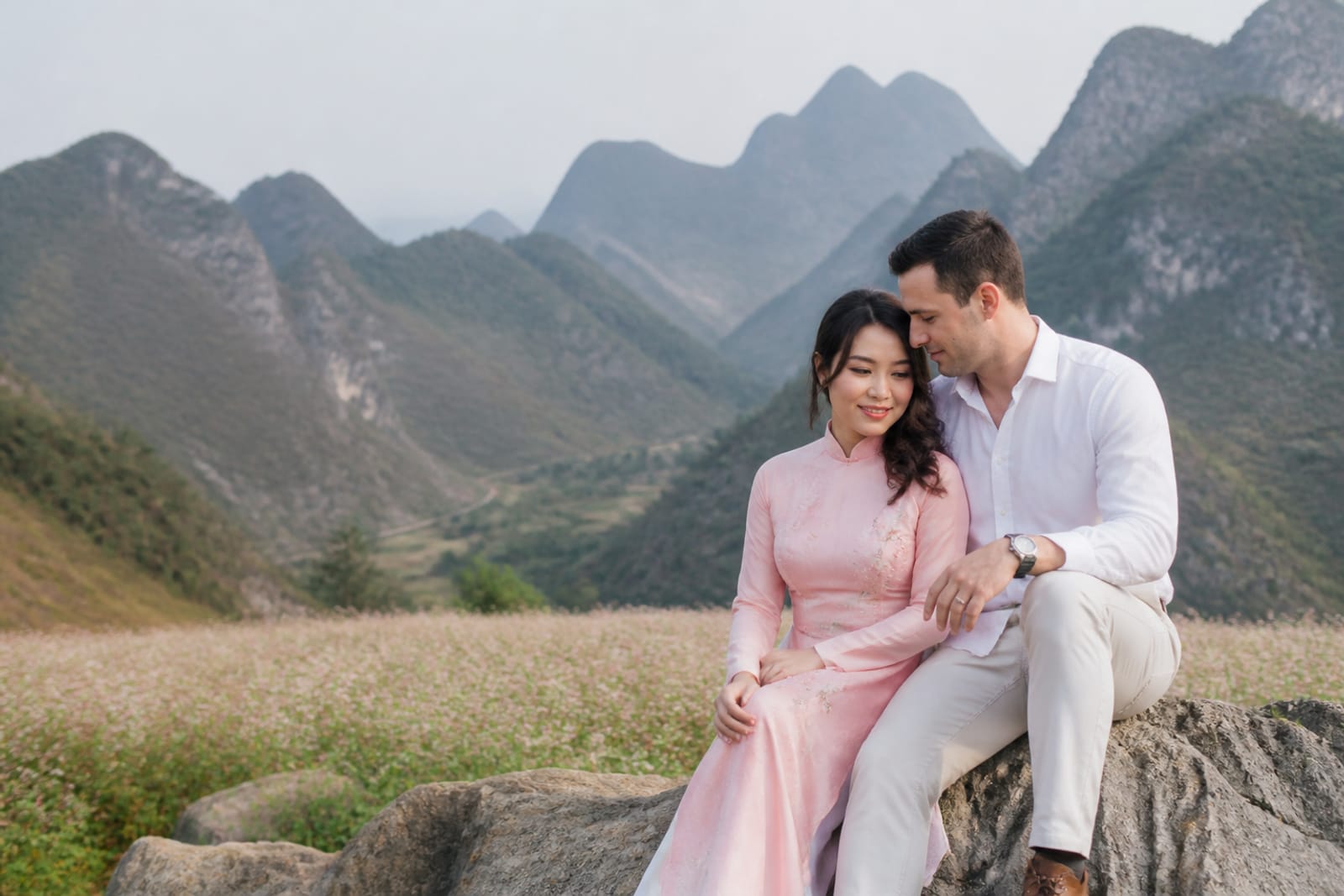
How to plan a full day: transport, outfit changes and backup light?
Start in Ha Giang town the evening before. Meet your driver and photographer at your hotel by 5:30 am—travel time to the fields is 30–60 minutes depending on which corner you're shooting. Bring your ao dai (freshly pressed, packed flat so fabric doesn't wrinkle), sturdy shoes, and a simple change (jeans and a light layer for when you're not shooting). The session runs 2–3 hours in the fields; by 8:30 am, light is too harsh and crowds begin to gather. Return to town by 10 am, change into casual clothes, and have late breakfast. If weather was poor in the morning, evening light (4–6 pm) offers a second session—softer, goldener, often clearer because afternoon showers have cleared. Pack a small bag with water, sunscreen (mist doesn't mean no UV), and a phone charger; signal is weak but exists.
Your photographer should shoot wide first (you two walking in the field, landscape visible behind), then medium (tighter on you two, flowers prominent), then detail (close-up of hands, fabric, flowers). This shooting order means the best light at sunrise catches full frames, not close-ups that flatten in harsh detail. Edited photos arrive 48 hours after the shoot (this timeline assumes your photographer works with a post-process plan—agree this in advance). A short vertical film (reel-style) works well for mountain shoots because movement (walking through flowers, wind moving fabric) reads better in video than in still.
How does hiring a local photographer differ from booking a Hanoi studio?
Hanoi studios (like Cáo Studio) operate in the city and nearby provinces but typically do not travel to Ha Giang—the distance (180+ km), road conditions, and two-day commitment make it a specialist job. A local Ha Giang photographer knows the flower calendar, the fields, the light, but may not have experience directing couples with fashion and movement in mind. The best approach: hire a local driver + guide who knows the fields, then book a Hanoi photographer (or work with Cáo Studio if you're doing a couple photoshoot in Hanoi proper before or after) to brief the local on framing and editing style. This costs more in logistics but ensures directing quality and post-production consistency. If you're already in Ha Giang and time is short, book a local photographer and share clear references of frames you love—light, pose, landscape ratio—so they understand what you're after even if their usual clients seek casual tour snapshots.
---
What to check before you book
- Photographer's portfolio from Oct–Nov shoots specifically — not summer mountain shots or beach work. Ask for five images from buckwheat season in the past two years.
- Weather forecast — book dates in the dry window (typically after Oct 15, before Nov 15) and allow a rain date. October can still carry tail-end summer moisture.
- Road access — confirm your photographer or driver has driven to this specific corner within the last two seasons. GPS alone fails; local knowledge matters.
- Outfit logistics — agree in advance where you'll change and how the ao dai is transported. It must arrive unwrinkled and stay clean until the editing photos go to post.
- Timeline and meal plan — a 5:30 am start needs an early hotel breakfast or a packed item. Confirm end time and what happens if light is poor (do you get a second session or a reschedule?).
- Post-production — ask how many edited images you receive, in what format, and the delivery date. Ask for raw files or ask how long you can download the gallery before it expires.
- Communication channel — exchange WhatsApp and agree on one messenger. Mountain roads mean intermittent signal; a backup plan (call at a certain time, or messages are read by 6 pm) avoids confusion.
---
Other autumn couple shoots near Ha Giang
If buckwheat season has passed or weather looks poor, Hoang Su Phi rice terraces in September (golden rice, pre-harvest) offer similar logistics with slightly better crowds. The terraces are also in Ha Giang province, require the same half-day commitment, but draw more tourists because rice is the more iconic crop. Mist and early-morning light work the same way. Cost factors are the same (transport, local guide, photographer fees, number of outfit changes). For a different climate and landscape, a couple photoshoot in Hanoi at temples and street backdrops (Tran Quoc Pagoda, Huc Bridge at dawn, Old Quarter alleyways) needs only 4–6 hours and no two-day trip—ideal if you're short on time but still want directed light and movement, not posed stiffness.
📸 Book on WhatsApp — ao dai photoshoot
---
FAQ
Do I need an ao dai to shoot in the buckwheat fields?
No—but an ao dai in white or cream moves beautifully in the flowers and photographs with depth that jeans lack. Most couples choose an ao dai precisely because the draping and silk catch light. Wear what feels like you; a simple white dress or linen shirt works if you prefer. Ask your photographer if they've styled similar shoots and what they recommend.
Can we shoot in late November, or will flowers be gone?
Late November flowers are sparse and past peak—rows thin out and lose the fullness that makes mid-October magical. Exactly when blooms end depends on frost and rain that season; ask a Ha Giang local or your hotel by mid-November to confirm if it's worth the trip. Early November is safest.
How muddy do the paths actually get?
October–November paths are damp but not waterlogged like summer rains would make them. Mud clings to boot soles but doesn't prevent walking. Your ao dai hem will pick up soil if it drags; wear it fitted or pinned to knee length for the session, then change into casual clothes after. Bring a plastic bag to hold muddy shoes during your return journey.
Is a two-day trip really necessary, or can we shoot and return to Hanoi the same day?
Technically yes, same-day is possible (Hanoi to Ha Giang is 3.5–4 hours each way), but you lose rest and light. Sunrise here is 5:45–6 am; meeting at 5:30 am means leaving your hotel by 5 am, meaning no good sleep. Mist often clears by 8 am, so you're done by mid-morning. A two-day stay (leave Hanoi afternoon, shoot early next morning, return afternoon or next evening) lets you rest and use golden hour evening light if morning was poor. Budget for lodging accordingly.
What if the photographer I hire and the local guide don't work well together?
This is real risk. Before the day, have the photographer and guide chat via voice message or call, exchange photos of the routes, and agree on three alternative spots if crowds or weather force a move. A guide who only knows logistics (road, parking, which family owns the field) differs from one who scouts for light and empty corners. Ideally, your guide has worked with photographers before and understands "soft side light" versus "harsh overhead"—ask when you book.
Does Cáo Studio shoot in Ha Giang?
No—Cáo Studio operates from Hanoi, Ho Chi Minh City, and Hoi An. For Ha Giang, hire a local photographer experienced in flower season, and use this guide to plan your spots and timing. If you're in Hanoi before or after your Ha Giang trip and want a couple photoshoot at temples or street light, Cáo Studio can handle that in the city.
FAQ
Do I need an ao dai to shoot in the buckwheat fields?
No—but an ao dai in white or cream moves beautifully in the flowers and photographs with depth that jeans lack. Most couples choose an ao dai precisely because the draping and silk catch light. Wear what feels like you; a simple white dress or linen shirt works if you prefer. Ask your photographer if they've styled similar shoots and what they recommend.
Can we shoot in late November, or will flowers be gone?
Late November flowers are sparse and past peak—rows thin out and lose the fullness that makes mid-October magical. Exactly when blooms end depends on frost and rain that season; ask a Ha Giang local or your hotel by mid-November to confirm if it's worth the trip. Early November is safest.
How muddy do the paths actually get?
October–November paths are damp but not waterlogged like summer rains would make them. Mud clings to boot soles but doesn't prevent walking. Your ao dai hem will pick up soil if it drags; wear it fitted or pinned to knee length for the session, then change into casual clothes after. Bring a plastic bag to hold muddy shoes during your return journey.
Is a two-day trip really necessary, or can we shoot and return to Hanoi the same day?
Technically yes, same-day is possible (Hanoi to Ha Giang is 3.5–4 hours each way), but you lose rest and light. Sunrise here is 5:45–6 am; meeting at 5:30 am means leaving your hotel by 5 am, meaning no good sleep. Mist often clears by 8 am, so you're done by mid-morning. A two-day stay (leave Hanoi afternoon, shoot early next morning, return afternoon or next evening) lets you rest and use golden hour evening light if morning was poor. Budget for lodging accordingly.
What if the photographer I hire and the local guide don't work well together?
This is real risk. Before the day, have the photographer and guide chat via voice message or call, exchange photos of the routes, and agree on three alternative spots if crowds or weather force a move. A guide who only knows logistics (road, parking, which family owns the field) differs from one who scouts for light and empty corners. Ideally, your guide has worked with photographers before and understands "soft side light" versus "harsh overhead"—ask when you book.
Does Cáo Studio shoot in Ha Giang?
No—Cáo Studio operates from [Hanoi](/hanoi), Ho Chi Minh City, and Hoi An. For Ha Giang, hire a local photographer experienced in flower season, and use this guide to plan your spots and timing. If you're in Hanoi before or after your Ha Giang trip and want a [couple photoshoot](/couple-photoshoot) at temples or street light, Cáo Studio can handle that in the city.
Ao dai, makeup, hair and a local photographer in Hanoi or Saigon — one WhatsApp message.