/pre-wedding-photoshoot
Hidden photo corners near Hon Tre island for couples
Hon Tre island (Nha Trang) has three tiers of photo spots: the packed pier and cable-car base (sunrise crowds by 5:45 am), mid-island cleared patches with sea views (light softens 6:30–7:00 am and 4:45–5:30 pm), and the eastern rocky shore where couples can walk out of frame into genuine morning light without other tourists. Best season is Jan–Aug (dry, calm sea, 6:10 am side light); avoid Oct–Nov (rainy, rough seas). A local Nha Trang photographer knows access routes and pays any pier fees; Cáo Studio shoots in Hanoi, Ho Chi Minh City and Hoi An, so for Hon Tre, hire locally or book a directed session in one of our bases then take the shots yourself. Light lasts 25 minutes at peak — timing beats any outfit.
Hon Tre island near Nha Trang has shifted from a quiet cable-car ride to a photoshoot hotspot. Most couples book a 2–3 hour session, shoot at the pier arrival point, and leave with images identical to 200 other couples' feeds. The real corners are off the main paths — and they reward couples who know the calendar, the hour, and which photographer to trust.
This guide separates the crowded landmarks from the working photo spots, shows you the light pattern by season, and helps you decide: hire a local Nha Trang photographer, book a Cáo Studio session in a nearby city, or plan a DIY shoot.
Which Hon Tre spots actually work for couples?
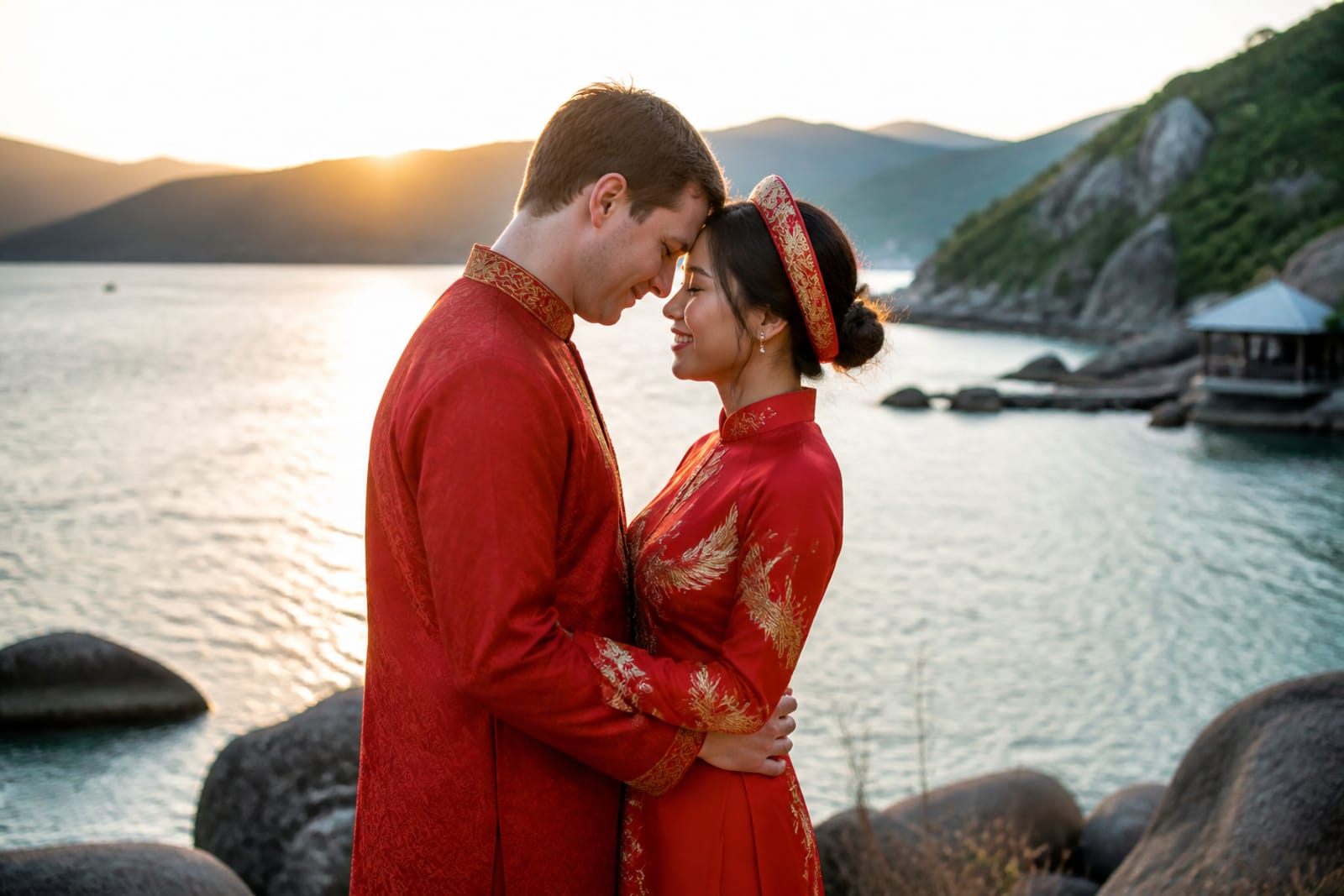
Three zones exist on and near Hon Tre. The cable-car pier and base lodge see 300+ visitors daily by 6:30 am — direct sun, no shade, hard shadows. The mid-island plateau (accessible by walking the cable-car path or boat) has cleared pavilions and sea views; light is softer here 6:30–7:00 am and 4:45–5:30 pm before it hits the water. The eastern rocky shore (boat access, ask locals) is almost never crowded; couples can walk, stop, sit on rocks, and let the light work without an audience — this is where the best frames happen because the photographer isn't rushing and the couple isn't performing.
Most couples spend 10 minutes at the pier, then move on. The hidden spots require walking 15–20 minutes on uneven ground or a boat ride (₫ prices vary — check locally), but the payoff is a frame that looks like your story, not a template.
When does the light actually work for couples at Hon Tre?
| Season | Best months | Light quality | Why it matters | Crowds |
|---|---|---|---|---|
| Dry | Jan–Aug | Soft side light 6:10–7:00 am; golden hour 5:00–5:30 pm | No haze, sea calm, color saturated | Fewer by 7:15 am |
| Rainy | Oct–Nov | Flat, grey, noon sun (6–7 hours); afternoon wind | Hard to frame; rough water behind couple | Peak crowds (escape weather) |
| Shoulder | Sep, Dec | Variable: some clear mornings, afternoon showers | Unpredictable; golden hour works if dry | Moderate |
Light at Hon Tre lasts in a "window" — not an all-day option. Side light (couple lit from the side, shadows sharp, sea behind them bright) occurs 6:10–6:50 am in Jan–Aug; by 7:15 am the sun has moved too high and the pier is mobbed. Afternoon golden light (sun low, warm, behind the couple) works 5:00–5:30 pm but only if clouds don't block it — the sea faces east, so sunset light hits them from behind, not the front.
Oct–Nov light is flat grey (good for even skin tone, bad for drama), and the sea churns (rough backdrop). Many couples still shoot then because they're already in Nha Trang, but the frames lack the clarity of a Jan–Aug 6:15 am session.
Conclusion: Book a Jan–Aug session at 6:10 am; if you're visiting Sep–Dec, shoot at midday with the sea on your side and accept softer, more muted tones.
How do you book a photographer for Hon Tre if Cáo Studio is not based there?
Cáo Studio operates in Hanoi, Ho Chi Minh City and Hoi An — if you want a directed couple session at Hon Tre, you have three paths:
Path 1: Hire a local Nha Trang photographer. Ask your hotel concierge or search Instagram #nhatrangphotographer; vet by looking at their couple work (not landscapes — couple work shows if they can direct you to walk, look at each other, and avoid stiff poses). Check: Do they own their own transport? Do they know the island access (pier, boat, cable-car staff)? Do they deliver edits in 2–3 days? Ask for a quote in WhatsApp or local messenger (Zalo is common in Nha Trang). Cost depends on session length (2–4 hours), number of outfits, and travel time.
Path 2: Fly to Hanoi or Ho Chi Minh City, book a Cáo Studio directed session, then shoot Hon Tre yourself. We'll show you the framing, light, poses and outfit strategy in a 4–6 hour session, then send you back to Nha Trang armed with the skills to recreate similar frames on Hon Tre with a tripod or a local photographer you trust. This suits couples who want professional guidance and a finished album from one session, plus the flexibility to explore Hon Tre after.
Path 3: DIY with a tripod. If you're comfortable with a remote, a 3-second timer, and post-processing, bring a compact tripod and a wireless remote — 6:15 am at the eastern rocks, you can shoot 50+ frames in 20 minutes with no crowd, no fee, and full creative control. A couple familiar with phone editing can produce sharp, warm frames this way; beginners often get out-of-focus or over-brightened results.
Conclusion: Hire locally if you want a professional on-island; book Cáo Studio elsewhere if you want a finished album and post-session guidance; DIY if you're time-rich and risk-tolerant.
📸 Book a couple photoshoot — directed, finished in 48 hours
What outfit strategy works on Hon Tre's rocky, sea-spray terrain?
Most couples wear a single outfit on Hon Tre because the island has one usable light window (25 minutes). Fabric choice matters: cotton ao dai works if the shoot is 6:15–6:45 am (no spray yet); by 7:00 am sea spray risks salt stains on silk. Western couple dresses (knee-length, lightweight, dark or warm tones) photograph well at the mid-island pavilion with the sea in the background; avoid white (blends with sea haze) and heavy fabrics (humidity at sea level). Shoes: wear something you can walk in — the eastern rocks are wet and uneven.
Many couples shoot one frame in an ao dai or dress, then change into casual linen or jeans for the "walking away" shot (couple exits frame toward the sea, holding hands, natural light, no pose). The outfit change takes 5–8 minutes; time it for the 6:40–7:00 am window so you're not shooting in harsh overhead sun.
If you're booking a local Nha Trang photographer, ask upfront if they have a makeup artist on-site (rare — bring your own) and whether they'll do a outfit change (factor in an extra 30 minutes of session time, so book a 3-hour rather than 2-hour slot).
Conclusion: One outfit works best at Hon Tre; if two, time the change for the 6:35–7:00 am golden window; avoid white and silk.
What hidden angles do photographers never shoot at Hon Tre?
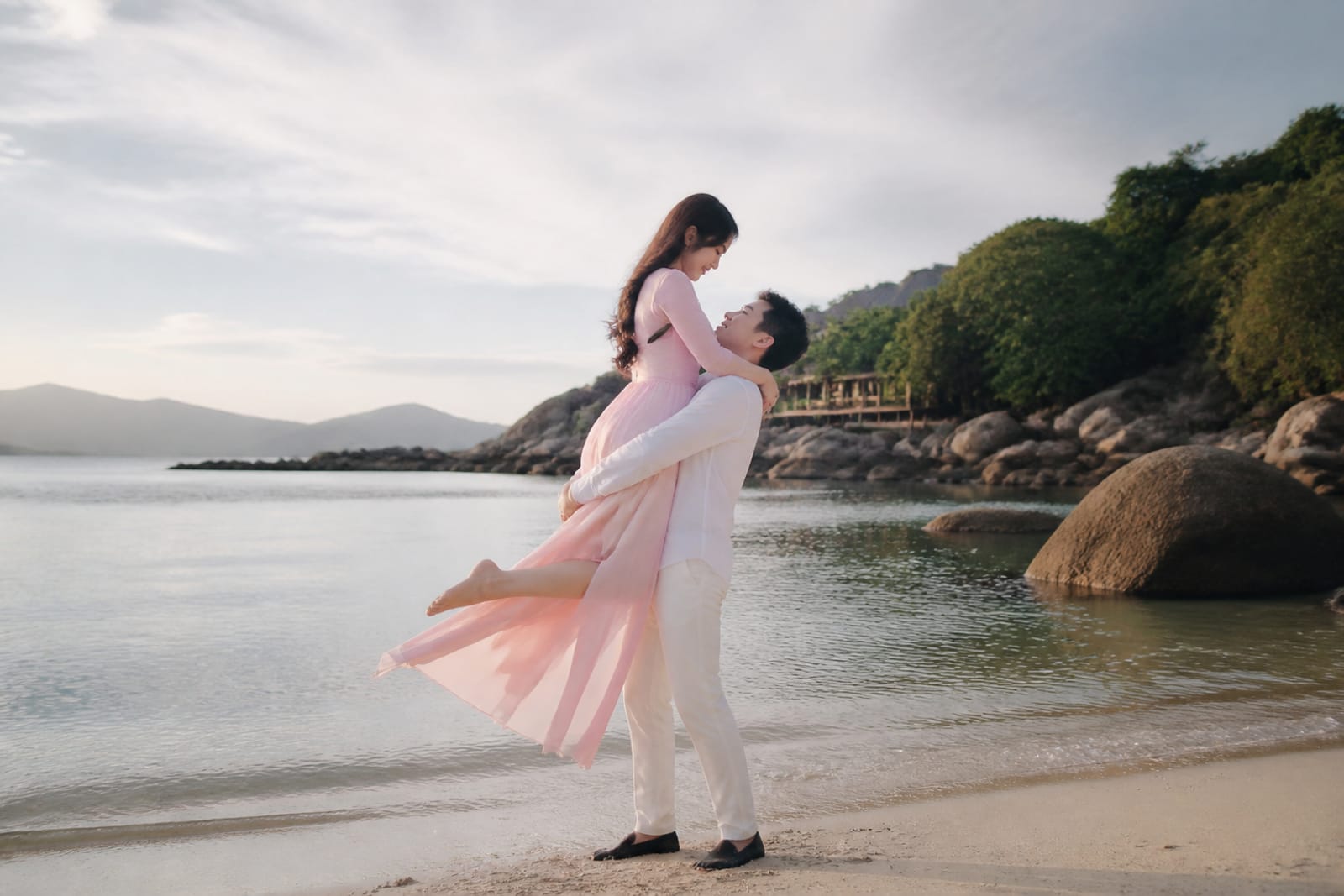
Standard Hon Tre frames: couple at the pier with cable car in the background, couple at the cable-car base lodge, couple on the mid-island pavilion facing the sea. These sell because they're recognizable. Hidden angles:
- The access path angle — couple walking toward the pier at 6:20 am, sun side-lighting them, rocks and morning mist below. No photographer shoots this because most don't arrive early enough.
- The rocky eastern shore at tide-change — rocks are partially submerged, water is glassy, couple sits on a high dry rock and the foreground has this graphic black-and-white graphic below them. Requires local knowledge of tides (not covered by standard tours).
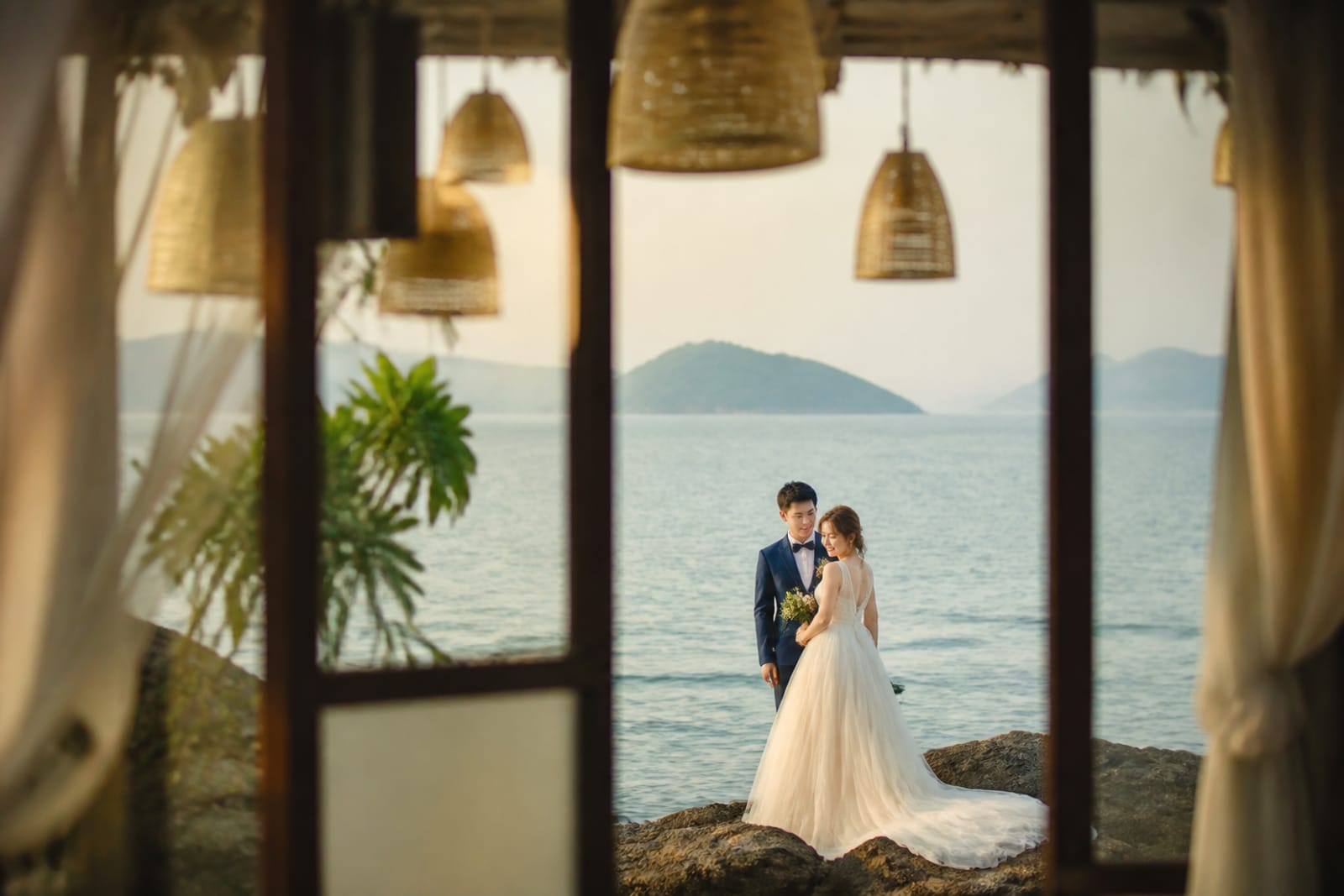
- Behind the cable car — couple in the shadow of the cable-car cabin, backlit sea-light creating a rim light on their silhouettes. Most photographers avoid shade; this one is deliberate.
- The pavilion stairs — couple descending mid-island pavilion stairs at 6:50 am, warm light on their faces, sea and mist behind and above. It's a 15-meter walk; most couples don't find it.
These angles aren't hidden because they're secret — they're hidden because they require early arrival, local navigation, understanding light direction, and a photographer (or couple) willing to walk beyond the posted photo spot.
Conclusion: Work with a photographer who arrives at 5:50 am, asks locals, and scouts beyond the main lodge; DIY couples: explore the pavilion area 6:20–6:50 am and test the stairs and side paths.
💄 Makeup & hair at your Nha Trang hotel — ready by 5:45 am
Should you fly to Hanoi, Ho Chi Minh City or Hoi An for a directed photoshoot instead?
If you're in Nha Trang for a beach holiday and want a couple photoshoot, hiring a local photographer takes 3–5 hours on-island and costs less (distance, no travel time for the photographer). If you're planning a multi-city Vietnam trip and want a finished, directed album plus new outfits styled by a team, flying to Ho Chi Minh City or Hanoi for a Cáo Studio session makes sense — you'll get a photographer, hair & makeup artist, and wardrobe coordination in one booking, then take 48–72 hours to recover and explore the city.
Couples often ask: "Should I book a studio in Hanoi (4 hours by plane from Nha Trang) or a local Nha Trang photographer?" The decision hinges on your trip length and budget factors (travel time to another city, total session cost, number of outfits, delivery timeline). Studio sessions (like Cáo) deliver more finished frames (50–100 edited images per session) because there's no time pressure and a team handles styling; local photographers deliver fewer (20–40) but capture more authentic moments because you're in your chosen location. Neither is wrong — it depends on whether you want the experience of a full production day or the location of a single perfect island spot.
Conclusion: Book local Nha Trang if you're island-based and want quick turnaround; book Cáo Studio elsewhere if you want a full team, multiple outfits, and a polished album.
🌸 See pre-wedding photoshoot options & lookbook
What to check before you book a photographer for Hon Tre
- Arrival time. Ask the photographer: "What time do you arrive at the pier?" Anything after 6:00 am loses the soft side light. Confirm in writing.
- Access & fees. Does the photographer pay the cable-car fare, boat fee, or pier access charge? Confirm who covers what. If they say "it's included in the session fee," ask the total in advance.
- Editing timeline. "When will I see proofs?" Local photographers: 3–7 days. Cáo Studio: 48 hours.
- Outfit change logistics. If two outfits, where will the couple change? Confirm there's a bathroom or private pavilion — no makeshift changing on rocks.
- Weather backup. If it rains on shoot day, is there a reschedule (free or paid) or a refund? Pin this down.
- Delivery format. How many edited images? What file type (JPEG, RAW, video)? Do you get a digital copy or only prints? Ask for specifics, not "about 50."
---
FAQ
Is Hon Tre island accessible year-round for photoshoots?
Yes, the cable car and pier operate year-round. However, Jan–Aug has calm seas and clear light; Oct–Nov brings rain and rough water that creates grey skies and unstable footing on rocks. Sep and Dec are unpredictable. Best season is Feb–Aug.
How early do we need to arrive to avoid crowds?
5:50 am. The pier sees its first tour groups by 6:30 am. If you arrive at 6:15 am or later, most frames will show other tourists. Early arrival is non-negotiable for a crowd-free shot.
Can we shoot at Hon Tre without hiring a photographer — just us and a tripod?
Yes. Bring a compact tripod and a wireless remote. Test it at 6:15 am on the eastern rocks — you can shoot 40+ frames in 20 minutes unsupervised. The trade-off: no one to direct your pose, no on-the-fly outfit feedback, and manual focus can miss if the wind moves the tripod.
What's the actual cost difference between a local Nha Trang photographer and Cáo Studio?
Session cost depends on duration, outfits, travel time and local rates — ask a local photographer on WhatsApp and ask Cáo Studio on WhatsApp for a comparison. The deciding factors are session length, number of edited images, and whether you value a team (Cáo) or a single photographer (local).
Do we need to wear traditional ao dai or can we wear Western clothes?
Both work. Ao dai photographs dramatically against the sea; Western dresses (knee-length, solid colors, lightweight fabrics) work equally well. Avoid white (blends with sea haze) and heavy silks (salt spray stains). Choose what feels natural to you and matches the mood.
What if we book a session and the weather turns bad on shoot day?
Ask the photographer's reschedule policy upfront — some offer a free reschedule within 2 weeks, others may charge a fee or offer no guarantee. Confirm this before you pay. Grey weather (Oct–Nov) is still shootable but creates flat, muted tones; rain makes footing unsafe, so most photographers reschedule if there's active rain.
FAQ
Is Hon Tre island accessible year-round for photoshoots?
Yes, the cable car and pier operate year-round. However, Jan–Aug has calm seas and clear light; Oct–Nov brings rain and rough water that creates grey skies and unstable footing on rocks. Sep and Dec are unpredictable. Best season is Feb–Aug.
How early do we need to arrive to avoid crowds?
5:50 am. The pier sees its first tour groups by 6:30 am. If you arrive at 6:15 am or later, most frames will show other tourists. Early arrival is non-negotiable for a crowd-free shot.
Can we shoot at Hon Tre without hiring a photographer — just us and a tripod?
Yes. Bring a compact tripod and a wireless remote. Test it at 6:15 am on the eastern rocks — you can shoot 40+ frames in 20 minutes unsupervised. The trade-off: no one to direct your pose, no on-the-fly outfit feedback, and manual focus can miss if the wind moves the tripod.
What's the actual cost difference between a local Nha Trang photographer and Cáo Studio?
Session cost depends on duration, outfits, travel time and local rates — ask a local photographer on WhatsApp and ask Cáo Studio on WhatsApp for a comparison. The deciding factors are session length, number of edited images, and whether you value a team (Cáo) or a single photographer (local).
Do we need to wear traditional ao dai or can we wear Western clothes?
Both work. Ao dai photographs dramatically against the sea; Western dresses (knee-length, solid colors, lightweight fabrics) work equally well. Avoid white (blends with sea haze) and heavy silks (salt spray stains). Choose what feels natural to you and matches the mood.
What if we book a session and the weather turns bad on shoot day?
Ask the photographer's reschedule policy upfront — some offer a free reschedule within 2 weeks, others may charge a fee or offer no guarantee. Confirm this before you pay. Grey weather (Oct–Nov) is still shootable but creates flat, muted tones; rain makes footing unsafe, so most photographers reschedule if there's active rain.
Ao dai, makeup, hair and a local photographer in Hanoi or Saigon — one WhatsApp message.