/pre-wedding-photoshoot
Hidden photo corners near Mui Ne fishing village for couples
Mui Ne fishing village rewards couples who shoot early: arrive by 6:30 am at the main harbor (Mui Ne town center) for calm water, soft side light, and empty docks. The village sits on the south coast, where dry season (November–April) offers consistent clear skies and strong morning light on boats and nets. A 20-minute walk east reaches quieter inlets with weathered wooden structures. Expect windy conditions November–March (sand drifts onto clothing); wear layers and bring a lint roller. Cáo Studio does not shoot in Mui Ne, but we guide couples booking local photographers on light, timing, and how to coordinate outfits and touch-ups on location.
Mui Ne is Vietnam's sunniest, driest area—a strategic advantage for couple shoots. The fishing village itself remains unglamorous: narrow lanes, salt-cured nets, and boats returning at dawn. This plainness is the asset. A couple walking past stacked nets in side light, or standing in front of a weathered blue fishing boat at 6:45 am, reads as cinematic because the light is real and the setting is unhurried.
The village does not have the postcard polish of Hoi An or Ha Long. It has silence, texture, and the kind of morning color—pale gold, grey water, rust on metal—that makes silhouettes and profiles work.
What time of day catches the best light in Mui Ne village?
Sunrise to 7:30 am is the only window. The sun rises over the water (east-facing harbor), so side light hits faces and objects at a low, forgiving angle. By 8 am, tour buses and fishing boats return, crowds gather, and light hardens. Late afternoon (4:30–5:30 pm) works for dune silhouettes, but not the village itself—the sun is too high and hot by midday to use the boats or nets effectively.
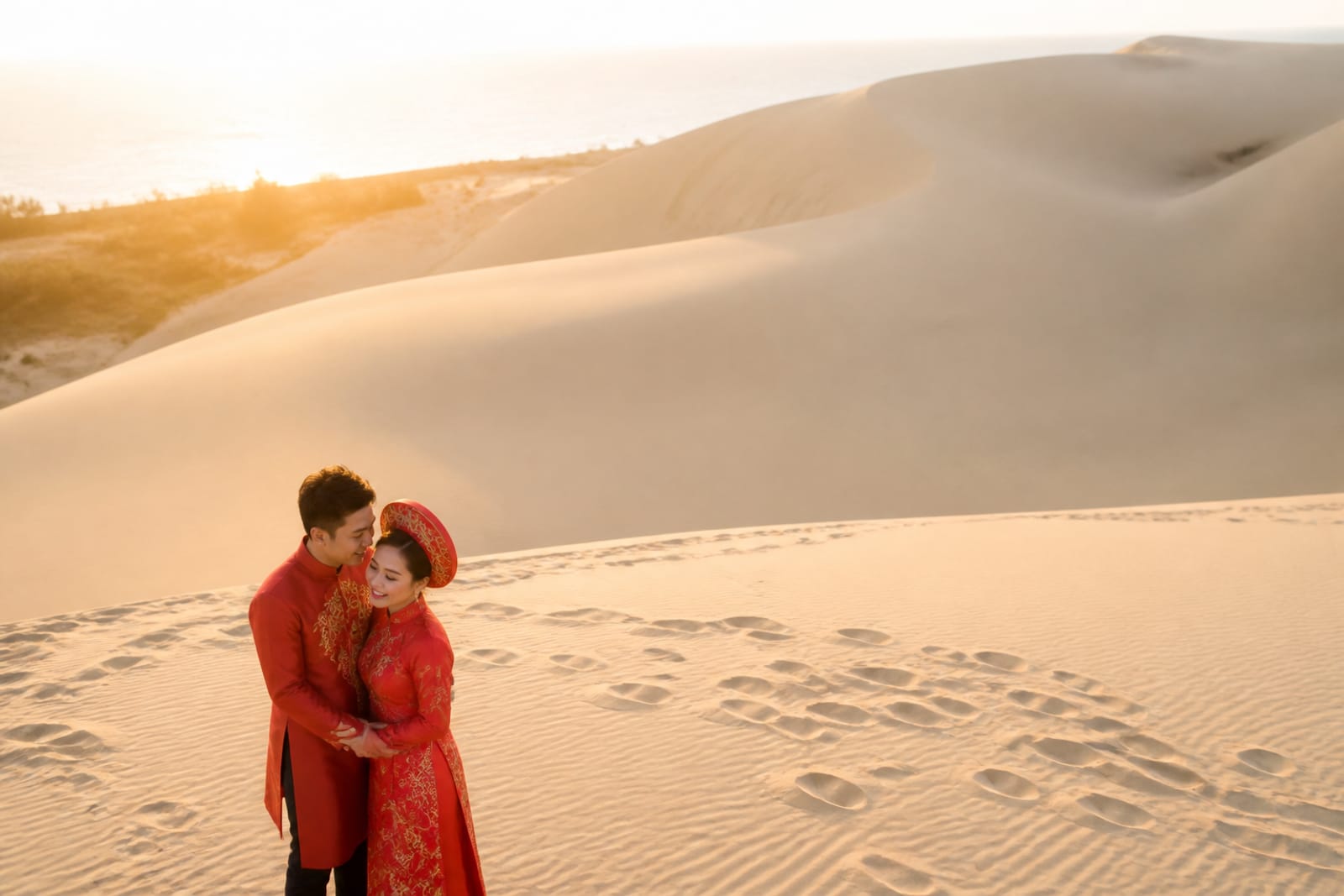
Decision frame: early morning suits couples seeking quiet, directed frames on location; late afternoon suits dune walks and silhouettes as a second scene.
Which season offers the clearest skies and steadiest light?
November to April is Mui Ne's dry window. December–February are coolest and driest; March–April remain clear but heat and occasional haze increase. May–November is wet and unpredictable, with afternoon downpours common and typhoon risk September–November.
For consistent side light and minimal weather delays, book November–February. Pack sunscreen and a windbreaker—November–March winds are strong, and sand lifts onto skin and clothing. Damp cloth or lint roller essential.
Where exactly should a couple position for the strongest frames?
The main harbor (center of Mui Ne town) has parked boats, nets spread on docks, and weathered structures—ideal for walking shots. Walk east along the shoreline for 15–20 minutes to find quieter inlets with fewer boats and a single or two, giving more isolation. The dunes begin 10–15 minutes inland from the main harbor; sunrise silhouettes there require a 30-minute round-trip walk, doable if you start at 6 am and return by 7:15 am to avoid heat.
Best frames come from movement: a couple walking past nets, stepping over rope, or sitting on a boat edge facing water. Stationary poses in front of landmarks read flat in this light.
| Scene | Best for | Light window | Season | Walking effort |
|---|---|---|---|---|
| Main harbor, boats and nets | Directed walking, profiles, detail shots | 6:30–7:30 am | Nov–Apr | 5 min each way |
| Eastern inlet shoreline | Quieter boats, isolation, golden reflections | 6:45–7:45 am | Nov–Apr | 20 min each way |
| Dune silhouettes (inland) | Couple facing sunset, arm-in-arm frames | 4:30–5:30 pm | Nov–Apr | 30 min round-trip |
| Harbor at magic hour (late dusk) | Blue hour, subtle color, fewer people | 5:30–6:15 pm | Nov–Apr | Local navigation needed |
How should a couple choose their outfit for the village setting?
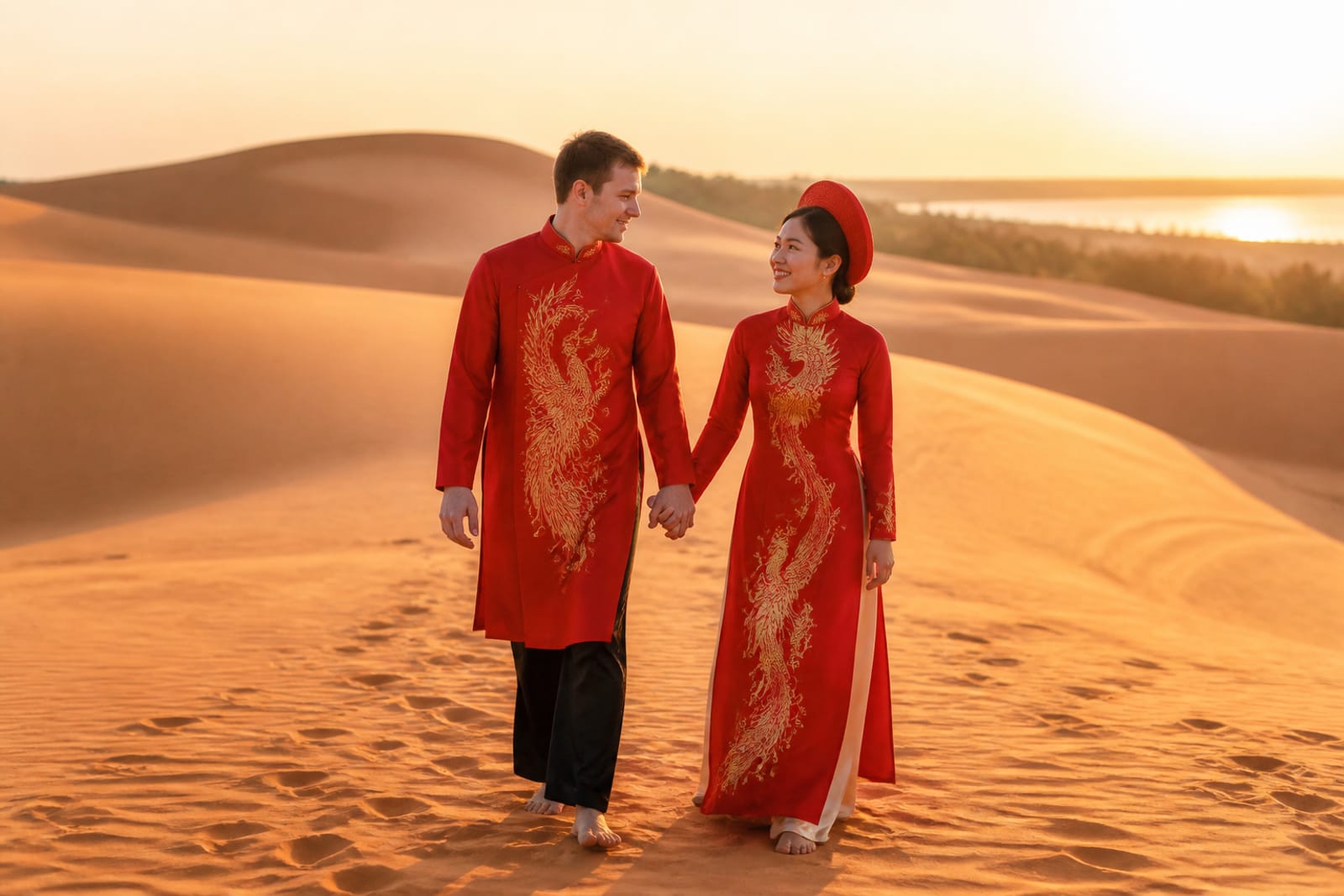
Wear neutral, natural fabrics that move and don't wrinkle in wind: linen pants, cotton dresses, loose knitwear in cream, grey, or soft colors. Avoid bright prints or white (reads blown-out in harsh reflections). An ao dai (traditional Vietnamese tunic) works if fitted well and worn without a scarf in wind—consider a sleeveless version or silk that moves. Bring a shawl or light wrap to layer against morning cool and wind.
Shoes: walk in flat sandals, sneakers, or soft leather; change into final shoes just before the photographer begins. Wet sand near the shore soaks canvas and fabric; wear water-safe footwear or go barefoot for beach frames.
Hair: tie back or use a light bun (wind moves loose strands into faces). Minimal jewelry (light metals, not heavy pieces that catch light and distract).
The goal is to look like you, unhurried—not "dressed up for the village." The setting rewards simplicity.
---

Who should you book—a local Mui Ne photographer or a traveling team?
Local Mui Ne photographers know the harbor tides, exact angles, and local fishermen—useful if you're flexible on timing and want cultural authenticity. Most are available via local tour operators or hotel recommendations. Cost typically factors in travel time, session length, and whether they handle makeup or outfits—ask before booking.
A traveling team (e.g., from Hanoi or Ho Chi Minh City) arrives with hair, makeup, and styling already coordinated, reducing on-site delays. They may be less familiar with Mui Ne's specific light and tides but excel at narrative framing and fast turnaround editing.
Cáo Studio does not operate in Mui Ne, but we shoot pre-wedding and elopement sessions in Hanoi, Ho Chi Minh City, and Hoi An. If you're combining a Mui Ne photoshoot with a formal ao dai session or couple shoot in a larger city, we can coordinate with a vetted local photographer in Mui Ne and handle your styling and editing.
📸 Book on WhatsApp — pre-wedding photoshoot
What should you confirm before booking a photographer in Mui Ne village?
- Light timing: confirm the photographer has shot the harbor at 6:30 am and knows which direction the sun rises (east, over water) and which harbor angles avoid backlight.
- Tides and fishermen: ask if the photographer knows when boats are parked (best for posing) vs. returning (busier, less predictable).
- On-site delays: if you're traveling from Ho Chi Minh or Hanoi, budget extra time for traffic and early-morning meetings (6:00 am start means a 4:30 am hotel pickup from most locations).
- Weather backup: confirm what happens if wind is strong or unexpected rain arrives—rescheduling vs. pivoting to indoor/sheltered scenes.
- Outfit and makeup coordination: clarify who handles hair and makeup. If the photographer doesn't, hire a separate artist or use Cáo Studio's hotel makeup and hair service the evening before (available in Hanoi, Ho Chi Minh City, and Hoi An).
- Delivery timeline: ask for a turnaround estimate. Quick turnarounds (24–48 hours for edited files) require a lightweight editing workflow—confirm if the photographer offers this.
- Backup scenes: if the harbor is too crowded or weather turns, does the photographer know quieter spots (riverside, salt flats inland, dune inlets)?
---
If you're already in Ho Chi Minh City or Hanoi, is it worth the drive to Mui Ne for a photoshoot?
Yes, if you have a full day and prefer authenticity over convenience. From Ho Chi Minh City, Mui Ne is 4–5 hours by car (one way). From Hanoi, it's a flight or 12+ hours driving. The trade-off: you gain weathered texture, strong dry-season light, and isolation—qualities that make for directed, narrative frames rather than posed tourist moments.
If time is limited, a local session in your city (Hanoi, Ho Chi Minh, Hoi An) with Cáo Studio ensures a full team (photographer, makeup, hair, styling) already coordinated, with 48-hour turnaround and no travel coordination. If you're staying in Mui Ne for other reasons (beach vacation, dune exploration), booking a local photographer for a morning harbor session is straightforward and rewarding—just arrive early, confirm light conditions, and bring the right outfit.
---
Practical checklist before your Mui Ne village photoshoot
- [ ] Book photographer at least 1–2 weeks ahead; confirm 6:30 am start time and harbor location.
- [ ] Check weather forecast 3 days before; confirm wind and visibility.
- [ ] Arrange hotel pickup by 5:30 am (factor in 15–20 min drive from central Mui Ne).
- [ ] Bring water, sunscreen, lint roller, and windbreaker.
- [ ] Wear neutral, fitted clothing (no loose patterns); pack shoes separately.
- [ ] If using a local photographer without a makeup artist, arrange touch-ups the night before or use travel-friendly makeup (powder, lipstick, brow pencil).
- [ ] Confirm photographer's camera (DSLR/mirrorless, stabilization for movement shots) and editing software (Lightroom, Capture One).
- [ ] Ask for a test shot at 6:35 am so you can adjust pose, light angle, or outfit before committing to frames.
- [ ] Agree on file format, turnaround timeline, and number of edited photos in advance.
- [ ] Plan a quiet breakfast or rest after the session (early mornings are intense; celebrate the shoot before reviewing frames).
---
FAQ
Is early morning the only time to shoot in Mui Ne fishing village?
Sunrise to 7:30 am is optimal for directed frames on boats and nets—soft, low side light and empty docks. Late afternoon (4:30–5:30 pm) works for dune silhouettes but not the village itself. Midday (9 am–3 pm) has hard light and crowds; avoid it unless you're shooting in shade or using silhouettes creatively.
What's the weather risk in November–April?
November–March are Mui Ne's driest months with strong, sometimes gusty winds that blow sand onto clothing and skin. Pack a windbreaker and lint roller. Rain is rare. April heat increases but skies remain clear. May–November brings afternoon downpours and typhoon risk September–November; unpredictable for scheduled shoots.
Do we need permits or permissions to shoot in the fishing village?
Check with your photographer or the local harbor office. Most early-morning personal shoots (non-commercial) don't require permits, but commercial and wedding shoots may. If unsure, ask your photographer—they'll know local customs and who to approach if fishermen are present.
Can we do both the harbor and the dunes in one session?
Yes, if you start at 6 am at the harbor (finish by 7:30 am) and hike inland to the dunes by 8:30 am for detail shots. A full dune silhouette session requires waiting until 4:30 pm—a long day. Most couples pick one primary scene (harbor) and a secondary (dunes) rather than equal time in both.
What if the photographer isn't local to Mui Ne—how do we ensure they know the light and timing?
Ask them to share 3–5 previous Mui Ne shoots taken at sunrise (6:30–7:30 am) with the sunrise direction and harbor angle visible. If they can't, either hire a local or book a traveling team that scouts the location one day before. Cáo Studio coordinates this for couples booking a session in nearby Ho Chi Minh City—ask on WhatsApp for referrals.
Can we wear an ao dai for a Mui Ne village photoshoot?
Yes, if fitted well and in solid, natural colors (cream, grey, silk blush). Avoid heavy scarves in wind; sleeveless or silk versions move better. Pack the ao dai separately and change into it at the harbor for final frames. The simple setting reads best with minimal styling—let the light and landscape carry the mood.
FAQ
Is early morning the only time to shoot in Mui Ne fishing village?
Sunrise to 7:30 am is optimal for directed frames on boats and nets—soft, low side light and empty docks. Late afternoon (4:30–5:30 pm) works for dune silhouettes but not the village itself. Midday (9 am–3 pm) has hard light and crowds; avoid it unless you're shooting in shade or using silhouettes creatively.
What's the weather risk in November–April?
November–March are Mui Ne's driest months with strong, sometimes gusty winds that blow sand onto clothing and skin. Pack a windbreaker and lint roller. Rain is rare. April heat increases but skies remain clear. May–November brings afternoon downpours and typhoon risk September–November; unpredictable for scheduled shoots.
Do we need permits or permissions to shoot in the fishing village?
Check with your photographer or the local harbor office. Most early-morning personal shoots (non-commercial) don't require permits, but commercial and wedding shoots may. If unsure, ask your photographer—they'll know local customs and who to approach if fishermen are present.
Can we do both the harbor and the dunes in one session?
Yes, if you start at 6 am at the harbor (finish by 7:30 am) and hike inland to the dunes by 8:30 am for detail shots. A full dune silhouette session requires waiting until 4:30 pm—a long day. Most couples pick one primary scene (harbor) and a secondary (dunes) rather than equal time in both.
What if the photographer isn't local to Mui Ne—how do we ensure they know the light and timing?
Ask them to share 3–5 previous Mui Ne shoots taken at sunrise (6:30–7:30 am) with the sunrise direction and harbor angle visible. If they can't, either hire a local or book a traveling team that scouts the location one day before. Cáo Studio coordinates this for couples booking a session in nearby Ho Chi Minh City—ask on WhatsApp for referrals.
Can we wear an ao dai for a Mui Ne village photoshoot?
Yes, if fitted well and in solid, natural colors (cream, grey, silk blush). Avoid heavy scarves in wind; sleeveless or silk versions move better. Pack the ao dai separately and change into it at the harbor for final frames. The simple setting reads best with minimal styling—let the light and landscape carry the mood.
Ao dai, makeup, hair and a local photographer in Hanoi or Saigon — one WhatsApp message.