/pre-wedding-photoshoot
Hidden photo corners near Thien Mu Pagoda for couples
Thien Mu Pagoda's photogenic zones cluster within a 300-metre radius: the pagoda base, the riverside approach, the staircase landing, and the tea house pavilion. Each catches different light—morning (6–9 a.m.) favours the east-facing stairs; noon flattens most angles; afternoon (3–5 p.m.) gilds the riverfront. The site requires respectful dress (covered shoulders, knees) and is busiest before 8 a.m. or after 4 p.m. If you're shooting an ao dai photoshoot or pre-wedding session, book a photographer who knows Hue's central-coast climate—dry Feb–Aug, typhoon-prone Oct–Nov—and can scout tight-access spots. Cáo Studio – Makeup & Photoshoot does not operate in Hue; this guide helps you plan with a local team. 📸 Book on WhatsApp — pre-wedding photoshoot
Which corner suits your aesthetic—temple steps, riverside, or pavilion?
The pagoda's stone staircase (leading upward from the entrance) is a classic couple pose point: symmetrical framing, deep shadow at midday, golden sidelight in early morning. It's tight—only 2–3 metres wide—so movement is constrained; best for still, formal portraits. The riverside embankment (north of the main building, overlooking the Perfume River) is open, softer, and catches afternoon glow; couples favour it for walking shots and candid embrace frames. The tea pavilion (east side, often misses tourist traffic) has latticed shade and intimate spatial depth; ideal for close-up emotion but requires explicit permission from monks. Each demands different lens distances and body positioning—stairs need wider angles; riverside suits 50–85mm portraiture.
Comparison: Thien Mu corners by light and access
| Corner | Best time of day | Season sweet spot | Dress code fit | Effort to reach | Why pick it |
|---|---|---|---|---|---|
| Stone staircase | 6–8 a.m. (sidelight) or 4–5 p.m. (backlight) | Feb–Apr (cool, clear skies) | Covered shoulders, knees required; ao dai drapes well | Medium (open access, slight climb) | Symmetrical framing, drama, temple grandeur |
| Riverside embankment | 3–5 p.m. (golden hour) | Feb–Aug (low rain risk) | Knee-length minimum; flowing fabrics photograph better | Easy (flat path, public space) | Soft water reflections, intimate walking shots, natural spacing |
| Tea pavilion | 10 a.m.–4 p.m. (dappled shade) | Year-round (shade buffers heat) | Casual acceptable if respectful | Medium (narrow stairs, seek permission) | Quieter backdrop, soft emotion, close framing |
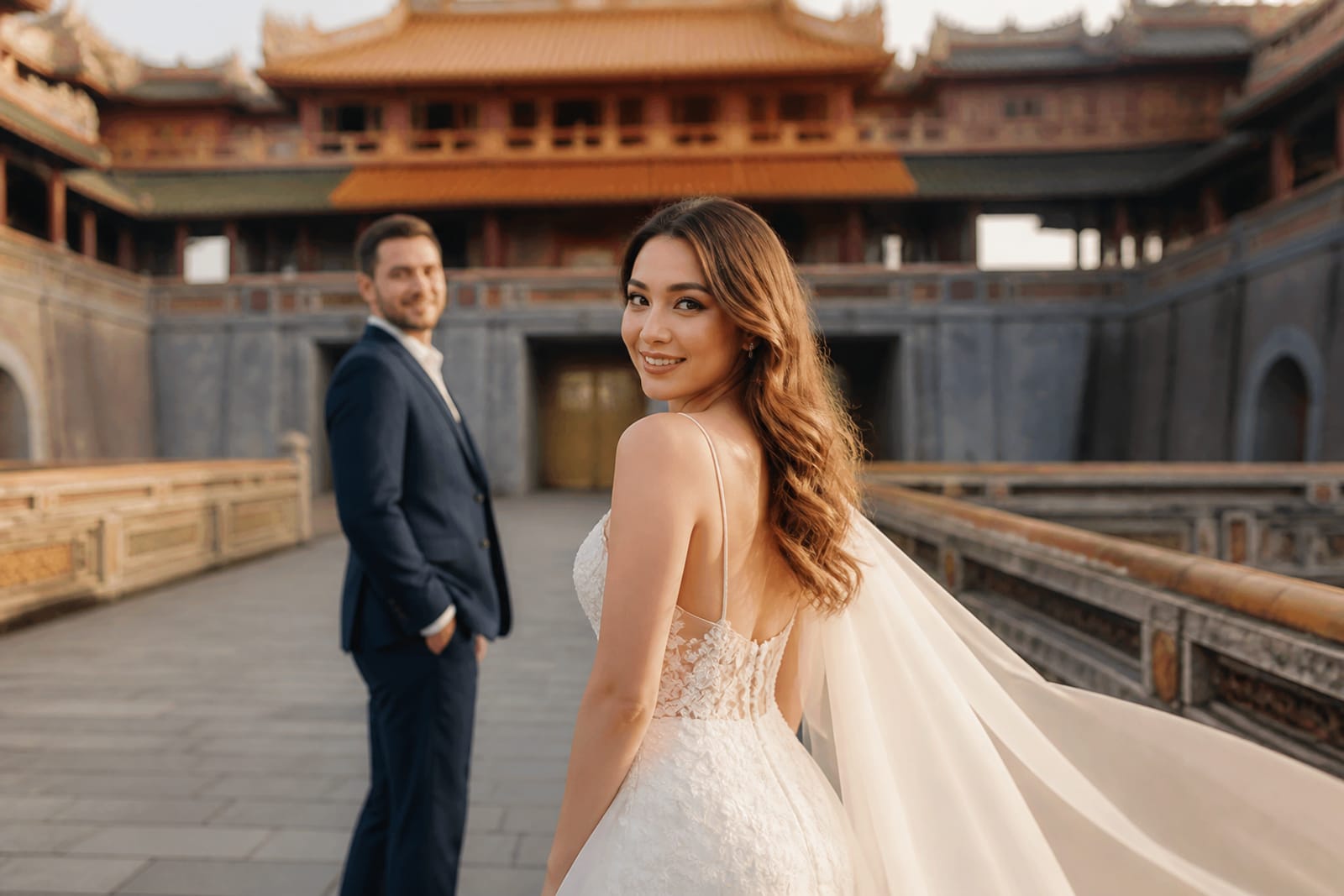
What season and weather actually control your shot quality?
Hue follows the central-coast monsoon pattern but wetter: February to April is ideal—cool, stable light, low rain. May to August brings intense noon glare (noon shadows become hard, dark pools) and afternoon humidity haze; shoot early or late only. September to December is typhoon season; October–November sees the heaviest rain and river flooding—some riverside paths may close, and clouds choke the sky for days. Book your shoot Feb–Apr if possible. If you're committed to May–Sep, plan for midday softness (shooting under pagoda eaves, pavilion lattice) and expect saturated, diffused colours rather than clean temple silhouettes. Rain is not automatic but is a serious planning factor; check the 7-day forecast 3 weeks out, and ask your photographer about alternative indoor or sheltered angles (temple interior, covered stairs) as backup.
Should you book Cáo Studio or a local Hue photographer?
Cáo Studio – Makeup & Photoshoot operates in Hanoi, Ho Chi Minh City, and Hoi An—not Hue. For a Thien Mu shoot, you'll book a local Hue team. How to vet them:
- Specificity over promises: ask for their portfolio at Thien Mu specifically, not a generic Hue album. Do they show the stairs? The river angle? Lighting time stamps?
- Scout knowledge: can they name light shifts by hour and explain why they avoid noon? A real practitioner scouts 2–3 times before booking.
- Outfit knowledge: do they advise on ao dai fit, layer choices, or suggest a local tailor? Generic photographers skip this.
- Backup plans: if rain hits or monks restrict access, what's their pivot? Good teams pre-identify 2–3 adjacent temples or indoor angles.
- Timeline: ask for a written itinerary (6–8 a.m. at stairs, 9–10 a.m. at pavilion, break for makeup, afternoon river walk). Vague "we'll figure it out" is a red flag.
If you're flying to Hoi An or Hanoi instead, or combining Hue with a second location, Cáo Studio – Makeup & Photoshoot handles couple photoshoots and pre-wedding sessions with full makeup and styling included; ask about multi-destination rates on WhatsApp.
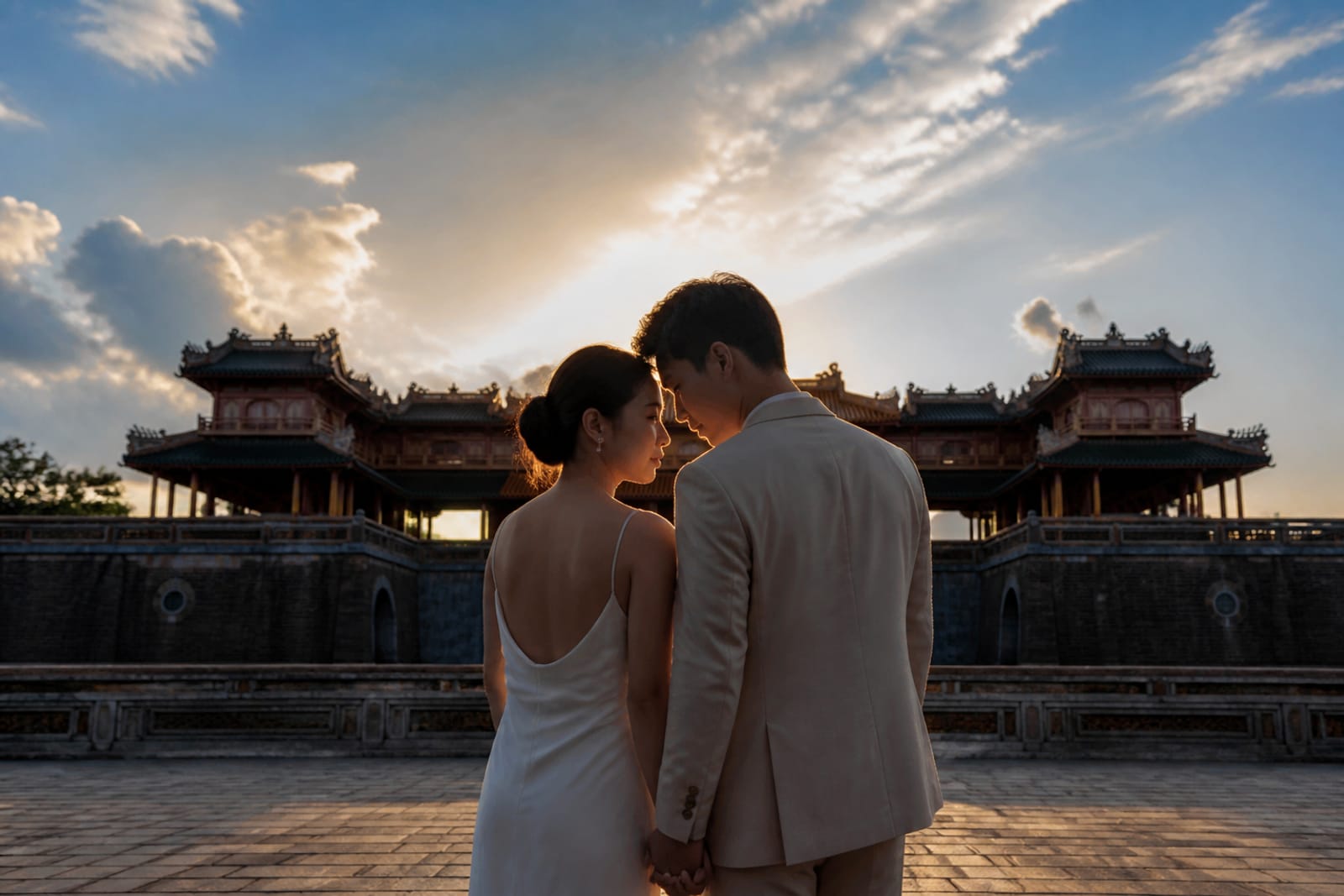
What outfit, fabric, and prep actually work in Hue's heat and monsoon?
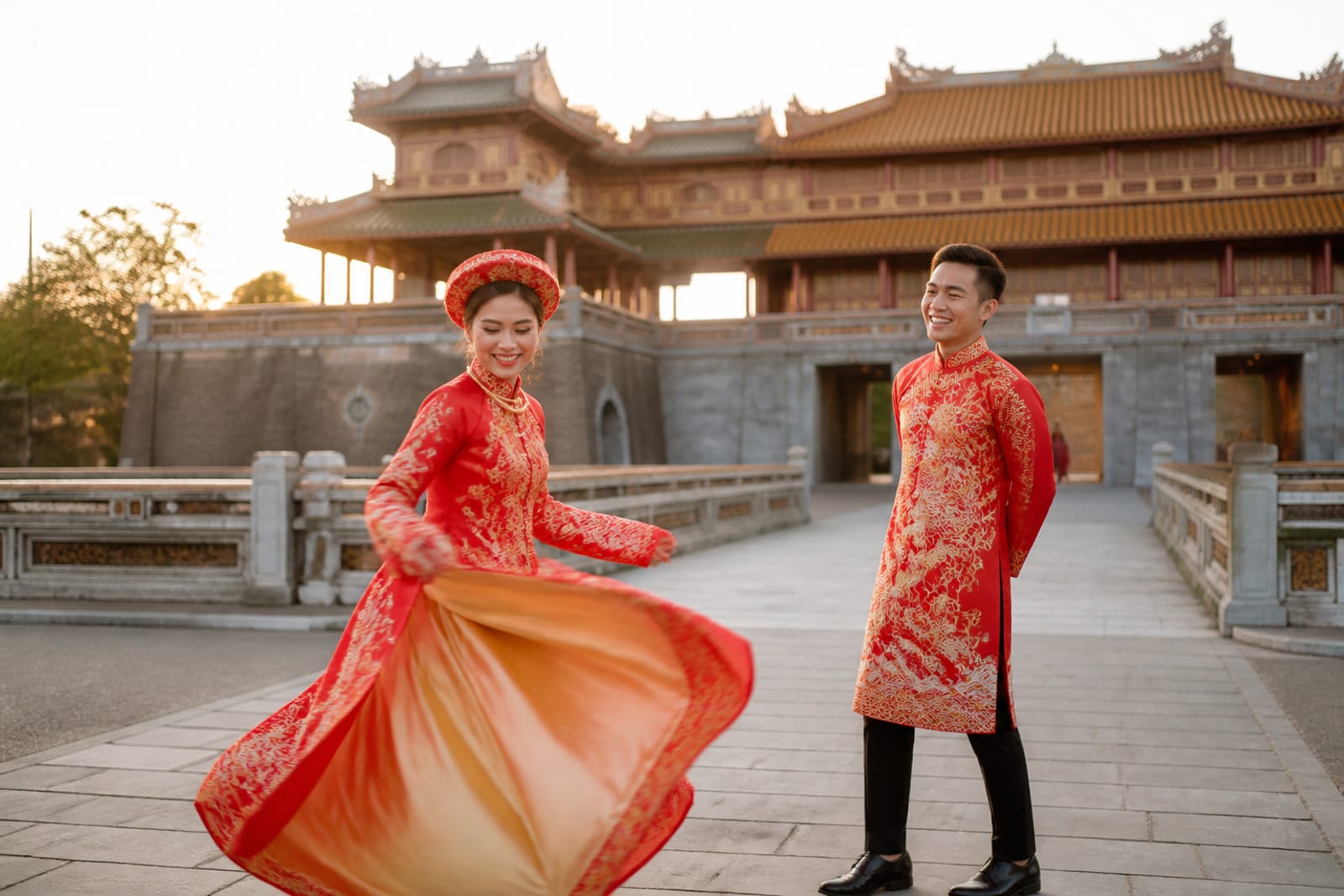
An ao dai is the natural choice—it's iconic at temple sites and photographs beautifully. Fit matters: a well-tailored ao dai skims the body, drapes long legs, and catches sidelight in the fabric folds. Tight, cheap versions collapse in photos and cling in humidity. If you're renting, visit a local tailor 2 days before the shoot for final tweaks; if bringing your own, try it in Hue's actual heat and mirror to see how it moves. Underneath, wear a slip or thin underdress (sweat staining silk is common); skip heavy petticoats in May–Sep heat.
For non-ao-dai options, favour loose, flowing fabrics (linen, silk, cotton blends) in neutral or jewel tones; cream, ivory, and pastels blow out in harsh light. Bring a second outfit—a casual modern dress or tailored trousers for variety—and plan outfit changes at the tea pavilion or a nearby cafe. Shoes: temple etiquette often requires removal indoors; wear slip-ons and carry small dressy flats or heels in a bag. Test makeup in Hue's mirror and humidity the night before; use long-wear primer and setting spray. Ask your photographer if they offer makeup & hair or can recommend a local stylist; Hue has skilled makeup artists, but coordination takes time.
How does the sacred site etiquette affect your shoot and team instructions?
Thien Mu is an active Buddhist temple. Dos and don'ts for couples and photographers:
- Dress code: shoulders covered, knees covered. An ao dai meets this; modern dresses must respect it too.
- Silence: photography is permitted in most areas, but avoid loud laughter, music, or directing staff loudly. Monks pray at certain times—ask a temple guardian when.
- Sacred objects: do not pose on altar steps, inside shrine rooms, or with statues as props. Many couples don't ask—it reads as disrespect and may get you asked to leave.
- Group dynamics: if your photographer brings an assistant, brief them on quiet conduct. Some temples restrict tripod use or require a permit for commercial shoots (check at the gate).
- Altars and monks: never block access, interrupt prayer, or ask monks to move for framing. Photograph monks only if they invite it.
- Tipping: small donations (if suggested) are appreciated; ask your photographer about local custom.
A photographer familiar with Hue temples will have this wired into their routine—they scout access times, know which monks are lenient, and steer couples toward respectful angles. If you're coordinating with a team remotely, send them a message like: "We want beautiful, reverent portraits. Show us how you balance photographic drama with temple respect." Their answer reveals professionalism.
What to check before you book a Thien Mu couple shoot
- Portfolio proof: images shot at Thien Mu, dated, with lighting time noted (not a generic Hue temple mix).
- Scouting timeline: do they scout? (2–3 visits before your date = professional standard.)
- Backup plan in writing: ask for their rain/access-restriction pivot and get it in an email or message.
- Outfit vetting: will they advise on fabric, fit, and layering? Do they know ao dai tailors in Hue?
- Makeup & hair: included or outsourced? If outsourced, do they coordinate timing and style brief?
- Inclusions confirmed: how many outfits, how many edited images, what's the delivery timeline? Get this in writing.
- Schedule: do they provide an hour-by-hour itinerary (stairs 6–8 a.m., pavilion 9–10 a.m., etc.)?
- Cost factors: location (tight access, river, pavilion), season (peak Feb–Apr = higher rates), number of outfits, and travel time from their studio. Ask on WhatsApp or email for a quote; never expect a number before a conversation.
If you're comparing a local Hue photographer to a Cáo Studio pre-wedding option in Hanoi or Hoi An, note that Cáo Studio includes makeup and styling at their studio or your hotel, professional editing, and a team that speaks English fluently—useful if communication matters. Local teams are cheaper and know Hue intimately; Cáo Studio's advantage is consistency and hassle-free logistics. Both are valid paths.
FAQ
Can I shoot inside Thien Mu Pagoda's shrine rooms, or only outdoors?
Interior photography is rarely forbidden, but some shrine areas restrict tripods or commercial cameras. Ask the monks at the gate before your shoot date. Outdoor stairs, pavilion, and riverside are always open. Respect any area they flag as off-limits.
What's the best month to shoot couples at Thien Mu if I'm flexible on dates?
February to April: cool, stable skies, minimal rain, and soft golden light. May to August works if you shoot early (6–8 a.m.) or late (4–5 p.m.), but heat and midday glare are harsh. Avoid October–November (typhoon, heavy rain).
Do I need a permit to hire a photographer at Thien Mu Pagoda?
Permits depend on the temple and your photographer's status. Ask your Hue photographer if they have a relationship with the temple; Cáo Studio does not operate in Hue, so check locally or request this in your first message to a potential team.
Can my photographer use a drone at Thien Mu?
Unlikely. Drones require civil aviation permits in Vietnam and temple approval. Most Thien Mu shoots exclude aerial footage. Confirm with your photographer and the temple in advance; don't assume it's possible.
If I book Cáo Studio instead of a local Hue photographer, can you shoot Hue and Hoi An in one trip?
Yes. Cáo Studio shoots in Hoi An (by appointment; ask dates on WhatsApp) and Hanoi. Hoi An and Hue are 120 km apart; you'd book separate days with a local Hue team and a Cáo Studio session in Hoi An. Discuss multi-destination logistics on WhatsApp.
What happens if it rains during my Thien Mu shoot?
A pro photographer has a backup—sheltered staircase angles, pavilion shoots, or a nearby covered cafe for outfit changes. Ask your chosen team: "What's your rain plan?" during booking. Cancellation and rescheduling policies also matter; confirm them in writing.
FAQ
Can I shoot inside Thien Mu Pagoda's shrine rooms, or only outdoors?
Interior photography is rarely forbidden, but some shrine areas restrict tripods or commercial cameras. Ask the monks at the gate before your shoot date. Outdoor stairs, pavilion, and riverside are always open. Respect any area they flag as off-limits.
What's the best month to shoot couples at Thien Mu if I'm flexible on dates?
February to April: cool, stable skies, minimal rain, and soft golden light. May to August works if you shoot early (6–8 a.m.) or late (4–5 p.m.), but heat and midday glare are harsh. Avoid October–November (typhoon, heavy rain).
Do I need a permit to hire a photographer at Thien Mu Pagoda?
Permits depend on the temple and your photographer's status. Ask your Hue photographer if they have a relationship with the temple; Cáo Studio does not operate in Hue, so check locally or request this in your first message to a potential team.
Can my photographer use a drone at Thien Mu?
Unlikely. Drones require civil aviation permits in Vietnam and temple approval. Most Thien Mu shoots exclude aerial footage. Confirm with your photographer and the temple in advance; don't assume it's possible.
If I book Cáo Studio instead of a local Hue photographer, can you shoot Hue and Hoi An in one trip?
Yes. Cáo Studio shoots in [Hoi An](/hoi-an) (by appointment; ask dates on WhatsApp) and [Hanoi](/hanoi). Hoi An and Hue are 120 km apart; you'd book separate days with a local Hue team and a Cáo Studio session in Hoi An. Discuss multi-destination logistics on WhatsApp.
What happens if it rains during my Thien Mu shoot?
A pro photographer has a backup—sheltered staircase angles, pavilion shoots, or a nearby covered cafe for outfit changes. Ask your chosen team: *"What's your rain plan?"* during booking. Cancellation and rescheduling policies also matter; confirm them in writing.
Ao dai, makeup, hair and a local photographer in Hanoi or Saigon — one WhatsApp message.