/pre-wedding-photoshoot
How Many Outfits to Bring for a Pre-Wedding Shoot in Vietnam
Bring 2–4 outfits for a standard pre-wedding shoot in Vietnam, depending on session length and location count. A single-location, half-day session works well with one western outfit plus one ao dai; a full-day multi-location shoot benefits from adding a second western set or a contrast ao dai (e.g., red over blush). More outfits mean more variety in the final edit but also longer session time and wardrobe logistics on-site. Cáo Studio – Makeup & Photoshoot schedules outfit changes into your timeline; confirm exact inclusions on WhatsApp. Avoid heavy, stiff fabrics in tropical heat; bring undergarments that work with both western and traditional dress. The northern cool-season (Dec–Feb) allows heavier layers; central and southern coasts benefit from lighter, breathable fits year-round.
The short answer: most couples shoot best with 2–4 outfits. The practical answer depends on what matters to you most—editing variety, comfort in heat, or ease of changing on location. We see this question every time someone books a pre-wedding shoot with us, and the answer is rarely the same twice. Here's how to choose.
What does "outfit" really mean in a pre-wedding shoot?
An outfit is one complete look from top to toe, including shoes and accessories. One western suit plus shirt plus tie is one outfit. One ao dai (traditional tunic and trousers) with a second-layer tunic is one outfit. Most couples conflate "outfit count" with "top-to-bottom changes," but the camera sees the whole frame. A new jacket or blazer over the same trousers reads as a new outfit in photos; a belt swap does not. In pre-wedding shoots, we count outfit changes by how long each swap takes on-location and whether the light or backdrop shifts enough to justify the time spent.
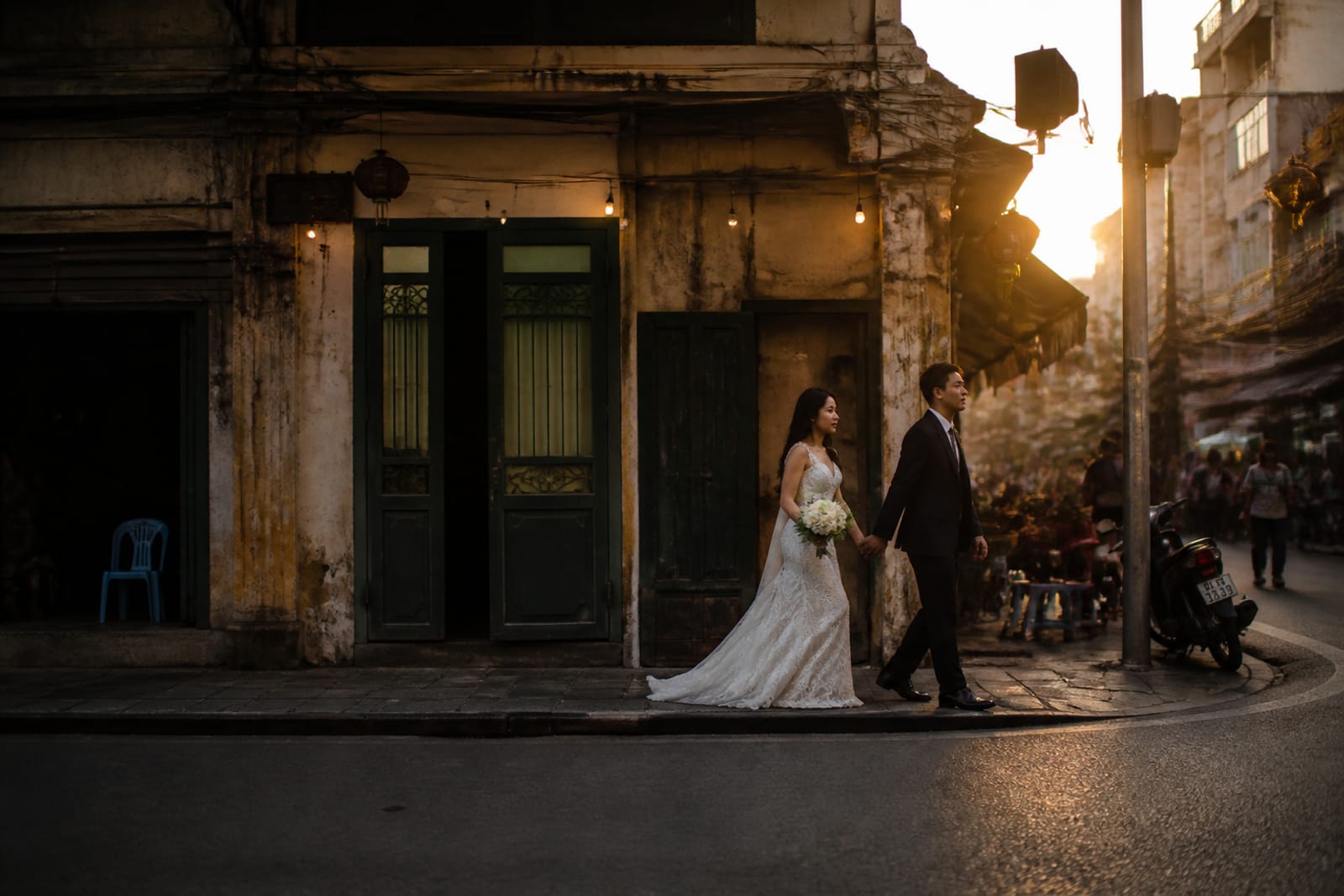
Should I wear an ao dai, western dress, or both?
Here's the framework most couples use:
| Scenario | Western + Ao Dai | Western Only | Ao Dai Only |
|---|---|---|---|
| Best for | Blending heritage & personal style | Speed, comfort in heat, few photos | Celebrating tradition, multiple ao dai colors |
| Time on-site | 45–90 min (2 outfit changes) | 15–30 min per outfit | 20–40 min per outfit |
| Northern season (Dec–Feb, cool) | Excellent—layers work | Good—lighter layers tolerate cold | Excellent—fabric drapes cleanly |
| Central coast (Feb–Aug, dry, bright) | Good if light & breathable | Best—one outfit fits long shoot | Good—pale colors reflect heat |
| Southern / wet season (May–Nov) | Manageable if quick changes | Best—avoid bulk, stay cool | Workable—white/cream ao dai shows sweat less |
| Why it works | Editors see contrast; outfit count justifies longer session | Simpler logistics; heat doesn't trigger outfit regret | Rich visual depth; you own the cultural narrative |
Most international couples at Cáo Studio choose the first option: one western outfit (suit, dress, or casual chic) plus one ao dai. This gives editors two aesthetically distinct narratives without running the session three hours. Wearing only an ao dai is common for couples celebrating Vietnamese heritage or shooting in Hoi An, where the town's architecture harmonizes with traditional dress.
How does location change affect outfit count?
Every new location shifts light, background texture, and season feel. Moving from an urban street to a temple courtyard to a riverside walkway can make the same outfit look like three different shoots—especially in pre-wedding work, where the couple's mood and the backdrop matter equally.
- Single location (e.g., your hotel, a temple compound, one park): 1–2 outfits suffice. Photographers reframe and wait for light changes. Editing variety comes from posing and angle, not wardrobe.
- Two locations (e.g., Old Quarter + West Lake): 2–3 outfits recommended. Change at the transition point; reuse one outfit at the second site if it fits the light.
- Three+ locations (e.g., Hanoi Old Quarter + temple + village): 3–4 outfits justify the travel time and vehicle logistics. Each location "owns" one or two outfits; don't overcomplicate by changing at every stop.
Ask on WhatsApp whether your pre-wedding shoot includes one location or more. Cáo Studio's Hanoi and Saigon sessions typically route 2–3 key spots; Hoi An appointments (by team travel) often consolidate outfits within the Ancient Town footprint.
What should I wear under an ao dai to avoid regret?
This is where most couples stumble in tropical heat. An ao dai has a split front skirt and a loose tunic; underneath goes fitted trousers and a thin undershirt. If you wear a heavy bra, thick tank top, or padded shorts, the silhouette breaks. Sweat shows instantly on pale ao dai fabric.
Essentials for comfort and camera-readiness:
- Undershirt: seamless, breathable cotton or mesh. Avoid thick bras with visible lines; consider a soft-cup or wire-free option.
- Trousers: the tailor includes them; wear the fitted white or black undershirt they recommend.
- Undergarments: no visible panty lines. Seamless briefs or thongs work best.
- Layers for cool season (Dec–Feb, Hanoi): a thin camisole under the ao dai tunic adds depth without bulk. The tunic's folds hide it in wide shots; close-ups show richness.
- Shoes: ao dai sits 1–2 cm above the ankle; show socks or go bare-legged if the tunic allows. Avoid thick-soled shoes that cut the line.
Heat and humidity (May–Sep in the north, May–Nov in the south and center) mean sweat is real. Wear a moisture-wicking base layer, and let your photographer know if you want touch-ups between outfit changes. This is standard in makeup & hair at your hotel sessions; ask if it's included in your shoot.
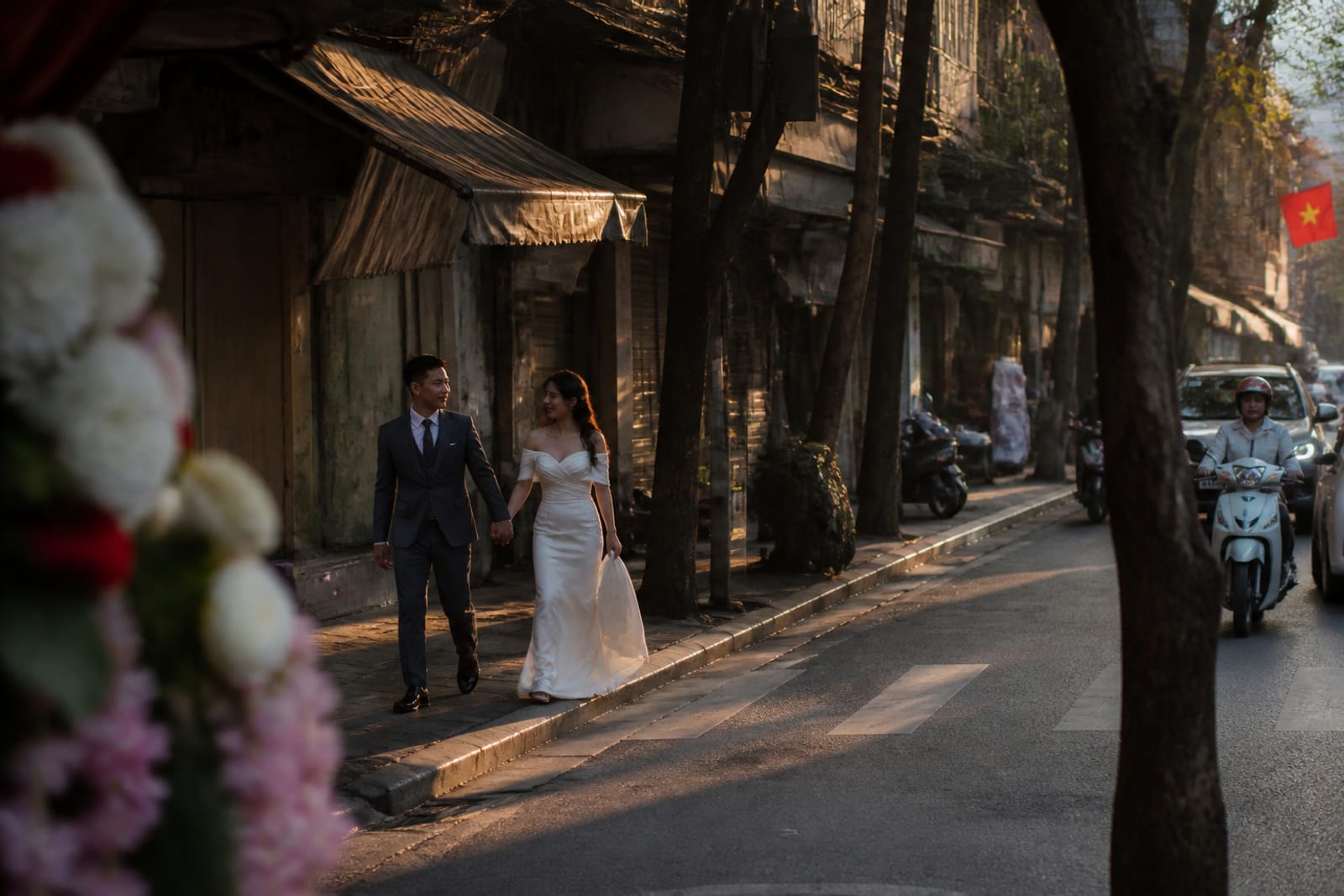
How do you actually change outfits on-location?
This is the logistics question nobody asks until they're standing in a temple alley with a garment bag and no privacy. Here's how we run it:
- Scout beforehand. Cáo Studio's team identifies a quiet, shaded spot—a hotel room, a private courtyard, or a borrowed shop corner—before the shoot starts.
- Timing. Outfit changes take 10–15 minutes if you're not redoing hair and makeup. If your ao dai needs re-tucking or your bra needs adjusting, add 5 minutes.
- Footwear. Bring shoes that slip on. Don't waste time unlacing boots during a change.
- Backup plan. If you're changing at a temple, we don't do it inside the prayer hall. If you're at a lake, the car or a nearby café works.
- Touch-ups. Lipstick and hair pins are quick. Full re-makeup isn't—confirm with your photographer whether touch-ups are included or whether a second makeup session is booked.
Most pre-wedding shoots at Cáo Studio run 4–6 hours (confirm exact timing on WhatsApp); within that window, 2 outfit changes feel natural. Three changes start to feel rushed unless the shoot is 8 hours or longer.
What mistakes happen most—and how to avoid them?
Outfit too heavy or formal. You're moving, posing, and walking outdoors in tropical or subtropical heat. A three-piece suit or a stiff wedding dress will weigh you down by hour three. Choose breathable fabrics and fits that allow arm movement. If you love formal wear, wear it for the first hour while light and energy are fresh.
Too many outfits, too little time. Bringing six outfits sounds exciting but means 2–3 minutes per outfit in the final edit. You end up with shallow variety and a rushed feel. Stick to 2–4.
Forgetting shoes. A new shoe color or style can read as an outfit change even if the top and bottoms stay the same. Bring 2–3 shoes (heels, flats, loafers) and test them with each outfit before the shoot day.
Wearing something you haven't sat in. You'll be on floors, stairs, and car seats. A dress that looks perfect standing still might gap or ride up when you sit. Try every outfit in real movement before the day.
Ao dai rental fit issues. If you're renting (see ao dai rental options), visit the tailor 1–2 weeks before the shoot. The tunic should sit at your natural waist, and the split skirt should fall cleanly. A poorly fitted ao dai will read as two inches narrower in photos and make you self-conscious.
Skipping the undergarment test. Wear your chosen bra and undershirt with the ao dai at home for one hour. If you see panty lines, sweat marks, or bra bumps in the mirror, you'll see them in photos too.
Seasonal mismatch. Booking a shoot in March (pre-summer, Hanoi) but wearing a thick knit sweater. Check the weather forecast and light conditions for your shoot date; we'll guide the ao dai choice and fabric weight once you confirm the date on WhatsApp.
How to actually decide: your outfit checklist
Use this before you book or pack:
- [ ] How long is your shoot? (Confirm on WhatsApp—4 hours? 6? 8?)
- [ ] How many locations? (One = 1–2 outfits; two = 2–3; three+ = 3–4.)
- [ ] Do you want an ao dai, western outfit, or both?
- [ ] If ao dai: will you rent or bring your own? (Rental means fitting 1–2 weeks prior.)
- [ ] If western: do you own outfit A, and do you want to buy/rent outfit B?
- [ ] What month are you shooting? (Cool season: Dec–Feb in Hanoi allows layers; warm/wet: May–Nov across Vietnam means light, breathable fabrics.)
- [ ] Where is your shoot? (Hanoi = /hanoi; Ho Chi Minh = /saigon; Hoi An = ask on WhatsApp for available dates.)
- [ ] Have you tried each outfit in real movement (sitting, walking, posing)?
- [ ] Do you have shoes that match and slip on easily?
📸 Book on WhatsApp — ao dai photoshoot | 💄 Makeup & hair at your hotel | 🌸 See the lookbook
---
What to check before you shoot
Don't guess. Message us on WhatsApp with:
- Your shoot date.
- How many hours you're booking.
- Whether you want 1, 2, or 3+ locations.
- If you're wearing an ao dai (rent or own?).
- Whether you have makeup & hair service booked.
We'll confirm the outfit-change timeline, suggest which locations work together, and flag any seasonal wardrobe considerations specific to your dates. Cáo Studio – Makeup & Photoshoot adjusts outfit count and timing for couple photoshoots, family sessions, and proposal & anniversary bookings too; same logic applies.
For outfit rentals, browse suit & groom rental and ao dai rental pages, then confirm sizes and delivery with WhatsApp. If you want the edited photos printed or laid into an album, see photo prints & frames and wedding photo album collections.
📸 Book on WhatsApp — pre-wedding photoshoot | 💄 Makeup & hair at your hotel | 🌸 See the lookbook
FAQ
Can I bring more than four outfits to a single session?
Yes, but only if your shoot is 8+ hours and includes 3+ locations. Beyond four outfits, editing time and on-site logistics (changing, touch-ups, transport) often cost more than the photo variety gains. Confirm extra outfit count on WhatsApp; we'll advise whether it justifies the session length.
Do I have to wear an ao dai for a pre-wedding shoot in Vietnam?
No. Many international couples wear only western outfits. An ao dai is culturally meaningful and visually rich if you want it, but it's not required. Choose what feels authentic to your story.
What if I'm renting an ao dai—do I need to rent a second one for outfit variety?
Not usually. Renting two ao dai in different colors or styles costs extra; most couples rent one and pair it with one western outfit instead. If you want two ao dai colors (e.g., red and white), discuss budget and timeline on WhatsApp.
How long does changing outfits actually take during a shoot?
10–15 minutes if you're changing in a private space with shoes that slip on. Add 5 minutes if hair needs re-pinning or makeup needs touch-ups. If you're changing every 30 minutes, you'll spend half your shoot getting dressed.
Should I bring outfits from home or rent them in Vietnam?
Bring what fits well and feels comfortable. Renting works if you want to avoid luggage weight or if you're trying an ao dai for the first time. See ao dai rental and suit rental options, or ask WhatsApp whether we recommend local tailors for rush fits.
What's the best season to shoot a pre-wedding session in Vietnam for outfit comfort?
December–February in Hanoi and the north (cool, dry, less humidity) suits layered outfits and formal wear. February–August on the central coast (dry, bright, clear light) works for breathable fabrics and pale colors. Avoid May–November in the north and May–November nationwide if you're wearing heavy fabrics; heat and afternoon downpours complicate logistics.
FAQ
Can I bring more than four outfits to a single session?
Yes, but only if your shoot is 8+ hours and includes 3+ locations. Beyond four outfits, editing time and on-site logistics (changing, touch-ups, transport) often cost more than the photo variety gains. Confirm extra outfit count on WhatsApp; we'll advise whether it justifies the session length.
Do I have to wear an ao dai for a pre-wedding shoot in Vietnam?
No. Many international couples wear only western outfits. An ao dai is culturally meaningful and visually rich if you want it, but it's not required. Choose what feels authentic to your story.
What if I'm renting an ao dai—do I need to rent a second one for outfit variety?
Not usually. Renting two ao dai in different colors or styles costs extra; most couples rent one and pair it with one western outfit instead. If you want two ao dai colors (e.g., red and white), discuss budget and timeline on WhatsApp.
How long does changing outfits actually take during a shoot?
10–15 minutes if you're changing in a private space with shoes that slip on. Add 5 minutes if hair needs re-pinning or makeup needs touch-ups. If you're changing every 30 minutes, you'll spend half your shoot getting dressed.
Should I bring outfits from home or rent them in Vietnam?
Bring what fits well and feels comfortable. Renting works if you want to avoid luggage weight or if you're trying an ao dai for the first time. See [ao dai rental](/ao-dai-rental) and [suit rental](/suit-rental) options, or ask WhatsApp whether we recommend local tailors for rush fits.
What's the best season to shoot a pre-wedding session in Vietnam for outfit comfort?
December–February in Hanoi and the north (cool, dry, less humidity) suits layered outfits and formal wear. February–August on the central coast (dry, bright, clear light) works for breathable fabrics and pale colors. Avoid May–November in the north and May–November nationwide if you're wearing heavy fabrics; heat and afternoon downpours complicate logistics.
Ao dai, makeup, hair and a local photographer in Hanoi or Saigon — one WhatsApp message.