/pre-wedding-photoshoot
How to Avoid Crowds at Da Lat Flower Gardens on Your Wedding Photo Day
Da Lat flower gardens draw heaviest crowds 9 am–4 pm year-round, worst during Dec–Jan and Tet. To avoid them: shoot Nov–Dec or Feb–Mar (dry season, fewer holiday visitors); arrive by 6 am (mist over pine hills, soft side light, paths empty); book a director, not a photographer alone—one team handles outfit, hair, makeup and framing so you're not re-doing setups between vendors. Cáo Studio doesn't operate in Da Lat, but a local photographer who scouts light (not poses) and moves fast will capture the garden between crowds. Never shoot midday; the harsh overhead sun flattens colour and forces you near shaded corners where tourists gather. Check the garden's opening hours and any permit needs before booking.
The most common mistake couples make in Da Lat is choosing the location first and the season second. Flower gardens bloom year-round at elevation, but tourist flow, light quality and weather shift dramatically. A frame that looks empty at 6 am fills with tour groups by 9 am. Your photographer either knows this rhythm or spends three hours waiting between takes—and your photos show the cost.
Why does crowd timing matter more than the garden itself?
A beautiful garden at noon becomes a backdrop to strangers in every frame. Light hammers straight down; shadows pool at the base of flowers. Even if your photographer crops tight, the energy of the place—why you chose it—vanishes. Shoot the same garden at 6:30 am and the mist clings to the pines, paths are empty, and side light catches the dew on each petal. The location doesn't change; the story does.
📸 Book on WhatsApp — pre-wedding photoshoot
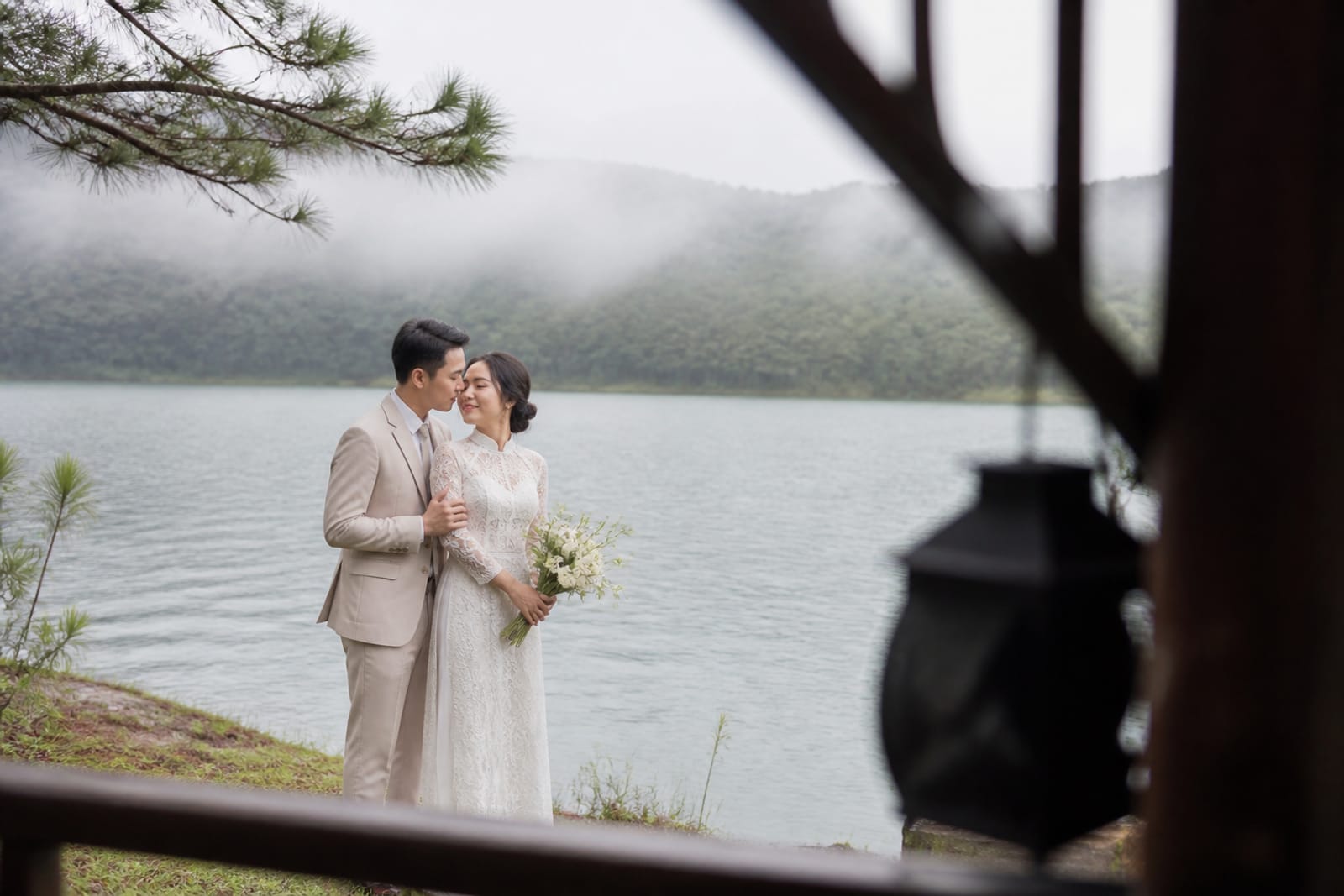
Which months offer the best light without the holiday rush?
| Season | Months | Light | Crowds | Weather | Best for |
|---|---|---|---|---|---|
| Dry season early | Feb–Mar | Soft morning mist, clear afternoon | Low–moderate | Cool, dry mornings; warm midday | Couple shoots, natural light |
| Dry season mid | Apr | Bright, clear; harsher midday | Moderate–high | Warm, stable | Early shoots only; avoid 10 am–3 pm |
| Rainy season | May–Nov | Muted, soft; afternoon showers | Low–moderate | Humid; rain risk 2–6 pm | Moody frames; mist over lakes at dawn |
| Holiday peak | Late Dec–mid Jan | Golden hour stretched; grey mornings | Heaviest | Cool, dry | Plan 5:30 am shoots; double travel time |
| Tet period | Late Jan–early Feb | Clear, cool; paths rammed | Extreme | Dry, cold mornings | Avoid unless you prioritize lunar calendar |
Nov–Dec and Feb–Mar offer the clearest compromise: dry season light, shoulder-season crowds, cool mornings ideal for layers and movement. If you shoot Dec 20–Jan 15, expect to queue at entry even at dawn; Tet (late Jan–early Feb) sees many sites close or operate limited hours.
How do you actually time a shoot to catch empty light?
Arrive 30 minutes before garden opening and scout with your photographer the evening before. Walk the paths, note where side light hits flowers at 6 am and 7 am (this shifts week to week). Identify three backup spots in case the first is occupied—a second flower bed, a nearby pine grove, a stone bridge where mist collects. If your photographer has shot there before, ask which corner stays empty past 8 am and why (shade from a ridge, far from the main entrance, uphill from tour-group paths). Confirm the garden's opening time the day before; some close for maintenance or Tet without notice. Never trust a schedule found online—call the gate or ask your hotel the morning of the shoot.
Should you hire a local photographer or travel with your own?
A photographer who lives in Da Lat or visits regularly knows the paths, the light windows, the guards' routines and which tour operators arrive when. They've shot there 50 times and can read the mist. A visiting photographer from Hanoi or Ho Chi Minh City shoots it once or twice, treats it like any garden, and spends your session learning the light.
Cost factor: Local teams charge less than travel-based studios (no transport), but fewer of them are trained in directed, non-posed framing. A national studio sends a director (outfit, hair, makeup, camera in one booking) but absorbs your travel time. The trade-off: one team moves faster and knows the light philosophy; a local-only team may shoot you posed against the flowers, not in the light.
What to check: Ask your photographer to show you five past Da Lat shoots (not the best ones—the representative ones). Do you see a story in the frames, or a couple standing in front of a garden? Do you see real light (side light, shadows, texture) or evened-out brightness? Did they shoot wide first, then medium, then detail—or just close-ups of faces? A director who understands light will move you through the space, not pose you in front of it.
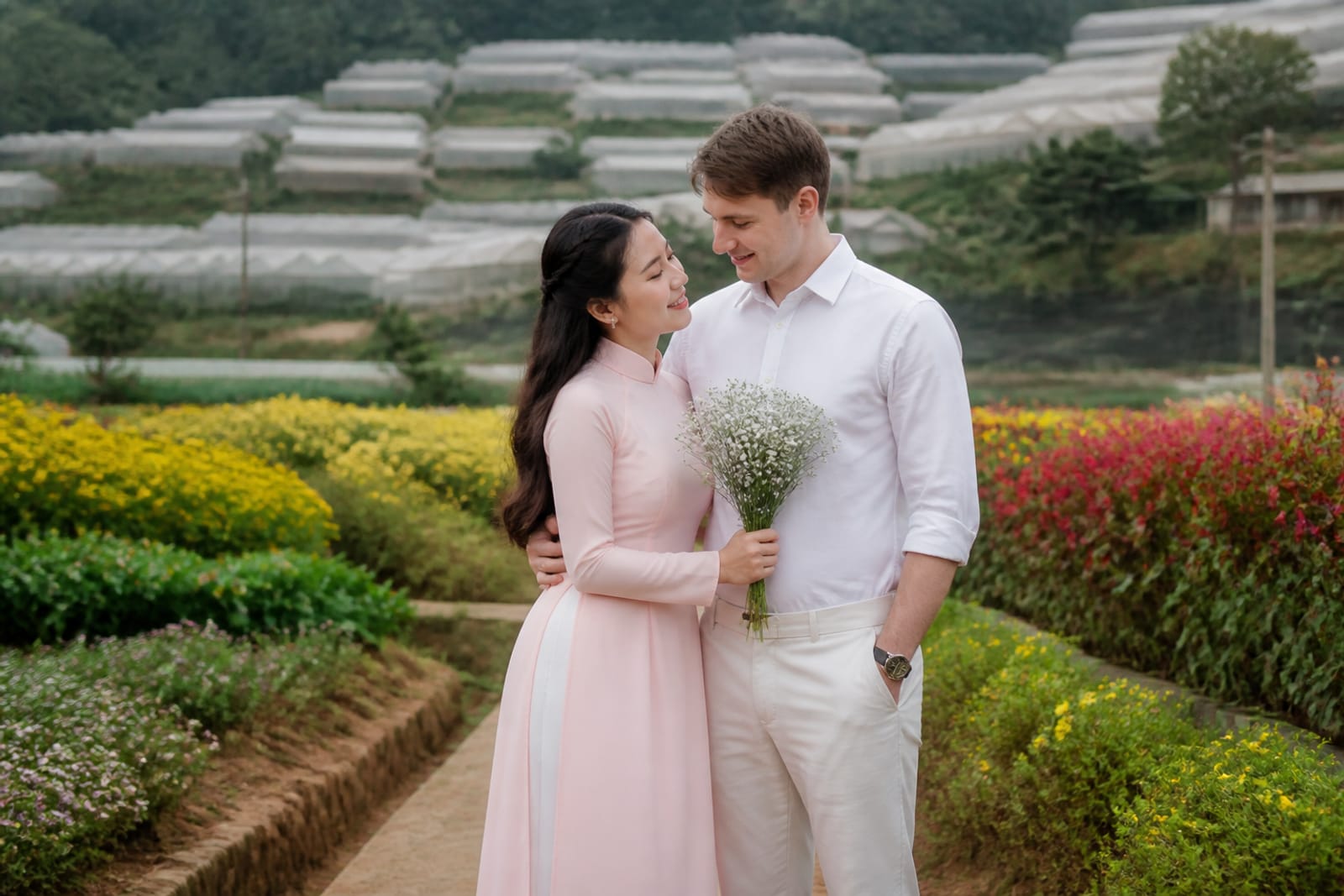
What outfit and prep choices keep you comfortable during an early shoot?
Da Lat mornings are cool (roughly 12–16°C) even in the dry season. Wear layers: a light cardigan over your dress, removed for the actual frames. Avoid heavy fabrics that wrinkle when you sit or walk through damp grass. If you're wearing an áo dài, ask your dresser if the silk can handle morning dew—delicate silks may spot. Bring a clean, dry handkerchief; misty grass soaks the hem and lower layers.
Makeup and hair must hold in humidity and cool air without looking overdone by 7 am light. Matte products outlast dewy finishes in mist; a light powder base keeps makeup from sliding if you perspire during the walk. Hair should move—a breeze through the gardens looks better than a set style. Ask your makeup artist if they've worked in Da Lat before; if not, request a trial run and ask them to skip heavy contour (it photographs flat in soft light).
What else can go wrong, and how do you protect your frames?
Rain. Da Lat sits at elevation; afternoon showers can start 1–2 pm even in the dry season. Shoot only before 11 am. If rain comes early, the garden becomes even emptier—soft, dramatic light—but paths turn slippery and your dress risks mud. Wear shoes with grip for the walk; change into heels for frames. Bring a small umbrella (doubles as a prop if the photographer is skilled).
Access closures. Gardens close for Tet cleanup, typhoon repairs or private events. Confirm entry is open 48 hours before your shoot, not just online.
Other couples. Peak wedding-photo times (Saturday mornings, late Dec) attract other shoots. Arrive at 5:30 am to claim empty light before 7 am when other crews start. If you spot another shoot, your photographer should be able to find a second story in an adjacent flower bed without stepping into their frames.
Permit gaps. Check if your photographer needs a commercial permit to shoot in the garden. Cáo Studio does not operate in Da Lat, so you're responsible for vetting any local team's permissions. A studio that's vague about permits is cutting corners.
---
What to check before you book a Da Lat shoot
- Photographer's portfolio: Five representative Da Lat shoots (not curated), showing real light, movement and story—not posed backdrops.
- Season & timing: Confirm they recommend Nov–Dec or Feb–Mar, and will shoot before 7 am. If they say "any time is fine," they don't know the light.
- Team size: One director (outfit, hair, makeup, camera) moves faster and makes decisions together than three vendors texting. Ask if makeup and hair are included or outsourced.
- Backup plan: Do they have three on-site locations in case your first choice is blocked? Can they pivot to a second garden in 20 minutes?
- Permit & access: Confirm they've shot commercially there before and know entry requirements. Ask what happens if the garden is unexpectedly closed.
- Delivery: How long until edited photos arrive? ("48 hours" is standard; longer delays often mean they're juggling multiple bookings.)
- Edit style: Look at their gallery. Do frames have consistent color, natural light and texture—or over-processed, filtered, or airbrushed? Does the light feel real?
Cáo Studio operates in Hanoi, Ho Chi Minh City and Hoi An. For a Da Lat pre-wedding photoshoot, hire a local director and apply the framework above. If you're planning a couple photoshoot in Hanoi or Saigon, we handle the outfit, light and story in one team.
---
FAQ
Can we shoot Da Lat flower gardens in Tet (late Jan–early Feb)?
Possible but crowded. Tet is peak holiday travel; many sites close for 3–7 days. If you insist, shoot 5:30 am (before anyone arrives) and confirm entry 48 hours ahead. Expect double the effort for half the empty light.
Does morning mist in Da Lat make colors look washed out?
No—mist softens and diffuses harsh light, making flower colors richer and more saturated because there's no blown-out glare. Midday, direct sun bleaches pastels. Mist is an asset, not a problem.
How far in advance should we book a Da Lat photographer?
4–8 weeks for Nov–Dec (shoulder-season peak for weddings), 2–4 weeks for Feb–Mar. Local crews often juggle multiple shoots; confirm availability the month before.
Is it cheaper to hire a local Da Lat photographer than travel with a national studio?
Usually yes—no transport cost—but vetting is harder. A local photographer who's never studied directed framing may default to poses. Cost shouldn't be the deciding factor; light philosophy and portfolio matter more.
Can we do a pre-wedding shoot in Da Lat and another in Hanoi with the same team?
If the team is based in Hanoi or Ho Chi Minh City, yes—but you'll pay travel cost and logistics time for Da Lat. If you're splitting shoots across cities, ask Cáo Studio; we shoot Hanoi and Saigon regularly and can advise on a multi-location pre-wedding photoshoot that suits your dates.
What's the difference between shooting a flower garden and shooting an áo dài studio rental in Da Lat?
Gardens offer real light, movement and story; studios offer control, no weather risk and consistent output. Gardens require early mornings and permit checks; studios fit tight schedules. For áo dài photoshoots, the light and outfit matter equally—choose the garden if you want narrative frames, a studio if you prioritize reliability.
FAQ
Can we shoot Da Lat flower gardens in Tet (late Jan–early Feb)?
Possible but crowded. Tet is peak holiday travel; many sites close for 3–7 days. If you insist, shoot 5:30 am (before anyone arrives) and confirm entry 48 hours ahead. Expect double the effort for half the empty light.
Does morning mist in Da Lat make colors look washed out?
No—mist softens and diffuses harsh light, making flower colors richer and more saturated because there's no blown-out glare. Midday, direct sun bleaches pastels. Mist is an asset, not a problem.
How far in advance should we book a Da Lat photographer?
4–8 weeks for Nov–Dec (shoulder-season peak for weddings), 2–4 weeks for Feb–Mar. Local crews often juggle multiple shoots; confirm availability the month before.
Is it cheaper to hire a local Da Lat photographer than travel with a national studio?
Usually yes—no transport cost—but vetting is harder. A local photographer who's never studied directed framing may default to poses. Cost shouldn't be the deciding factor; light philosophy and portfolio matter more.
Can we do a pre-wedding shoot in Da Lat and another in Hanoi with the same team?
If the team is based in Hanoi or Ho Chi Minh City, yes—but you'll pay travel cost and logistics time for Da Lat. If you're splitting shoots across cities, ask Cáo Studio; we shoot [Hanoi](/hanoi) and [Saigon](/saigon) regularly and can advise on a multi-location [pre-wedding photoshoot](/pre-wedding-photoshoot) that suits your dates.
What's the difference between shooting a flower garden and shooting an áo dài studio rental in Da Lat?
Gardens offer real light, movement and story; studios offer control, no weather risk and consistent output. Gardens require early mornings and permit checks; studios fit tight schedules. For [áo dài photoshoots](/ao-dai-photoshoot), the light and outfit matter equally—choose the garden if you want narrative frames, a studio if you prioritize reliability.
Ao dai, makeup, hair and a local photographer in Hanoi or Saigon — one WhatsApp message.