/pre-wedding-photoshoot
How to Avoid Crowds at Ghenh Rang for Your Wedding Photo Day
Ghenh Rang (Quy Nhon, central Vietnam) is a rocky turquoise inlet best shot February–August in early morning (6–7 am) or late afternoon (5–6 pm) when light is soft and crowds are thin. Most visitors arrive 8 am–4 pm; booking a pre-wedding photoshoot with a local photographer or team ensures you're guided to less-trafficked vantage points, outfitted for the rocks and spray, and shooting while the cove is yours. Solo couples risk timing the light wrong, turning an ankle on wet stone, or arriving mid-crowd. Cáo Studio's Saigon base can coordinate with trusted local teams for Quy Nhon shoots; ask on WhatsApp for availability and what a half-day Ghenh Rang session includes. ---
When does Ghenh Rang have the fewest tourists?
Dawn and dusk are non-negotiable. Between 6–7 am, Ghenh Rang is often empty; by 8 am, small groups arrive. The golden hour before sunset (5–6 pm) clears by 7 pm. Midday (10 am–3 pm) draws tour buses and day-trippers. Book a session that arrives at the cove by 6 am or plan to shoot from 5 pm onward. Season matters: February–August is drier and less crowded than September–December, when rainy-season typhoons can close coastal roads entirely.
📸 Book on WhatsApp — couple photoshoot
What should you wear to shoot safely on wet rocks?
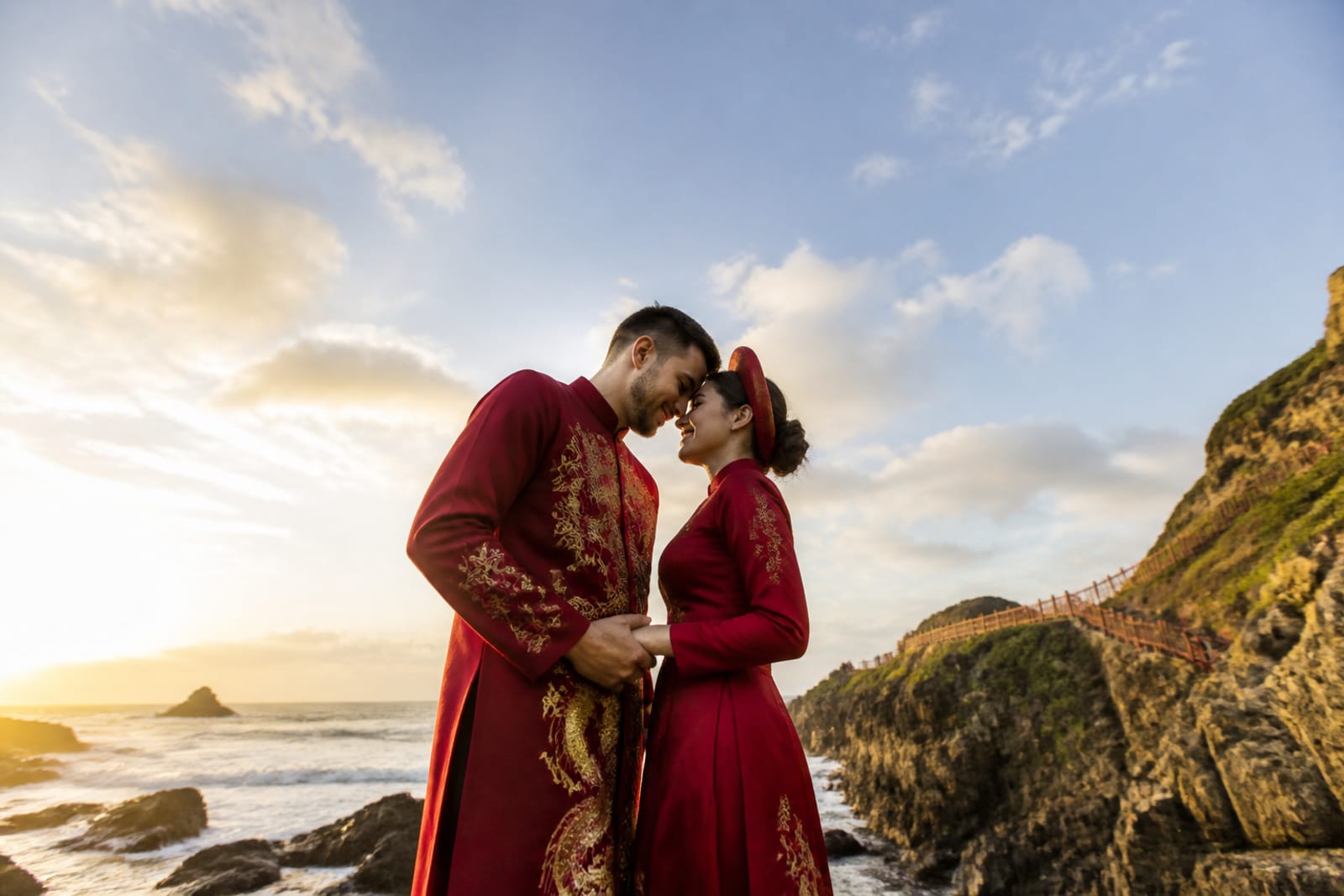
Ghenh Rang's rocks are slick, uneven and covered in algae. Avoid trailing skirts, long hemlines or delicate fabrics that snag. If wearing an áo dài, choose a structured silk or linen that moves but doesn't pool; ask your stylist to pin the hem or bring a second outfit (shorts, a fitted dress). Wear water shoes or non-slip sandals you can ditch for frames. A cover-up or robe over swimwear lets you change without a crowd seeing. Bring a towel; spray is inevitable. Cáo Studio's makeup & hair team can advise on waterproof makeup and how to style for wind and salt spray if you're shooting in Hanoi or Saigon first, then flying to Quy Nhon.
Should you hire a local photographer or travel with your own team?
| Approach | Best For | Logistics | Light Knowledge |
|---|---|---|---|
| Local Quy Nhon guide + couple | Budget-conscious, one outfit, familiar with tides | Meets you at cove, no travel time | May miss golden-hour precision |
| Cáo Studio-coordinated local shoot | Couples wanting direction + one-team experience | Ask WhatsApp for partner availability | Guided framing, soft light prioritized |
| Bring your own photographer | Control, multiple outfits, curated style | You manage transport, timing, safety | Depends on photographer's coastal experience |
Hiring a local guide is faster and cheaper (no airfare). But a directed session—where the photographer scouts light, timing and safe footing—yields frames that don't look like every other Ghenh Rang couple photo. If Cáo Studio's Saigon team has a Quy Nhon partner, you get continuity: the same creative brief and editing style as a Hanoi or Saigon shoot. Couples uncomfortable with logistics prefer this; couples on tight budgets and tight schedules book local-only.
How do you avoid the afternoon sun and harsh shadows?
Ghenh Rang faces south-southeast; mid-morning sun creates blown highlights on turquoise water and dark shadows under rocks. Shoot before 10 am (sun low, soft, wraps the rocks) or after 5 pm (low angle, golden, no glare). Midday is unavoidable if you're only free then; use rock overhangs, shoot into the shade, or reframe to the shaded east side of the cove. A professional photographer scouts this; solo couples often arrive at noon, find harsh light, and blame the location. Timing beats any other trick.
What's the honest comparison: day trip vs. dedicated shoot day?
| Factor | Day-Trip Solo | Guided Half-Day Shoot | Multi-Day Pre-Wedding |
|---|---|---|---|
| Crowd avoidance | Possible, requires 5 am start | Guaranteed, team handles timing | Guaranteed, multiple locations |
| Outfit changes | One, or rushed | One or two, planned | Two–three, styled per location |
| Light expertise | You hope | Photographer directs | Director scouts + brief |
| Safe footing | Your risk | Guide watches | Planned, tested route |
| Frames per hour | Few, rushed | 50–100, varied | 100–200, wide to detail |
| Cost factors | Flights, food, own time | Photographer fee, half-day | Photographer fee, guide, travel time |
A day trip works if you're already in Quy Nhon, wake at 5 am, and accept a handful of usable frames. A guided shoot guarantees light, safety and frames; costs more because you're paying expertise and logistics. A multi-day pre-wedding (Quy Nhon + Hoi An + Hanoi, or Quy Nhon alone over two days) lets the photographer return to Ghenh Rang at different tides, times and weathers—frames deepen because the team knows the light intimately. Couples with flexibility and a clear creative vision (áo dài, intimate couples frames, cinematic style) invest in the longer approach.
---
What do professional pre-wedding teams bring that solo couples don't?
A directed team arrives with a shot list (wide: the cove, you two walking; medium: you looking at each other; detail: wet rocks, foam, your hands). They've scouted tides, rock stability and where spray reaches. Makeup is waterproof; hair is pinned for wind. They know which angles avoid the tour-operator boat dock and where light shifts by 20 minutes. You walk, look, do something; the photographer frames. Solo couples often spend 30 minutes finding a "good spot" and posing stiffly at the viewpoint—they shoot what's obvious, not what's real.
How to book a Ghenh Rang shoot: what to check before confirming
Before you commit, ask the photographer or coordinator:
- Tide times on your date. Ghenh Rang's accessible rocks shift with tide; low tide exposes flatter stone; high tide compresses the cove. The team must know the tide window and plan the shoot inside it.
- Weather guarantee or reschedule clause. Typhoon season (Sep–Dec) brings sudden rain; confirm whether you can reschedule if a storm arrives.
- Parking and entry. The cove is free and public, but ask where the team parks and if any permit is needed. (Check locally if uncertain.)
- Outfit and styling plan. Confirm whether makeup, hair and outfits are pre-arranged or if you're bringing your own. Cáo Studio coordinates outfit choice on WhatsApp; most local-only teams expect you to provide.
- Delivery timeline. When are edited frames delivered? A directed shoot usually takes 48 hours; local guides may take longer.
- Safe transport to your hotel. After a salt-spray shoot, you'll be damp; confirm the photographer can transport you back or recommends a taxi service.
---
Quy Nhon timing: season and light across the year
| Month | Light | Crowds | Weather | Best Time to Shoot |
|---|---|---|---|---|
| Feb–Apr | Bright, low angle | Moderate | Dry, mild | 6–7 am, 5–6 pm |
| May–Aug | Intense midday, soft dawn/dusk | Moderate to high | Dry, warm | Early dawn or late dusk only |
| Sep–Dec | Variable, rainy spells | Low | Rainy, typhoon risk | Avoid; reschedule if possible |
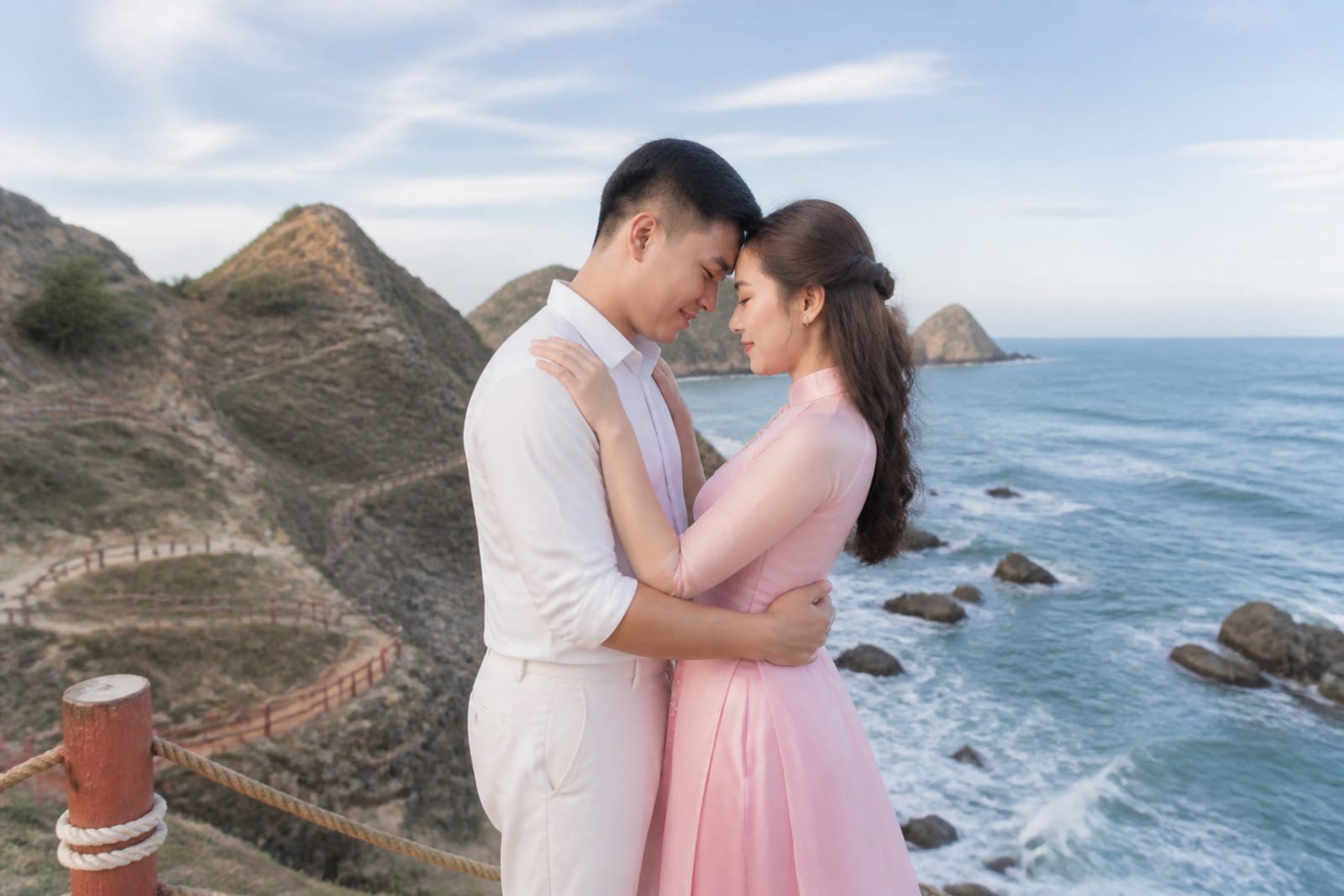
February to August is the safest window. Light is consistent, the path to the cove is dry, and typhoons are rare. May–August can be very warm; shoot at dawn. September–December brings unpredictable rain and typhoons (especially October–November); confirm weather 3 days before and have a reschedule clause in your booking. Tet (late January–mid February) draws holiday crowds, so book early if you're wedding-planning during Lunar New Year.
---
Why book a directed shoot over a solo trip?
Direction. The photographer knows the cove's light window and frames it—you don't pose, you walk and move naturally.
Safety. A guide points out slippery stones, spray risks and safe footing. Couples have slipped, twisted ankles, or soaked their phone; a team prevents this.
Continuity. If you're doing a pre-wedding photoshoot across multiple cities (Hoi An, Hanoi, Saigon, Quy Nhon), a single team ensures one aesthetic and editing style. Cáo Studio can coordinate this via WhatsApp.
Frames that tell a story. Solo couples take selfies or ask strangers to shoot; directed teams capture you two in the landscape—genuine, lit, composed.
Honest trade-off: Directed shoots cost more than a day trip because you're paying for expertise, time and coordination. The question is whether usable, beautiful frames are worth that cost. Most couples say yes after seeing the result.
---
Real risks and how to mitigate them
Risk: Wet phone / lost shots. Bring a waterproof case or leave your phone in the car. A professional photographer carries backup cards and bodies; ask if they do.
Risk: Sunburn or heat exhaustion. Bring sunscreen, a hat and water. The cove has no shade; an afternoon shoot is brutal. Stick to dawn or dusk.
Risk: Wrong outfit. Trailing fabrics snag on rocks; delicate makeup washes off. Confirm with your team what works. Cáo Studio's makeup & hair team advises on waterproof products and how to prep.
Risk: Rushed frames. If you're catching a flight or have only 90 minutes, tell the photographer upfront. They'll adjust the shot list and prioritize. A tight timeline means fewer outfit changes and one focused location (Ghenh Rang only, not Ghenh Rang + another beach).
Risk: Crowds arrive mid-shoot. Tour groups are unpredictable. Shoot early (6 am) or confirm with your photographer that they'll move you if a crowd arrives. A real team has a backup angle 20 meters away.
---
📸 Book on WhatsApp — pre-wedding photoshoot
Next steps: from Ghenh Rang to your wedding album
After the shoot, ask for:
- Edited photos within 48 hours (industry standard).
- A short vertical film (5–10 seconds) for Instagram or ceremony teasers.
- A full-resolution backup for your wedding album or prints.
- Retouching guidance: if you want skin tones adjusted or blown highlights recovered, discuss this upfront.
Cáo Studio delivers edited photos plus a short film as part of the pre-wedding photoshoot package; exact inclusions are confirmed on WhatsApp. If you're printing frames for a wedding photo album, ask the photographer for print-ready files and advice on size (6×8 in, 8×10 in) and paper finish (matte, glossy, linen). Local Quy Nhon photographers may not offer albums; coordinate this with Cáo Studio if you want a unified look across all wedding imagery.
---
What to check before you book
✓ Photographer's coastal experience. Ask to see 3–5 Ghenh Rang or beach shoots. Do frames show real light, not flat midday? Are couples natural, not stiff?
✓ Tide knowledge. The photographer should mention tide times without you asking. If they don't, they haven't scouted Ghenh Rang properly.
✓ Safety plan. Ask how they handle slippery rocks, spray, and sudden weather. A vague answer is a red flag.
✓ Outfit and makeup clarity. Confirm whether hair, makeup and outfits are provided or if you bring your own. Waterproof makeup is non-negotiable.
✓ Delivery timeline and files. When are edited photos ready? How many edited images do you receive? Are raw files included? (Cáo Studio specifies this on WhatsApp; most local guides do not.)
✓ Reschedule policy. Typhoon season is real; ensure a weather clause exists.
✓ Cost factors. Guided shoots cost more than solo trips because of travel time, expertise and coordination. Ask whether the fee includes transport to/from your hotel or if that's extra. Confirm whether a second outfit or location adds cost.
---
Cáo Studio's role in Quy Nhon shoots
Cáo Studio (based in Hanoi and Saigon) does not operate a Quy Nhon branch. However, we can coordinate with trusted local photographers who share our values: one team handling direction, timing and editing in a unified aesthetic. If you're planning a multi-city pre-wedding (e.g., Hoi An + Quy Nhon, or Saigon + Quy Nhon), ask us on WhatsApp about Quy Nhon partners and how we can brief them on your style, outfits and shot list. This way, your Quy Nhon frames match your Hoi An or Saigon work—same color grading, same narrative.
Alternatively, many international couples hire Cáo Studio for the bulk of their pre-wedding (áo dài shoot in Hanoi, couple sessions in Ho Chi Minh City) and book a local guide for Quy Nhon independently. Both work; coordination is the difference.
---
FAQ
Is Ghenh Rang safe for wedding photos if I've never climbed rocks before?
Yes, if you wear proper footwear and go with a guide. The rocks are slippery and uneven, not vertical. A photographer who's scouted the cove will direct you to stable footing and warn you about spray zones. Avoid full-length skirts or heels; bring water shoes. Most couples manage fine with basic caution.
What's the best month for Ghenh Rang photos?
February to August (dry season). February–April has mild temperatures and consistent light; May–August is warm but still dry. September–December brings typhoon risk and rainy spells—check weather 3 days before and have a reschedule clause. Tet (late Jan–mid Feb) draws crowds; book early if you're shooting then.
Can I do a Ghenh Rang shoot and another Quy Nhon location in one day?
Yes, if you start at 6 am and finish by 9 am at Ghenh Rang, then move to another beach or temple for a second shoot (10 am–1 pm or 4–6 pm). This requires a professional photographer who knows Quy Nhon well and can chain locations efficiently. Local-only guides may resist; coordination with Cáo Studio's partner team (ask WhatsApp) ensures a multi-location brief.
Do I need a permit to shoot wedding photos at Ghenh Rang?
Ghenh Rang is a public cove with no entry fee or formal permit requirement. However, check locally closer to your date—regulations change. Ask your photographer or Cáo Studio's coordinator (WhatsApp) to confirm current requirements.
How long does a typical Ghenh Rang shoot take?
A half-day directed shoot is 2–3 hours (arrival by 6 am, light until 8–9 am; or arrive by 5 pm, shoot until 7 pm). This yields 50–100 edited frames per outfit. Solo couples often spend 30–60 minutes; Cáo Studio's coordinated shoots are 2–3 hours to capture wide, medium and detail frames. Exact timing is confirmed on WhatsApp.
Should I hire a makeup artist for a Ghenh Rang shoot?
Strongly recommended. Salt spray, humidity and humidity destroy makeup by mid-morning. Waterproof foundation, setting spray and ocean-resistant eyeshadow are essential. Cáo Studio's makeup & hair team advises on this; most local Quy Nhon guides assume you'll bring your own (and it may not hold). Budget for waterproof makeup or coordinate with your photographer.
Can Cáo Studio shoot my Ghenh Rang wedding photos?
Cáo Studio's home bases are Hanoi, Ho Chi Minh City and Hoi An. We don't have a Quy Nhon team, but we can coordinate with a trusted local photographer and brief them on your style and shot list via WhatsApp. If you're doing a multi-city pre-wedding (e.g., áo dài shoot in Hanoi, couple shoot in Quy Nhon), this ensures visual continuity across all locations.
FAQ
Is Ghenh Rang safe for wedding photos if I've never climbed rocks before?
Yes, if you wear proper footwear and go with a guide. The rocks are slippery and uneven, not vertical. A photographer who's scouted the cove will direct you to stable footing and warn you about spray zones. Avoid full-length skirts or heels; bring water shoes. Most couples manage fine with basic caution.
What's the best month for Ghenh Rang photos?
February to August (dry season). February–April has mild temperatures and consistent light; May–August is warm but still dry. September–December brings typhoon risk and rainy spells—check weather 3 days before and have a reschedule clause. Tet (late Jan–mid Feb) draws crowds; book early if you're shooting then.
Can I do a Ghenh Rang shoot and another Quy Nhon location in one day?
Yes, if you start at 6 am and finish by 9 am at Ghenh Rang, then move to another beach or temple for a second shoot (10 am–1 pm or 4–6 pm). This requires a professional photographer who knows Quy Nhon well and can chain locations efficiently. Local-only guides may resist; coordination with Cáo Studio's partner team (ask WhatsApp) ensures a multi-location brief.
Do I need a permit to shoot wedding photos at Ghenh Rang?
Ghenh Rang is a public cove with no entry fee or formal permit requirement. However, check locally closer to your date—regulations change. Ask your photographer or Cáo Studio's coordinator (WhatsApp) to confirm current requirements.
How long does a typical Ghenh Rang shoot take?
A half-day directed shoot is 2–3 hours (arrival by 6 am, light until 8–9 am; or arrive by 5 pm, shoot until 7 pm). This yields 50–100 edited frames per outfit. Solo couples often spend 30–60 minutes; Cáo Studio's coordinated shoots are 2–3 hours to capture wide, medium and detail frames. Exact timing is confirmed on WhatsApp.
Should I hire a makeup artist for a Ghenh Rang shoot?
Strongly recommended. Salt spray, humidity and humidity destroy makeup by mid-morning. Waterproof foundation, setting spray and ocean-resistant eyeshadow are essential. Cáo Studio's [makeup & hair team](/makeup-and-hair) advises on this; most local Quy Nhon guides assume you'll bring your own (and it may not hold). Budget for waterproof makeup or coordinate with your photographer.
Can Cáo Studio shoot my Ghenh Rang wedding photos?
Cáo Studio's home bases are Hanoi, Ho Chi Minh City and Hoi An. We don't have a Quy Nhon team, but we can coordinate with a trusted local photographer and brief them on your style and shot list via WhatsApp. If you're doing a multi-city pre-wedding (e.g., áo dài shoot in Hanoi, couple shoot in Quy Nhon), this ensures visual continuity across all locations.
Ao dai, makeup, hair and a local photographer in Hanoi or Saigon — one WhatsApp message.