/pre-wedding-photoshoot
Hue or Mui Ne for pre-wedding photos: which light suits your story
Hue suits couples who want intimate, layered frames: the Perfume River at dawn, lantern-lit ancient streets, misty mountain light. Best Sep–Dec when grey northern-central skies soften the lens. Mui Ne works for bold, graphic couples drawn to texture and scale: red dunes, fishing boats, golden-hour drama. Book Nov–Apr for steady light and calm sand (May–Oct brings afternoon downpours and wind). Both need a local guide who reads light—Cáo Studio shoots in Hoi An by appointment and coordinates pre-wedding sessions across central Vietnam; for Mui Ne, we plan the shoot but recommend a local photographer who knows the dune shifts and tidal timing. Neither destination needs crowds or monument poses: both reward movement, walking light, and letting the landscape lead the frame. 📸 Book on WhatsApp — pre-wedding photoshoot | 🌸 See the lookbook ---
Why does light direction matter more than the landmark itself?
Landmarks don't guarantee frames—light does. Hue's Trang Tien Bridge photograph could be flat grey at noon or theatrical with side-light at 6 am. Mui Ne's dunes look muddy in overcast afternoon but glow magenta at sunrise. A photographer who arrives two hours early to watch the light cross the river, not the couple, books your session around that hour. In Hue, November through January brings consistent soft light from the east in early morning, perfect for backlit riverside walks. In Mui Ne, the same season offers warm directional light across the dunes from 5:30–7 am before thermals lift dust. Cáo Studio's ao dai photoshoot approach—directed by light, not pose—applies equally whether you're in a riverfront courtyard or walking a dune ridge. The real question is not which location, but which direction of light matches how you move.
What season locks you into Hue versus Mui Ne?
| Destination | Ideal months | Light character | Why | Travel effort |
|---|---|---|---|---|
| Hue | Sep–Dec | Soft, diffused, cool-toned | Northern-central monsoon brings overcast skies; mist off river; grey light is forgiving | Short city walks, temple access |
| Hue | Jan–Aug | Sharp, harsh shadows | Summer heat and southern sun; harsh direct light; golden hour brief | Midday heat; fewer frame options |
| Mui Ne | Nov–Apr | Warm, directional, low-angle | Dry season; cooler air; sand steady; sunrise and sunset long | 4–5 hour drive; sunrise requires 4:30 am start |
| Mui Ne | May–Oct | Humid, scattered clouds, short windows | Monsoon; afternoon downpours common; wind shifts sand; light patchy | Unpredictable; poor sand conditions |
Hue's advantage is reversible: if you're locked to summer dates, accept that you'll shoot early (5:30 am for side-light on the river, then retreat before 9 am heat). Mui Ne in the rainy season is not a bet—sand gets blown, clouds block the sunrise, and a single afternoon downpour can force a reschedule. Cáo Studio coordinates pre-wedding sessions with full awareness of these windows; for Mui Ne, we help you plan but you'll want a local who can pivot fast if weather shifts.
How do you move differently in each landscape?
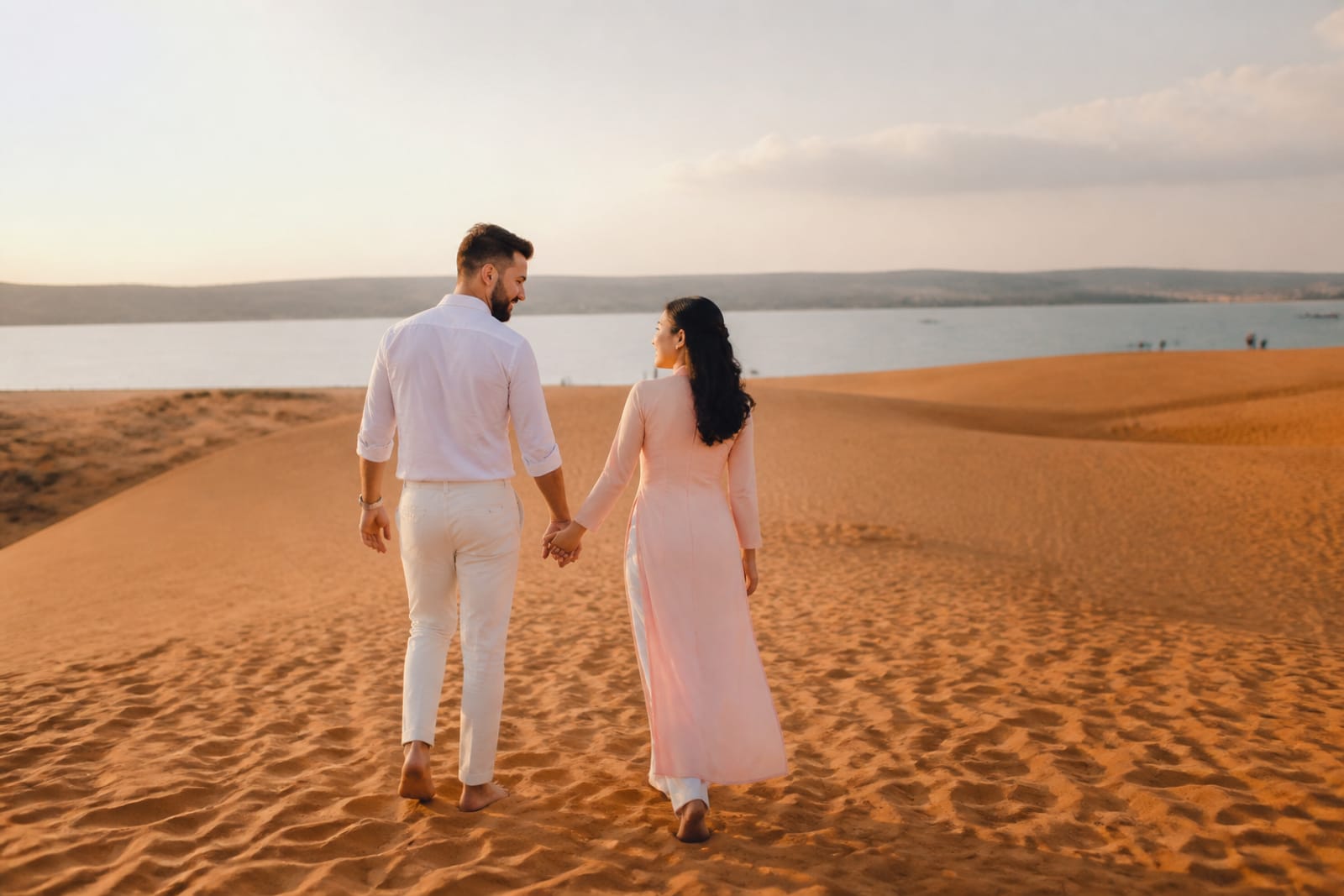
Hue's spaces are linear and layered: bridges span water, streets run between shuttered shopfronts, staircases lead through temple courtyards. A frame works when you're walking toward or across something—not standing at it. The Perfume River shoot means you and your partner walk the bank at dawn, the mist rises, the light catches your silhouettes, and the photographer shoots from ahead and behind, not from the side. You're in motion, the river is in motion (tidal, at dawn), and the light moves across stone. Mui Ne is the opposite: it's open, graphic, monumental. The dunes have no path—you walk up a ridge and the scale of sand becomes the frame. Light here works across you, not around you. A couple walking toward the horizon on a dune at sunrise isn't "posing at the landmark"; they're walking into a graphic landscape where their scale and the light's angle matter more than a monument behind them. Hue asks you to weave; Mui Ne asks you to walk a line. Choose based on whether you move better through complexity or across openness.
Should weather uncertainty change your choice?
Hue's risk is fog—but fog is useful. December to February fog on the Perfume River creates moody, intimate frames; it's not a failure, it's the point. January drizzle softens light further. The gamble in Hue is summer: June–August heat is direct, and afternoon light turns yellow-harsh. You'd need to shoot 5–6 am to avoid it, which kills flexibility.
Mui Ne's risk is wind and rain. November through March is stable; May through October is genuinely unpredictable. A 40-minute drive from Phan Thiet means if sand blows mid-morning or a storm hits, you've lost the shoot or the light. The dunes shift seasonally too—wind from the northeast (Nov–Mar) sculpts ridges differently than monsoon wind. If your dates are flexible, this alone tips toward Hue. If you're locked to, say, June, accept Mui Ne is a bet and shoot either very early (dunes before the wind picks up) or after a rain (when the sand is damp and holds ridges). Cáo Studio helps you read the forecast and pivot outfits; a local Mui Ne photographer will know the daily micro-shifts.
What outfit choices signal Hue versus Mui Ne energy?
An áo dài works in both, but differently. In Hue, the fabric matters—a heavier silk catches the soft light and drapes elegantly when you're walking or turning. Jewel tones (deep emerald, burgundy, navy) photograph warm in grey light. White or pale silk risks looking washed-out under overcast skies unless the photographer uses side-light to sculpt the fabric. Layering—a thin outer áo dài over a contrasting inner layer, visible at the splits—adds depth in moody light.
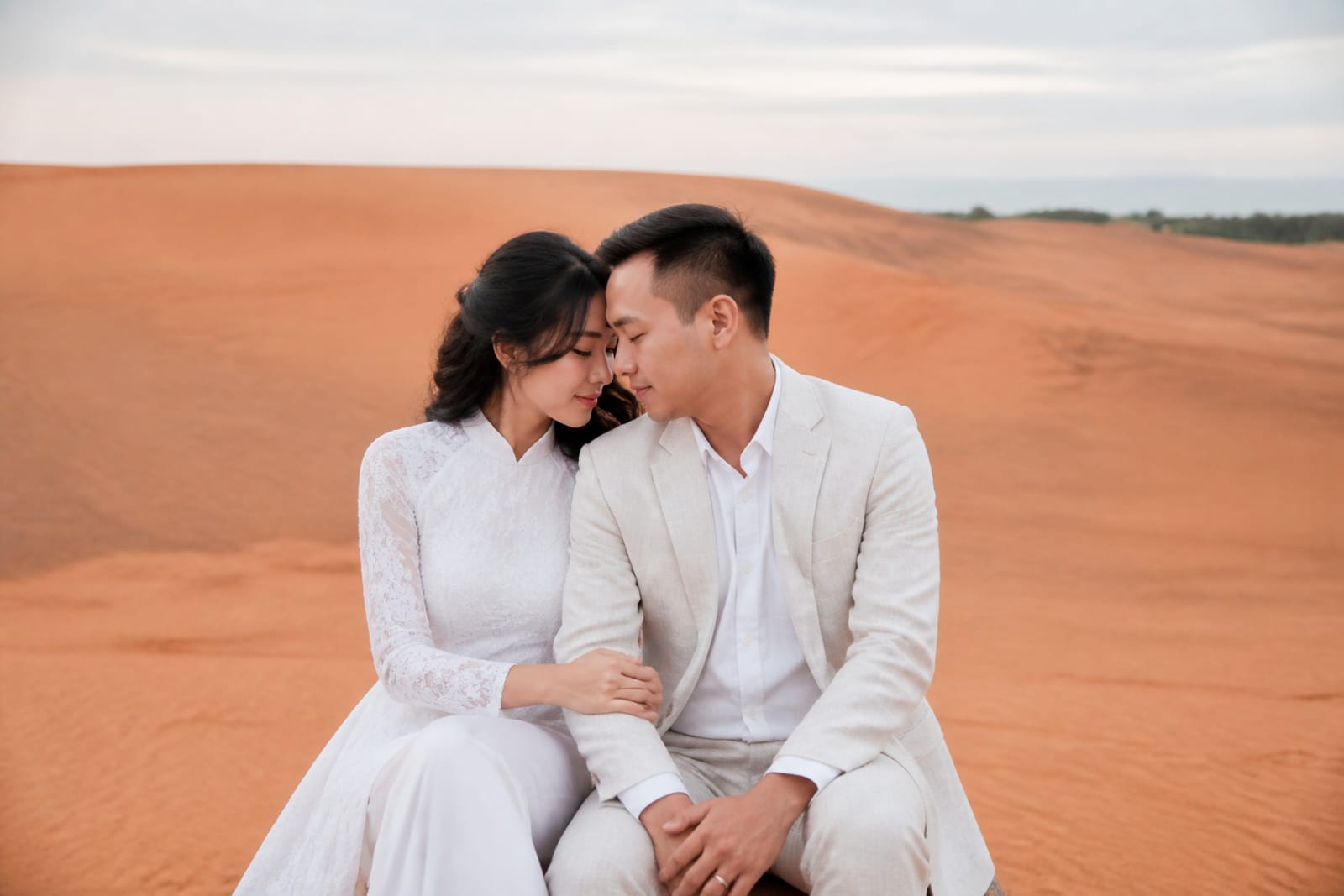
Mui Ne asks for graphic contrast. A white or cream áo dài pops against red sand and blue sky. Silk sheen catches the golden-hour light, which is the whole point. Single-tone fabrics read better in high-contrast light; patterns can muddy in harsh shadows. If you're wearing Western pre-wedding clothes in Mui Ne, pastels and whites work; in Hue, darker jewel tones and textures prevent the grey light from draining color. Cáo Studio's ao dai photoshoot page shows examples in both locations; our makeup and hair service adjusts for the light—warmer tones in Hue's cool sky, stronger definition in Mui Ne's bright, open air.
How do you know if a photographer can actually work in either place?
Ask them this: "Show me a frame from your worst-light day—overcast, no direct sun, no golden hour. How did you make it work?" A real answer: "I shot side-light off a building, used the diffused sky as a fill, and moved them to break up the flat background." A weak answer: "We waited for better light" or "We rescheduled." Then ask: "Have you shot at sunrise on dunes? What happened when the wind picked up?" This separates locals (who know sand timing and forecasts) from travelers.
Cáo Studio's approach—one team handles outfit, hair, makeup, and photography—means the photographer and stylist read the light together. If the grey Hue morning is moodier than forecast, makeup can shift slightly (more definition, warmer undertone). If Mui Ne sunrise brings unexpected clouds, the outfit choice and poses pivot immediately. A single coordinator beats three vendors sent separately; the photographer isn't waiting for a makeup artist, and the couple isn't re-posing between vendors.
---
What to check before you book
- Dates locked? If Sep–Dec, Hue is safe. If you're flexible and want the best light, Dec–Feb for Hue, Nov–Apr for Mui Ne.
- Local knowledge. Has the photographer shot in this destination in this season? Can they describe the sunrise timing, tidal shift (Hue), or sand conditions (Mui Ne)?
- One team or three vendors. Can your outfit, hair, makeup and photographer coordinate, or are they separate? A single coordinator moves faster and reads the light together.
- Backup plan. If weather shifts, can they pivot outfits or shoot time same-day, or do they reschedule automatically?
---
Next steps
You've narrowed the destination. Now define the story: are you moving through ancient streets (Hue) or walking into scale and light (Mui Ne)? Then book a photographer who has shot both in the season you're locked to, and who can explain the sunrise timing and light direction before you arrive. Cáo Studio handles pre-wedding and elopement sessions across Hanoi, Ho Chi Minh City, and Hoi An by appointment; for Mui Ne, we help you plan the shoot and recommend a local photographer who knows the dunes. For any destination, reach out on WhatsApp—we'll send a quote and a timeline.
💄 Makeup & hair at your hotel | 🌸 See the lookbook | 📸 Book on WhatsApp — pre-wedding photoshoot
---
FAQ
Is Hue or Mui Ne cheaper to shoot in?
Both have entry permits and guide fees (check locally), but neither cost is meaningful compared to travel time. Hue is a city (easier logistics); Mui Ne requires a 4–5 hour drive from Saigon and sunrise requires an early start. Budget for that shift, not landmark fees.
Can we shoot both Hue and Mui Ne in one trip?
Only if you have 5+ days. Hue is best at dawn (5:30–7 am), then the day is yours. Mui Ne needs a 4–5 hour drive from Phan Thiet and a 4:30 am dune start; adding Hue means two separate dawn shoots and heavy travel. One location, one dawn, one story is stronger.
What if we get bad weather on shoot day?
In Hue, overcast is often better than clear—soft light, no harsh shadows. Rain is riskier; if drizzle, we shoot under temple eaves or shift to covered streets. In Mui Ne, a downpour kills the shoot (sand washes, light flattens); wind is manageable if you arrive before thermals kick up. Always book with a photographer who offers same-day reschedule or time-shift.
Do we need to wear áo dài in either place?
No, but áo dài reads strongest in both—especially Hue's moody light and Mui Ne's graphic landscape. Western pre-wedding clothes work if you choose tones and fabrics for the light (jewel tones for Hue; whites and pastels for Mui Ne). See our ao dai photoshoot and lookbook for examples in both settings.
How early do we actually have to wake up?
Hue sunrise shoots: 5:30 am start, light peaks 6:15–7:00 am. Mui Ne: 4:30 am departure from town, dune arrival 5:15 am, light peaks 5:45–6:30 am. Both demand real early mornings. If you're not a dawn person, Hue's grey light works all morning; Mui Ne loses magic after 7:30 am.
Can a regular tourist photographer shoot this, or do we need Cáo Studio?
A talented local who has shot pre-weddings in your chosen season will deliver strong frames. Cáo Studio's edge is coordination—one team handles outfit, hair, makeup, and light so the photographer doesn't re-pose you between vendors. For Hue or Hoi An, book us; for Mui Ne, we help plan and recommend a local who knows the dunes.
FAQ
Is Hue or Mui Ne cheaper to shoot in?
Both have entry permits and guide fees (check locally), but neither cost is meaningful compared to travel time. Hue is a city (easier logistics); Mui Ne requires a 4–5 hour drive from Saigon and sunrise requires an early start. Budget for that shift, not landmark fees.
Can we shoot both Hue and Mui Ne in one trip?
Only if you have 5+ days. Hue is best at dawn (5:30–7 am), then the day is yours. Mui Ne needs a 4–5 hour drive from Phan Thiet and a 4:30 am dune start; adding Hue means two separate dawn shoots and heavy travel. One location, one dawn, one story is stronger.
What if we get bad weather on shoot day?
In Hue, overcast is often better than clear—soft light, no harsh shadows. Rain is riskier; if drizzle, we shoot under temple eaves or shift to covered streets. In Mui Ne, a downpour kills the shoot (sand washes, light flattens); wind is manageable if you arrive before thermals kick up. Always book with a photographer who offers same-day reschedule or time-shift.
Do we need to wear áo dài in either place?
No, but áo dài reads strongest in both—especially Hue's moody light and Mui Ne's graphic landscape. Western pre-wedding clothes work if you choose tones and fabrics for the light (jewel tones for Hue; whites and pastels for Mui Ne). See our [ao dai photoshoot](/ao-dai-photoshoot) and [lookbook](/lookbook) for examples in both settings.
How early do we actually have to wake up?
Hue sunrise shoots: 5:30 am start, light peaks 6:15–7:00 am. Mui Ne: 4:30 am departure from town, dune arrival 5:15 am, light peaks 5:45–6:30 am. Both demand real early mornings. If you're not a dawn person, Hue's grey light works all morning; Mui Ne loses magic after 7:30 am.
Can a regular tourist photographer shoot this, or do we need Cáo Studio?
A talented local who has shot pre-weddings in your chosen season will deliver strong frames. Cáo Studio's edge is coordination—one team handles outfit, hair, makeup, and light so the photographer doesn't re-pose you between vendors. For Hue or Hoi An, book us; for Mui Ne, we help plan and recommend a local who knows the dunes.
Ao dai, makeup, hair and a local photographer in Hanoi or Saigon — one WhatsApp message.