/pre-wedding-photoshoot
Luxury Pre-Wedding Photoshoot in Quy Nhon: Light, Season & How to Book
A luxury pre-wedding photoshoot in Quy Nhon means directing you and your partner through the coastal light—early morning at rocky outcrops where the sun sits low and warm, or late afternoon along quiet beaches—rather than posing you in front of the view. The best months are Feb–Aug: the sea is calm, the sky clear, and the light golden without the rainy-season haze. Cáo Studio shoots in Hanoi, Ho Chi Minh City and Hoi An; for Quy Nhon, we can coordinate a local photographer or guide you through planning your own shoot with one. The session typically runs 2–3 hours at one or two locations, moving with the light and the tide. What kills a coastal shoot: choosing midday (harsh shadow under your chin), shooting during rainy season (grey skies, unpredictable winds), or staying in one spot too long (light moves fast on the coast).
A luxury pre-wedding shoot in Quy Nhon is not a package you buy; it's a decision about light, season, location and the person behind the camera. The coast itself does not make the shoot. The light does—and light in Quy Nhon depends entirely on month, time of day and your choice of rocky cove versus beach. This guide walks you through that choice so you book with confidence.
Why Quy Nhon's coastline works for pre-wedding shoots
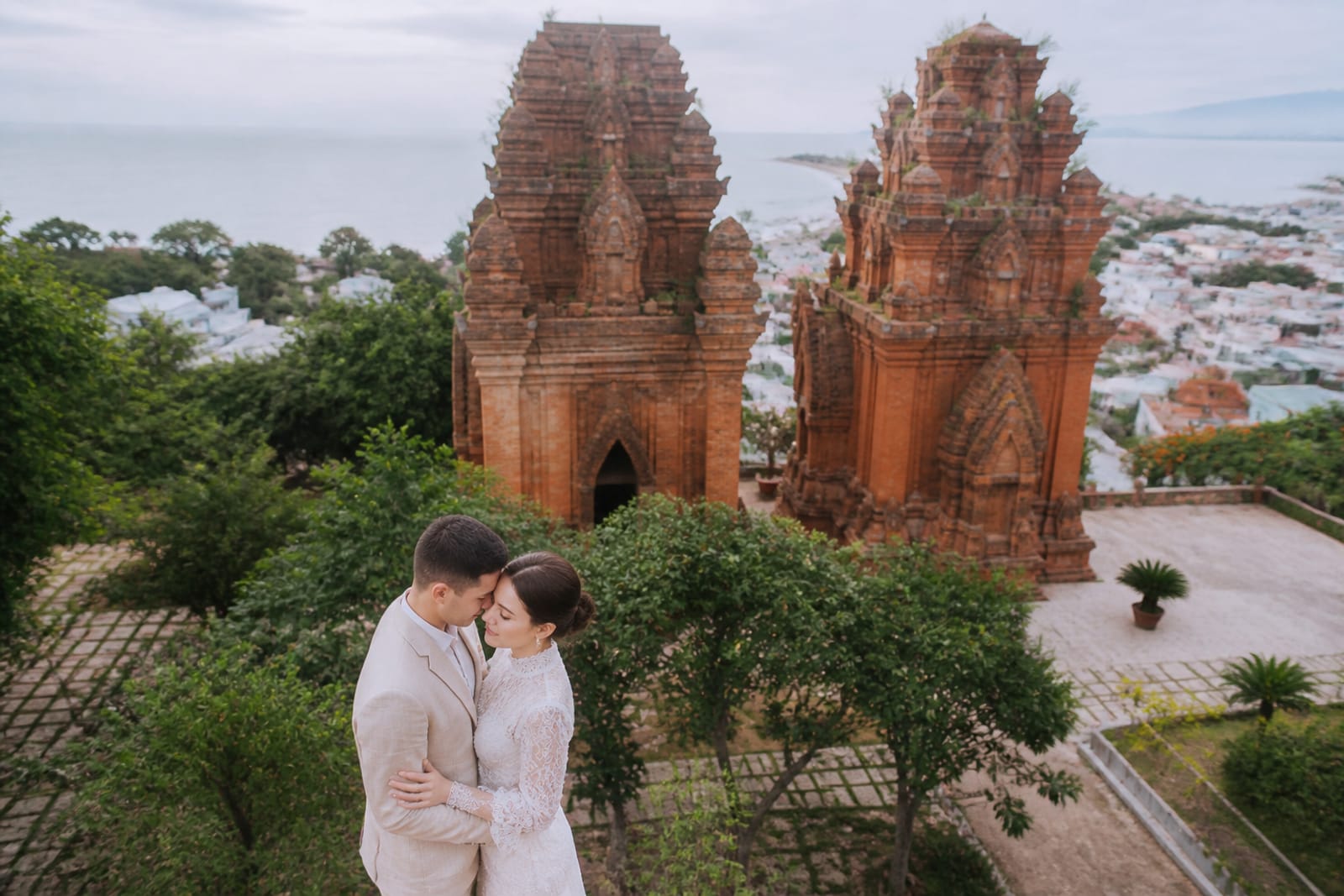
Quy Nhon sits on Vietnam's central coast, about 250 km south of Da Nang. Its defining feature for photoshoot location scouts is not sand beaches but turquoise coves between granite and limestone rocks—natural framing that pulls the eye from your figures to the water and sky. Unlike Hoi An's urban temple backdrops or Hanoi's urban geometry, Quy Nhon offers isolation and raw texture: weathered stone, shallow tide pools, and the kind of empty-shoulder feel that lets a director work without crowds. The trade-off is accessibility: you'll need transport between coves, and some require hiking or scrambling. That effort is part of why the shoot works—movement, real wind in hair, genuine breath. A photographer who knows Quy Nhon's tides and light angles will scout at low tide to find the framing that vanishes at high tide; that specificity is what separates a luxury shoot from a "nice beach photo." Cáo Studio shoots in Hanoi, Ho Chi Minh City and Hoi An with our own team; for Quy Nhon, we recommend coordinating with a local photographer who knows the coast intimately.
📸 Book on WhatsApp — pre-wedding photoshoot
Which months have the clearest light for Quy Nhon pre-wedding shoots?
Feb–Aug is the dry season on the central coast: the sea is calm, the sky is predictable, and the sun rises and sets without grey overcast. In these months, you get consistent light to shoot into—the photographer can meter the sky and expose your faces without blown-out backgrounds. Sep–Dec is the rainy season; Oct–Nov is peak typhoon and flood season, with grey skies and offshore winds that make scheduling fragile. If you're planning a Quy Nhon shoot, book your travel dates within Feb–Aug and alert your photographer at least 4–6 weeks in advance so they can scout locations and confirm weather windows. Tet (late Jan–mid Feb) brings crowds to any Vietnamese coast, but the light is still clear; plan a shoot in the first week of Jan or mid-Feb if you're flexible. The message: dry season is not just about comfort—it's about the light you paid for.
Early morning or late afternoon: which light suits your aesthetic?
Two windows dominate a coastal shoot: sunrise to 7:30 am, and 4:30 pm to sunset. Early morning light is soft, directional and cool-toned; the sea is glassy; few boats or swimmers are visible. You're moving quickly because the sun climbs fast—a 2-hour window in the first hour after sunrise, then the light hardens. Late afternoon light is warm and longer-lasting: the sun dips gradually from 4:30 pm to 7 pm, giving a photographer 2–3 hours to move between locations without chasing the light upward. Early morning suits couples who want a cinematic, serene mood and are willing to be awake and ready by 5:30 am. Late afternoon suits those who want warmth in the frame and flexibility with timing. Midday (9 am–4 pm) is almost never booked for a luxury shoot—the sun is directly overhead, your faces are shadowed, and the contrast between you and the bright sea is too extreme. A director will always argue for the edges of the day.
Tide, weather windows and what can go wrong on the day
The central coast's tides swing 1–1.5 meters twice daily; low tide opens rocky pools and narrow beach access that vanishes at high tide. A photographer scouting Quy Nhon will know that the "best" cove is reachable only between 5:00 and 7:00 am at low tide—book that time or pick a second location. Weather is the other hinge: rainy season (Sep–Dec) can close a shoot within 24 hours if a storm moves in. A luxury photoshoot means your photographer has a backup plan—a second cove scouted in advance, or a covered pavilion where you can still shoot. Before you book, ask your photographer directly: "What's your plan if the tide is wrong on the day? What if rain comes?" A vague answer is a red flag. Also ask about transport: do they have a vehicle, or will you hire a taxi to move between two locations? The cost and time add up; knowing beforehand saves stress. For Cáo Studio shoots in Hanoi, Ho Chi Minh City and Hoi An, our team coordinates logistics end-to-end; for Quy Nhon, you're liaising with a local crew, so clarity on these details is critical.
Choosing outfit, hair and makeup for coastal light
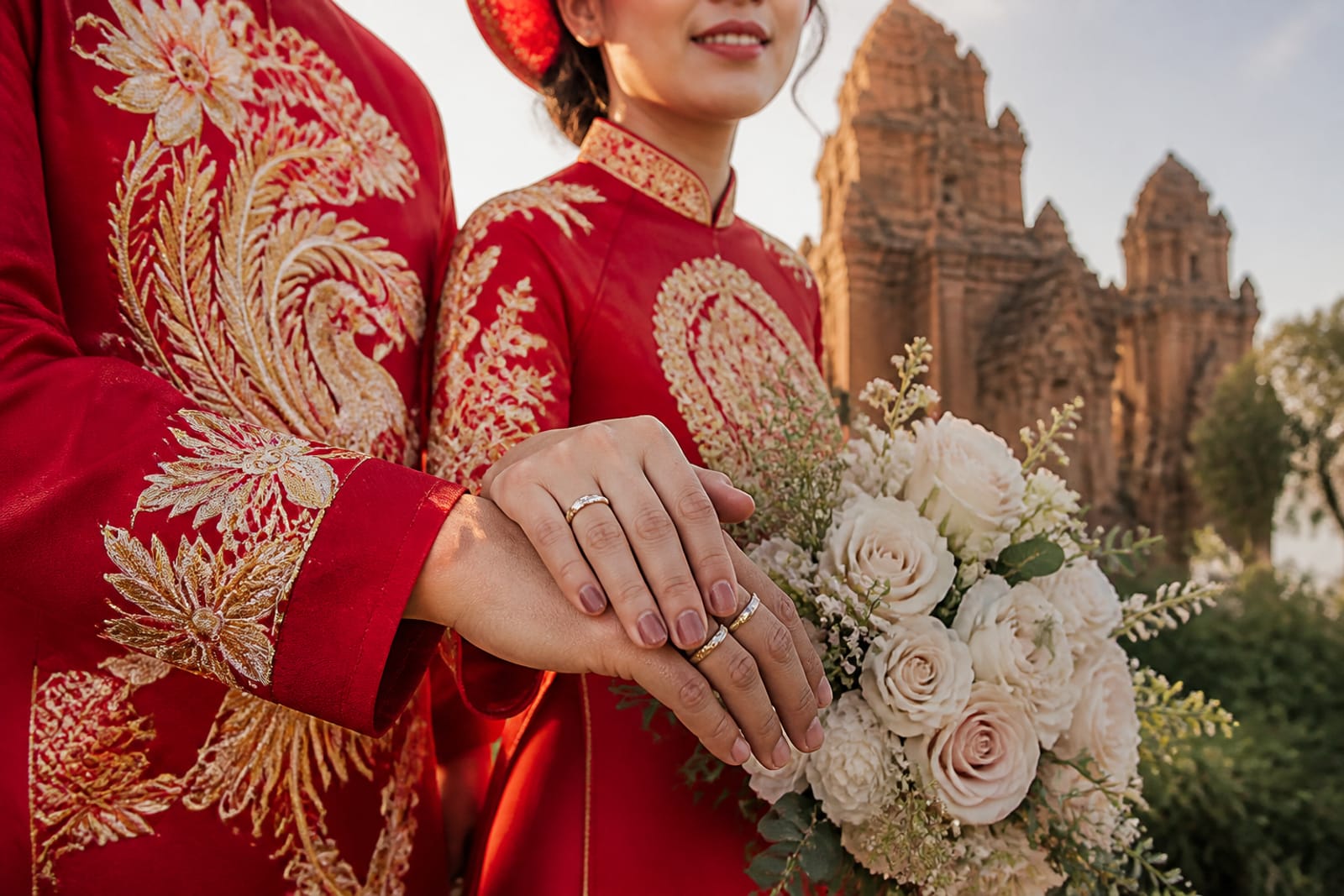
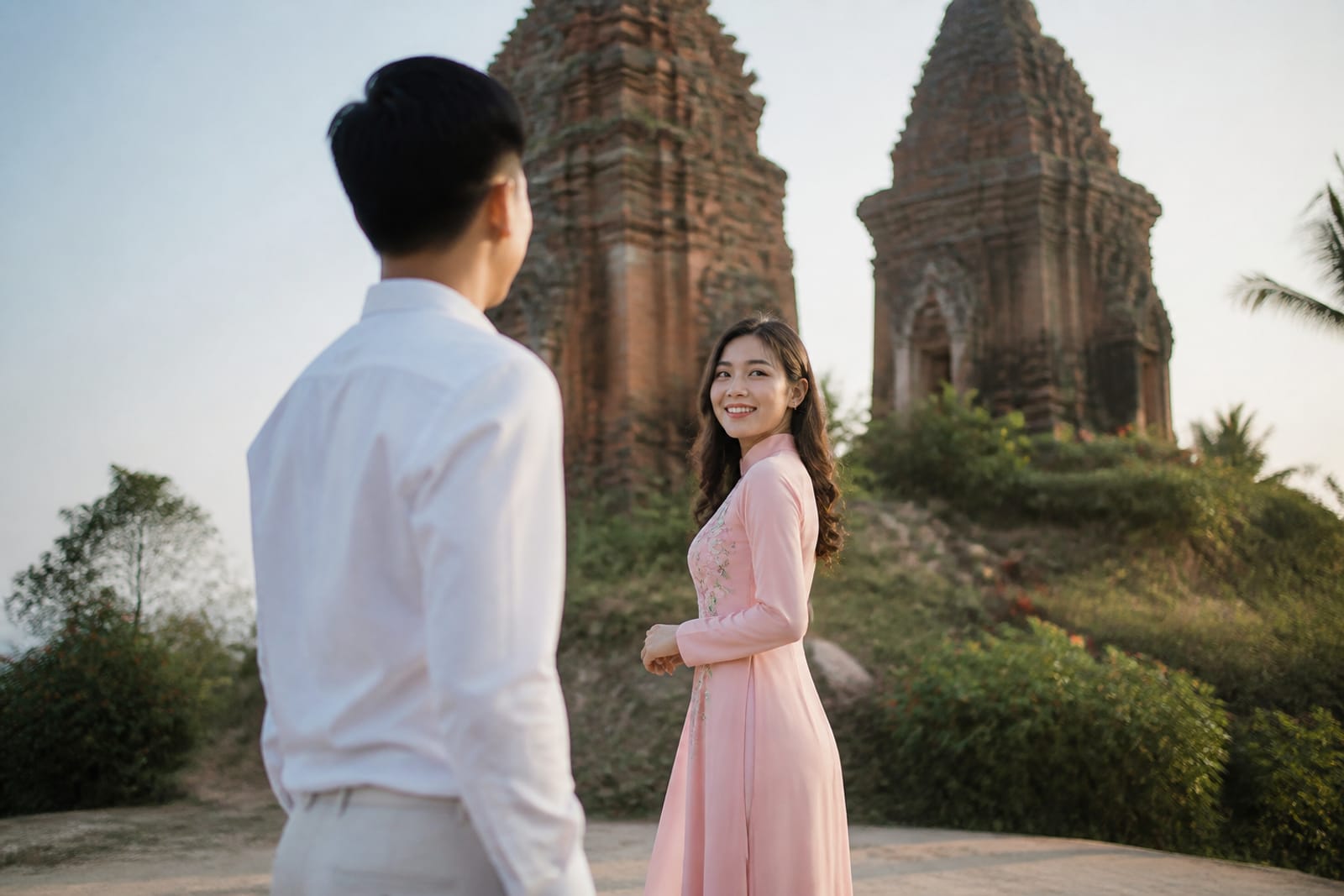
The sea's reflective quality means light bounces up into your face; makeup should be slightly more defined than for studio work, but not theatrical. A natural base with warm undertones suits the golden-hour light; if you're shooting early morning, cooler makeup can look pale in the blue light. For outfit, the wind is constant on the coast—loose fabrics photograph beautifully (fabric floating, movement in hair) but can whip into your face or tangle. An áo dài works exceptionally well in Quy Nhon's light: the silk catches the sun and drapes in the wind. Lighter colours (cream, pale blue, gold) reflect light and read well against the turquoise water; darker áo dài can recede into shadows. If you're wearing Western dress, consider a lightweight fabric that moves—silk, linen, cotton—and a long cut so your legs aren't in direct harsh sun. Avoid white or cream fabric that will blow against your body in ways you can't predict. Hair: tie it back loosely if the wind is strong, or plan to move it between shots. A director should be giving you these notes during the briefing, not on the day. Hair and makeup should ideally be done at your hotel 45 minutes before departure so you arrive at the first location ready and composed; makeup & hair at your hotel ensures freshness and calm.
Comparison: local photographer, travel-photographer rental, or studio-coordinated shoot
| Approach | Best for | Light & season control | Why it works |
|---|---|---|---|
| Local Quy Nhon photographer | Budget-conscious couples, flexible dates | Strong; knows tides & light windows | Intimate knowledge of coast; lower travel cost. |
| Rental photographer (not local) | Tourists wanting a guarantee | Moderate; they scout 1–2 visits before | Portfolio and insurance, but unfamiliar with Quy Nhon specifics. |
| Studio coordination (Cáo Studio for Hanoi/HCMC/Hoi An base) | Pre-wedding couples wanting full creative direction | Strongest in Hanoi/HCMC/Hoi An; Quy Nhon requires local partner | Studio team oversees messaging and edit; less control if local crew is hired. |
Cáo Studio's strength is directing a single integrated team—photographer, makeup artist, stylist—on location. For Quy Nhon, we do not have our own team stationed there; instead, we can recommend a local photographer and brief them on our visual language (directed, not posed; wide, medium, detail framing; light-driven timing). Ask on WhatsApp if Quy Nhon coordination is available for your dates.
What to check before you book a Quy Nhon pre-wedding shoot
- Photographer's portfolio: Look for 3–5 Quy Nhon or coastal shoots. Do the frames tell a story (walking, looking at each other, genuine movement)? Or are they posed in front of rocks?
- Scouting and briefing: Has the photographer scouted the locations recently? Will they walk you through the day's plan, light angles and tide times before you arrive?
- Backup plan: What happens if weather shifts or tide timing changes? Is a second location in the plan?
- Hair and makeup: Is it included, or do you arrange separately? If you arrange it, how early should it be done? (Answer: at least 45 minutes before departure.)
- Outfit changes: How many outfits are realistic in a 2–3 hour window? Most coastal shoots work with one outfit and one backup; moving clothes in windy conditions is slow.
- Editing and delivery: How many edited photos will you receive? In what format? By when? (For Cáo Studio shoots, these details are confirmed on WhatsApp; for local Quy Nhon bookings, get it in writing before you pay.)
- Timeline and meeting point: Confirm the exact time and location you'll meet the photographer. Quy Nhon's roads are not always direct; allow buffer time.
For couples in Ho Chi Minh City or Hanoi planning a Quy Nhon pre-wedding shoot, consider pairing it with a pre-wedding photoshoot session at home first—an indoor, controlled shoot that guarantees gorgeous frames and reduces pressure on the coast. Cáo Studio also shoots couple photoshoots in Hanoi and Ho Chi Minh City if you'd like a shoot closer to your base.
FAQ
Is Quy Nhon's rainy season (Sep–Dec) impossible for a photoshoot?
Not impossible, but risky. Oct–Nov brings typhoon season and grey skies. If you must shoot then, ask your photographer for a covered backup plan and book a 4–5 hour window to weather brief downpours. Avoid scheduling a tight timeline during rainy season.
How much of a difference does hiring a local Quy Nhon photographer versus a travel photographer make?
A local knows the tide calendar, which coves are accessible at what times, and seasonal light patterns. A travel photographer will scout on arrival, costing time and potentially missing optimal windows. Local knowledge compounds over seasons; hire accordingly.
Can we do a multi-location Quy Nhon shoot in one session?
Yes, if locations are close and tide timing allows. Moving between distant coves costs 20–30 minutes per transition. A 3-hour shoot realistically covers 2 locations well; cramming three spreads the team thin and leaves no time to move with light.
What happens if we arrive for our shoot and the tide is wrong?
A scouted backup location should be in the plan. Ask your photographer before booking: "If tide timing shifts, where's plan B?" If they don't have one, find someone who does.
Should we book Quy Nhon or Hoi An for a luxury pre-wedding shoot?
Quy Nhon offers isolation and rock formations; Hoi An offers urban temples, lanterns and river access. Quy Nhon is longer drive from Hanoi/HCMC and requires local coordination. Hoi An is where Cáo Studio shoots with our own team—faster to brief, guaranteed creative direction. Ask on WhatsApp which suits your vision.
How much should a local Quy Nhon photographer cost?
Budget varies by experience and package scope. Before booking, clarify what's included: number of edited photos, delivery timeline, outfit changes, and whether makeup/hair are included or separate. Compare what you get, not the headline price.
FAQ
Is Quy Nhon's rainy season (Sep–Dec) impossible for a photoshoot?
Not impossible, but risky. Oct–Nov brings typhoon season and grey skies. If you must shoot then, ask your photographer for a covered backup plan and book a 4–5 hour window to weather brief downpours. Avoid scheduling a tight timeline during rainy season.
How much of a difference does hiring a local Quy Nhon photographer versus a travel photographer make?
A local knows the tide calendar, which coves are accessible at what times, and seasonal light patterns. A travel photographer will scout on arrival, costing time and potentially missing optimal windows. Local knowledge compounds over seasons; hire accordingly.
Can we do a multi-location Quy Nhon shoot in one session?
Yes, if locations are close and tide timing allows. Moving between distant coves costs 20–30 minutes per transition. A 3-hour shoot realistically covers 2 locations well; cramming three spreads the team thin and leaves no time to move with light.
What happens if we arrive for our shoot and the tide is wrong?
A scouted backup location should be in the plan. Ask your photographer before booking: "If tide timing shifts, where's plan B?" If they don't have one, find someone who does.
Should we book Quy Nhon or Hoi An for a luxury pre-wedding shoot?
Quy Nhon offers isolation and rock formations; Hoi An offers urban temples, lanterns and river access. Quy Nhon is longer drive from Hanoi/HCMC and requires local coordination. Hoi An is where [Cáo Studio shoots](/hoi-an) with our own team—faster to brief, guaranteed creative direction. Ask on WhatsApp which suits your vision.
How much should a local Quy Nhon photographer cost?
Budget varies by experience and package scope. Before booking, clarify what's included: number of edited photos, delivery timeline, outfit changes, and whether makeup/hair are included or separate. Compare what you get, not the headline price.
Ao dai, makeup, hair and a local photographer in Hanoi or Saigon — one WhatsApp message.