/pre-wedding-photoshoot
Moc Chau tea hills: best light for wedding photos (time & season)
Moc Chau tea hills photograph best at sunrise (5:30–7:00 am) when mist clings to the rows and light wraps soft and directional; late afternoon (4:00–5:30 pm) offers warm side light across the terrain but with heavier tourist traffic. Winter (December–February) brings clearer skies and cooler comfort, though early mornings frost the grass; spring (March–April) has longer daylight and blossoms but afternoon crowds and variable humidity. A directed pre-wedding photoshoot with Cáo Studio means one team—photographer, makeup artist, stylist—arrives early, reads the light, and positions you to walk and interact within the landscape, not pose at it. Cost factors include travel time from Hanoi, outfit and makeup setup, and whether you shoot one outfit or layer multiple looks across the hill. Before booking, confirm the exact date, weather forecast and how many edited frames suit your timeline. 📸 Book on WhatsApp — pre-wedding photoshoot ---
What time of day freezes the best light in Moc Chau tea fields?
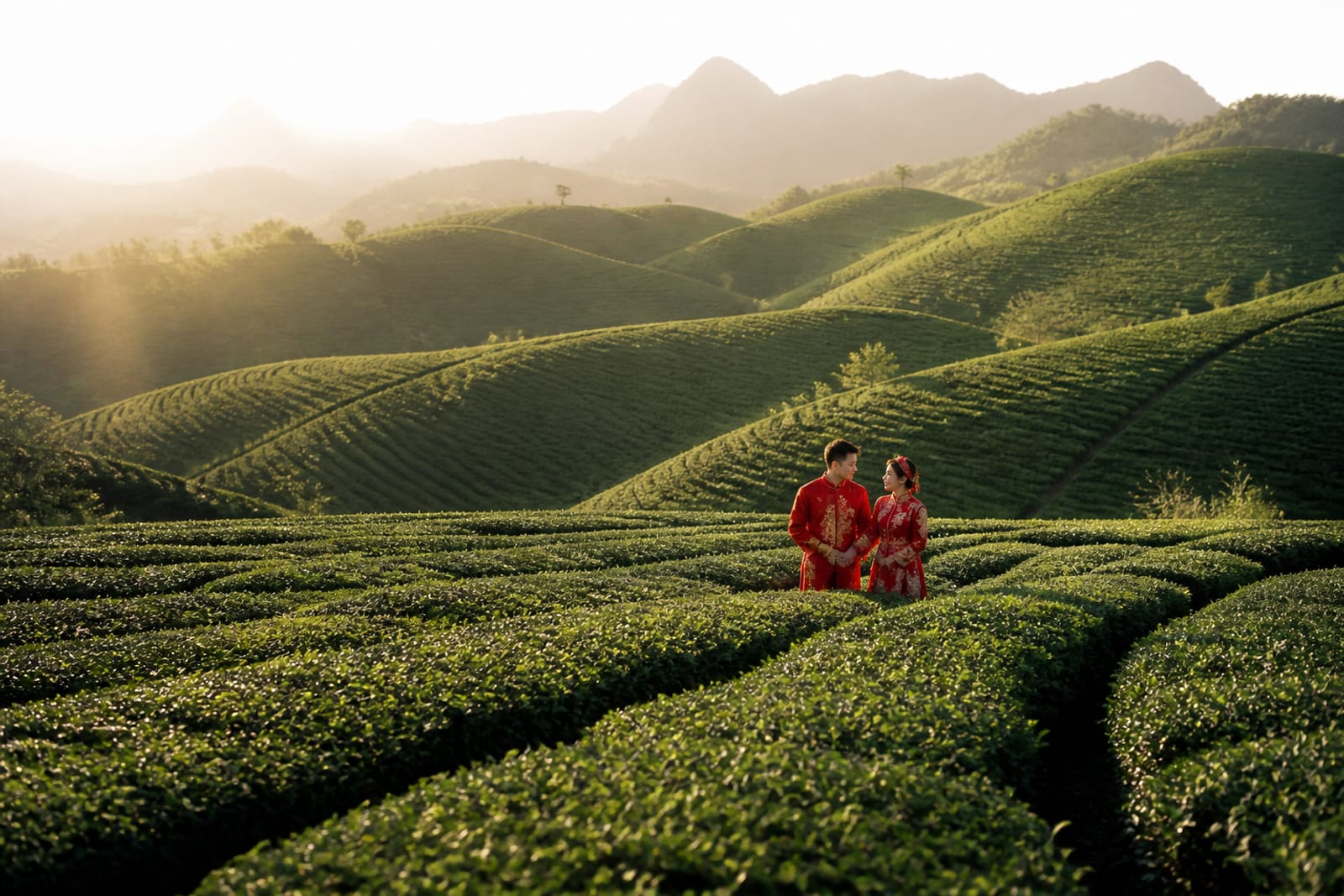
Early morning (5:30–7:00 am) and late afternoon (4:00–5:30 pm) frame the tea hills most differently. At sunrise, mist sits low and even, wrapping your faces in soft, diffused light—no harsh shadows, perfect for intimate two-person framing and wide landscape shots that include the terraced rows receding uphill. The air is coolest then; your skin reads fresh and natural. Late afternoon light arrives warm and angled: it sculpts the tea plants' edges, casts long shadows across the terrain, and wraps side light across a walking couple. The trade: afternoon heat rises, humidity climbs, and tour buses peak between 3:00 and 5:00 pm. Morning light lasts longer (the sun moves slower near the horizon) and clears faster—by 8:00 am, mist burns away and the light flattens. A directed photoshoot team arrives before dawn, positions you for the clearest first frames, then adapts as light shifts. Sunrise delivers the strongest, most unique tea-hill frames.
How does Moc Chau's winter light differ from spring and summer?
Winter (December–February) offers the clearest, most stable light. Skies hang pale and cool; the air is dry and crisp. Mist settles thicker and lingers longer—often until 7:30 or 8:00 am—because overnight cold holds it. This extends the "golden window" for soft, even light. Frost coats the grass early morning; wear layers you can remove or plan outdoor makeup touch-ups between shots. Spring (March–April) brings longer daylight and occasional plum and cherry blossoms on nearby trees, but humidity rises and afternoon haze thickens. Clouds roll in unpredictably; afternoon light scatters. Summer (May–September) is hot, humid and rainy; mist clears by 6:30 am and midday light is harsh. Winter light is most photogenic; spring offers more daylight hours and floral accents; summer is least reliable. If you're choosing a season, winter and early spring (Jan–March) produce the frames most couples keep for life.
Should you shoot solo outfits or layer multiple looks on the tea hills?
Your outfit strategy depends on how many edited frames you want and how much setup you need. One outfit (dress or áo dài, hair, makeup fixed once) means one arrival, faster shooting, and a tighter narrative—all frames tell one story. Two outfits require an intermediate change, extra makeup touch-up time, and a longer on-site window; light may shift between setups. The tea hills reward walking and repositioning within one outfit more than multiple quick changes: the landscape is vast, the light moves, and moving your couple through different rows and angles across 90 minutes captures more variation than standing still and changing clothes. Makeup & hair at your hotel happens before you leave for the hills, so arrival is fast and the team can focus on light, not touch-ups in the field. If you want two outfit chapters (e.g., ceremony dress, then casual), plan 2–2.5 hours on-site and confirm exact change logistics with your director beforehand. One outfit, 90 minutes, tells a stronger story on tea hills than rushed multi-outfit sessions.
| Approach | Best for | Light & season fit | Why it works |
|---|---|---|---|
| One outfit, 90 min | Couples who want a narrative arc within one look | Winter sunrise, any spring morning | Light doesn't shift enough to justify outfit change; more time to walk, interact, reposition |
| Two outfits, 2+ hours | Couples who want ceremony and casual contrast | Winter or early spring (stable morning light) | Two distinct chapters; requires longer site time and pre-planned change spot |
| Tea fields + hotel/garden follow-up | Couples who want tea hills plus intimate indoor frames | Sunrise session (4–7 am), then hotel afternoon slot | Splits logistics; lets makeup settle between locations; captures two light moods |
What weather and crowd factors matter most for Moc Chau tea-hill booking?
Winter (Dec–Feb) brings chill—3–10°C early morning—so wear layers, thermal leggings under áo dài, and closed-toe shoes for frost-wet grass. Spring (Mar–Apr) is mild and dry but tourist buses peak weekends; arrive by 5:30 am to clear the popular rows before crowds. Summer rain and heat reduce frame quality; avoid. Typhoon season (Sep–Nov) brings unpredictable downpours. Winter stability and spring bloom timing trade off against spring crowds. A directed team books earliest possible light slots (5:00–5:30 am arrival) and knows which tea-field sections stay quieter—they route your couple through real geography, not tourist-trap photo spots. Before booking, ask your director: "How early can we arrive?" and "Does your team know quiet rows?" Crowds don't kill the shoot; arriving before them does.
What should you confirm with your photographer before booking Moc Chau?
Before you commit, ask these five things. First: arrival time and who arranges transport from Hanoi? (Cáo Studio travels and co-ordinates; confirm pickup and drive time.) Second: exactly how many edited frames do you receive, and when? (The studio's timeline is confirmed on WhatsApp; usually 48 hours for a short vertical film plus edited stills.) Third: can the team handle an outfit change, or is it one look? (Logistics vary; confirm so you don't plan two dresses and arrive to find only one was booked.) Fourth: what happens if weather turns? (Wind, unexpected rain, or thick cloud shifts light; ask the studio's reschedule or reshoot policy beforehand.) Fifth: does the quote include makeup & hair, or is that add-on? (Makeup & hair at your hotel may be bundled or separate; confirm to avoid surprises.) A director who answers these clearly before you book is one you can trust in the field when light changes.
---
How to frame Moc Chau light if you book a local photographer instead of Cáo Studio
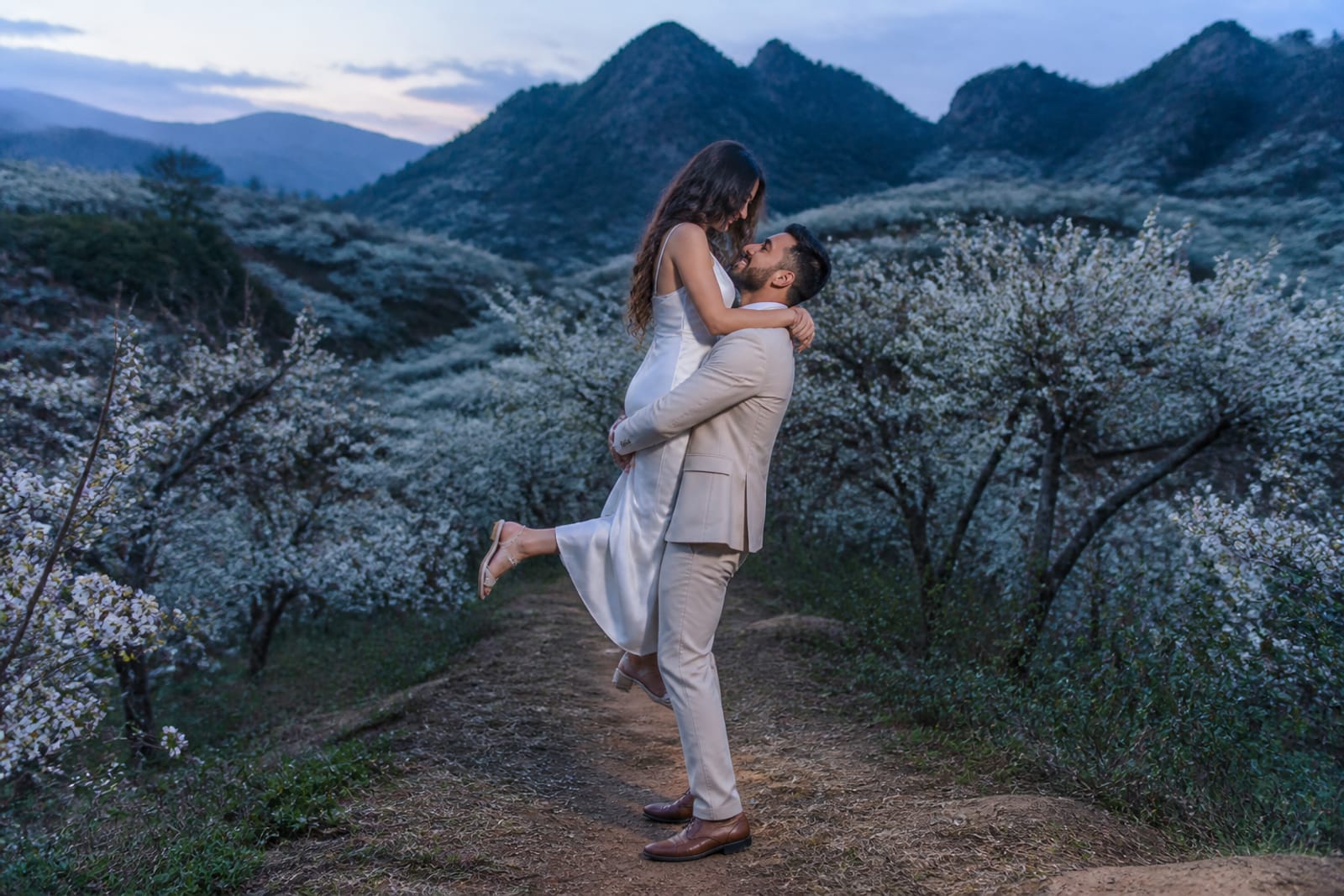
If you source a local Moc Chau photographer outside Cáo Studio, look for these skills. Arrive-early experience: they've shot at 5:30 am before and know how mist moves. Directorial framing: they guide you to walk and interact within the landscape (not pose at it)—ask to see frames where couples move, sit on the grass, or touch shoulders while facing the rows. One-team coordination: ideally, your makeup artist and photographer communicate beforehand, so makeup light-holds the first 90 minutes without constant touch-ups. Lens choice for wide light: they carry a wide-angle lens (24–35 mm equivalent) to capture the scale of the tea hills and the quality of early-morning light wrapping across them. Contingency clarity: they explain verbally—or show examples—of how they'd reshoot if weather sours. Vet their portfolio for tea-hill sequences (not just static portraits), and book for winter or early spring. Cost factors: photography rate, transport from their base, and how many edited files they deliver and when. Cáo Studio's pre-wedding shoots in Moc Chau integrate photographer, makeup, hair and styling into one directed session; ask on WhatsApp for availability and exact package details.
---
Real light shifts: a minute-by-minute example from a winter Moc Chau sunrise
Winter morning, 5:30 am arrival: sky is dark grey-blue, mist hangs thick 1–2 meters above the grass, and light is barely directional—it's coming from nowhere visible yet. Frames are soft, monochromatic, moody. 5:50 am: sun begins to orange the horizon to the east; mist catches the warm tone and glows pale gold. Light is now directional from one side; shadows lengthen on the tea rows. This is the 10-minute window for the strongest soft-side-light frames. 6:10 am: mist burns fast; sky lightens; directional light hardens slightly but is still wrapped in overhead haze. Warmth lingers. 6:30 am: mist mostly gone, light is now coming from a clear direction (60° angle from horizontal), and shadows are pronounced. Sky is pale blue. Frames shift from dreamy to sculptural. 7:00 am: direct sun is clearer; if you're in full sun without cloud, light hardens; shadows deepen. Mist is gone. This sequence is why a directed team plans specific frames for each 20-minute window: wide shots and walking moments in the first mist-light phase (5:50–6:10), intimate two-person framing as mist clears (6:10–6:30), and landscape-scale frames once light solidifies (6:30–7:15). A photographer shooting "whenever" misses the story.
---
Logistics: how a Moc Chau pre-wedding shoot actually runs
Your team picks you up from your Hanoi hotel by 4:30 or 5:00 am (exact time confirmed on WhatsApp). Makeup and hair were completed at your hotel the evening before or early morning, so arrival at the tea hills is 5:30–5:45 am—ready to shoot. The photographer and director scout the light and position you for the first frames within 10 minutes; no setup delays. You walk, sit, hold each other, change positions—guided by the director, not posed. The photographer captures wide landscape framing first (you in context), then medium two-person shots, then detail close-ups (hands, faces, reactions). By 6:30 am, you've moved through 2–3 distinct sections of the tea hills; each has different light and terrain. You pause for hydration and a subtle makeup check (lip, powder if needed). By 7:00–7:30 am, mist is gone and light has changed; the team may shoot a final sequence or begin the drive back. You're back at your hotel by 9:00–9:30 am, fresh and with 40–80 unedited frames on the director's camera. Edited photos and a short vertical film arrive within 48 hours. The whole experience is calm, directed and efficient—no standing around, no waiting for poses to feel natural.
---
Cost factors to discuss before booking
Price is quoted on WhatsApp and depends on several levers (never fixed amounts). Travel distance: Moc Chau is 150 km northwest of Hanoi; team travel time and fuel are factored into the quote. Team size: photographer alone costs less than photographer + makeup artist + stylist; bundled teams (makeup & hair included) cost more upfront but avoid separate vendor coordination. Outfit and styling: one outfit means faster setup; two outfits require extra prep and on-site change logistics. Edited frames and delivery: fewer edited files and longer delivery (2–4 weeks) cost less than rapid turnaround (48 hours) with high-resolution digital files. Season: winter and spring peak-demand seasons may have different rates than summer. Ask Cáo Studio on WhatsApp: "What does a Moc Chau winter sunrise shoot include, and what's the cost basis?" so you understand where the quote comes from. Do not compare a solo Hanoi photographer's rate to a studio's bundled rate; they're different services.
---
Renting an áo dài or wedding dress for Moc Chau tea hills
Moc Chau's tea-field terrain and morning cold affect outfit choice. An áo dài works beautifully—the fabric drapes, moves naturally as you walk, and the traditional cut photographs well in wide landscape frames. Winter áo dài in heavier silk or cotton keeps you warm; spring áo dài in lighter fabric works too. If you're renting, ask the rental house: "Does the áo dài fit comfortably over thermal leggings?" because you'll need layers. A Western wedding dress works if it's fitted (loose skirts tangle in tea rows and pick up frost), but hems and trains are harder to manage on uneven ground. Many couples choose áo dài for Moc Chau and save Western dress for studio or hotel frames. Ao dai rental and wedding dress rental pages outline options; confirm with your rental house the exact fit and whether they've styled Moc Chau shoots before. If you book Cáo Studio, the director advises outfit choice during WhatsApp planning and co-ordinates with your rental house if needed.
---
📸 Book on WhatsApp — pre-wedding photoshoot | 💄 Makeup & hair at your hotel | 🌸 See the lookbook
---
FAQ
Can Cáo Studio shoot Moc Chau tea hills, or is that outside your service area?
Cáo Studio is based in Hanoi and Saigon. Moc Chau is 150 km from Hanoi; the team travels for pre-wedding and elopement shoots. Ask on WhatsApp (+84 338 762 340) to confirm availability, exact logistics, and whether a Moc Chau session fits your date and budget factors.
What's the best month for Moc Chau tea-field wedding photos?
December–February (winter) offers the clearest, most stable light and longest-lasting morning mist. March–April (spring) adds daylight hours and occasional blossoms but brings afternoon haze and crowds. Summer is hot and rainy; avoid. Winter light is most unique.
Do I need special footwear for a Moc Chau shoot on tea hills?
Yes. Closed-toe shoes with grip are essential—grass is uneven, often frost-wet, and sloped. Avoid heels and open sandals. Thermal leggings under an áo dài keep you warm early morning. Ask your makeup artist to prepare for cooler conditions (longer-hold foundation).
How many hours should I book for Moc Chau, and what if light is bad that morning?
A typical session runs 90 minutes on-site (5:30 am–7:00 am arrival to exit). If weather (heavy rain, thick cloud) ruins light, ask Cáo Studio's reschedule or reshoot policy on WhatsApp when you book. Winter is most reliable; summer is riskiest.
Can I combine Moc Chau tea hills with another location (like a hotel or Hanoi Old Quarter) in one day?
Yes. Moc Chau early-morning session (finish by 7:30 am) + hotel afternoon session or evening Old Quarter shoot is feasible. This requires longer total time and may mean two makeup setups. Confirm logistics with your director so nothing overlaps or feels rushed.
If I book a local Moc Chau photographer instead of Cáo Studio, what should I ask to vet them?
Ask to see examples of tea-hill sunrise frames (not studio shots); confirm they arrive by 5:30 am; check whether they've directed couples to move and interact (not just pose); and ask their reshoot or bad-weather policy. Vet their portfolio for narrative sequences, not single portraits.
FAQ
Can Cáo Studio shoot Moc Chau tea hills, or is that outside your service area?
Cáo Studio is based in Hanoi and Saigon. Moc Chau is 150 km from Hanoi; the team travels for pre-wedding and elopement shoots. Ask on WhatsApp (+84 338 762 340) to confirm availability, exact logistics, and whether a Moc Chau session fits your date and budget factors.
What's the best month for Moc Chau tea-field wedding photos?
December–February (winter) offers the clearest, most stable light and longest-lasting morning mist. March–April (spring) adds daylight hours and occasional blossoms but brings afternoon haze and crowds. Summer is hot and rainy; avoid. Winter light is most unique.
Do I need special footwear for a Moc Chau shoot on tea hills?
Yes. Closed-toe shoes with grip are essential—grass is uneven, often frost-wet, and sloped. Avoid heels and open sandals. Thermal leggings under an áo dài keep you warm early morning. Ask your makeup artist to prepare for cooler conditions (longer-hold foundation).
How many hours should I book for Moc Chau, and what if light is bad that morning?
A typical session runs 90 minutes on-site (5:30 am–7:00 am arrival to exit). If weather (heavy rain, thick cloud) ruins light, ask Cáo Studio's reschedule or reshoot policy on WhatsApp when you book. Winter is most reliable; summer is riskiest.
Can I combine Moc Chau tea hills with another location (like a hotel or Hanoi Old Quarter) in one day?
Yes. Moc Chau early-morning session (finish by 7:30 am) + hotel afternoon session or evening Old Quarter shoot is feasible. This requires longer total time and may mean two makeup setups. Confirm logistics with your director so nothing overlaps or feels rushed.
If I book a local Moc Chau photographer instead of Cáo Studio, what should I ask to vet them?
Ask to see examples of tea-hill sunrise frames (not studio shots); confirm they arrive by 5:30 am; check whether they've directed couples to move and interact (not just pose); and ask their reshoot or bad-weather policy. Vet their portfolio for narrative sequences, not single portraits.
Ao dai, makeup, hair and a local photographer in Hanoi or Saigon — one WhatsApp message.