/pre-wedding-photoshoot
Mu Cang Chai rice terraces wedding photos: best time and light
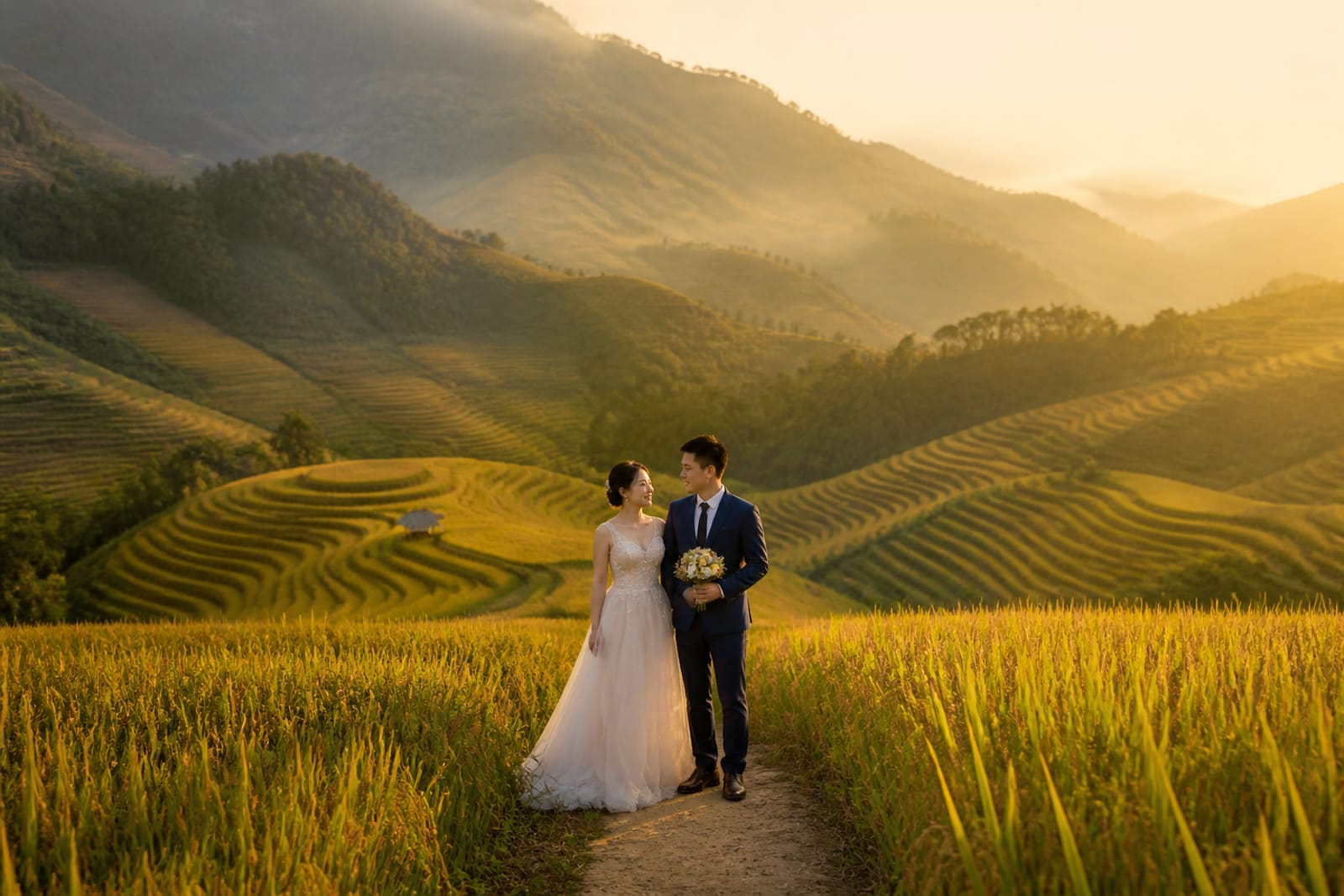
Mu Cang Chai rice terraces photograph best during golden hour (first light after sunrise, last light before sunset) when low sun hits the water and creates depth. The terraces water-fill around May–June and hold gold light from mid-September to early October; these windows matter more than time of day alone. Shoot facing the sun (into backlight for rim light on water) or with side light grazing the ridges. A four-hour drive from Hanoi means you stay overnight or leave at 4 am. Cáo Studio does not operate in Mu Cang Chai; book a local Hanoi-based photographer who knows the site and can navigate mountain roads and permits, or hire a fixer. Pair your terrace shoot with an ao dai session or couple photoshoot in Hanoi before or after to maximize your trip. ---
Is golden hour the only time that works?
Golden hour (first 90 minutes after sunrise, last 90 minutes before sunset) gives the clearest, warmest light and strongest water reflections. Midday (10 am–3 pm) produces harsh shadows in the terraces and washes out the green and gold. Overcast mornings work if clouds are thin; diffused light flattens relief, so you need foreground drama (a person walking, a water buffalo, your couple in ao dai) to compensate. Dawn light is cleaner and softer than dusk because fewer clouds have built up; dusk often brings haze from the valley. If you're staying overnight, shoot both sunrise and sunset to compare—one will always surprise you.
📸 Book on WhatsApp — ao dai photoshoot | 💄 Makeup & hair at your hotel | 🌸 See the lookbook
When do the terraces hold water and gold?
| Timeframe | Terrace State | Light Quality | Best For | Why It Works |
|---|---|---|---|---|
| May–June | Flooded, muddy-green water | Soft, cloud-filtered | Moody, intimate couples | Water fills; cloud cover reduces shadows |
| July–August | Flooded but algae-covered; fewer tourists | Intense, dramatic side light | Adventure and contrast | Heat haze can work for dreamy feel |
| Sept–early Oct | Transitioning to gold; some areas drying | Warm, golden (clearest), longest reflections | Classic wedding shots | Peak season; terraces glow at dawn/dusk |
| Oct–Nov | Drying; some gold, some brown patches | Uneven (some bright, some shaded) | Texture and story | Weather is driest; typhoon risk is lower |
| Dec–Feb | Dry; brown and grey | Cold, clear morning light | Minimalist, moody tone | Fewer tourists; sharp shadows; harsh midday |
Best window for the "classic" golden terrace shot: mid-September to early October. Water still holds, sun angle is low, and cloud cover is beginning to clear after the wet season. Avoid October–November typhoon season for safety; the drive becomes risky and shoots may be cancelled.
What outfit and styling work on the mountain?
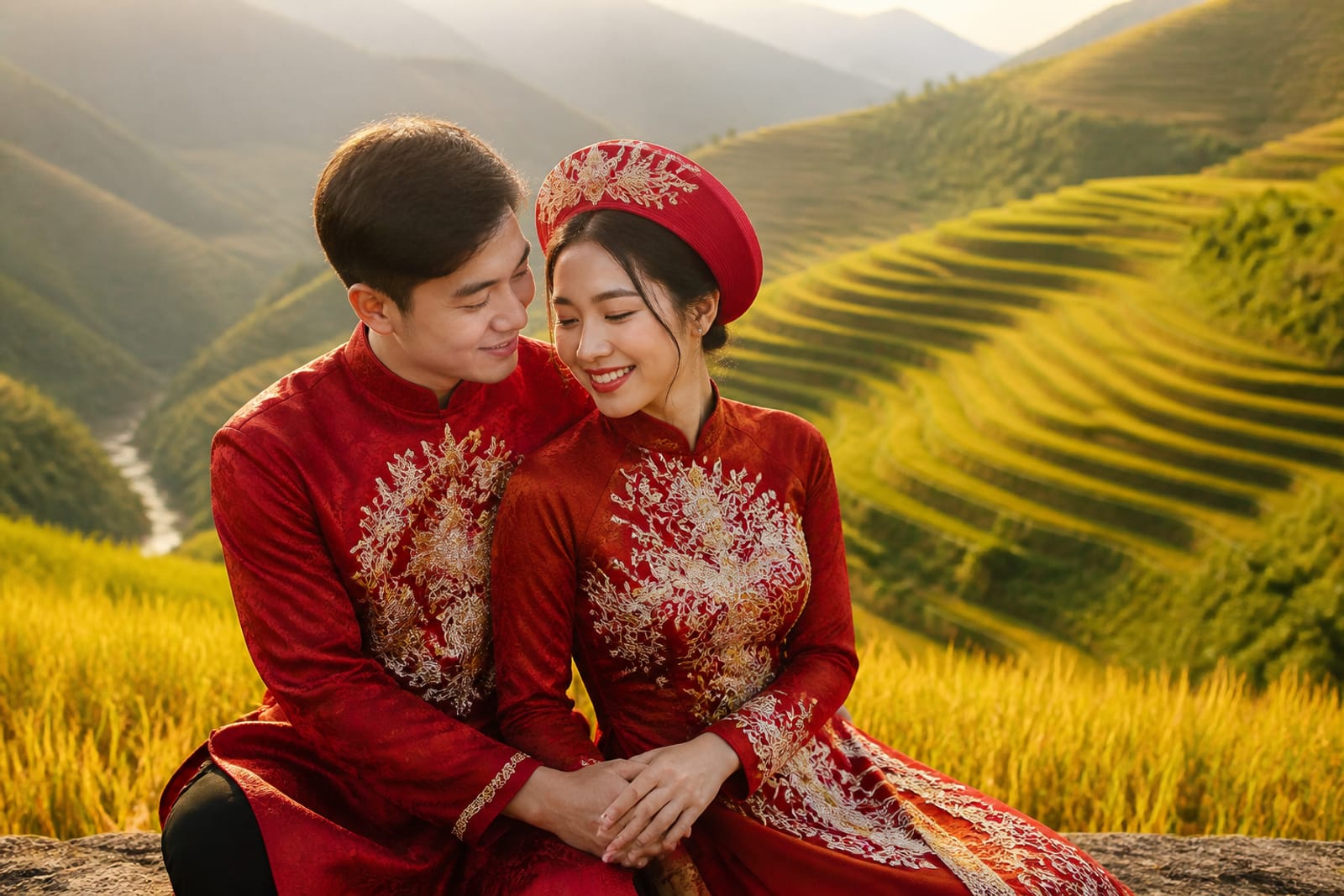
Ao dai is the natural choice—the fabric drapes over the uneven terrain and photographs well in warm light. Long silk or cotton ao dai in jewel tones (emerald, burgundy, navy) or cream pop against the green and gold. Avoid white (washes out in bright sun) and neon (dates the frame). Wear flat shoes or sandals that grip wet earth; terrace paths are muddy and steep. Hair should be loose or in a soft braid to move with the breeze; tight styles look stiff in film. Minimal jewelry prevents glare and distraction. If you're not in ao dai, wear long linen or cotton layers in warm, earthy tones; bring a shawl or scarf that you can drape for movement. Makeup must last through humidity and sweat—ask your makeup artist to use setting spray and waterproof liner. Pack a backup outfit if you're shooting multiple terraces; mud and water splashes are inevitable.
Do you need a local guide or can you self-scout?
Mu Cang Chai sits in Yen Bai province, a four-hour drive northwest of Hanoi on mountain roads that are narrow and poorly marked after dark. Shooting at dawn means leaving Hanoi at 3–4 am or staying overnight in Mu Cang Chai (book a guesthouse; services are basic). A local guide or fixer who knows the terraces prevents wasting light on the wrong slope, navigates permits (some sites require payment or permission from the commune), and ensures your car can reach shooting spots. Hiring a photographer who is based in or regularly travels to Mu Cang Chai is worth the investment—they know which terraces hold water in which season, which slopes catch sunrise, and how to pose a couple without causing them to slip. If you're coordinating a shoot from outside Vietnam, work with a Hanoi photographer or Cáo Studio's Hanoi base to arrange the logistics; they can connect you to a trusted local guide. Self-scouting (renting a car and GPS-ing the coordinates) is risky: you lose light searching, risk getting lost, and may miss the best frames because you don't know the site.
How does light direction change your framing?
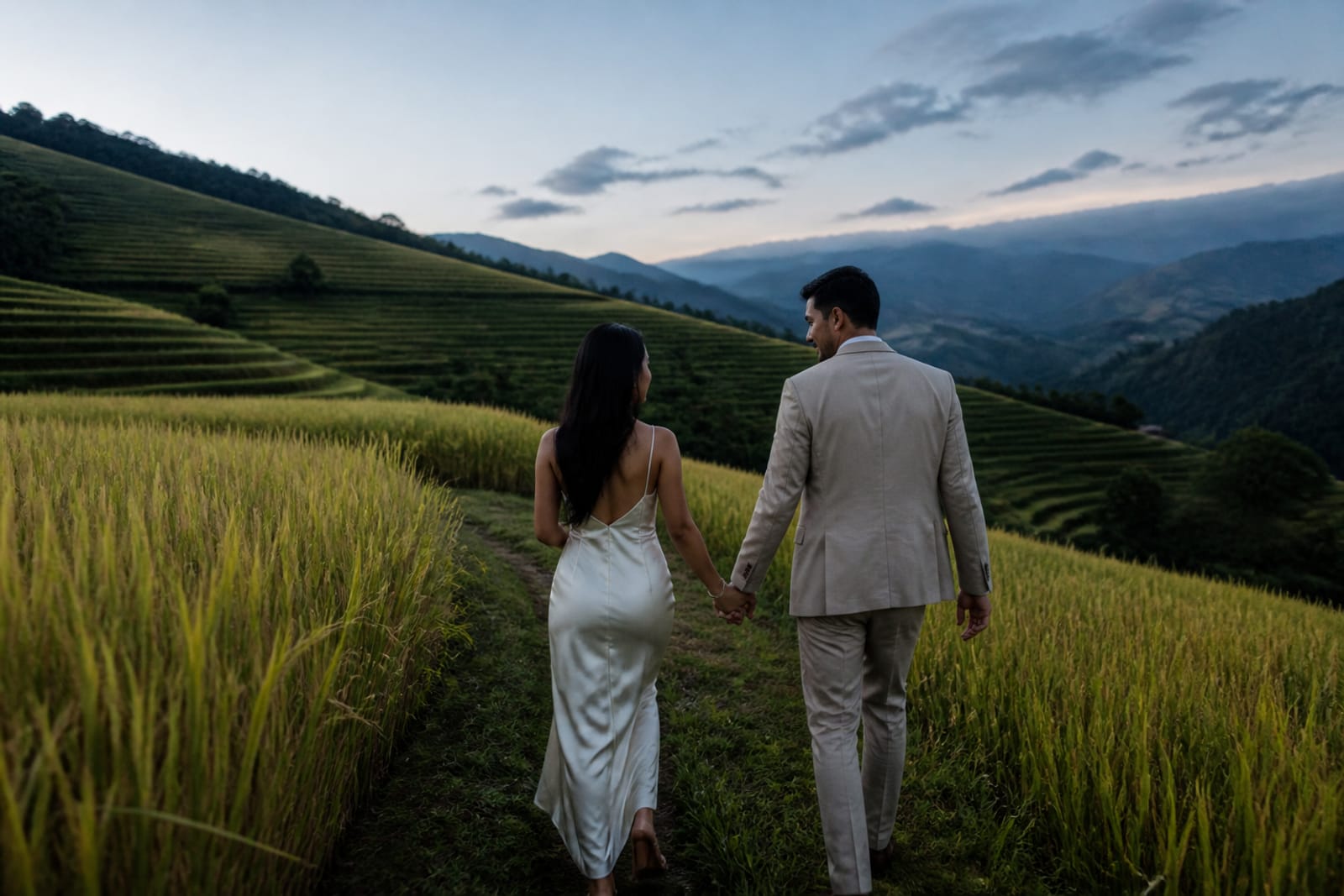
Backlit (shooting into the sun): The sun is behind your couple or subject, creating a halo or rim light on their outline and throwing the terraces into silhouette or shadow. This isolates your subject and adds drama. Works best at dawn and dusk when the sun is low and not blinding the camera. Expose for the couple, not the sky, or use a reflector or fill flash to lift their face.
Side light (sun grazing across the terraces): The sun comes from the left or right, skimming across the ridges and water. This emphasizes texture, ripples, and depth. Ideal for wide landscape shots with the couple walking across the frame or standing in profile. Works throughout golden hour but most defined in early morning and late evening.
Front light (sun behind the camera): The sun lights the terraces and couple's faces directly. Clearest colors and sharpest detail, but can feel flat if the sun is high. Use this when clouds diffuse the light or for detail shots (hands, fabrics, faces) during gentle mid-morning or mid-afternoon overcast periods.
Diffused (heavy cloud cover): No harsh shadows, even light across the whole scene. Terraces look muted but mood is soft and romantic. Requires a stronger subject (movement, emotion, contrast in clothing) to carry the frame because the landscape alone looks grey.
Pair side light or backlit shots with pre-wedding photoshoot editing that lifts skin tones and deepens the terrace colors—a professional Hanoi photographer will know this workflow.
What questions should you ask before booking a Mu Cang Chai photographer?
On experience and location knowledge:
- Have you shot Mu Cang Chai in this season before? (Confirm they know the water cycle and light patterns.)
- Which terraces do you usually use for couples? (Specific sites = they've scouted and have a plan.)
- Do you have a backup location if weather or access changes? (Shows flexibility and contingency thinking.)
On logistics and safety:
- How do we get there, and how long is travel time from Hanoi? (Clarifies the 4-hour drive and your start time.)
- Is a local guide or fixer included, or do we arrange one? (Some photographers work alone; others bring a guide.)
- What happens if the weather is bad on the shoot day? (Reschedule policy, refund, or alternative plan.)
On outfit and makeup:
- Can you recommend or coordinate a makeup artist who works in mountain heat? (Prevents makeup melting and reshoots.)
- Should we bring multiple outfits, or is one ao dai enough? (Depends on time and energy; a pro will advise based on season and light.)
On deliverables and timeline:
- When will edited photos be ready? (Do not expect 48-hour turnaround for a location this remote; ask for a realistic timeline.)
- How many photos do we receive, and in what format? (Cloud drive, USB, prints; raw files or edited only.)
- Will you shoot video or stills only? (A wedding video package may be separate.)
On cost factors:
- Ask for a quote that itemizes travel, local permits, guide fees, and editing time—do not assume all are included. (Mention that the drive and overnight stay create cost factors; get a clear breakdown on WhatsApp.)
What to check before you book:
- Confirm the photographer is available on your specific dates and has shot Mu Cang Chai in that month/season.
- Ask for a lookbook or portfolio specifically from Mu Cang Chai—not generic Vietnam landscapes.
- Check that your outfits (ao dai, layers, shoes) are suitable for muddy, wet terrain; confirm with your stylist or makeup artist.
- Book overnight accommodation in Mu Cang Chai (or nearby Yen Bai) at least two weeks ahead; options are limited.
- Check current weather forecasts and typhoon alerts if shooting September–November; reschedule if a typhoon warning is issued.
- Arrange travel insurance that covers shoot cancellations due to weather or road closure.
- Verify the photographer's liability insurance and get a written agreement about access, permits, and contingencies.
If you'd rather coordinate a full wedding or pre-wedding photoshoot in a more accessible location, consider Hanoi's ao dai hotspots (Huc Bridge, West Lake, Temple of Literature) or Hoi An's lantern-lit old town—both are easier to reach and offer reliable light year-round. Contact Cáo Studio on WhatsApp to discuss a Hanoi-based shoot before or after a Mu Cang Chai trip, or to get a referral to a trusted local Mu Cang Chai photographer.
📸 Book on WhatsApp — couple & family photoshoot | 💄 Makeup & hair at your hotel
---
FAQ
Is Mu Cang Chai worth traveling four hours from Hanoi just for photos?
Yes, if you have 2–3 days and want a distinctive backdrop that no other Vietnam location offers. The terraces are only photogenic May–October; in winter (Dec–Feb) they're dry and brown. Pair it with a Hanoi shoot to maximize your trip and reduce travel strain.
Can we shoot Mu Cang Chai without staying overnight?
Only if you leave Hanoi at 3–4 am for a sunrise shoot, then drive back after golden hour (around 8–9 am). You'll lose dusk light and the option to scout or reshoot. Most couples stay one night to shoot both sunrise and sunset without rushing.
What if it rains during our Mu Cang Chai shoot?
Light rain can add drama and reflections to the water; heavy rain makes terrain dangerous and visibility poor. A professional photographer will have a rain contingency (move to a sheltered terrace, postpone, or reschedule). Confirm the cancellation and reschedule policy before booking—do not expect a refund if weather is poor but safe.
Do we need permits or permission to shoot in Mu Cang Chai?
Some terraces are private land or managed by the commune, and some charge a small fee for photography or access. A local guide handles this; a photographer based in Hanoi will know which terraces are free and which require payment. Always ask your photographer upfront.
How is Mu Cang Chai different from rice terraces in Sapa or Bali?
Mu Cang Chai's terraces are tighter, more densely water-filled May–June, and turn golden-brown by September—a unique color palette. Sapa's terraces are higher altitude, cooler, and foggier. Bali's are tropical and year-round green. Mu Cang Chai suits couples who want drama and isolation without crowds; book a Hanoi photographer who has worked there before.
Should we hire a Hanoi photographer or book someone local to Mu Cang Chai?
A Hanoi-based photographer with Mu Cang Chai experience offers portfolio proof and established workflows; a local Mu Cang Chai guide has day-to-day knowledge of terraces and weather. Ideal: a Hanoi photographer who regularly travels to Mu Cang Chai or works with a trusted local fixer. Ask for references and a portfolio before committing. --- 📸 Book on WhatsApp — pre-wedding & elopement | 🌸 See the lookbook | 📞 FAQ
FAQ
Is Mu Cang Chai worth traveling four hours from Hanoi just for photos?
Yes, if you have 2–3 days and want a distinctive backdrop that no other Vietnam location offers. The terraces are only photogenic May–October; in winter (Dec–Feb) they're dry and brown. Pair it with a Hanoi shoot to maximize your trip and reduce travel strain.
Can we shoot Mu Cang Chai without staying overnight?
Only if you leave Hanoi at 3–4 am for a sunrise shoot, then drive back after golden hour (around 8–9 am). You'll lose dusk light and the option to scout or reshoot. Most couples stay one night to shoot both sunrise and sunset without rushing.
What if it rains during our Mu Cang Chai shoot?
Light rain can add drama and reflections to the water; heavy rain makes terrain dangerous and visibility poor. A professional photographer will have a rain contingency (move to a sheltered terrace, postpone, or reschedule). Confirm the cancellation and reschedule policy before booking—do not expect a refund if weather is poor but safe.
Do we need permits or permission to shoot in Mu Cang Chai?
Some terraces are private land or managed by the commune, and some charge a small fee for photography or access. A local guide handles this; a photographer based in Hanoi will know which terraces are free and which require payment. Always ask your photographer upfront.
How is Mu Cang Chai different from rice terraces in Sapa or Bali?
Mu Cang Chai's terraces are tighter, more densely water-filled May–June, and turn golden-brown by September—a unique color palette. Sapa's terraces are higher altitude, cooler, and foggier. Bali's are tropical and year-round green. Mu Cang Chai suits couples who want drama and isolation without crowds; book a Hanoi photographer who has worked there before.
Should we hire a Hanoi photographer or book someone local to Mu Cang Chai?
A Hanoi-based photographer with Mu Cang Chai experience offers portfolio proof and established workflows; a local Mu Cang Chai guide has day-to-day knowledge of terraces and weather. Ideal: a Hanoi photographer who regularly travels to Mu Cang Chai or works with a trusted local fixer. Ask for references and a portfolio before committing. --- [📸 Book on WhatsApp — pre-wedding & elopement](/pre-wedding-photoshoot) | [🌸 See the lookbook](/lookbook) | [📞 FAQ](/faq)
Ao dai, makeup, hair and a local photographer in Hanoi or Saigon — one WhatsApp message.