services/ao-dai-photoshoot
Mui Ne Ao Dai Photoshoot Guide: Planning, Spots & Studio Packages
Mui Ne's red sand landscape is one of Southeast Asia's most photogenic destinations—but ao dai shoots there demand real planning. Light changes fast. Logistics differ from Hanoi. Outfits need different care. This guide walks you through what actually works, what fails, and how to choose between a studio session versus hiring a local photographer on-site.
Why does Mui Ne light look different from city photoshoots?
Mui Ne sits on a narrow peninsula with unobstructed sea and desert. Light bounces off sand and water, creating a warm, high-contrast environment that flatters warm skin tones but can bleach or overexpose skin if shot midday. There's no urban shadow relief—dunes reflect light upward, turning noon shots harsh. Early morning (5:30–7:30 AM) gives you soft, directional light and low shadows for fine detail on embroidery. Late afternoon (4:00–6:00 PM) works if clouds roll in; direct sunset often backlight-blows highlights unless your photographer knows exposure compensation.
📸 Book on WhatsApp — ao dai photoshoot
Unlike hotel shoots or couple & family photoshoots in downtown Hanoi, Mui Ne demands a pre-dawn start. Fatigue is real. Most travelers underestimate how early 5:30 AM means—you need transport by 5:00, which means a 4:15 AM wake-up. Plan accordingly.
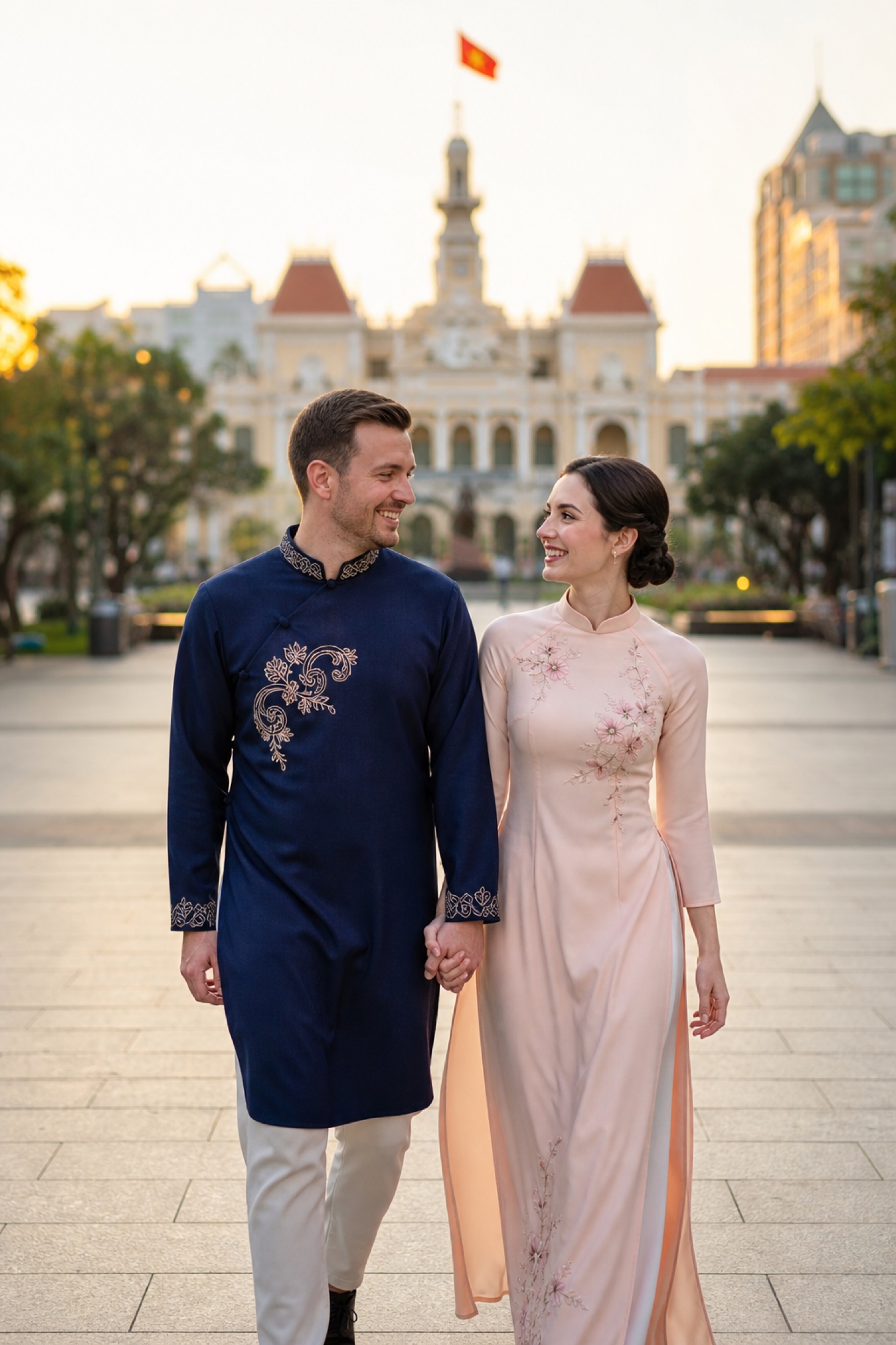
Which Mui Ne photo spots actually deliver in ao dai?
Red sand dunes (Binh Thuan Dune area):
- Best time: 5:45–7:15 AM (soft gold light, long shadows on texture).
- Why it works: Undulating landscape gives depth; red tones complement jewel-bright ao dai (emerald, burgundy, navy stand out most).
- What fails: Midday (10 AM–3 PM) flattens colour; sand gets hot on feet; heat haze ruins detail.
- Etiquette: This is a public natural area; no permits needed, but hire a guide or local driver who knows safe walking paths—sand can shift.
Fishing village (Phan Thiet waterfront):
- Best time: 6:00–7:30 AM or 5:00–5:45 PM (fishers active, warm side-light on boats and nets).
- Why it works: Authentic texture—weathered wood, indigo nets, morning bustle—contrasts with formal ao dai elegance.
- What fails: Peak tourist hours (9 AM–11 AM) crowd frames; fishers don't always welcome cameras after 7 AM.
- Etiquette: Always ask permission before photographing people or boats. A small tip (50,000–100,000 VND) to a family goes far.
Mui Ne beach (Kee Ga Lighthouse area):
- Best time: 5:30–6:30 AM (long shadows, calm water reflects sky, golden hour glow).
- Why it works: Open seascape reads clean; lighthouse structure frames the frame; breeze won't be strong yet.
- What fails: Wind kicks up sand by 8 AM; salt spray can damage ao dai if you wade; direct sun after 7 AM creates squinting.
- Etiquette: The lighthouse is an active landmark; no climbing without permit. Stay on public beach areas.
Phan Thiet Old Town (colonial architecture, quiet streets):
- Best time: 6:00–7:00 AM (empty streets, soft yellow light on shuttered buildings).
- Why it works: Vintage doors, weathered walls, ceramic tiles create a moody, nostalgic frame that suits formal ao dai.
- What fails: Street sweeping starts early; some residents object to early morning strangers; light shifts fast among buildings.
- Etiquette: Be respectful of people's homes; don't shoot through windows or linger outside residences.
How do you prepare an ao dai for Mui Ne conditions?
Ao dai fabric (silk, cotton, or silk-blend) is delicate. Heat, salt spray, sand, and humidity can damage dyes and weaken seams in ways that don't show until after your shoot.
Before the session:
- Fit check (1–2 days prior): Try the áo on with the trousers and shoes you'll wear. Humidity can cause fabric to swell; if it feels snug in Hanoi, it'll feel tight in Mui Ne's salty air.
- Fabric type matters: Silk (traditional, cool on skin) wrinkles easily and stains visibly; cotton-silk blend hides creases better and tolerates sand contact. Ask yourself: will this be worn again, or is it a one-off shoot?
- Undershirt (100% cotton or silk-blend, white or neutral): Wear one under the áo to prevent sweat marks and friction. Avoid synthetic spandex—it locks heat and causes chafing on long shoots.
- Backup áo: If renting, check the rental includes a spare or has insurance for accidental tears. Sand and salt can weaken threads; a backup prevents panic if the first gets snagged.
During the session:
- Sand protection: Wear seamless socks or silk foot protectors under trousers until you reach the photo spot; swap for bare feet or embroidered shoes only when the camera is rolling.
- Moisture: Áo dai adheres to wet skin. Bring a lightweight silk or cotton scarf to drape over shoulders between shots; lets fabric breathe and prevents sweat stains.
- Spray bottle: A fine-mist bottle of distilled water (not tap—minerals leave marks) keeps fabric crisp between takes without soaking it.
After the session:
- Rinse immediately (if salt water touched it): Rinse gently in cool, distilled water to remove salt crystalline buildup, which weakens fibres over time.
- Air dry (never machine): Hang on a padded hanger in a shaded, breezy spot; direct sun can set salt stains.
- Iron gently (if silk): Use a silk setting (low heat, no steam) on the underside only; ironing ao dai face-on can leave shine marks.
Studio photoshoot vs. local photographer: What's the real trade-off?
| Option | Best for | Timeline | Flexibility | Outfit | Logistics |
|---|---|---|---|---|---|
| Studio package (Hanoi/Saigon, travel to Mui Ne by request) | Travellers wanting polished hair, makeup, multiple themed outfits, edited prints | 2–3 weeks booking; they travel on your dates | Limited to pre-scouted spots; set timeline | 1–3 curated áo dai included or co-selected | Transport, accommodation, styling team all coordinated |
| Local Mui Ne photographer (freelance or via guesthouses) | Backpackers, budget-conscious, spontaneous; want authentic local knowledge | 2–5 days notice; flexibility with weather delays | High—move between spots freely, adjust on-the-fly | Bring your own áo; limited styling input | You arrange transport; photographer meets on-site |
| DIY + phone/action camera | Solo travellers, vlogging, casual memories; no budget for hired crew | No booking lag | Extreme—self-directed, tripod-timed | Your áo, no professional styling | Zero coordination; you're the director and subject |
Cáo Studio – Makeup & Photoshoot operates studio branches in Hanoi and Saigon. For Mui Ne, the team does not maintain a Mui Ne studio; however, they can discuss travel-shoot options on WhatsApp. This means you get professional hair, makeup, and curated ao dai, but you're paying for their travel costs and a longer lead time (3+ weeks).
Local Mui Ne freelancers (via guesthouses, Instagram, or local guides) cost 30–50% less and are more flexible. Trade-off: less polished editing, limited English, no guarantees on delivery timeline or copyright terms. Quality varies wildly.
DIY approach (tripod, phone, self-timer) costs zero but limits creative angles and requires technical camera knowledge. Most DIY ao dai shoots feel cropped, over-exposed, or static.
Decision framework:
- Choose studio if: You want studio-quality styling, edited gallery, and have 3+ weeks and 2–3 million VND budget.
- Choose local if: You're in Mui Ne already, want same-day or 48-hour turnaround, speak some Vietnamese, and prioritize authenticity over polish.
- Choose DIY if: You're solo, want casual memories, and can spend 2+ hours learning phone exposure modes.
How do you avoid common Mui Ne ao dai shoot mistakes?
Mistake 1: Booking for midday light. Noon sun creates harsh shadows under the nose and cheekbones, washes out fabric colour, and causes squinting. Always specify 5:30–7:30 AM or 4:30–6:00 PM in your booking. If a photographer pushes midday, ask why—there's rarely a good reason.
Mistake 2: Not accounting for humidity and sweat. Mui Ne's coastal humidity is 70–90% year-round. Even a 30-minute early-morning shoot will generate perspiration. Áo dai cling. Makeup runs. Fabric shows wet patches. Solution: wear a moisture-wicking undershirt, bring face blotting papers and a light powder, and schedule 5–10 minute rest breaks. A professional makeup artist (like Cáo's hotel makeup service) includes sweat-proof primers.
Mistake 3: Wearing a rented áo without trying it first. Sand gets into seams. Humidity swells fabric. A áo that fit in Hanoi feels suffocating in Mui Ne. Always try on with a thin undershirt, move freely, and confirm rental has insurance or a backup. Or rent locally in Mui Ne (cheaper, same-day swap if needed).
Mistake 4: Shooting without a backup outfit. One áo fails (tear, stain, sweat damage, wrong colour in morning light). Professional ao dai photoshoot packages include 2–3 outfits; local shooters often don't. Bring or rent a second áo in a different colour (jewel tones photograph best at sunrise).
Mistake 5: Ignoring weather. Mui Ne's dry season (Nov–Apr) is most reliable; May–Sept brings afternoon thunderstorms and overcast skies. Overcast light is soft (good for skin detail) but drains colour from fabrics. Check a 7-day forecast 3 days before your shoot; if 60%+ rain probability, reschedule. Most photographers allow one free reschedule for weather.
Mistake 6: Not prepping footwear. Bare feet on hot sand (7 AM+) hurt fast. Embroidered beaded shoes are beautiful but impossible to walk in on uneven dunes. Solution: wear seamless socks until the shot, then swap for shoes for the frame only. Have the photographer take 10–15 frames in 30 seconds so you're not balancing uncomfortably.
Mistake 7: Forgetting cultural etiquette at fishing villages. Fishers are working, not a photo backdrop. Always ask permission, wait for a natural pause, and never interrupt active nets or boat repairs. A small tip (cash, 50,000–100,000 VND, not photos shared online) is standard respect. Never photograph kids or elderly without explicit consent; some locals feel photos steal their spirit (a real cultural belief in rural areas).
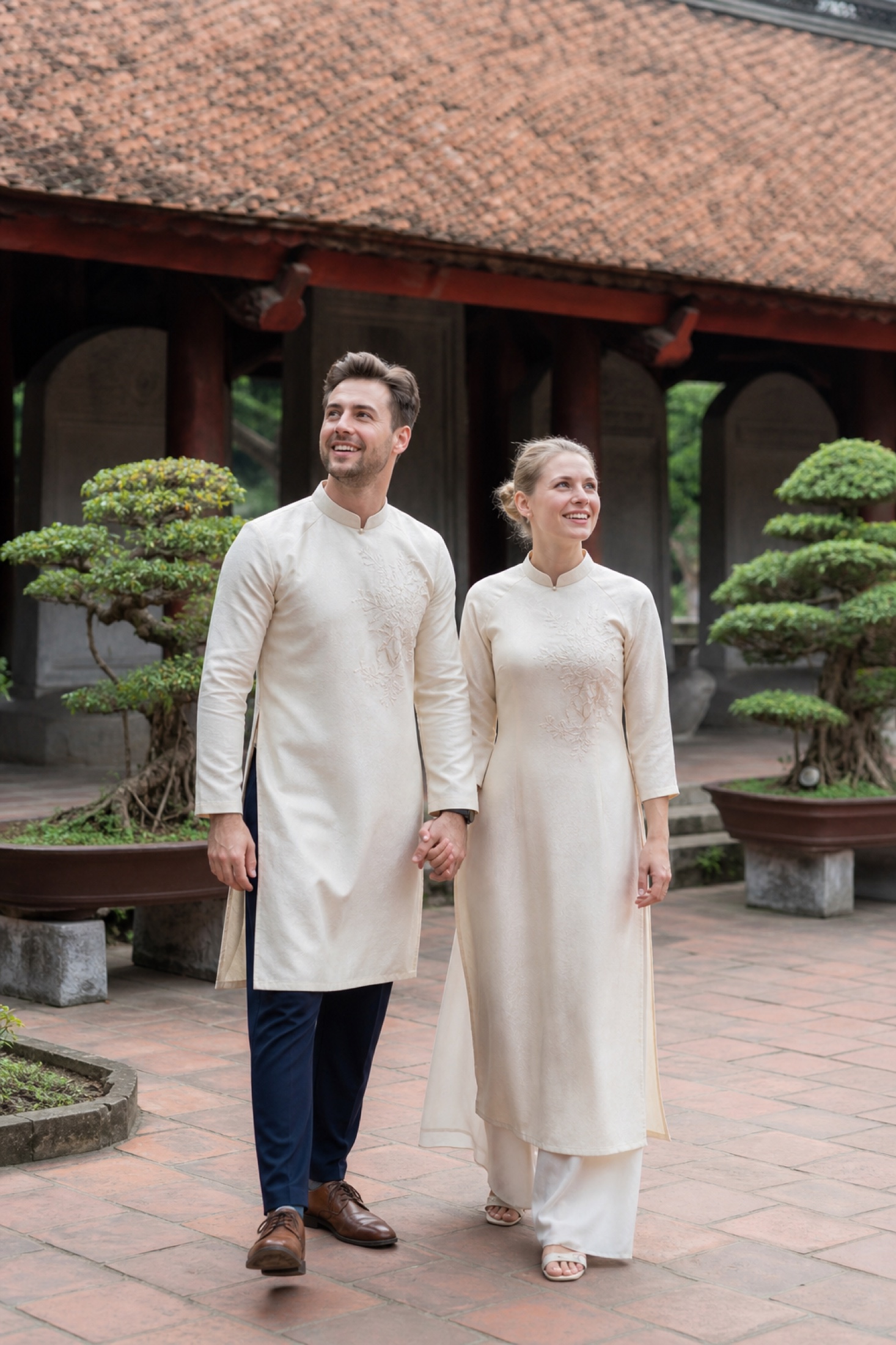
What to check before you book a Mui Ne ao dai shoot.
| Checkpoint | Why it matters | What to ask |
|---|---|---|
| Sunrise timing | Light angle and softness vary by date; Dec 22 vs. June 21 sunrises differ by 1+ hour. | "What time is sunrise on [your date]?" Confirm 5:45 AM meeting is pre-sunrise, not post. |
| Backup date/weather clause | Afternoon storms (May–Sept) can ruin outdoor shoots with zero notice. | "If it rains, do I get a free reschedule or refund?" |
| Outfit inclusion | Some studios include áo dai; freelancers rarely do. Renting vs. bringing yours has cost & risk trade-offs. | "Do you provide áo dai, or do I rent/bring my own?" If rental, "Is insurance included?" |
| Edited gallery timeline | Professional studios send edited photos in 2–4 weeks; local photographers often 3–6 weeks. | "When will I receive the edited gallery?" Ask for a contract term. |
| Copyright & prints | Who owns the digital files? Can you print them? Some contracts restrict reuse. | "Do I own print rights? Can I post to social media & personal use?" |
| Styling & hair/makeup | Studio packages include pro makeup; local shooters rarely do. DIY makeup in Mui Ne heat often melts. | "Is hair/makeup included? If not, what's your recommendation for a local artist?" |
| Transportation & location scouting | Does the photographer meet you, or do you hire transport? Are dunes accessible by car, or is a 20-min hike required? | "Where do we meet? Is it car-accessible? What should I wear to get there?" |
Real-world timeline: How a Mui Ne ao dai shoot actually unfolds.
Day before:
- Confirm 5:30 AM meeting point via WhatsApp or phone (no email—connectivity can be spotty).
- Lay out ao dai, shoes, undershirt, socks; confirm fit once more.
- Eat a light dinner (3–4 hours before bed) so you're not bloated at 5 AM.
- Set two alarms; Mui Ne traffic means you need 30-min buffer if transport is late.
Shoot day (5:00 AM wake-up for 5:30 AM start):
- 5:00–5:20 AM: Light breakfast (toast, banana, water), bathroom break, light makeup base if DIY (a professional makeup artist arrives earlier and does everything on-site).
- 5:20–5:30 AM: Meet photographer/transport.
- 5:30–7:30 AM: Shoot at primary location (dunes or beach). 15–20 min per outfit. 5–10 min rest breaks.
- 7:30–8:00 AM: Move to secondary spot (village or old town) if booked; light is still soft.
- 8:00–8:30 AM: Final touch-ups, 3–5 money shots.
- 8:30 AM: Wrap. Return to accommodation for breakfast, shower, rest.
- Total time on feet: 2.5–3 hours. Fatigue is real.
Post-shoot:
- Photographer uploads a contact sheet (unedited thumbnails) within 48 hours.
- You select 20–40 favourite frames.
- Photographer edits and sends gallery in 2–4 weeks (studio standard) or 3–6 weeks (local freelancer).
- Review, request minor adjustments (no extra charge for small edits), and photographer sends final files.
Comparing your options: A decision matrix.
| Dimension | Cáo Studio (travel to Mui Ne) | Local Mui Ne Photographer | DIY (Phone/Action Camera) |
|---|---|---|---|
| Cost | 1.5–3M VND (transport + 2–3 outfits + styling + editing) | 500K–1.5M VND (photographer only) | ~50K VND (transport, ao dai rental) |
| Prep time | 3+ weeks booking | 2–5 days | 0–2 days |
| Outfit count | 2–3 curated ao dai | Your own or rented locally | Your own ao dai only |
| Makeup & hair | Professional (included) | Not included; you hire separately | DIY or guesthouse stylist (variable) |
| Editing quality | High (colour grading, retouching, sharpness) | Medium–high (varies by photographer) | Low (phone default or basic filter) |
| Delivery time | 2–4 weeks | 3–6 weeks | Instant (on phone) |
| Language barrier | None (English-speaking team) | Likely some; Vietnamese/English mix | N/A |
| Flexibility | Moderate (set dates, scouted spots) | High (move freely, adapt on-the-fly) | Extreme (self-directed, any time) |
| Best outcome | Polished, magazine-style album | Authentic, spontaneous, local flavour | Casual, intimate, personal memory |
---
What's your priority? If you want professional polish, curated styling, and a keepsake album, a studio option (whether Cáo travels or you hire locally) is the move. If you're already in Mui Ne, prefer spontaneity, and speak some Vietnamese, a freelancer is cheaper and faster. If you're solo, budget-conscious, and just want nice memories, DIY works—but expect to spend 1–2 hours learning phone exposure settings.
---
Cáo Studio's Hanoi & Saigon ao dai packages: What's included?
Cáo Studio – Makeup & Photoshoot operates fixed studios in Hanoi and Saigon. They specialize in ao dai sessions with professional styling, makeup, and edited galleries. For Mui Ne specifically, the team does not run a permanent studio; however, you can inquire on WhatsApp about travel-shoot feasibility and costs.
Standard studio package includes:
- 90–120 minute session (Hanoi or Saigon location).
- 2–3 curated ao dai (or bring your own).
- Professional makeup & hair styling.
- 40–60 edited digital images.
- Online gallery (private link for download).
What differs from a Mui Ne shoot:
- Location: Fixed studio with controlled lighting (no sunrise logistics).
- Outfits: Curated studio ao dai or your own (studio choice is faster, but your own feels more personal).
- Turnaround: Gallery in 2–3 weeks (faster than freelancers).
- Cost: Studio rates are published on the pricing page; Mui Ne travel would add transport + accommodation costs (ask on WhatsApp for exact quote).
If you're pre-wedding or celebrating an anniversary, explore Cáo's proposal & anniversary package or pre-wedding & elopement options—they may include Mui Ne as a secondary location.
---
📸 Book on WhatsApp — ao dai photoshoot
---
Suggested keepsakes after your Mui Ne ao dai shoot.
Once your gallery is final, turn prints into lasting memories. Consider:
- Framed gallery wall: 2–4 printed images in matching frames (8×10 or 5×7 size) displayed together. Adds elegance to your home.
- Photo book: Lay out 20–30 favourite images in a hardcover album; feels more curated than a loose stack of prints.
- Canvas or metal print: One hero shot enlarged to 16×24 or 20×30 inches, printed on canvas (warm, textured) or metal (modern, glossy). Makes a statement piece.
- Keepsake box: Small wooden or acrylic box holding printed photos, dried flowers from the shoot day, and handwritten notes.
Browse Cáo's collections for gift & keepsake options (frames, albums, prints) to frame or present your shoot memories professionally.
---
FAQ
Is Mui Ne better for ao dai shoots than Hanoi?
Different, not better. Mui Ne offers dramatic sand and seascape; Hanoi gives urban architecture and temple backdrops. Mui Ne is sunset/sunrise-only shooting; Hanoi allows flexible timing. Choose Mui Ne if you want landscape drama; Hanoi if you prefer city elegance. Both suit ao dai beautifully.
Do I need a professional photographer in Mui Ne, or can I use my phone?
Phone works for casual snapshots, but ao dai detail (embroidery, silk drape, face expression) needs a decent camera, stable tripod, and exposure knowledge. A freelance photographer (500K–1.5M VND) is cheaper than a studio and delivers polished results in 3–6 weeks. DIY is free but needs 2+ hours practice beforehand.
What months are safest for Mui Ne ao dai shoots?
November–April (cool, dry, low rain). Sunrise light is most consistent Dec–Feb. May–Sept brings 60–80% humidity, afternoon thunderstorms, and afternoon haze that dulls colours. If booking May–Sept, confirm a backup date clause with your photographer.
Can I bring my own ao dai to a freelance photographer in Mui Ne?
Yes, always. Most freelancers expect this. Bring it in a clean garment bag, try it on the night before, and wear a thin undershirt underneath during the shoot. If renting in Mui Ne, book 2–3 days ahead at a guesthouse or local tailor (faster, same-day swaps possible).
How much does a local Mui Ne ao dai photoshoot cost?
Freelance photographers charge 500K–1.5M VND (US$20–$60) for a 2–3 hour session with 40–60 unedited or lightly edited images. Studio packages (Hanoi-based teams) cost 2–3M VND+ if they travel. DIY (you + phone/action camera) is free except for ao dai rental (200K–500K VND per day).
Should I hire a makeup artist for a Mui Ne shoot if my photographer doesn't include one?
Yes, especially if you have dark skin or plan early morning (humidity + heat = melting makeup). A local makeup artist in Phan Thiet costs 200K–500K VND for 60 minutes; they use sweat-proof primers and water-resistant products. Alternatively, Cáo Studio's hotel makeup & hair service can be arranged if you're staying in a major Mui Ne resort.
FAQ
Is Mui Ne better for ao dai shoots than Hanoi?
Different, not better. Mui Ne offers dramatic sand and seascape; Hanoi gives urban architecture and temple backdrops. Mui Ne is sunset/sunrise-only shooting; Hanoi allows flexible timing. Choose Mui Ne if you want landscape drama; Hanoi if you prefer city elegance. Both suit ao dai beautifully.
Do I need a professional photographer in Mui Ne, or can I use my phone?
Phone works for casual snapshots, but ao dai detail (embroidery, silk drape, face expression) needs a decent camera, stable tripod, and exposure knowledge. A freelance photographer (500K–1.5M VND) is cheaper than a studio and delivers polished results in 3–6 weeks. DIY is free but needs 2+ hours practice beforehand.
What months are safest for Mui Ne ao dai shoots?
November–April (cool, dry, low rain). Sunrise light is most consistent Dec–Feb. May–Sept brings 60–80% humidity, afternoon thunderstorms, and afternoon haze that dulls colours. If booking May–Sept, confirm a backup date clause with your photographer.
Can I bring my own ao dai to a freelance photographer in Mui Ne?
Yes, always. Most freelancers expect this. Bring it in a clean garment bag, try it on the night before, and wear a thin undershirt underneath during the shoot. If renting in Mui Ne, book 2–3 days ahead at a guesthouse or local tailor (faster, same-day swaps possible).
How much does a local Mui Ne ao dai photoshoot cost?
Freelance photographers charge 500K–1.5M VND (US$20–$60) for a 2–3 hour session with 40–60 unedited or lightly edited images. Studio packages (Hanoi-based teams) cost 2–3M VND+ if they travel. DIY (you + phone/action camera) is free except for ao dai rental (200K–500K VND per day).
Should I hire a makeup artist for a Mui Ne shoot if my photographer doesn't include one?
Yes, especially if you have dark skin or plan early morning (humidity + heat = melting makeup). A local makeup artist in Phan Thiet costs 200K–500K VND for 60 minutes; they use sweat-proof primers and water-resistant products. Alternatively, Cáo Studio's [hotel makeup & hair service](/services/makeup-and-hair) can be arranged if you're staying in a major Mui Ne resort.
Ao dai, makeup, hair and a local photographer in Hanoi or Saigon — one WhatsApp message.