/pre-wedding-photoshoot
Mui Ne white sand dunes for pre-wedding photos: honest review and alte
Mui Ne's white sand dunes offer wide, sculptural frames but suit pre-wedding shoots only under strict conditions. The dry season runs November to April; dunes are best at sunrise (before 6:30 am) when sand is cool and light is soft. Wind peaks November to March, which tears ao dai fabric and lifts sand into hair and makeup—plan for heavy re-touch or shoot indoors (hotel, temple) instead. A four-hour session requires 90 minutes of travel each way from Mui Ne town, plus sunrise timing means a hotel stay. Cáo Studio shoots in Hanoi, Ho Chi Minh City and Hoi An, where urban and cultural light is consistent, wind is lower, and outfit handling is easier. If you love dunes, choose February–March (cooler, less wind) and book a local Mui Ne photographer experienced with fabric and touch-up pacing.
Mui Ne's white sand dunes rank among Southeast Asia's most photogenic landscapes. The sweeping curves, early-morning shadows and scale flatter both dress and couple. Yet pre-wedding shoots here demand trade-offs most planners underestimate: wind damage, extreme heat, long travel, and outfit wear that clips timelines. This guide compares Mui Ne against urban and cultural alternatives, walks you through the decision, and outlines what to check before booking.
Why do Mui Ne dunes look good in photos but feel risky for pre-wedding shoots?
Dunes work for still images because the scale reads as romantic and the dawn light is soft. Wind is the real problem. November to March, strong northeast winds blow sand directly at faces, hair and fabric. An ao dai—light silk with delicate seams—tears or stains in minutes. Makeup requires re-application every 15–20 minutes; hair coils come loose. Couples report spending more time fixing wind damage than posing. Heat is secondary but real: by 7 am, sand is hot enough to make barefoot walking painful, and by 8 am, light turns harsh and flat. The logistics are brutal: most couples stay in Mui Ne town (90 minutes' drive from the dunes), which means a 4 am pickup, a two-hour round trip, and only 60–90 minutes of usable shooting time before heat and wind spike. If your shoot is meant to feel calm and directed, dune wind works against that goal. Most pre-wedding shoots in Vietnam succeed because the team (photographer, makeup, hair, stylist) moves as one unit and adjusts in real time—dune wind breaks that rhythm.
| Option | Best for | Light & Season | Why or why not for pre-wedding |
|---|---|---|---|
| Mui Ne dunes | Dramatic scale, solo/couple travel photos | Sunrise Nov–Mar; intense by 8 am | Wind damages ao dai; long travel; short window; re-touch heavy |
| Hanoi (Red River, temples, old town) | Urban romance, cultural depth, ao dai framing | Soft Feb–Mar, Oct–Nov; grey Dec–Jan (moody) | Consistent light, walkable, team coordination easy, wind low, quick turnaround |
| Ho Chi Minh City (Bitexco, riverside, French quarter) | Modern couple energy, rooftop light, Saigon vibe | Dry Feb–Apr; some heat but less wind than dunes | City heat manageable indoors/rooftop; fast outfit change; no sand damage |
| Hoi An (Ancient Town, lantern bridge, riverside) | Heritage ao dai, lantern framing, intimate couples | Drier Feb–Aug; typhoon risk Sep–Dec | Compact locations, walking distance, controlled light in old town, low wind |
The table above shows that dunes excel at scale but fail at consistency and team workflow. If you want a day you remember as calm and directed—not rushed and re-touched—urban and cultural settings in Hanoi, Ho Chi Minh City or Hoi An deliver faster and with less outfit risk.
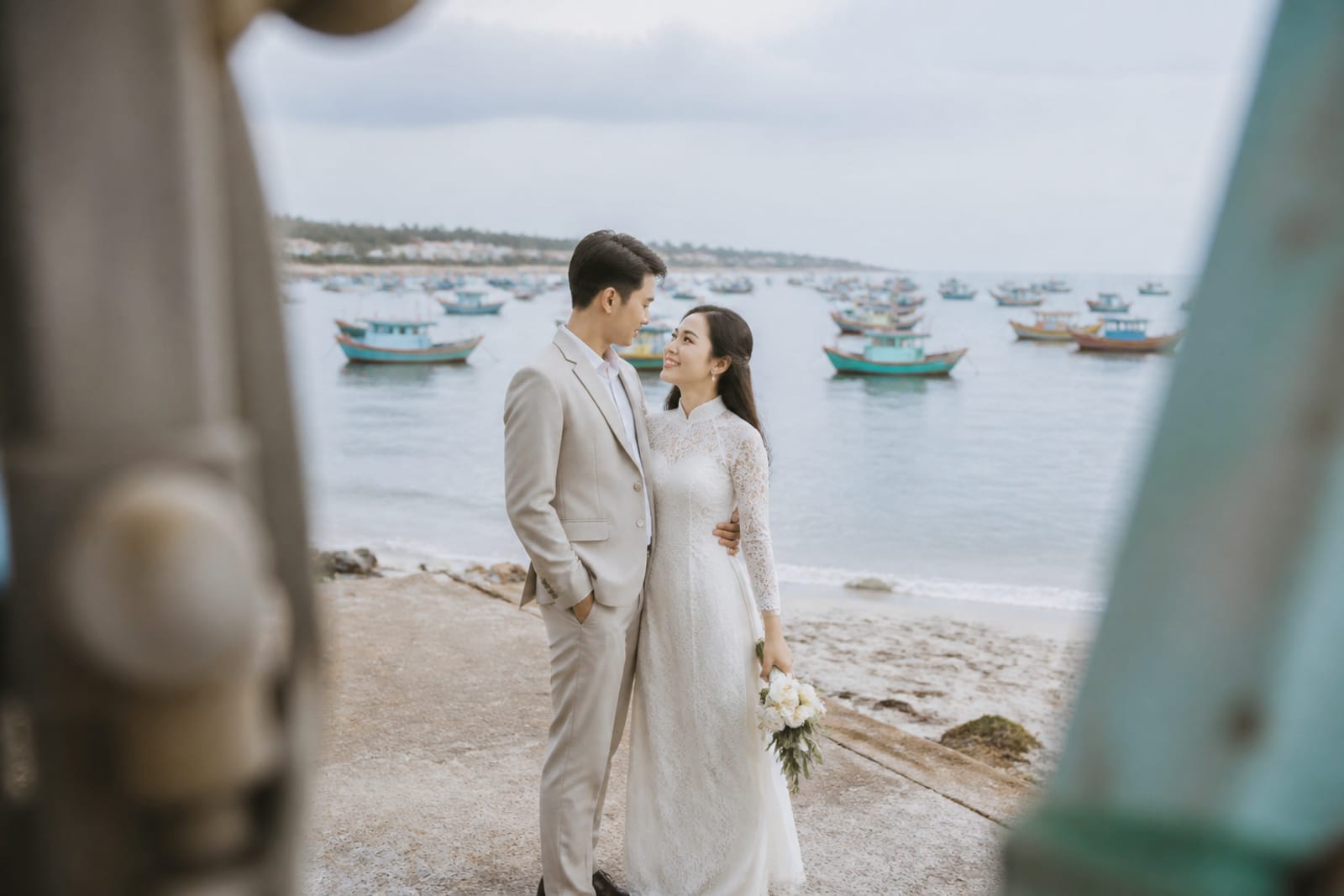
When does Mui Ne dune timing actually work for a pre-wedding shoot?
Mui Ne dunes are shootable only in a narrow window: February and March, sunrise slot, with a local team experienced in fabric and re-touch. January is windy (northeast wind still strong). April onward, heat and humidity spike, and the dry season ends. October to December brings typhoon risk, rain and poor light. If you insist on dunes, target 5:45 am–7:00 am shooting time. Arrive the day before and stay overnight in Mui Ne. Plan 90 minutes of usable light, not a full morning. Bring an extra ao dai or outfit in case wind damages the first. Budget time (and money, discussed on WhatsApp) for frequent hair and makeup re-touch. A local Mui Ne photographer matters enormously: they know which dune sections face northeast (worst wind) and which face west (shelter). They'll have done this dozens of times and won't panic when sand flies. If you're shooting from Hanoi or Ho Chi Minh City, a Mui Ne day-trip adds cost, fatigue and reduces flexibility if weather turns bad. For pre-wedding shoots booked from abroad, Hanoi or Ho Chi Minh City bases (with Cáo Studio) guarantee a re-shoot day if weather fails; Mui Ne makes that logistically hard.
What are the practical logistics and outfit damage risks?
A Mui Ne dune session starts at 4:00 am hotel pickup. You'll travel 90 minutes over a winding road to reach the dunes. Sunrise is around 6:10 am (February–March). You have until 7:30 am before light hardens and heat rises. That's 90 minutes of shooting, minus walk-in time and outfit setup. Sand gets into every fold: ao dai hems, seams, hair braids, undergarments, shoes. Silk ao dai fabric is delicate; rough handling or sand friction causes visible stains or small tears that show in close-ups. Makeup (foundation, mascara, blush) doesn't hold in wind; re-application mid-shoot is standard. Hair requires spray and pins every 30 minutes. Many couples report that by the time they felt "ready," the light had moved or wind had reset their hair again. If you're renting an ao dai, check the rental contract for damage liability—sand stains and small tears often incur fees. Hotels in Mui Ne town aren't equipped for rapid dress changes or intensive makeup re-touch the way Cáo Studio's makeup & hair at your hotel service handles it. Couples who've done both (dunes vs. controlled city shoots) report dunes feel chaotic; city shoots feel directed. Wind also affects the content you get: blurred motion is hard to control, and poses shift rather than holding still. For a couple photoshoot that's meant to be romantic, not windswept, city venues consistently outperform dunes.
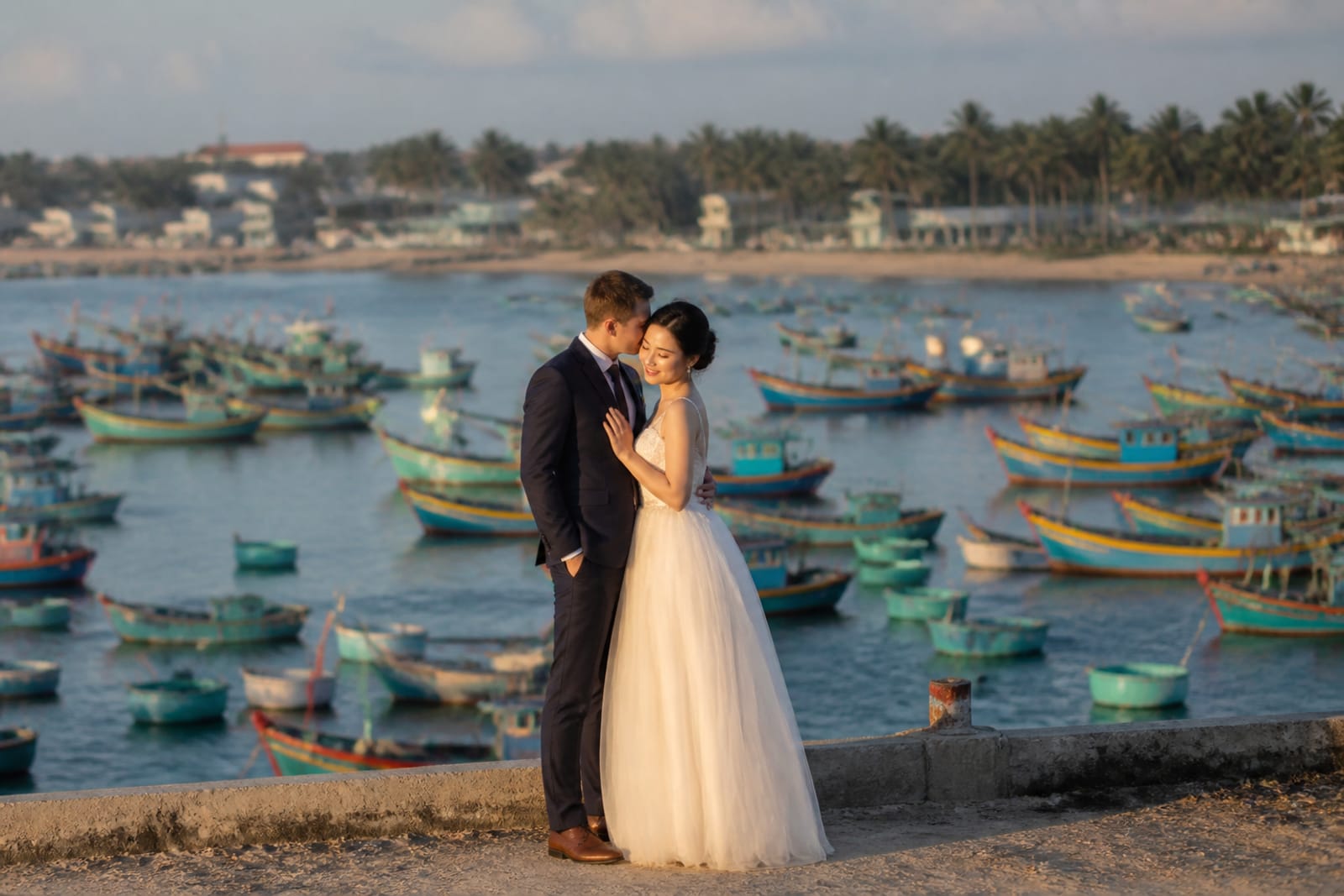
How do Hanoi, Ho Chi Minh City and Hoi An compare as pre-wedding alternatives?
Hanoi (February–March or October–November): Red River, Huc Bridge, Tran Quoc Pagoda, old town backstreets. Light is soft and consistent; wind is low. Makeup and hair last all day. Outfits stay clean. Walking distance between locations keeps the day calm. The team (photographer, makeup artist, hair, stylist) operates in rhythm. A four-hour shoot covers 3–4 locations. Hanoi's grey, moody light in December–January suits certain couple aesthetics. By May, heat and humidity climb, and light flattens. Hanoi shoots with Cáo Studio include consultation on outfit, light timing and location scouting. Turnaround is 48 hours for edited frames.
Ho Chi Minh City (December–April): Bitexco rooftop, Saigon River, French Quarter colonial streets, Thao Dien riverside. Light is warm and directional. Indoor rooftop shoots bypass weather entirely. City heat is real but manageable with quick outfit changes and indoor breaks. Modern couple energy reads differently than heritage; urban suits contemporary styles. Saigon's pace is faster; shoots move between locations quickly. Wind is lower than dunes. Ho Chi Minh City with Cáo Studio coordinates hotel pickups and rooftop access. Makeup and hair are handled the same way as Hanoi.
Hoi An (February–August): Ancient Town at dusk, lantern bridge, riverside, rice fields. Light is soft and warm; crowd volume rises by 8 am. Pre-wedding couples often book early morning (6:00–7:30 am) for empty town frames, then shift to rice-field locations by mid-morning. Hoi An's compact geography means less travel time and lower outfit wear. Typhoon and rain risk rises September–December. Hoi An photoshoots are by appointment; team travels from Hanoi or Ho Chi Minh City base. Ask on WhatsApp for available dates.
All three cities offer consistent light, low wind, easy outfit handling, and team coordination—none of which Mui Ne guarantees. If you're choosing between Mui Ne and a city, ask yourself: do you want cinematic scale, or do you want a day that feels calm and crafted? Dunes give scale; cities give craft.
What's the real decision framework: should you book Mui Ne or an alternative?
Use this checklist to decide:
- Willing to wake at 4 am and accept only 90 minutes of usable light? Yes → dunes possible. No → city.
- Ao dai is your outfit and it's not a backup? Yes → city reduces damage risk. No (or extra dress available) → dunes acceptable.
- Want a calm, directed day or dramatic, adventurous energy? Calm → city. Dramatic → dunes.
- Traveling from overseas and need a re-shoot buffer? Yes → city (easier reschedule). No → dunes feasible.
- Prefer low outfit touch-up or accept frequent hair/makeup re-application? Low touch-up → city. Frequent re-touch OK → dunes.
- Have 3+ days in Mui Ne, or just passing through? 3+ days → dunes make sense. Passing through → city speed is advantage.
Most couples booking pre-wedding shoots with Cáo Studio choose Hanoi or Ho Chi Minh City because the outcome (calm, directed, outfit-safe, fast turnaround) outweighs dune aesthetics. Dunes are best for vacation/solo travel photos, not high-stakes couple moments.
📸 Book on WhatsApp — pre-wedding photoshoot
What to check before you book a Mui Ne dune shoot
If you're set on dunes, confirm these with your photographer:
- Dune location: which sections face wind, which offer shelter. Request the sheltered zone.
- Backup date clause: if wind is too strong on shoot day, what's the reschedule policy?
- Outfit damage policy: are sand stains covered under the session fee, or does the couple pay for re-cleaning or rental penalties?
- Re-touch schedule: how often will hair and makeup be refreshed? Every 20 minutes? Every 45?
- Sunrise timing: confirm exact pickup time and expected light window (often 60–90 minutes, not a full morning).
- Travel included: is 90-minute round-trip transport included in the session fee, or separate? (Discuss cost factors on WhatsApp with any provider.)
- Backup indoor location: if wind is severe, is there a fallback (hotel, temple, indoor venue) without extra charge?
Most Mui Ne-based photographers are skilled and will handle these transparently. Cáo Studio's bases are Hanoi, Ho Chi Minh City and Hoi An (by appointment); if you're set on Mui Ne, we recommend booking a local Mui Ne photographer with a portfolio of pre-wedding work and asking these questions directly.
💄 Makeup & hair at your hotel | 🌸 See the lookbook
---

FAQ
Is sunrise the only time to shoot at Mui Ne dunes?
Yes, practically. Sunrise (5:45–7:00 am) is the only window with soft light and manageable heat. By 8 am, light is harsh and sand is hot. Morning mist and cool sand are why dunes read well in photos at dawn. Afternoon shoots are possible but look flat and feel uncomfortably hot.
Will my ao dai be damaged by Mui Ne sand?
Likely, yes. Sand works into seams, hems and fabric folds. Light silk stains easily and can snag. Many couples discover sand damage in close-up photos only after the shoot. Rental contracts often hold couples responsible for cleaning or repair fees. City shoots (Hanoi, Ho Chi Minh City) eliminate this risk entirely.
How much longer is a Mui Ne trip than a city pre-wedding shoot?
Mui Ne requires overnight stay (hotel the night before), 4 am pickup, 90-minute drive, 90 minutes shooting, 90-minute return drive. That's a full day plus evening. City shoots (Hanoi, Ho Chi Minh City) can be done in 4–5 hours with no overnight travel, especially if you're already staying in the city. For travelers on tight schedules, cities are significantly faster.
Can I do a pre-wedding shoot at Mui Ne without hiring a local photographer?
Logistically yes, but it's risky. A friend with a camera won't know which dune sections face worst wind, how to pace outfit touch-ups, or how to frame the uneven terrain. Pre-wedding shoots require direction—posing, light management, and decision-making in real time. Hiring a skilled local Mui Ne photographer (with a portfolio) is essential. If you're booking from overseas, Cáo Studio bases in Hanoi, Ho Chi Minh City or Hoi An offer the alternative: guaranteed direction and 48-hour turnaround.
Are there other beach or sand locations in Vietnam that work better for pre-wedding shoots?
Mui Ne is the most famous, but wind and heat are challenges everywhere on sand. Coastal cities like Hoi An, Da Nang and Phu Quoc offer sandy backdrops plus nearby cultural or urban venues, so you can choose based on light and mood rather than fighting landscape weather. If you want water and light without sand damage, consider riverside or harbor shoots in Ho Chi Minh City or Hoi An instead. Ask on WhatsApp about location options for your dates.
What's the best month to shoot at Mui Ne if I'm determined to go?
February and March: cooler, wind is lower than January, and dry season is still active. Light is soft and consistent. April onward, heat and humidity spike. October to December brings typhoon risk and poor light. January is still windy from the northeast. February–March is your window—book 3–4 weeks ahead if possible, and confirm sunrise timing with your photographer.
FAQ
Is sunrise the only time to shoot at Mui Ne dunes?
Yes, practically. Sunrise (5:45–7:00 am) is the only window with soft light and manageable heat. By 8 am, light is harsh and sand is hot. Morning mist and cool sand are why dunes read well in photos at dawn. Afternoon shoots are possible but look flat and feel uncomfortably hot.
Will my ao dai be damaged by Mui Ne sand?
Likely, yes. Sand works into seams, hems and fabric folds. Light silk stains easily and can snag. Many couples discover sand damage in close-up photos only after the shoot. Rental contracts often hold couples responsible for cleaning or repair fees. City shoots (Hanoi, Ho Chi Minh City) eliminate this risk entirely.
How much longer is a Mui Ne trip than a city pre-wedding shoot?
Mui Ne requires overnight stay (hotel the night before), 4 am pickup, 90-minute drive, 90 minutes shooting, 90-minute return drive. That's a full day plus evening. City shoots (Hanoi, Ho Chi Minh City) can be done in 4–5 hours with no overnight travel, especially if you're already staying in the city. For travelers on tight schedules, cities are significantly faster.
Can I do a pre-wedding shoot at Mui Ne without hiring a local photographer?
Logistically yes, but it's risky. A friend with a camera won't know which dune sections face worst wind, how to pace outfit touch-ups, or how to frame the uneven terrain. Pre-wedding shoots require direction—posing, light management, and decision-making in real time. Hiring a skilled local Mui Ne photographer (with a portfolio) is essential. If you're booking from overseas, Cáo Studio bases in Hanoi, Ho Chi Minh City or Hoi An offer the alternative: guaranteed direction and 48-hour turnaround.
Are there other beach or sand locations in Vietnam that work better for pre-wedding shoots?
Mui Ne is the most famous, but wind and heat are challenges everywhere on sand. Coastal cities like Hoi An, Da Nang and Phu Quoc offer sandy backdrops *plus* nearby cultural or urban venues, so you can choose based on light and mood rather than fighting landscape weather. If you want water and light without sand damage, consider riverside or harbor shoots in Ho Chi Minh City or Hoi An instead. Ask on WhatsApp about location options for your dates.
What's the best month to shoot at Mui Ne if I'm determined to go?
February and March: cooler, wind is lower than January, and dry season is still active. Light is soft and consistent. April onward, heat and humidity spike. October to December brings typhoon risk and poor light. January is still windy from the northeast. February–March is your window—book 3–4 weeks ahead if possible, and confirm sunrise timing with your photographer.
Ao dai, makeup, hair and a local photographer in Hanoi or Saigon — one WhatsApp message.