/pre-wedding-photoshoot
Night Pre-Wedding Photos in Ho Chi Minh City: Light, Spots & Booking
Night pre-wedding photoshoots in Ho Chi Minh City capture golden-hour and evening light across landmarks like Bitexco, the Saigon River, and colonial District 1 streets—shooting roughly 5–7 p.m. in the dry season (Dec–Apr) avoids harsh midday heat and sudden wet-season downpours that plague May–Nov. A typical session with Cáo Studio – Makeup & Photoshoot runs 2–3 hours, starting in fading daylight, moving through blue hour and into city lights, with on-location makeup touch-ups and outfit changes. Plan 4–6 weeks ahead; book makeup and hair coordination to avoid midday heat damage; scout locations in advance (riverside walks are crowded after 5 p.m.; temple visits require early arrival); wear comfortable shoes for moving between spots. Avoid Tet (late Jan–mid Feb) when many venues close and streets flood with crowds. --- Night pre-wedding photoshoots in Ho Chi Minh City are not a single service—they're a creative choice that shapes where, when and how you'll spend your shoot. The city's tropical heat, seasonal rain and uneven street lighting demand different strategies than daytime or studio shoots. This guide walks through timing, location scouting, what to book beforehand, and why some couples choose night sessions while others don't.
What makes Ho Chi Minh City light special after sunset?
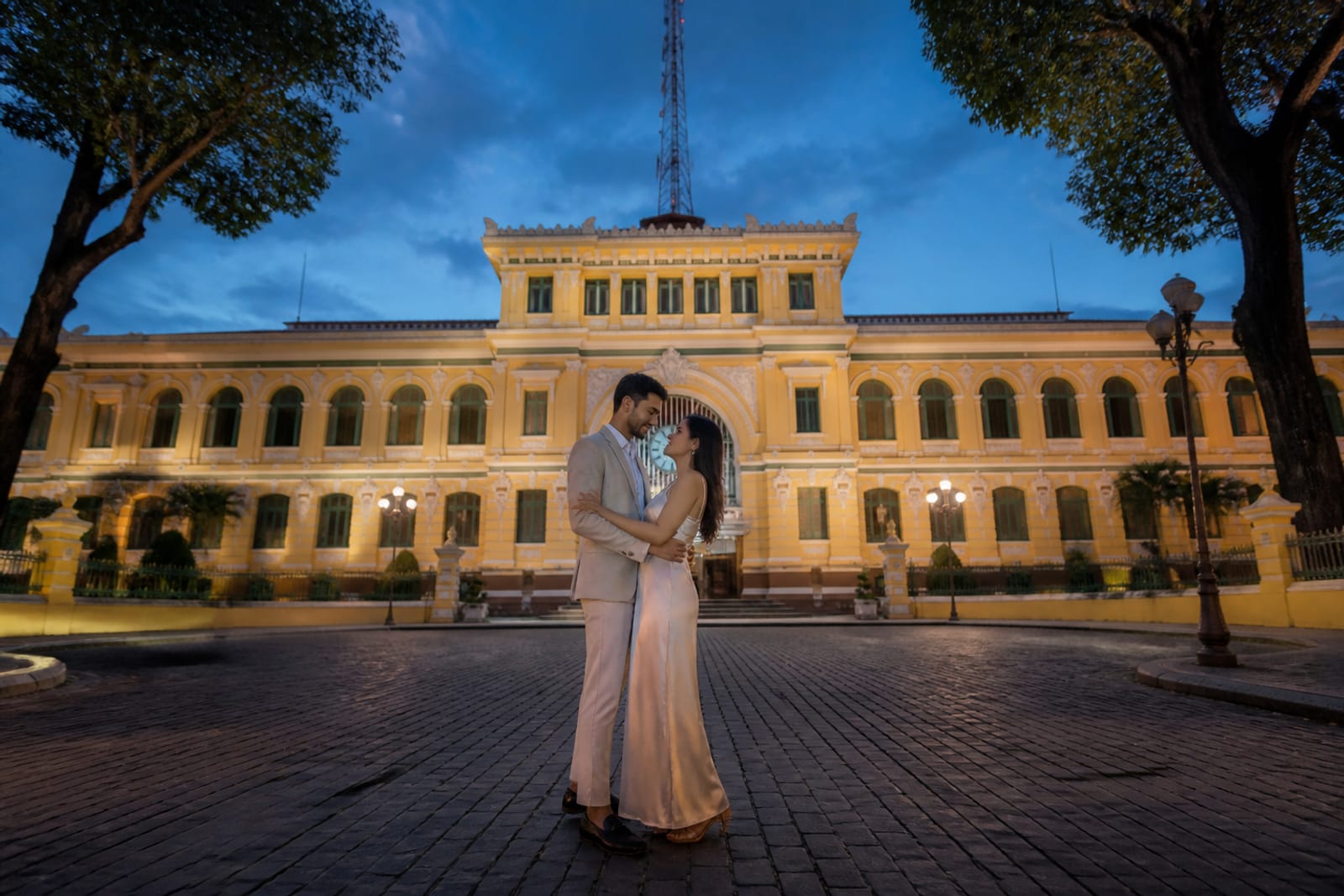
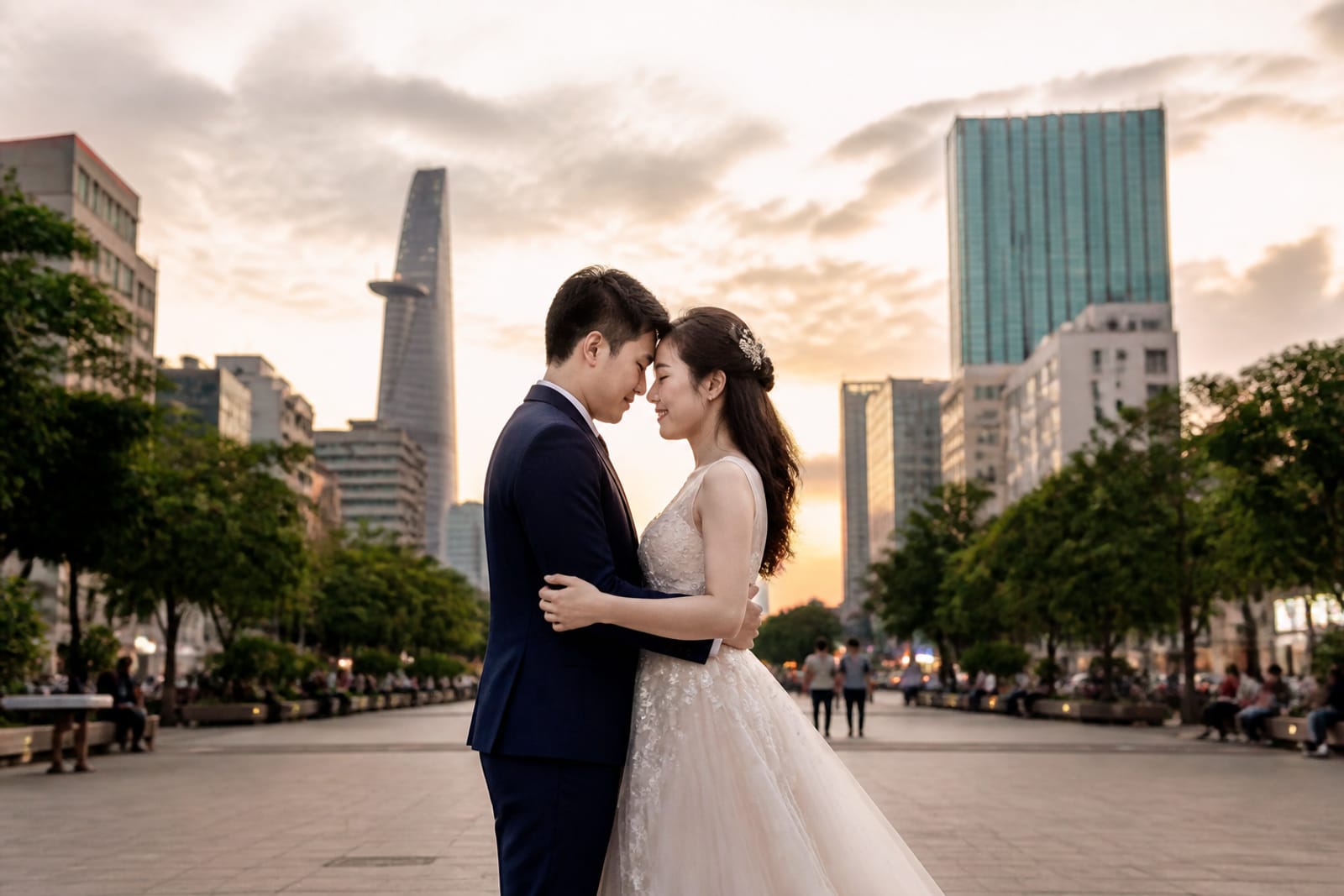
Golden hour in Saigon (roughly 5–6:30 p.m.) delivers warm, directional light that flatters skin and makes riverside backdrops glow without the harsh shadows of midday. Once the sun dips below the horizon, the city's streetlights, shop signs and building neon create a soft, layered glow—especially visible in District 1's French colonial buildings, along Dong Khoi Street, and on the Saigon River promenade. Blue hour (the 20–40 minutes after sunset when the sky holds a deep blue hue) is brief in tropical latitudes and requires quick shooting; night shots afterward rely on ambient city light, which is uneven—dark pockets near temples and parks, bright clusters around hotels and restaurants. Midday light in Saigon is nearly impossible to shoot in outdoors (sun directly overhead, harsh shadows on faces, heat exhaustion risk), so evening and early-night sessions let couples stay comfortable and shoot in genuinely flattering conditions.
📸 Book on WhatsApp — pre-wedding photoshoot | 💄 Makeup & hair at your hotel
When in the year should you book a night pre-wedding shoot?
Ho Chi Minh City's dry season (Dec–Apr, warmest and most predictable) is ideal: cool early evenings (25–28°C), clear skies and stable light that lasts a full golden hour. Dec–Feb is most comfortable for being outdoors and waiting between shots; rainfall is minimal. The rainy season (May–Nov) brings afternoon and evening downpours (sometimes lasting 30–60 minutes), especially Oct–Nov when typhoons are most active—lightning is a real hazard and clouds block the evening glow entirely, forcing rescheduling. Tet (late Jan–mid Feb) closes many landmarks, creates massive street crowds, and disrupts vendor and staff availability. If you're set on a wet-season date, plan a shorter session (1.5–2 hours instead of 3), scout indoor or covered backdrops (hotel lobbies, museum interiors, covered market passages), and carry waterproof makeup kits.
How do you choose between famous landmarks and hidden courtyards?
| Location Type | Best For | Light Conditions | Why Pick It |
|---|---|---|---|
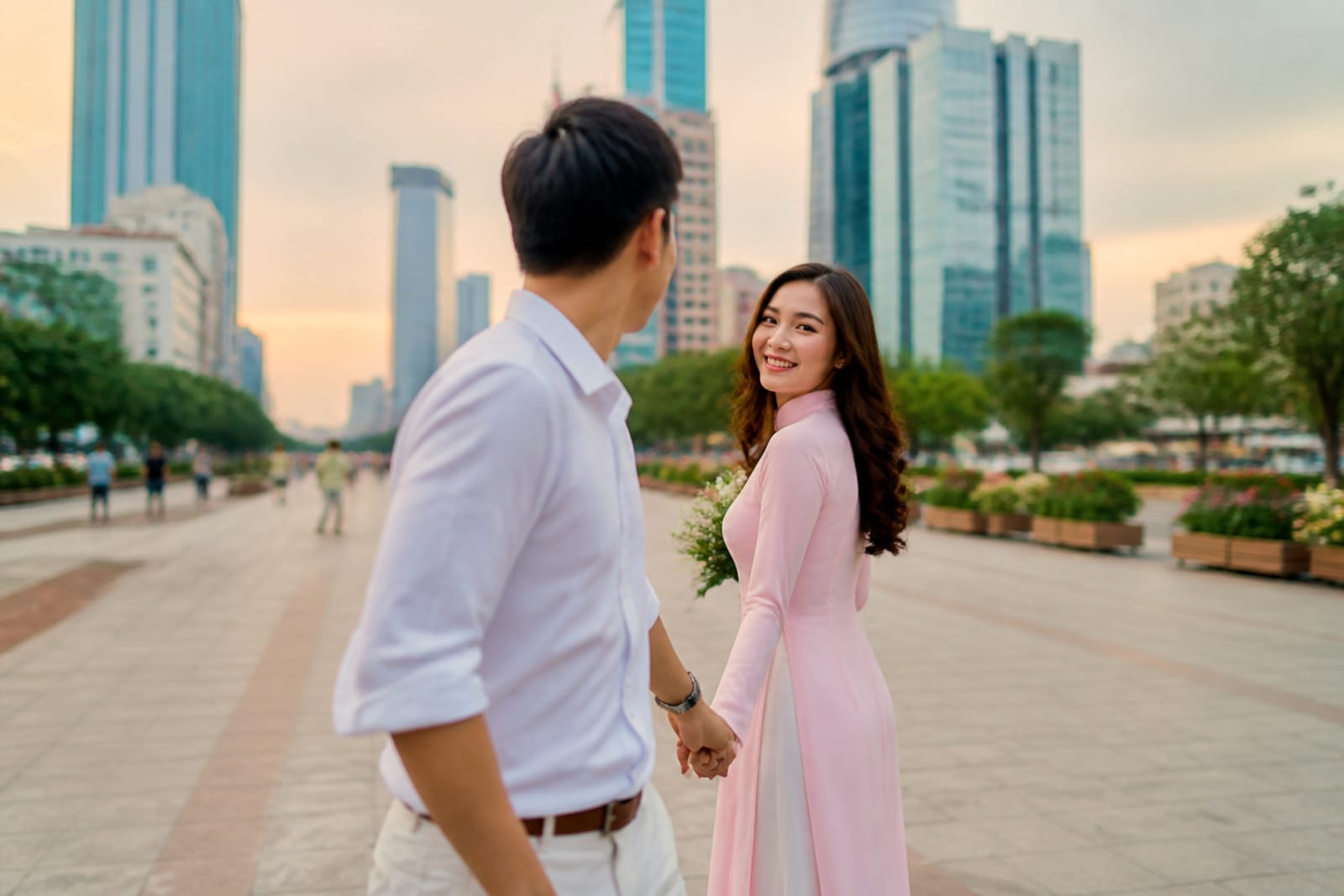
| Riverside (Saigon River promenade, Ton Duc Thang St.) | Iconic couple shots | Golden hour reflects off water; blue hour frames skyline | Wide, open space; light is diffuse; crowds build after 6 p.m. |
| Colonial District 1 (Dong Khoi, Nguyen Hue) | Romantic, intimate | Streetlights create pools of warm light; building facades glow at dusk | Texture, history, narrow angles; street traffic noise and crowds |
| Temple/pagoda entrance (Binh Tay Market area, small pagodas) | Cultural, reverent | Early golden hour only; poor light after 6 p.m. due to dense surroundings | Requires 4:30–5:30 p.m. start; etiquette rules apply (no PDA, modest dress) |
| Hotel lobby or rooftop (if guest or pre-arranged) | Controlled, elegant | Artificial uplighting; no weather risk; full creative control | Costs factor (access, time); suits couples who want consistent light and fewer location logistics |
| Vintage narrow alleys (Pham Ngu Lao backstreets) | Moody, street-style | Shadowed, mottled light; requires strong editing; unpredictable at night | Fewer tourists; dynamic texture; higher risk of uneven exposure; requires experienced photographer |
Riverside and colonial streets are Cáo Studio's most-booked spots because light is predictable and crowds are manageable if you start by 5 p.m. Temples require early arrival and strict etiquette—ask your photographer to confirm access before booking. Hidden alleys suit couples who want atmosphere over polish, but demand post-production color grading and carry higher technical risk (shadows, uneven ambient light).
What should you arrange before your shoot date?
Book makeup and hair at your hotel 2–3 weeks ahead if you want on-location prep; this saves commute time and avoids humidity damage between your room and the first photo spot. Confirm your outfit choices with the photographer (ao dai, Western dress, suit—each photographs differently in low light; ao dai's silk and embroidery glow beautifully but require careful posing; Western dresses need layers to avoid harsh wind exposure). Arrange transportation: taxis or Grab between locations take 5–15 minutes depending on traffic (heavier after 5:30 p.m.); tell your driver your route in advance so they don't drop you mid-street. Bring a small bag with water, phone chargers, blotting papers, and a light wrap—Saigon evenings are cool but unpredictable. If shooting in Dec–Feb, sunscreen still applies (evening light reflects off buildings). Scout at least one location in daylight to understand sightlines, foot traffic, and where the photographer can position themselves.
Confirm the session timeline in writing on WhatsApp: start time, planned locations, outfit changes, break points, and end time. Night sessions run longer than daytime because light is slower and you're moving between lit and unlit zones; a 3-hour block is common. Ask whether the edit timeline extends beyond a daytime rate (night photos often need color grading; check if that's included in your package details on WhatsApp).
How do you keep outfits and makeup looking fresh during a 2–3 hour night session?
Makeup must withstand humidity, sweat and repeated face-touching during wardrobe changes. Book a makeup artist experienced with tropical heat and evening light (warm tones photograph differently under tungsten streetlights than in golden sun). Ask whether touch-ups are included during the session. Ao dai or Western dress should be fitted and steamed before shooting—wrinkles show under directional evening light. Bring a sewing kit, safety pins, and a garment steamer if you're changing outfits mid-session (costume changes in cars or public bathrooms are rushed; a hotel room as a midpoint location saves stress). Shoes: wear comfortable walking shoes during scouting and between locations; change into heels or embellished shoes only for the actual photos (5–10 minutes per outfit). Keep fabric freshener and a compact mirror in your bag. If shooting in the rainy season, pack plastic covering and microfiber cloths.
Your photographer and makeup artist have worked in Saigon's evening conditions before—they'll know which fabrics and makeup textures hold up. Check their portfolio for night shoots and ask them what they recommend for your dress code.
What do you need to check before booking?
Ask the photographer:
- Which locations are pre-scouted and which require day-of discovery (unknown terrain = longer shoot time)?
- Is makeup and hair included or booked separately?
- Are location permits or access fees (temples, paid viewpoints) your responsibility or theirs?
- What is the rescheduling policy if weather forces a cancellation? (Important in May–Nov.)
- How many outfit changes can fit into your booked time?
- Is a second camera operator available if you want simultaneous angles (especially useful for blue hour, which passes quickly)?
- What are the editing priorities—color grading for night light, retouching, delivery format (digital files, prints, album)?
Cáo Studio operates three Hanoi branches and one Saigon location with in-house makeup and styling; ask on WhatsApp what package details are confirmed (hours, number of edited files, outfit inclusions, delivery timeline) so you're not surprised later.
Compare options by season, not just by price. A Dec–Feb session in daylight will cost fewer factors (fewer reschedules, shorter prep time, simpler light) than a wet-season night shoot with multiple outfit changes and color grading. Both are legitimate choices; choose based on what atmosphere and timing matter to you.
See the full pre-wedding photoshoot guide for elopement options, Hoi An alternatives, and couple-specific planning. Explore couple and family photoshoots if you're adding family portraits. Browse the lookbook to see night and golden-hour samples from Ho Chi Minh City shoots.
---
FAQ
Can I shoot a night pre-wedding in the rainy season (May–Nov)?
Yes, but expect rescheduling risk. Afternoon storms (often 2–6 p.m.) can delay evening sessions. Plan a shorter 1.5–2 hour window, scout covered backdrops like hotel interiors, and confirm a rain-date clause on WhatsApp before booking.
What's the difference between golden hour and blue hour?
Golden hour is 30–60 minutes before sunset when the sun is low and warm-toned—best for flattering skin and bright backgrounds. Blue hour is the 20–40 minutes after sunset when the sky glows deep blue—short, requires fast shooting, creates dramatic moody shots. Night light after blue hour relies on city streetlights and neon, which is uneven and requires strong editing.
Do I need to hire a makeup artist separately or is it included?
It depends on your package. Confirm on WhatsApp whether makeup and hair are included, outsourced, or booked as an add-on. On-location makeup (at your hotel or before the shoot) prevents humidity and sweat damage and saves commute time.
How do I avoid harsh shadows and uneven light in colonial District 1 at night?
Scout in daylight to find streetlight patterns and building reflections. Shoot early (5–6:30 p.m.) when ambient light is still strong. Position your photographer so the light source is in front of or to the side of your face, not directly overhead. Expect some uneven tones; color grading during editing corrects this.
Is it safe to shoot outdoors at night in Ho Chi Minh City?
Yes—tourist areas like the riverside, Dong Khoi Street, and District 1 are busy, well-lit and heavily policed after 6 p.m. Avoid isolated alleys alone. Hire a photographer familiar with the city who knows which neighborhoods are safe for evening shoots and can guide your route.
What do I wear under an ao dai for a night photoshoot?
Wear a smooth, flesh-tone slip or bodysuit that matches your skin tone to prevent visible lines under the silk. Avoid white or black, which show through. Bring a light cardigan or shawl—Saigon evenings (Dec–Apr) can be cool, and ao dai offers little insulation. Ask your photographer how movement and posing look in low light; some poses flatten silhouettes unless positioned carefully.
FAQ
Can I shoot a night pre-wedding in the rainy season (May–Nov)?
Yes, but expect rescheduling risk. Afternoon storms (often 2–6 p.m.) can delay evening sessions. Plan a shorter 1.5–2 hour window, scout covered backdrops like hotel interiors, and confirm a rain-date clause on WhatsApp before booking.
What's the difference between golden hour and blue hour?
Golden hour is 30–60 minutes before sunset when the sun is low and warm-toned—best for flattering skin and bright backgrounds. Blue hour is the 20–40 minutes after sunset when the sky glows deep blue—short, requires fast shooting, creates dramatic moody shots. Night light after blue hour relies on city streetlights and neon, which is uneven and requires strong editing.
Do I need to hire a makeup artist separately or is it included?
It depends on your package. Confirm on WhatsApp whether makeup and hair are included, outsourced, or booked as an add-on. On-location makeup (at your hotel or before the shoot) prevents humidity and sweat damage and saves commute time.
How do I avoid harsh shadows and uneven light in colonial District 1 at night?
Scout in daylight to find streetlight patterns and building reflections. Shoot early (5–6:30 p.m.) when ambient light is still strong. Position your photographer so the light source is in front of or to the side of your face, not directly overhead. Expect some uneven tones; color grading during editing corrects this.
Is it safe to shoot outdoors at night in Ho Chi Minh City?
Yes—tourist areas like the riverside, Dong Khoi Street, and District 1 are busy, well-lit and heavily policed after 6 p.m. Avoid isolated alleys alone. Hire a photographer familiar with the city who knows which neighborhoods are safe for evening shoots and can guide your route.
What do I wear under an ao dai for a night photoshoot?
Wear a smooth, flesh-tone slip or bodysuit that matches your skin tone to prevent visible lines under the silk. Avoid white or black, which show through. Bring a light cardigan or shawl—Saigon evenings (Dec–Apr) can be cool, and ao dai offers little insulation. Ask your photographer how movement and posing look in low light; some poses flatten silhouettes unless positioned carefully.
Ao dai, makeup, hair and a local photographer in Hanoi or Saigon — one WhatsApp message.