/pre-wedding-photoshoot
Night Pre-Wedding Photos in Mai Chau and Pu Luong
Night pre-wedding photos in Mai Chau and Pu Luong are possible but differ from daytime shoots. Both valleys close in mist and darkness after 6:30 pm from November to February; evening golden light ends by 5:30 pm in winter. Mai Chau offers terracotta-roofed stilted houses and closer village access; Pu Luong has wilder limestone cliffs but harsher weather and longer walks in low light. Cáo Studio does not operate night shoots in these remote areas — the team works daylight-only in mountain terrain for safety and image quality. A local Hanoi-based photographer familiar with village roads, homestay logistics and post-processing for mist is essential. Choose Mai Chau for intimate homestay scenes; Pu Luong for dramatic landscape drama. Book 2–3 weeks ahead; confirm weather, guide hire, and vehicle access before travel. ---
Can you shoot pre-wedding photos at night in Mai Chau?
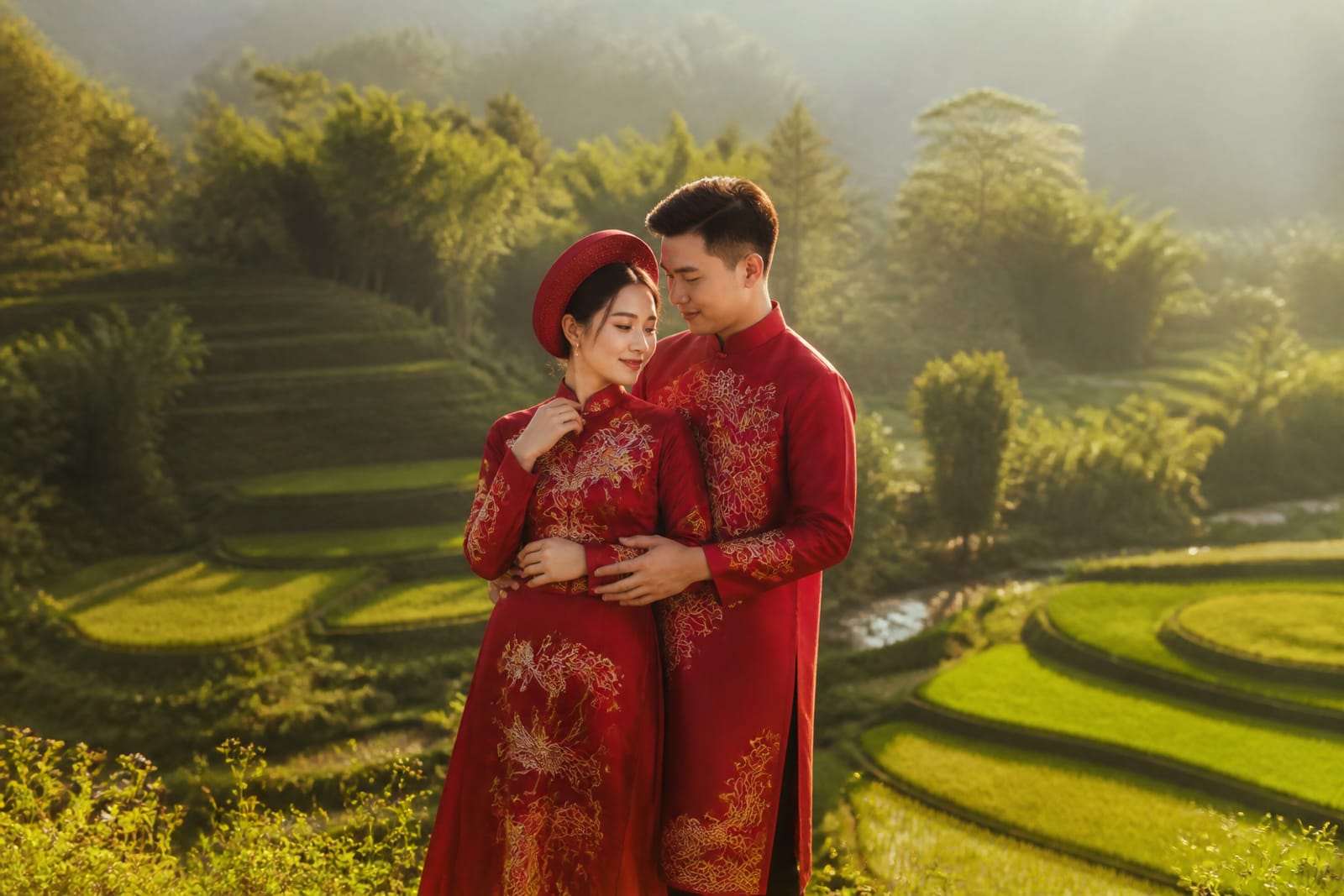
Mai Chau's night environment—wooden stilt houses, narrow paths, livestock—presents challenges for authentic framing. After sunset (around 5:30 pm in winter, 6:30 pm in summer), ambient light drops sharply; artificial uplighting of homestays reads as stagey, not cinematic. A skilled local team can use homestay lanterns, starlight and torches to create mood, but motion is slow and safety risks (uneven terrain, animals, open water channels) rise significantly. Night shoots here work best as part of a day-into-evening session, capturing the last 30–45 minutes of golden hour then transitioning to ambient-only framing as dusk arrives—not a dedicated 7 pm–midnight production.
📸 Book on WhatsApp — pre-wedding photoshoot
How does Pu Luong compare to Mai Chau for night pre-wedding work?
Pu Luong's limestone terrain is steeper, mist lingers longer into evening, and established homestay infrastructure is thinner than Mai Chau. Night sessions here demand a guide who knows the valley floor paths by memory—cell signal is weak, GPS unreliable in gorges. The reward: Pu Luong's scale (cliffs, terraces, forest canopy) creates drama that survives low light better than Mai Chau's human-scale homestays. However, the walking distance and rock hazard make night-only shoots inadvisable for pre-wedding couples; a dawn or late-afternoon session with a return walk at dusk is safer and yields stronger frames. Pu Luong suits couples willing to hike by day and accept limited dusk framing, not night-dedicated bookings.
| Aspect | Mai Chau | Pu Luong | Winner for night pre-wedding? |
|---|---|---|---|
| Light survival | Homestay ambient + torches | Cliff reflection + starlight (rare) | Mai Chau (houses hold lantern light) |
| Walking terrain | Flat, livestock trails | Steep, loose rock, hidden roots | Mai Chau (safer in low light) |
| Mist timing | Clears by 7 am; light mist 5–6 pm | Thick until 8 am; returns 5 pm onward | Mai Chau (more predictable) |
| Homestay access | Established network; prior liaison easy | Scattered; guides vary in responsiveness | Mai Chau (faster logistics) |
| Atmosphere | Intimate, tactile, village-human | Epic, remote, landscape-dominant | Personal choice—both work if light-aware |
Why does Cáo Studio recommend daytime pre-wedding shoots in these valleys?
Cáo Studio works only in Hanoi, Ho Chi Minh City and Hoi An, and for mountain regions like Mai Chau and Pu Luong, the studio does not operate dedicated sessions—these areas require local guides, overnight coordination, and terrain knowledge Cáo Studio's urban-based team does not retain. For couples drawn to pre-wedding frames in these valleys, daytime (6:30 am–4:30 pm) maximizes directed light, story clarity and safety. The team can then edit-process fast and ship files within 48 hours of their return to Hanoi. Night shoots in remote terrain introduce variables—fog density, guide availability, animal hazard, power loss—that delay post-processing and compromise the rapid-delivery promise. If a couple insists on dusk framing, hybrid sessions (day + golden hour) are feasible; true night photography in rice terraces is outside the studio's scope.
What does a realistic pre-wedding night timeline look like in Mai Chau or Pu Luong?
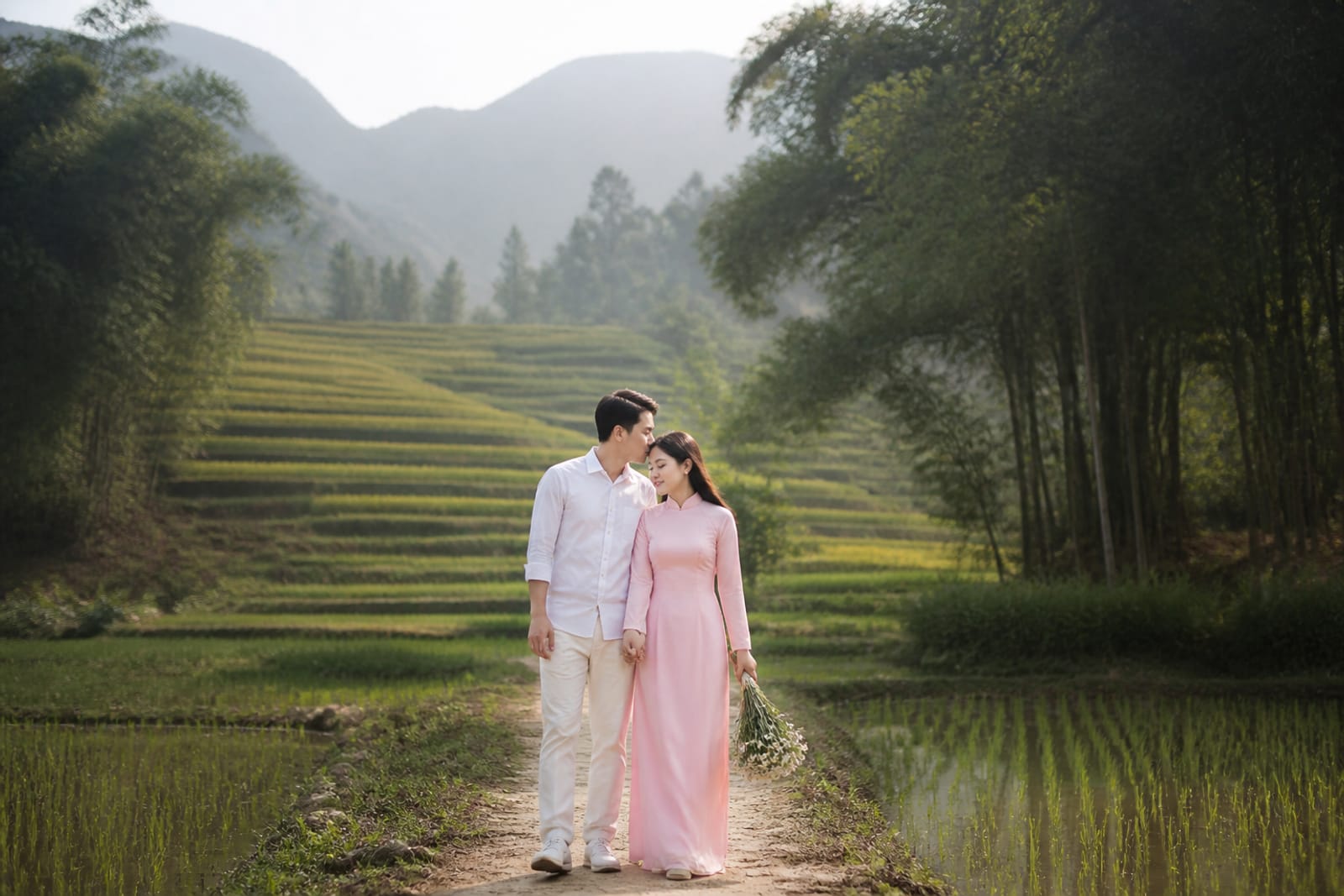
Plan a 12–16 hour day trip: depart Hanoi 6 am, arrive Mai Chau by 8:30 am for makeup and wardrobe at a homestay. Shoot 9 am–12 pm (mid-morning light, village activity, water scenes). Break for lunch. Shoot 2 pm–4:30 pm (side-lit terrace work, detail framing). Pack up by 5 pm; depart 5:30 pm to clear the pass before dark. No true night session is feasible without sleeping overnight—and overnight complicates next-day makeup touch-ups, file backup and schedule predictability. If overnight is chosen, only a 30–45 minute dusk session (5:30 pm–6:15 pm) is safe and meaningful; frame it as golden-hour-to-dusk, not "night photography." Pu Luong adds 45 minutes each way, tightens the timeline, and reduces usable hours.
What should you check before booking a night pre-wedding shoot in these valleys?
Ask the photographer: (1) Have they shot this location after 5 pm and delivered edited files within 7 days? (2) Who provides a valley guide, and are they hired separately or included in the fee? (3) Is a vehicle with headlights reserved for the return journey? (4) What happens if mist thickens and visibility drops below 5 meters—do you reschedule or shoot anyway? (5) Which homestay owner have they worked with, and is rapport pre-established? (6) How will they meter exposure (manual, spot, live histogram)? (7) Are backup lenses and tripod rated for 4–8°C and high humidity? A credible local photographer answers all seven with specifics, not assurances. If they say "don't worry, it'll be magical," find another. For Cáo Studio couples interested in these regions, contact the team on WhatsApp to discuss hybrid day-into-evening options or a referral to a vetted local partner in Hanoi.
Is a pre-wedding night shoot worth the cost and logistics trade-off?
Night frames rarely outweigh day frames in a pre-wedding album—silhouettes read poorly in print, emotion obscures in shadow, and editing mist-heavy images flattens color. Couples drawn to "nighttime romance" often prefer day-lit, moody-edited work (cool tones, long shadows, muted saturation) that retains detail and narrative. The cost factor: night shoots require guide hire (separate line item), longer vehicle rental (round-trip safety margin), and possible overnight homestay booking—three additions to a day-only session. Logistics factor: mist forecasts are unreliable 5+ days ahead, so final-week confirmation is mandatory, raising booking friction. Unless the couple has a specific night-scene story in mind (proposal-like moment, lantern release, starlit embrace), the 70/30 return favors daytime. A hybrid approach—day session with a 45-minute dusk extension—balances aesthetics, cost and logistics.
---
What to check before you book
- Photographer familiarity: Ask for 3–5 prior shoots in your chosen valley; request gallery links or WhatsApp album samples. Rural area work differs from city studio work.
- Local guide inclusion: Confirm whether guide hire is bundled or invoiced separately; ask for their mobile number and language fluency.
- Weather contingency: Does the contract allow rescheduling if mist exceeds 80% opacity or rainfall occurs? Written terms matter in seasonal zones.
- File delivery timeline: Expect 10–14 days for local mountain shoots (slower connection, more files to cull); confirm turnaround in writing.
- Outfit fit in terrain: Bring a test walk in your dress/suit before booking. Pu Luong mud, Mai Chau stair ramps, and livestock waste require practical footwear planning.
- Backup power: Ask if the photographer carries external batteries and chargers for your phone and theirs—cell towers are sparse.
---
For pre-wedding and elopement sessions in accessible areas, Cáo Studio and its Saigon base offer full-team direction (photographer, makeup artist, stylist) with 48-hour turnaround. For Mai Chau and Pu Luong night work, a local Hanoi-based photographer is the practical choice; ask the Cáo Studio team for trusted referrals on WhatsApp.
🌸 See the lookbook | 📸 Book on WhatsApp — pre-wedding photoshoot
---
FAQ
Can I do a pre-wedding shoot during the rainy season (May–September) in Mai Chau or Pu Luong?
Yes, but expect daily afternoon downpours and thick mist until 9–10 am. Plan for a short morning window (6:30–8:30 am). Shoot fast; water on the lens and damp air degrade image sharpness. Reschedule buffer is wise.
Do I need to hire a guide separately if I book a local photographer in Mai Chau?
Usually yes. The photographer focuses on framing; a valley guide navigates terrain, manages homestay timing and handles livestock or water obstacles. Clarify inclusion before booking—it's often a separate line item.
What's the best season for pre-wedding night shots in Pu Luong?
Avoid Nov–Feb (heavy mist). Late Sep–early Oct offers clearer evenings and cooler temps, but rain is still common. Feb–Apr is drier, but mist persists. Honestly, daytime year-round outperforms night in Pu Luong.
Will my ao dai survive a trek through rice paddies in Mai Chau?
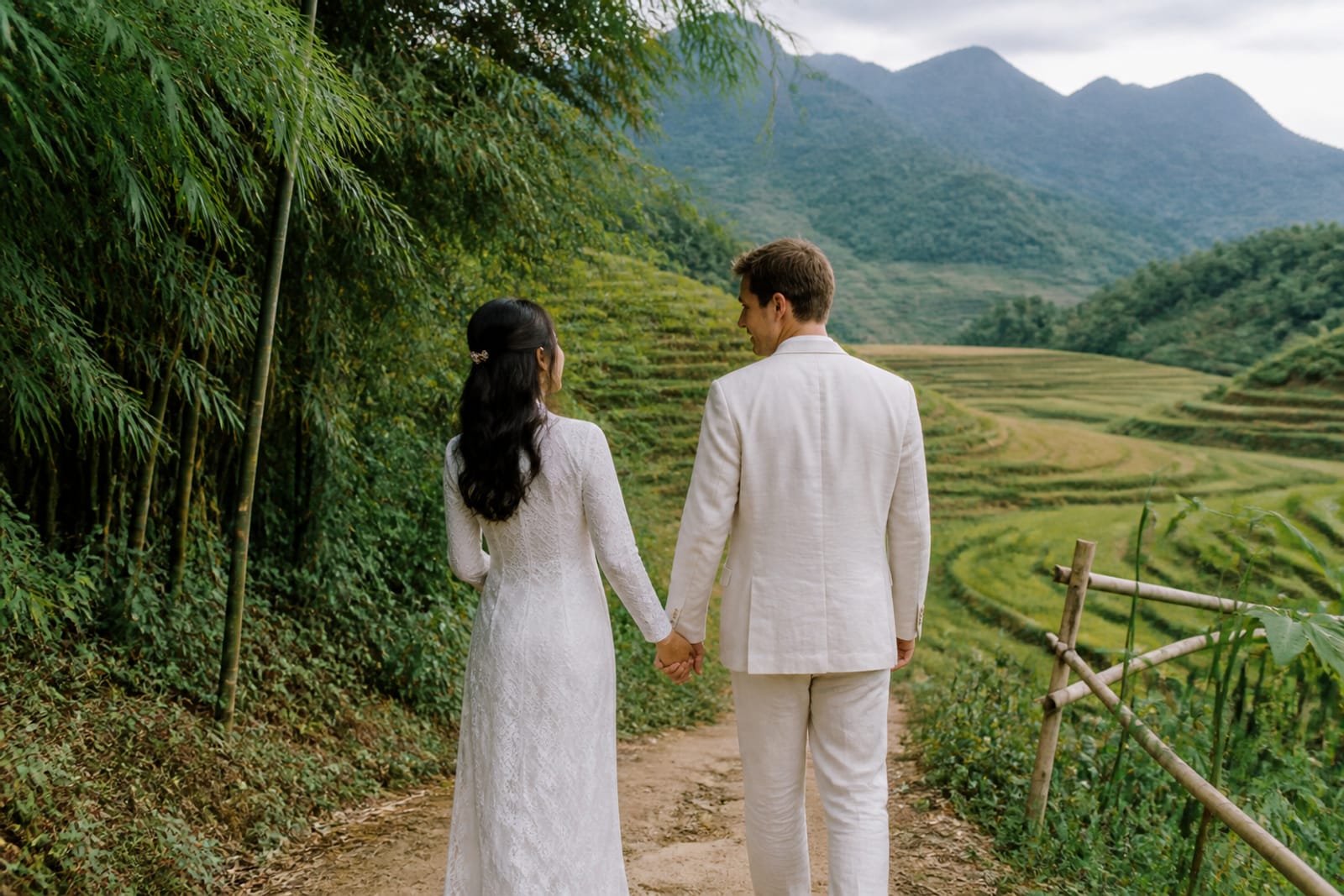
No. Mud, water channels and rocks damage silk and embroidery. Wear the ao dai for posed homestay scenes only; travel in casual clothes, then change on-site. A local team coordinates this; always ask how they handle outfit protection.
How much editing can a local photographer do for mist-heavy shots?
Moderate editing improves mist (clarity, local contrast, warmth boost), but severe fog cannot recover detail. If mist fills 60%+ of your frame, that image is a silhouette—plan for it aesthetically or accept loss. Clear-light sessions yield better final albums.
Does Cáo Studio offer night pre-wedding shoots in Mai Chau or Pu Luong?
No. Cáo Studio operates in Hanoi, Ho Chi Minh City and Hoi An only. For Mai Chau and Pu Luong, the team can refer a vetted local photographer or suggest a day-into-evening hybrid session in a closer valley. Contact the team on WhatsApp to discuss options.
FAQ
Can I do a pre-wedding shoot during the rainy season (May–September) in Mai Chau or Pu Luong?
Yes, but expect daily afternoon downpours and thick mist until 9–10 am. Plan for a short morning window (6:30–8:30 am). Shoot fast; water on the lens and damp air degrade image sharpness. Reschedule buffer is wise.
Do I need to hire a guide separately if I book a local photographer in Mai Chau?
Usually yes. The photographer focuses on framing; a valley guide navigates terrain, manages homestay timing and handles livestock or water obstacles. Clarify inclusion before booking—it's often a separate line item.
What's the best season for pre-wedding night shots in Pu Luong?
Avoid Nov–Feb (heavy mist). Late Sep–early Oct offers clearer evenings and cooler temps, but rain is still common. Feb–Apr is drier, but mist persists. Honestly, daytime year-round outperforms night in Pu Luong.
Will my ao dai survive a trek through rice paddies in Mai Chau?
No. Mud, water channels and rocks damage silk and embroidery. Wear the ao dai for posed homestay scenes only; travel in casual clothes, then change on-site. A local team coordinates this; always ask how they handle outfit protection.
How much editing can a local photographer do for mist-heavy shots?
Moderate editing improves mist (clarity, local contrast, warmth boost), but severe fog cannot recover detail. If mist fills 60%+ of your frame, that image is a silhouette—plan for it aesthetically or accept loss. Clear-light sessions yield better final albums.
Does Cáo Studio offer night pre-wedding shoots in Mai Chau or Pu Luong?
No. Cáo Studio operates in Hanoi, Ho Chi Minh City and Hoi An only. For Mai Chau and Pu Luong, the team can refer a vetted local photographer or suggest a day-into-evening hybrid session in a closer valley. Contact the team on WhatsApp to discuss options.
Ao dai, makeup, hair and a local photographer in Hanoi or Saigon — one WhatsApp message.